Is Wix Good for eCommerce? An Honest 2026 Answer

By Michael Andrews | Published: 2026-09-16 | Updated: 2026-09-16 | 20 min read
Thinking of running an online shop on Wix? This honest 2026 guide covers what Wix Stores genuinely does well, where it falls short, how it compares to Shopify, and, most importantly, how to actually make a Wix store rank on Google and get cited by AI. Written by a specialist who has done SEO on Wix, and nothing but Wix, for fourteen years.
Is Wix good for eCommerce? It is one of the most common questions I get, usually from someone about to open an online shop who has heard conflicting things and does not know who to believe. I have done SEO on Wix, and nothing but Wix, for 14 years, including plenty of online stores, so let me give you a straight answer rather than a sales pitch. The short version is yes, Wix is a genuinely capable eCommerce platform for most small and mid-sized shops, and a Wix store can rank and sell every bit as well as one built anywhere else. The longer version, including where Wix is not the right choice and how to actually make a Wix store rank, is what this guide is for.
I am going to cover what Wix eCommerce actually gives you, what it does well, where it genuinely falls short, how it stacks up against Shopify, and then the part that matters most to me, how to make a Wix store visible on Google and in the new AI shopping tools. If you would rather learn all of this as structured lessons, it is covered free in my complete Wix SEO course.
The short answer
Yes, Wix is good for eCommerce for the large majority of businesses that come to it: independent retailers, makers, service businesses adding a shop, and growing brands selling anything from a handful to a few thousand products. It gives you a real online store, a full website, a blog and marketing tools in one place, which is exactly what most small businesses want. Where the answer becomes "maybe not" is at the very large or very specialised end, which we will get to honestly. And crucially, whether your Wix store succeeds in search comes down to how well it is optimised, not to the Wix name. Google has confirmed the platform is not a ranking factor.
What Wix eCommerce actually gives you
Wix's online store product is usually called Wix Stores, part of Wix eCommerce. To accept payments you need one of Wix's Business and eCommerce Premium plans rather than the free plan. Once you are on one, you get a genuinely complete set of shop features. It is worth seeing the full picture, because a lot of people underestimate how much is built in.
- Product pages with images, galleries, options and variants, descriptions and pricing.
- A shopping cart and a full checkout, with multiple payment providers and support for cards, digital wallets and more.
- Collections, which are your product categories, for organising and browsing your catalogue.
- Shipping, tax and delivery rules, discounts, coupons and gift cards.
- Abandoned cart recovery, subscriptions and recurring payments, and pre-orders.
- Multi-channel selling, so you can list on Instagram, Facebook, Google and marketplaces alongside your own site.
- Dropshipping and print-on-demand integrations for people who do not hold their own stock.
- A physical point of sale option, so the same catalogue can sell in person and online.
- All of this sitting inside a full Wix website, with a blog, bookings, and everything else under one roof.
That last point is the one I would underline. With Wix you are not bolting a shop onto a separate website. Your shop, your content, your blog and your other business tools live together, which keeps everything simpler to run and, done well, helps them all support each other in search.
What Wix does genuinely well for online stores
Having built and optimised a lot of these, here is where Wix earns its keep for eCommerce.
- It is genuinely all-in-one. For a small business owner without a developer, having the store, website, blog and marketing in one dashboard is a real advantage, not a marketing line.
- The editing experience is visual and forgiving. You can build and change your shop yourself without touching code, which matters when you want to run promotions or update products quickly.
- The SEO controls are proper, not token. You can edit the title tag, meta description and URL slug on product and collection pages, add alt text to images, and control indexing. This is the part people wrongly assume Wix hides, and it does not.
- It generates product structured data automatically. Wix outputs the behind-the-scenes product markup, such as name, price and availability, that can make your listings eligible for richer results in Google, and you can strengthen it further.
- It plugs straight into Google for shopping. Wix connects to Google Merchant Center so your products can appear in Google's free shopping listings and paid campaigns.
- It handles the technical basics for you. HTTPS, mobile responsiveness, an automatic sitemap and sensible canonical handling all come as standard, so you are not fighting the platform to get the foundations right.
Where Wix eCommerce genuinely falls short
I am not here to pretend Wix is perfect, because it is not, and knowing the limits helps you choose well. Here is the honest side.
- Very large catalogues need care. Wix runs stores with large numbers of products, but once you get into many thousands of items, the sheer scale of pages needs deliberate technical SEO to keep Google crawling and indexing efficiently. It is doable, but it is work.
- The app ecosystem is smaller than Shopify's. Shopify has a bigger marketplace of specialist eCommerce apps. For most stores Wix covers what you need, but if you rely on a very niche third-party tool, check it exists first.
- It is less specialised than a dedicated commerce platform. Wix is a website builder that does eCommerce very well. Platforms built only for commerce can offer more depth at the high-volume, multi-warehouse, heavily customised end.
- You are within Wix's structure. You get strong SEO control, but not the total, raw control over every technical detail that a fully custom or open-source build gives a developer. For the vast majority of stores that is a fair trade for the simplicity, but it is worth naming.
Expert Tip: None of these are reasons a normal small or mid-sized shop should avoid Wix. They are the honest edges of the platform, and they only really bite at genuine scale or in unusual, highly specialised setups. If that is not you, the limitations are largely theoretical.
The part that actually decides success: SEO for a Wix store
Here is the truth almost nobody selling you a platform will say plainly. The platform is not what makes your store rank. Your optimisation is. A brilliantly optimised Wix store will beat a neglected Shopify one every day of the week, and the reverse is just as true. So if you are choosing Wix, or already on it, this is where your energy should go. Below is how I approach eCommerce SEO on Wix, and every part links to the deeper lesson if you want it. If you sell on Wix, see my Wix ecommerce SEO strategy to get your shop found on Google.
Product pages are where the money is
Most eCommerce sales pages are product pages, so they deserve the most attention. Write a unique, genuinely descriptive title tag and meta description for each key product, use a clean URL slug, and write real product copy rather than pasting the manufacturer's description that a hundred other shops also use. Thin or duplicated product text is the single most common thing holding stores back. I cover the full method in the lessons on product page optimisation and the wider foundations of eCommerce SEO on Wix.
Use product structured data properly
Structured data is what lets Google show the extras that make shopping listings stand out, such as price and availability. Wix adds a baseline automatically, and strengthening it is one of the highest-value technical wins on a store. It now does double duty too, because the same machine-readable product data is what AI shopping assistants read when they decide what to recommend. I go into both in the lessons on product and offer schema on Wix and on making product pages machine readable for AI.
Do not neglect category and collection pages
Your category pages, which Wix calls collections, are quietly some of the most powerful pages on a store, because they can rank for broad, high-value searches like "handmade wool blankets" rather than one specific product. Give them real intro copy, sensible titles and a logical structure, and link them well. Done properly, a good category page can outrank the marketplaces. I cover this in the lessons on category and collection page SEO and category taxonomy and internal linking.
Handle duplicate content and canonicals
Stores naturally create similar or duplicate pages, through product variants, filtered views and pagination. Left unmanaged, that dilutes your rankings. Wix handles canonicals sensibly by default, but on a store you want to understand what is happening so nothing important gets buried. The lesson on duplicate content and canonical tags walks through it.
Optimise your product images
Images sell products, and they are also a search channel in their own right. Descriptive file names, proper alt text and well compressed images help you rank in image search, keep pages fast, and make the store more accessible. The detail is in the lesson on product image SEO for Wix stores.
Keep large stores crawlable
If you do have a big catalogue, this is the technical piece that matters most. You want Google spending its crawling on your important pages, not lost in endless filtered or near-duplicate URLs. Getting this right is the difference between a large Wix store that indexes well and one that does not. The lesson on crawl budget for large Wix collections covers it.
Get your products into Google Shopping
Beyond normal search, you want your products in Google's shopping results, including the free listings. Wix connects to Google Merchant Center to make that happen, and getting your product feed clean and complete is what makes it work. See the lessons on Google Merchant Center integration and Google Shopping free listings and Performance Max.
Use reviews and content to pull people in
Genuine product reviews build trust and can add to your listings, and content marketing, such as buying guides that link through to your products, brings in people earlier in their decision. Both turn a static shop into something that attracts and converts. The lessons on product reviews, blog to product funnels and abandoned cart recovery and conversion cover how.
Wix versus Shopify, honestly
This is the comparison everyone wants, so here is my fair take. Shopify is a platform built purely for commerce, and at the large, fast-scaling, highly specialised end it offers more depth and a bigger app ecosystem. If your whole business is a high-volume store and nothing else, Shopify is a serious contender. Wix, by contrast, is a full website builder that does eCommerce very well, and its advantage is being all-in-one: your store, your marketing site, your blog and your bookings in a single, easy to run place, usually at a lower total cost for a small business. For most independent and growing shops, that combination wins. Neither platform has a built-in SEO advantage. Google ranks the store, not the software. If you are weighing a move, the lesson on migrating from Shopify to Wix without losing rankings covers doing it safely.
Who Wix eCommerce is right for, and who it is not
To make this practical, here is roughly how I steer people.
- A great fit: independent retailers and makers, service businesses adding a shop, and growing brands with anywhere from a few to a few thousand products who also want a proper website, blog and marketing in one place.
- A good fit with care: larger catalogues of several thousand products, which Wix can absolutely handle with deliberate technical SEO.
- Worth thinking harder: very large, fast-scaling operations with tens of thousands of products, complex multi-warehouse logistics, or a dependence on a very specific niche commerce app, where a dedicated platform may serve you better.
The AI shopping shift
One last thing that is changing fast and worth getting ahead of. People increasingly ask AI assistants for product recommendations rather than scrolling a page of results, and those assistants read the structured, machine-readable data on your product pages to decide what to suggest. This means the same clean product markup that earns you rich results in Google now also decides whether an AI recommends you at all. A well optimised Wix store, with proper product data, is well placed for this. A neglected one, on any platform, is invisible to it. I connect eCommerce SEO to this new world in the lesson on making your product pages machine readable for AI.
Does a Wix store cost more to run?
Cost is a fair question, and the honest answer is that it depends on a few moving parts rather than a single price. Running a Wix store means a Business and eCommerce Premium plan, the payment processing fees charged by whichever provider takes your card payments, your domain, and the cost of any extra apps you choose to add. That is broadly the same shape of cost as any hosted store platform: a plan, transaction fees, and optional add-ons. Where Wix often works out well for a small business is that the website, blog, bookings and marketing tools are already included, so you are not paying separately for a site and a shop and a blogging platform. Rather than fixate on the headline plan price, work out the total for everything your business actually needs in one place, because that is where Wix tends to compare favourably for smaller operations. Prices and plan names change, so check the current figures on Wix directly before you decide.
Common mistakes that quietly hold Wix stores back
Across the stores I have worked on, the same handful of issues come up again and again, and none of them are the platform's fault. Avoid these and you are already ahead of most competitors.
- Using the supplier's product descriptions unchanged. If your product text is identical to a hundred other shops, you have given Google no reason to prefer you. Rewrite it in your own words.
- Leaving product titles and metas on autopilot. Every important product and category page deserves a written, specific title tag and meta description, not a generic default.
- Ignoring category pages. People pour effort into product pages and forget that category pages capture the broader, higher-volume searches. That is a large missed opportunity.
- Thin or missing structured data. Not strengthening the product markup means missing out on richer listings and, increasingly, on being understood by AI shopping tools.
- Slow, heavy product images. Huge uncompressed images hurt both speed and image search. Compress them and name them properly.
- No content around the products. A store with buying guides and useful content pulls people in far earlier than one that is just a catalogue waiting to be found.
- Forgetting the shop is part of a whole site. Your store benefits from the authority of your whole website, so internal linking, your blog and your overall SEO all feed it.
Your first 90 days on a new Wix store
If you are starting fresh, here is a grounded order of work that avoids overwhelm and puts the highest-value tasks first.
- Weeks 1 to 2: Foundations. Get on the right eCommerce plan, connect your domain, and set up your store structure and collections logically before you add lots of products. Connect Google Search Console.
- Weeks 3 to 5: Product and category pages. Write unique titles, metas and descriptions for your key products and categories, sort your URL slugs, and add proper alt text to images. Quality over speed here.
- Weeks 6 to 8: Technical and shopping. Strengthen your product structured data, check your canonicals and indexing, compress your images, and connect to Google Merchant Center so your products can appear in shopping results.
- Weeks 9 to 12: Content and trust. Publish a couple of buying guides that link through to your products, start gathering genuine reviews, and set up abandoned cart recovery so you are not leaking sales.
- Ongoing: Keep adding useful content, keep your product data clean, and build your visibility. A store is never finished, it compounds.
Fix your Wix SEO from your dashboard
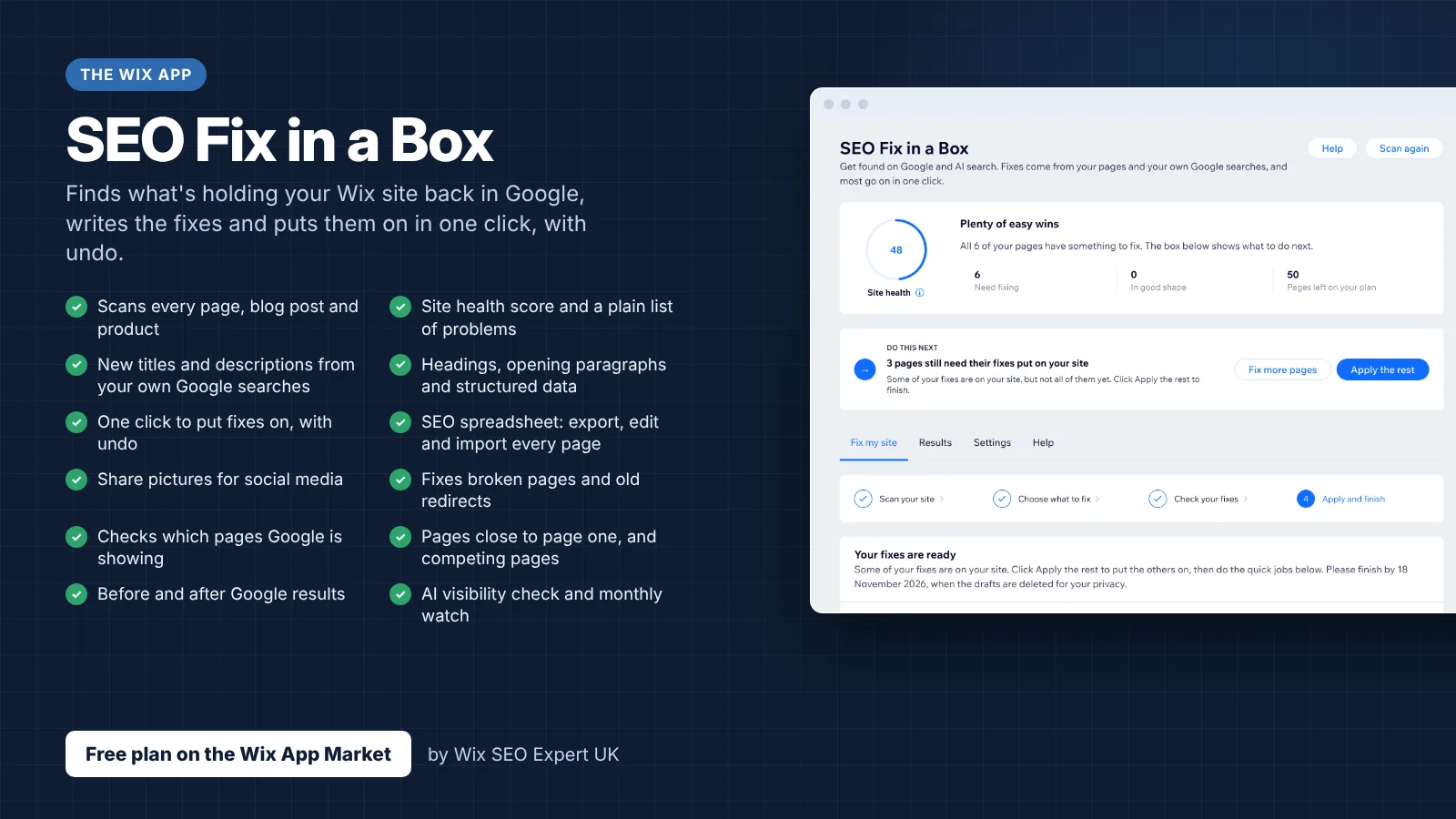
Wix SEO Fix in a Box scans every page, writes your fixes from your own Google searches and puts them on in one click, with undo. Start on the free plan.
Want this sorted on your own Wix site?
I have worked only on Wix for 14 years. Get Wix SEO Fix in a Box on the Wix App Market to find and fix what is holding your site back, or see my packages and prices if you would rather I did it all for you.
Frequently asked questions
Can you actually make money with a Wix online store?
Yes. Wix gives you a full store with products, cart, checkout and payments, and thousands of real businesses sell through it every day. Whether you make money depends on your products, your pricing and how visible your store is, not on the fact that it is built on Wix. The platform is not the limiting factor.
Do I need a paid plan to sell on Wix?
Yes. To accept online payments you need one of Wix's Business and eCommerce Premium plans rather than the free plan. The free plan is fine for building and previewing, but taking real orders requires an eCommerce plan and a connected domain.
Is a Wix store bad for SEO compared to Shopify?
No. Neither Wix nor Shopify has a built-in SEO advantage, and Google has confirmed the website builder is not a ranking factor. Both give you editable titles, metas, slugs and product structured data. What decides your rankings is how well the store is optimised, not which of the two you chose.
Does Wix add product schema automatically?
Wix outputs baseline product structured data, such as name, price and availability, automatically for your store products, which can make them eligible for richer results in Google. You can and should strengthen it further for the best results, especially now that AI shopping tools read the same data.
Can Wix handle a large product catalogue?
Yes, with care. Wix runs stores with large catalogues, but once you reach many thousands of products the scale needs deliberate technical SEO to keep Google crawling and indexing your important pages efficiently. It is entirely doable, it just is not automatic at that size.
Is Wix good for dropshipping?
Yes. Wix integrates with dropshipping and print-on-demand services, so you can sell without holding your own stock. The SEO principles are exactly the same as any other store, and the usual challenge is writing unique product content rather than relying on the supplier's descriptions that every other dropshipper also uses.
The bottom line
So, is Wix good for eCommerce? For the large majority of businesses, yes. It gives you a genuinely capable online store inside a full website, it hands you real control over your SEO, and a Wix store can rank and sell as well as one built anywhere else. The honest caveats sit at the very large and very specialised end, and for most shops they are theoretical. What actually decides whether your store wins is the work you put into your product pages, your categories, your structured data and your visibility. If you want it handled properly, see how I work on my about page, And if you would rather learn it yourself, it is all in my free Wix SEO course.