Is Wix Good for SEO? An Honest 2026 Answer

By Michael Andrews | Published: 2026-09-15 | Updated: 2026-09-15 | 18 min read
The "Wix is bad for SEO" line is years out of date. Here is what Wix can really do in 2026, where it has limits, and why some Wix sites still do not rank.
If you have spent any time in Facebook groups, Reddit threads or old blog posts, you will have run into the same flat statement over and over: "Wix is bad for SEO." It gets repeated so often that people take it as settled fact and never question where it came from or whether it is still true.
I am going to give you the honest version, because this is the only thing I do. I am Michael Andrews. I have worked with Wix and nothing but Wix for fourteen years, I have completed more than 800 Wix projects, and I hold 456 five-star reviews on the Wix Marketplace. I am the UK's only Wix Marketplace Legend Partner who works solely in SEO. I have no reason to defend Wix if it did not deserve it, and I have no interest in selling you a platform. My job is to make Wix sites rank, so I care about what is actually true.
So here is the direct answer, and then I will back every part of it up.
The short answer
Yes, Wix is good for SEO in 2026. A Wix site can rank on the first page of Google for competitive terms, it can win featured snippets, and it can show up in AI answers from ChatGPT, Perplexity and Google's AI Overviews. I see it happen every week.
But there is a condition attached, and it is the part people skip. Wix gives you a genuinely strong set of SEO tools. It does not use them for you. A Wix site that is published and left alone will sit there doing very little, exactly like a WordPress site, a Squarespace site or a hand-coded site that nobody optimised. The platform is not what ranks you. The work is what ranks you. Wix simply stopped being a reason you cannot do that work, and that happened years ago.
Across multiple industries including accountancy, HR consulting, therapy, pet care, e-commerce and trades, Wix sites have achieved page-one rankings with measurable traffic growth confirmed through Google Search Console data. My State of Wix SEO 2026 report shows GSC-verified gains across 12 client sites in very different industries.
Wix SEO is the work of optimising a Wix site so it ranks in Google and other search engines. It covers your titles and meta descriptions, your headings and page structure, your content, your site speed and mobile setup, and your structured data.
The reason so many people still believe Wix is bad for SEO is that they are repeating a criticism that was fair in about 2015 and has not been true for a long time. Let me show you where it came from.
Where the "Wix is bad for SEO" myth came from
Ten years ago, the criticism had teeth. Early Wix sites were built on a technology that leaned heavily on JavaScript to draw the page, and back then Google struggled to read pages like that. The important text and links were not always in the raw HTML that a search crawler first sees, so pages could be indexed poorly or slowly. On top of that, early Wix gave you very little control. You often could not edit your own page titles or descriptions properly, you could not set up redirects, and your URLs were messy. For someone who understood SEO, it was frustrating, and the frustration was justified.
Its early sites used Flash, which search engines could not read at all. Through the mid-2010s it relied heavily on client-side JavaScript rendering and hashbang URLs, which caused crawling and indexing problems. The reputation stuck because outdated articles and forum posts still rank for these queries, and some SEO professionals have not re-evaluated the platform since those early years.
That is the Wix people are still describing when they say it is bad for SEO. The problem is that the platform they are describing no longer exists.
Wix rebuilt the way its sites are served so that the content search engines need is delivered properly. It added full control over the parts of a page that SEO depends on. It moved its hosting onto a fast global content delivery network. It added structured data, redirects, canonical tags, a proper sitemap, robots control and far more. The old criticism was aimed at a car that has since had a new engine, new brakes and a new gearbox fitted, and people are still reviewing it based on a test drive from a decade ago.
You do not have to take my word for how far it has come. Google has said it directly.
What Google actually says about Wix
This matters more than any agency review, because Google is the referee. John Mueller, one of Google's most senior and public Search Advocates, was asked years ago whether Wix sites can rank. His answer was blunt: "Wix websites work fine in search." He has repeated the same point in different words many times since. The platform you build on is not a ranking factor. Google does not give WordPress a head start and it does not hold Wix back. What Google rewards is helpful content, a good experience for the person visiting, and clear signals about what your page is and who stands behind it.
Google's own guidance in Search Central says the same thing in a different way. It tells you to focus on content quality, crawlability, and a good page experience. It does not tell you which website builder to use, because from Google's side it does not care. A well-optimised Wix page and a well-optimised WordPress page are, to a crawler, just two well-optimised pages.
So if the platform is not the problem, and Google is happy to rank Wix, the real question changes. It stops being "is Wix good for SEO" and becomes "am I actually using the SEO tools Wix gives me." Most people are not, and that is the honest reason their Wix site is not ranking. Let me walk you through exactly what those tools are, because once you see the full list, the old myth falls apart on its own.
The SEO tools Wix gives you in 2026
This is the part I want you to read slowly, because when people tell you Wix cannot do SEO, almost every item on this list proves them wrong. Every one of these is built in, and every one of these is something I set up properly on client sites every week.
Wix in 2026 gives you full control over titles, meta descriptions, canonical tags, structured data, Open Graph tags and XML sitemaps.
Title tags and meta descriptions
You have full control of the title tag and meta description on every single page. These are the two most important pieces of text you control, because the title tag is the blue clickable headline in Google and the meta description is the grey text under it. On Wix you can write them by hand for the homepage, every service page, every blog post and every product. You can use dynamic patterns so that hundreds of store or blog pages fill their own titles from their content. The rule I hold to on every client site is a title tag under 60 characters so Google does not cut it off, and a meta description under 155 characters for the same reason. Wix lets you hit both.
Clean URL slugs and site structure
You control the slug, which is the readable part of the web address at the end of the URL. You can make it short, lower case and keyword-relevant, for example /wix-seo-audit rather than a string of numbers. You control your menu and page structure so that your most important pages sit near the top and everything has a logical home. Good structure helps Google understand which pages matter and helps a visitor find what they came for, and Wix gives you the control to build it well.
301 redirects
If you change a URL, delete a page, or move your content, you can set a permanent 301 redirect so the old address sends people and Google to the new one and you keep the ranking value. Wix has a full redirect manager built into the dashboard. You can also bulk upload redirects, which is exactly what you need during a site migration. This single feature, which old Wix lacked, is one of the biggest reasons the platform is now safe for serious SEO. If you are moving an existing site onto Wix, my Wix SEO Migration Guide walks through doing it without losing your rankings.
Canonical tags
Wix sets canonical tags for you, and lets you override them where you need to. A canonical tag tells Google which version of a page is the master when similar content could otherwise look like duplication. Getting this right stops your own pages competing with each other, which is a quiet ranking killer that most site owners never notice.
XML sitemap and robots.txt
Wix automatically generates and updates an XML sitemap, which is the map you hand to Google so it can find all your pages. You can submit it in Google Search Console in a couple of clicks. Wix also lets you edit your robots.txt file, so you can control which parts of your site crawlers should and should not look at, and you can set any individual page to noindex if you do not want it in Google at all. That level of crawl control is everything a technical SEO needs.
Structured data and schema markup
This is where Wix has moved fastest, and it is the area I specialise in. Wix lets you add structured data, also called schema markup, which is behind-the-scenes code that spells out to Google exactly what a page is: a local business, a product with a price and reviews, an FAQ, an article, an event. Structured data is what earns you the rich results in Google, the star ratings, the product prices, the breadcrumbs. Wix now auto-generates schema for blog posts, and I cover how that works in my course lesson on Wix's automatic blog schema. On top of the automatic layer, Wix gives you a Custom Code area in the dashboard where you can inject your own hand-built JSON-LD into the page head, which is how I add the deeper schema that most sites are missing.
Image alt text, compression and a fast CDN
Every image on a Wix site can have alt text, which is the description that helps Google understand the image and helps the page rank in image search and with accessibility. Wix compresses and serves your images through its content delivery network, which means they load quickly from a server near your visitor wherever they are in the world. Image weight is one of the most common causes of a slow page, and Wix handles a lot of it for you.
Heading structure you control
You control your headings, the H1 down to H6. The H1 is the main heading of the page and it should be used once, like the title of a chapter, telling Google and the reader what the page is about. Below it, H2 and H3 headings break the content into clear sections. Poor heading structure, either no H1 at all or a dozen H1s fighting each other, is one of the most common problems I find on sites that are not ranking. Wix gives you the control to get it right, and my Wix Blog SEO Guide goes deeper on structuring content that ranks.
Mobile and page experience
Every Wix site is mobile responsive, and you can edit the mobile view separately so it looks right on a phone. Google indexes the mobile version of your site first, so this is not optional, it is fundamental, and Wix builds it in. Wix has also put a lot of engineering into performance and Core Web Vitals, which are Google's measures of how quickly and smoothly a page loads and becomes usable. Modern Wix sites are considerably faster than the ones that gave the platform its old reputation.
Multilingual and hreflang
If you sell into more than one country or language, Wix Multilingual lets you build translated versions of your pages and it handles the hreflang tags that tell Google which language and region each version is for. That is a genuinely fiddly piece of technical SEO on many platforms, and Wix manages it for you.
Custom code and head injection
For anything the standard settings do not cover, Wix gives you a Custom Code area where you can add scripts and tags to the head or body of your site, either across every page or on specific pages. This is how you add Google Analytics, Google Tag Manager, a Meta pixel, or custom structured data. It is the escape hatch that means you are never boxed in, and it is a big part of why I can do advanced work on the platform.
Built-in integrations and AI SEO tools
Wix connects directly to Google Search Console so you can verify your site and submit your sitemap from inside the dashboard. It has a built-in SEO setup checklist that walks a beginner through the basics, keyword suggestions powered by a Semrush integration, and, as of 2026, a growing set of AI SEO tools. Wix's own SEO Hub now openly focuses on structured data and AI, including AI-generated schema and NLWeb support, so that your content can show up not just in classic search but in conversational engines like AI Overviews and ChatGPT. If you want to go further, my generative engine optimisation for Wix service covers the full process. In other words, Wix is building toward exactly the kind of AI visibility work I do by hand, which tells you where the platform's priorities are.
Breadcrumbs and internal navigation
Wix supports breadcrumb navigation, the little trail of links near the top of a page that shows where it sits, for example Home then Services then Wix SEO Audit. Breadcrumbs help visitors understand where they are and give Google a clean picture of your site's structure, and they can show up in the search result itself in place of a bare URL. Combined with the control you have over your menus and internal links, this means you can build a site architecture that both people and crawlers follow easily, which is one of the quiet foundations of ranking that almost nobody outside SEO thinks about.
Local SEO and Google Business Profile
If you serve a town or a region, Wix is well set up for local SEO. You can build proper location content, add your name, address and phone number consistently, mark up your business with LocalBusiness structured data, and target the surrounding towns you actually cover. Wix connects to Google Business Profile so your listing, your map pack presence and your website work together. Local intent is where a huge share of small business searches sit, someone typing a service and a place name, and Wix gives you everything you need to compete for it. This is a large part of the work I do for service businesses, clinics and trades.
Wix's blog platform supports categories, tags, RSS, author pages and custom URLs, which covers the fundamentals of blog SEO. Wix Stores handles product pages, category pages, product schema and checkout, with dedicated e-commerce SEO settings for each product.
Analytics and measurement
You cannot improve what you do not measure. Wix has its own built-in analytics, and it connects cleanly to Google Analytics 4, Google Search Console and Google Tag Manager through the same Custom Code and integration settings. That means you can see which pages bring people in, which search terms you appear for, where visitors drop off, and which enquiries came from organic search. Proper measurement is what turns SEO from guesswork into a process, and Wix does not get in the way of any of it.
Author and E-E-A-T signals
Google increasingly wants to see who stands behind a piece of content and whether they have real experience and authority, a set of signals it groups under E-E-A-T, which stands for experience, expertise, authoritativeness and trust. On Wix you can build proper author profiles on your blog, a strong About page that establishes credentials, and Person and Organization structured data that connects your content to a named, real expert. For a professional service business, marking up who you are and why you can be trusted is one of the highest-value things you can do, and it feeds straight into how AI engines decide whether to recommend you.
That is the toolkit. Read back over it and ask yourself honestly whether it sounds like a platform that "cannot do SEO." It is not missing anything a small or medium business needs to rank. The gap has never been the tools. The gap is that the tools sit there unused.
Where Wix genuinely has limits
I promised you the honest version, so here are the real limits, because a fair answer includes them.
Wix is a hosted, closed platform. You do not get access to the server, and you cannot install anything you like the way you can on self-hosted WordPress. If your project needs very specific server-level control, a custom database-driven application, or one particular developer plugin that only exists for another system, Wix may not be the right fit. For the overwhelming majority of businesses this never comes up, but it is a real boundary and I will not pretend it is not there.
The genuine limitations are that some advanced server-level configurations require Velo (Wix's development platform), and the platform does not give you direct access to .htaccess or server config files.
Wix has historically been less suited to sites with tens of thousands of pages, the kind of very large publisher or enterprise catalogue that pushes any platform hard. It has improved a great deal here, but if you are running something at that scale it deserves a proper conversation rather than a blanket answer.
And there is a softer limit that has nothing to do with Wix's code: the platform is so easy to publish on that a lot of people publish and stop. They never do the keyword research, never write the meta, never structure the headings, never build a single link. That is not a fault in the platform, but it is the honest reason a large share of Wix sites underperform. The ease of building lulls people into thinking ranking is automatic too. It is not, on any platform.
None of these limits change the answer for a normal business website, a local service company, a shop, a clinic, a studio or a consultant. For all of those, Wix is more than capable.
Wix versus WordPress, the fair version
This is the comparison everyone reaches for, so let me be even-handed. Self-hosted WordPress gives you total control and a plugin for almost anything, and in expert hands it is extremely powerful. It also hands you the full responsibility: your own hosting, your own security, your own updates, your own broken plugins at eleven o'clock at night. Its SEO ceiling is very high and so is its maintenance floor.
Wix takes the hosting, security, updates and the content delivery network off your plate entirely, and gives you a strong, modern SEO toolset inside a system that does not break when two plugins disagree. Its SEO ceiling is now high enough that I rank clients against WordPress competitors regularly, and its maintenance floor is close to zero.
Most general SEO advice is written for WordPress, so people try WordPress steps on Wix, find the buttons in different places, and assume Wix is the problem. Once you know where Wix keeps each setting, it is as straightforward as any platform.
The right choice depends on the project, not on a slogan. What is simply not true any more is the idea that choosing Wix means giving up on SEO. Google's own John Mueller has weighed in on this exact Wix versus WordPress question and landed in the same place I do: use the tool that fits you, then do the work. If you want the deeper breakdown of that decision, my guide on building a Wix site the right way covers the foundations.
The part most people miss in 2026: getting found in AI
Here is where the conversation has moved, and where a lot of the "is Wix good for SEO" articles are still a year or two behind.
More and more people no longer scroll a page of blue links. They ask an assistant. They type "who is the best dentist in Benfleet" or "recommend a Wix SEO expert in the UK" into ChatGPT, Perplexity or Google's AI Overviews, and they act on the answer they get back. If your website is not written in a way those engines can read and trust, you are not in that answer, no matter how good your business is.
This is answer engine optimisation, sometimes called GEO or AEO, and it is the fastest growing part of my work. The way I handle it is a two-layer structured data approach. The first layer is the standard schema that Google has always read: your local business details, your website, your pages, your reviews and your FAQs. The second layer is an entity layer built specifically so that AI engines understand who you are, what you do, where you operate and why you are trustworthy, and so they put you forward when someone asks. Wix is a strong platform for this, precisely because that Custom Code head area lets me add exactly the schema each engine needs, and because Wix itself is now building AI structured data into the product. You can follow how the platform keeps changing in my Wix SEO Changelog.
The businesses getting this in place now are taking an early lead that is going to be very hard to catch later. It is the single biggest opportunity on the table in 2026, and it works beautifully on Wix.
So why do some Wix sites still not rank?
If Wix has all these tools and Google is happy to rank it, why are there still Wix sites sitting on page five? In almost every case I audit, it comes down to the same short list, and not one item on it is the fault of the platform.
The title tags and meta descriptions were never written, so Google filled them in with whatever it found, or left them duplicated across every page. There was no keyword research, so the site talks about "bespoke solutions" while its customers are typing "emergency plumber near me". The headings are a mess, with no H1 or a dozen of them. The content is thin, a couple of short paragraphs where the top-ranking page has a thorough, helpful answer. There are no internal links guiding Google and visitors between related pages. There is no structured data, so the site is invisible to rich results and to AI. And there are no external links pointing to the site, so it has no authority, which is a separate piece of work I cover in my Wix Link Building Strategy.
Every one of those is fixable. Every one of those is work, not a platform limitation. Move that same site onto WordPress without doing the work and it will rank exactly as badly, because the platform was never the problem.
A practical Wix SEO checklist
If you want to put this into action yourself, here is the order I work in. Start by connecting Google Search Console and submitting your Wix sitemap. Do proper keyword research and decide the single main phrase each page should target. Write a unique title tag under 60 characters and a unique meta description under 155 characters for every page. Give every page one clear H1 and a logical set of H2 and H3 headings. Write genuinely helpful content that fully answers what the visitor came for, rather than a thin paragraph. Set a clean, readable slug on every URL. Add alt text to every meaningful image. Add structured data, starting with your business, your reviews and your FAQs, and then build the AI layer on top. Link your related pages to each other. Fix any broken links and set 301 redirects for anything you have moved or removed. Then earn some quality links from other trusted sites. If you want to learn the whole thing properly and free, I teach all of it step by step in my Complete Wix SEO Course.
Do that, and the "is Wix good for SEO" question answers itself, because your Wix site will be ranking.
How long does SEO take on a Wix site?
This is the question I am asked most, and the honest answer is that it takes the same time on Wix as it takes anywhere, because the platform does not change the timeline, the work does. SEO is not a switch. Google has to crawl your changes, re-index your pages, and then watch how people respond to you in the results before it decides to move you up. On a brand new site or a very quiet one, you are often looking at three to six months to see real, stable movement on meaningful terms, and longer for the most competitive phrases. On an established site that already has some history and authority, well-targeted changes can show results a good deal faster, sometimes within weeks.
What Wix does give you is speed of execution. Because I am not wrestling with hosting, plugin conflicts or a fragile build, I can get the on-page work, the structure and the structured data in place quickly and cleanly, which means the clock on Google's side starts sooner. The mistake I see people make is judging SEO after three weeks, deciding it "does not work on Wix", and stopping right before the point where it would have started to pay off. Ranking is a compounding process. The site that keeps publishing helpful content, tightening its structure and earning the odd quality link pulls steadily away from the one that gave up.
Is it worth paying someone, or can you do Wix SEO yourself?
You can absolutely do a great deal of this yourself, and I want you to. That is exactly why I built a free course of hundreds of lessons rather than hiding it all behind a paywall. If you are prepared to put in the hours, learn keyword research, write your own meta, structure your headings and add basic schema, you can get a Wix site ranking on your own, and plenty of people do.
Where it becomes worth bringing in a specialist is when your time is better spent running your business, or when the work goes beyond the basics into the areas that move the needle hardest: proper keyword research and mapping, the two-layer structured data that gets you into AI answers, technical fixes, a real content plan, and link building. Those are the parts that separate a site that ticks the boxes from a site that actually outranks its competitors. It is the difference between a car that runs and a car that is tuned. Both drive. Only one wins. Whichever route you take, the point stands: none of it is held back by choosing Wix.
Fix your Wix SEO from your dashboard
Wix SEO Fix in a Box scans every page, writes your fixes from your own Google searches and puts them on in one click, with undo. Start on the free plan.
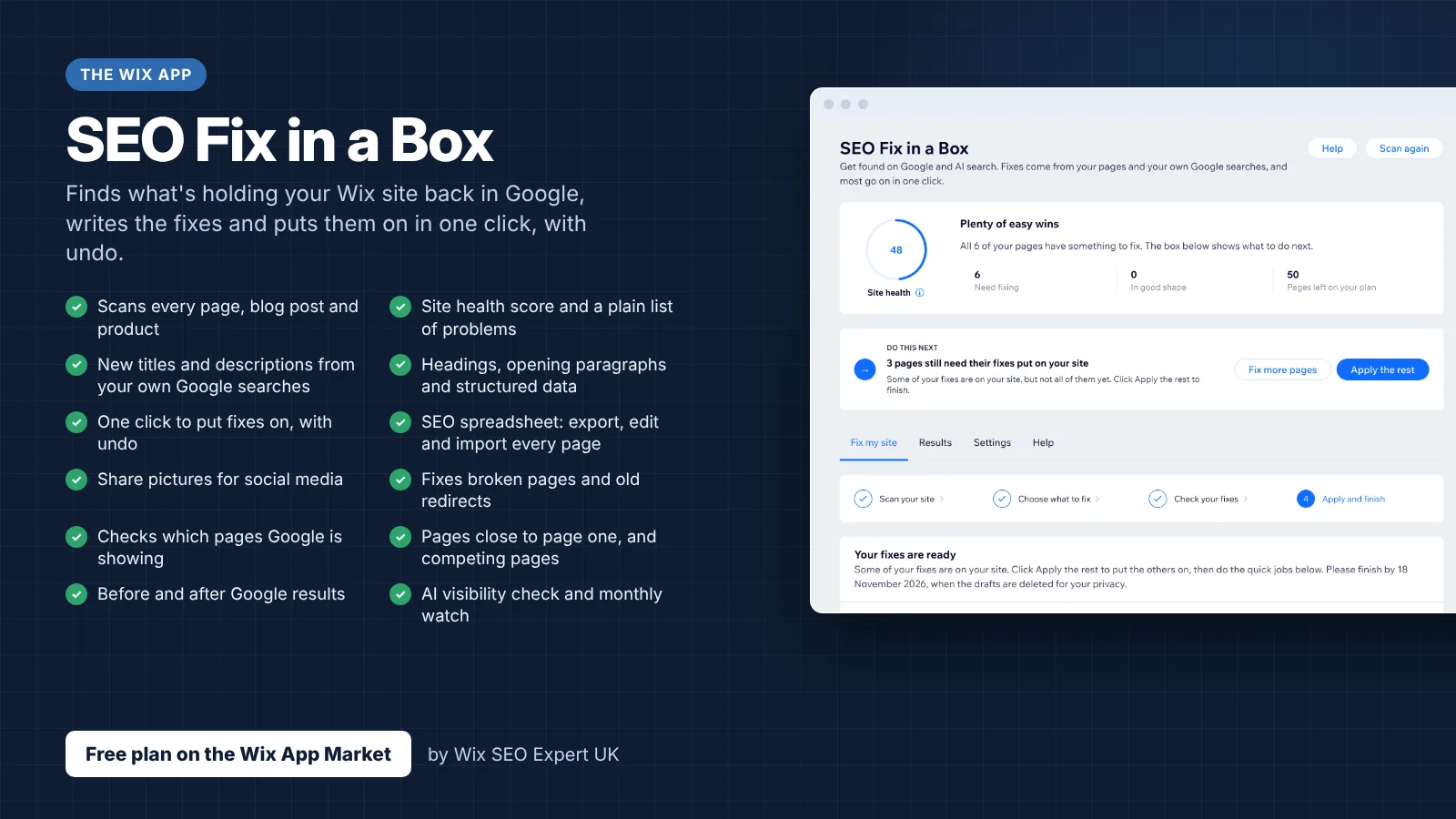
Want this sorted on your own Wix site?
I have worked only on Wix for 14 years. Get Wix SEO Fix in a Box on the Wix App Market to find and fix what is holding your site back, or see my packages and prices if you would rather I did it all for you.
Frequently Asked Questions
Is Wix good for SEO in 2026?
Yes. Wix in 2026 gives you full control of title tags, meta descriptions, URL slugs, 301 redirects, canonical tags, an XML sitemap, robots.txt, structured data and more, all on fast hosting with a global content delivery network. Google has confirmed that Wix sites can rank normally. The platform is capable, so results come down to whether the SEO work is actually done on the site.
Did Google say Wix is bad for SEO?
No. Google has said the opposite. Google's Search Advocate John Mueller stated plainly that Wix websites work fine in search, and Google's guidance makes clear that the website builder you choose is not a ranking factor. What Google rewards is helpful content, good crawlability and a strong page experience, all of which are achievable on Wix.
Why do people still say Wix is bad for SEO?
Because they are repeating a criticism that was fair around 2015, when early Wix relied on JavaScript that search engines struggled to read and gave owners very little control over titles, redirects and URLs. Wix rebuilt how its sites are served and added the full SEO toolset years ago, but the old reputation lingers in forums and outdated blog posts.
Can a Wix website rank on the first page of Google?
Yes. I get Wix sites onto the first page of Google for competitive terms regularly, across local service businesses, shops, clinics and professional firms. First-page ranking depends on keyword research, well-written on-page content and meta, a clean technical setup, structured data and quality links, none of which the Wix platform prevents.
Can a Wix site show up in AI search like ChatGPT and Google AI Overviews?
Yes, and this is one of Wix's current strengths. Wix lets you add custom structured data through its Custom Code area, and it is building AI-focused schema into the product itself. With the right two-layer structured data in place, a Wix site can be understood and recommended by ChatGPT, Perplexity and Google's AI Overviews, not just by classic search.
Is Wix or WordPress better for SEO?
Neither has a built-in ranking advantage, because the platform is not a ranking factor. Self-hosted WordPress offers more control and more plugins but hands you all the hosting, security and maintenance responsibility. Wix gives you a strong SEO toolset with the hosting, security, updates and speed handled for you. For most small and medium businesses, Wix ranks just as well with far less upkeep.
How long does it take a Wix site to rank on Google?
The timeline is the same as on any platform, because the work drives it, not the builder. A new or quiet site usually needs three to six months to see stable movement on meaningful terms, and longer for very competitive phrases. An established site with some history can move faster, sometimes in weeks. Wix helps by letting the on-page and technical work go in quickly and cleanly, so Google starts assessing your changes sooner.
Do I need a paid Wix plan for SEO to work?
You need a paid Wix Premium plan to connect your own custom domain and to remove Wix branding, and a real domain is essential for serious SEO. The core SEO tools, the control over titles, meta, slugs, redirects, sitemaps, structured data and the rest, are part of the platform. In practice, any business that is serious about ranking will be on a Premium plan with its own domain anyway.
The honest bottom line
Wix is good for SEO in 2026. The tools are all there, Google is happy to rank it, and it now handles the AI side of search better than most people realise. The only thing standing between a Wix site and the first page of Google is the work, and that has been true on every platform since search began.
That work is the whole of what I do. I have spent fourteen years on Wix and nothing else, I have completed more than 800 Wix projects, and I hold 456 five-star reviews for doing exactly this. If you have a Wix site that is not pulling its weight, or you are about to build one and want it set up to rank from day one, that is my specialism. You can see more about me and how I work here, or get in touch and I will take a proper look at your site.