Generative Engine Optimisation (GEO): the new playbook
Module 26: AI, SGE & Future-Proof SEO | Lesson 311 of 683 | 30 min read
By Michael Andrews, Wix SEO Expert UK
Generative Engine Optimisation (GEO) is the emerging discipline of optimising content to be cited and referenced by AI-powered search engines: Google AI Overviews, Perplexity, ChatGPT Search, Bing Copilot, and emerging AI assistants. As these AI systems become primary interfaces for information discovery, GEO becomes as important as traditional SEO. The fundamental shift is from ranking in a list of links to being the source that AI systems trust enough to cite and recommend. This lesson covers the complete GEO playbook for Wix site owners.
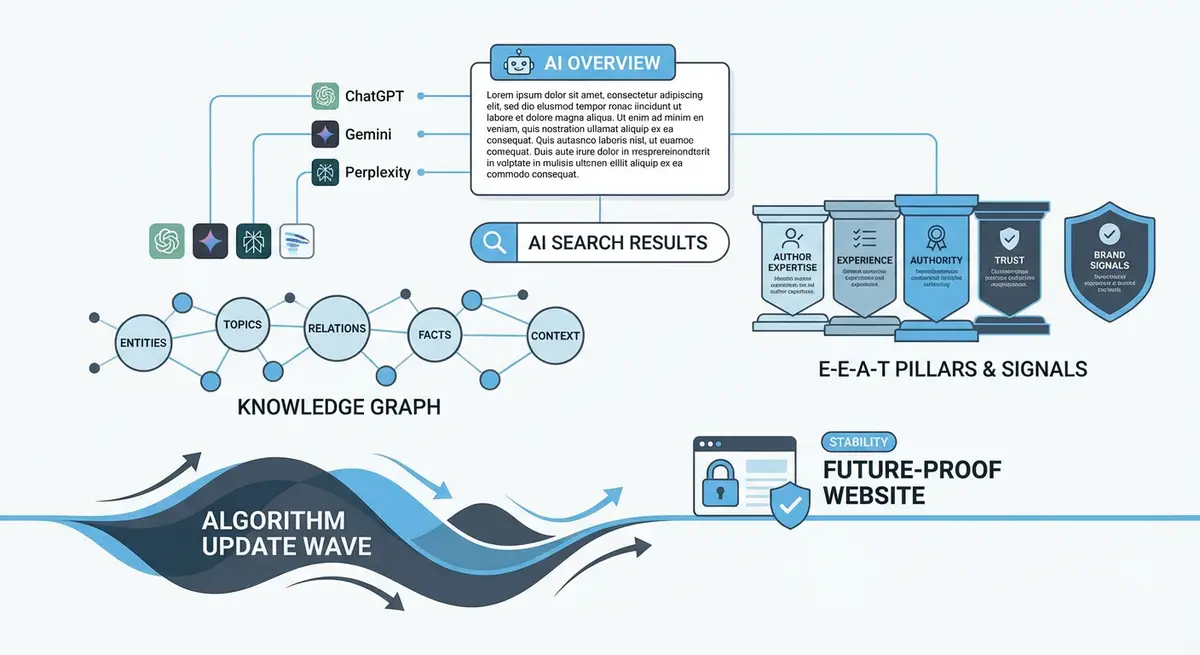
How GEO Differs from Traditional SEO
Traditional SEO optimises for a ranking algorithm that orders pages in a list. GEO optimises for a language model that synthesises information from multiple sources into a single answer. The signals that matter, the content formats that work, and the measurement approaches are fundamentally different.
- Traditional SEO: rank in a list of 10 blue links. GEO: be cited as a trusted source within an AI-generated answer.
- Traditional SEO: keyword density, backlink volume, and click-through rate matter most. GEO: factual accuracy, comprehensiveness, entity associations, and content extractability matter most.
- Traditional SEO: measured in rankings, clicks, and traffic. GEO: measured in citation frequency, brand mentions in AI responses, and referral traffic from AI platforms.
- Traditional SEO: content can be long-form and exploratory. GEO: direct, factual, well-structured content with specific claims performs best.
- Traditional SEO: optimises primarily for Google. GEO: must consider multiple AI platforms with different citation behaviours.
The AI Search Landscape in 2026
Understanding where your audience encounters AI-generated answers determines where to focus your GEO efforts. Each platform has different content sourcing behaviour and different requirements for citation.
- Google AI Overviews: Uses its own search index. Cites pages already ranking well in organic results. Strong preference for E-E-A-T signals and structured content.
- ChatGPT Search: Uses the Bing index for real-time information. Cites sources from Bing search results. Indexation in Bing Webmaster Tools is essential.
- Perplexity: Crawls the web independently and uses multiple search APIs. Cites sources with clear, factual content and strong entity signals. Often cites niche expert sources over general ones.
- Bing Copilot: Uses the Bing index integrated with Microsoft Copilot. Cites Bing-indexed pages with strong authority signals.
- Claude (via web search): When enabled, uses search results to ground responses. Values comprehensive, well-structured sources.
Content Signals AI Engines Prefer to Cite
Research from Princeton, Georgia Tech, and industry practitioners has identified the content characteristics that AI engines most frequently cite. These signals apply across all major AI search platforms.
- Factual accuracy: AI systems prioritise sources with verifiable, accurate claims. Incorrect or outdated information gets filtered out.
- Direct answers: Content that begins with a clear, direct answer to the query in the first paragraph or section.
- Structured data: JSON-LD schema markup helps AI systems understand content context, entity relationships, and information hierarchy.
- Named entities: Clearly associated author names, organisation names, and location names create entity connections AI systems can verify.
- Citations and sources within your own content: AI systems trust content that references primary research, official documentation, and authoritative publications.
- Consistent brand mentions across the web: Citations, reviews, directory listings, and social proof that corroborate your entity across multiple platforms.
- Original data and research: Proprietary statistics, survey results, and unique findings that cannot be found elsewhere.
- Quotable statements: Concise, authoritative statements that the AI can extract and attribute directly to your brand or author.
The BLUF Principle for GEO
BLUF stands for Bottom Line Up Front, a communication principle from military briefings. For GEO, it means starting every page and every section with the most important information first. AI systems process content sequentially and weight earlier content more heavily for citation extraction. A page that buries its key insight in paragraph seven is less likely to be cited than a page that states it in paragraph one.
## How Long Does SEO Take on Wix?

SEO on Wix typically takes 3-6 months to show
significant results for competitive keywords, with
initial improvements often visible within 4-8 weeks
for low-competition terms. The timeline depends on
your domain authority, competition level, content
quality, and technical foundation.

[Expanded detail follows below the direct answer...]
Making Your Content Crawlable by AI Bots
AI search engines use crawlers to index web content, similar to traditional search engine crawlers but with different identifiers. You need to ensure your Wix site allows these crawlers access to your content.
Ensuring AI crawler access to your Wix site
- Check your robots.txt at yoursite.com/robots.txt. Ensure you are not blocking GPTBot (ChatGPT), PerplexityBot, ClaudeBot, or Google-Extended.
- If you find Disallow rules for any AI crawlers, remove them unless you have a specific reason to block AI indexation.
- Submit your Wix sitemap to Bing Webmaster Tools at bing.com/webmasters. ChatGPT Search uses the Bing index, so Bing indexation is essential for ChatGPT visibility.
- Create or update your llms.txt file at yoursite.com/llms.txt with a structured summary of your site, your expertise areas, and links to your most authoritative content.
- Ensure your Wix site renders content in HTML that crawlers can access. Wix handles server-side rendering automatically, which is good for AI crawler access.
Building Topic Clusters for AI Authority
AI engines assess topical authority by evaluating the depth and breadth of your content on a subject. A site with one article about Wix SEO has low topical authority. A site with 50 interconnected articles covering every aspect of Wix SEO, from technical foundations to advanced strategies, has high topical authority that AI engines trust and cite.
Build topic clusters around your core expertise areas. Create a comprehensive pillar page that covers the topic broadly, then create 8-15 supporting cluster pages that cover specific subtopics in depth. Interlink all cluster pages to the pillar and to each other. This interconnected content structure demonstrates to AI engines that you have comprehensive expertise on the topic.
Original Data: The Most Citable Content Type
Original research, proprietary data, and unique findings are the most frequently cited content in AI-generated answers. When an AI system needs a specific statistic or data point, it looks for the original source. If you publish "Our analysis of 500 Wix sites found that 73% have missing meta descriptions", that statistic becomes a citable asset that AI systems will attribute to your site whenever the topic arises.
- Run surveys of your clients or audience and publish the results with methodology details.
- Analyse your own business data and share anonymised findings as industry benchmarks.
- Compile data from public sources into original analysis that provides unique insights.
- Create case studies with specific, measurable results that AI systems can cite as evidence.
- Publish annual reports on trends in your industry with data-backed predictions.
Cross-Platform Entity Signals
AI engines verify entity credibility by checking for consistent brand information across multiple platforms. The more platforms that corroborate your entity details, the more trusted your brand becomes in AI citation decisions. This is similar to traditional E-E-A-T but extends to the platforms AI systems specifically check.
- Google Business Profile: Complete with all details, recent posts, and reviews.
- LinkedIn Company Page: Active, with employee connections and regular content.
- Crunchbase: Business details including founding date, location, and description.
- Wikidata: Structured entity data that feeds directly into knowledge graphs.
- Industry directories: Relevant listings in your sector-specific directories.
- Social media profiles: Active, consistent presence across platforms with your brand name.
GEO Tools and Resources
- Bing Webmaster Tools: Submit your sitemap and monitor indexation for ChatGPT Search visibility
- Perplexity: Test your brand visibility by querying your topics and checking citation results
- ChatGPT: Query your brand name and key topics to audit your AI visibility
- Schema.org: Reference for structured data types that strengthen entity signals for AI engines
Complete How-To Guide: Implementing Generative Engine Optimisation on Wix
How to implement GEO on your Wix website step by step
- Step 1: Audit your current AI search visibility. Search 10 of your key topics in ChatGPT, Perplexity, and Google AI Overviews. Record whether your brand or content is cited in any responses. This establishes your baseline.
- Step 2: Apply BLUF formatting to your top 10 pages. Rewrite the opening paragraph of each page to provide a direct, factual answer to the primary question the page addresses. Remove introductory padding and get to the point immediately.
- Step 3: Add factual density to your content. Replace vague statements with specific claims backed by data. Instead of "we help businesses grow online", write "we have improved organic traffic by an average of 180% for 150+ Wix clients since 2019".
- Step 4: Implement comprehensive schema markup. Add Organization schema to your homepage, Person schema to your About page, and Article schema to every blog post. Include sameAs links, knowsAbout properties, and dateModified timestamps.
- Step 5: Submit your Wix sitemap to Bing Webmaster Tools at bing.com/webmasters. ChatGPT Search uses the Bing index, so indexation in Bing is essential for ChatGPT visibility.
- Step 6: Check your robots.txt at yoursite.com/robots.txt. Ensure you are not blocking GPTBot, PerplexityBot, ClaudeBot, or Google-Extended. Remove any Disallow rules for these crawlers.
- Step 7: Create or update your llms.txt file with a structured summary of your site, your expertise areas, and links to your most authoritative content pages.
- Step 8: Build or strengthen topic clusters. For your primary expertise area, create a pillar page and at least 8-10 supporting cluster pages. Interlink them thoroughly. This demonstrates topical authority that AI engines reward with citations.
- Step 9: Add original data to your content. Run a client survey, analyse your own results data, or compile unique industry benchmarks. Publish the findings with specific numbers. Original data is among the most citable content types for AI engines.
- Step 10: Include citations and sources within your own content. Link to and reference primary research, industry reports, and authoritative publications. AI engines trust content that demonstrates research rigour and source attribution.
- Step 11: Build cross-platform entity signals. Ensure your brand appears consistently on Google Business Profile, LinkedIn, Crunchbase, relevant directories, and industry publications. Each verified listing strengthens your entity recognition across AI systems.
- Step 12: Set up weekly GEO monitoring. Every Monday, query your top 10 topics in ChatGPT and Perplexity. Record whether you are cited, what content is referenced, and track trends monthly to measure your GEO progress.
Was this lesson useful?
It takes 1 minute to tell me. The course is free and I want to keep it that way, and your feedback shows me what is working and helps other people find it.
This lesson on Generative Engine Optimisation (GEO): the new playbook is part of Module 26: AI, SGE & Future-Proof SEO in The Most Comprehensive Complete Wix SEO Course in the World (2026 Edition). Created by Michael Andrews, a Wix Marketplace Legend Partner with 14 years of hands-on experience, 800 completed Wix SEO projects and 456 verified five-star reviews.