Wix Blog SEO: How to Rank Posts on Google

By Michael Andrews | Published: 2026-02-05 | Updated: 2026-03-08 | 9 min read
A Wix blog is a powerful SEO asset when optimised correctly. This guide covers every optimisation from keyword research to post structure, internal linking, and schema markup that gets Wix blog posts ranking on Google.
The Wix Blog is one of the platform's most powerful SEO tools, but most Wix website owners use only 20% of its capability. A properly optimised Wix blog can generate significant organic traffic, build topical authority, and convert visitors into customers. Here is the complete optimisation process.
Before You Write: Keyword and Intent Research
Never write a Wix blog post without a target keyword. Every post should be written to rank for a specific search query. Choose a long-tail keyword (3–5 words) with genuine search volume and a search intent that your blog post can genuinely satisfy.
Wix Blog Post URL Optimisation
Wix auto-generates blog post URLs that often look like: yoursite.com/post/the-title-of-your-blog-post. These are reasonable but can be improved. Access the post's SEO panel and customise the URL slug to be shorter and more keyword-focused.
- Target: yoursite.com/wix-seo-guide
- Not: yoursite.com/post/the-complete-guide-to-wix-seo-for-beginners-in-2026
- Keep URL slugs under 60 characters
- Use your primary keyword in the URL slug
- Never change a URL slug after a post is indexed without setting a 301 redirect
On-Page SEO for Wix Blog Posts
- Title tag: Include primary keyword, keep under 60 characters, write for clicks not just rankings
- Meta description: 150–160 characters, compelling summary with a reason to click
- H1: The post title, include your primary keyword
- H2 subheadings: Break content into clear sections, use semantic keywords in H2s
- First 100 words: Include primary keyword naturally in opening paragraph
- Featured image: Add alt text with keyword, compress before uploading
- Internal links: Link to 3–5 related pages on your Wix website
- External links: Link to 1–2 authoritative external sources (e.g. Google Search Central) for credibility
Content Depth: The Most Important Ranking Factor for Blog Posts
Google ranks the content that best answers the searcher's query. Check the top 3–5 results for your target keyword: How long are they? What subtopics do they cover? What questions do they answer? Your post needs to be at least as comprehensive as the current top rankers, and ideally more so.
Updating Old Wix Blog Posts for Recovered Rankings
If a Wix blog post that used to rank has dropped in position, updating it is usually faster and more effective than writing a new post. Update statistics, add new sections, improve on-page SEO, and add new internal links. Set the post's "last updated" date and add a freshness signal at the top.
Fix your Wix SEO from your dashboard
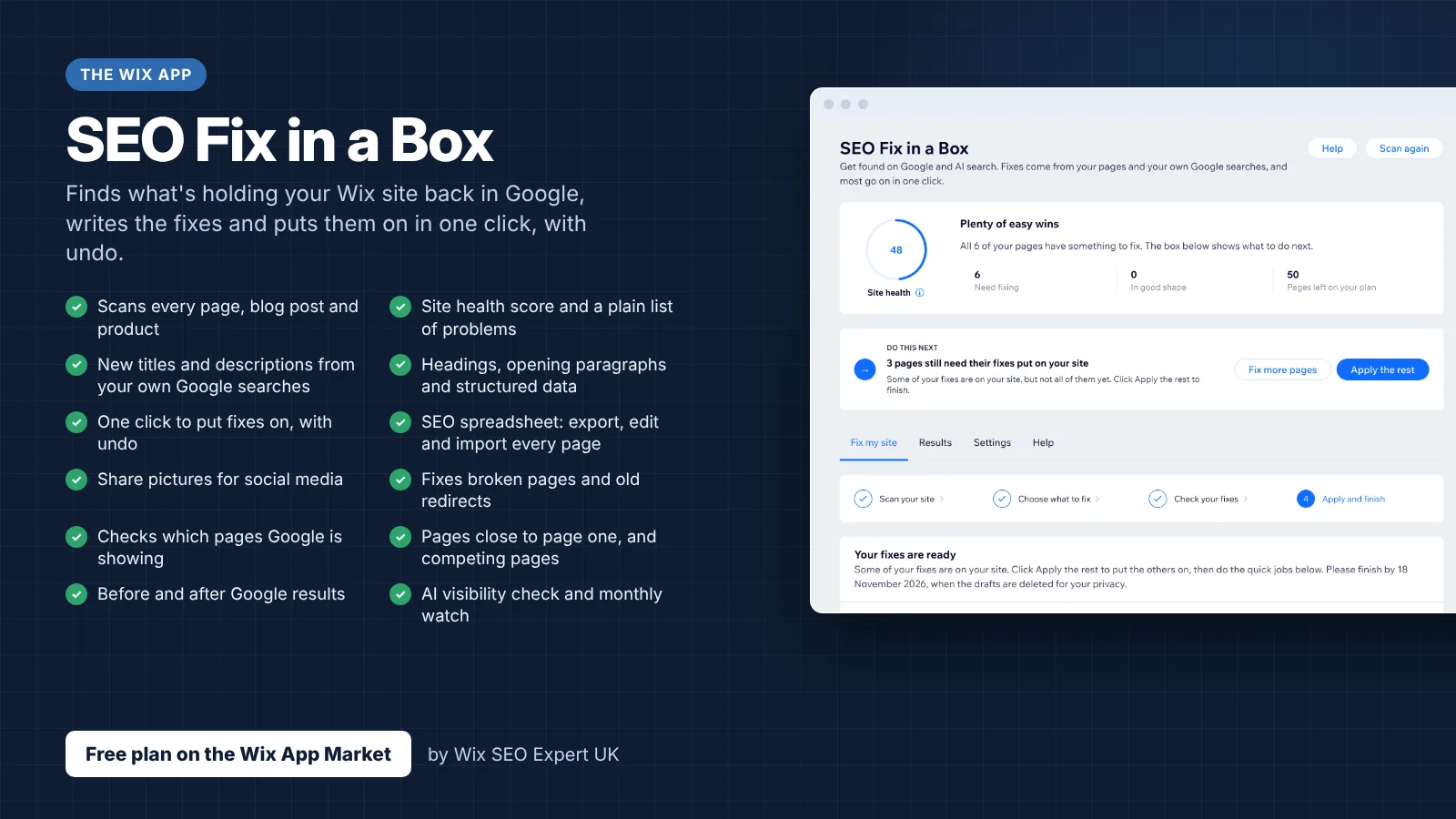
Wix SEO Fix in a Box scans every page, writes your fixes from your own Google searches and puts them on in one click, with undo. Start on the free plan.
Want this sorted on your own Wix site?
I have worked only on Wix for 14 years. Get Wix SEO Fix in a Box on the Wix App Market to find and fix what is holding your site back, or see my packages and prices if you would rather I did it all for you.
Frequently Asked Questions
How long should a Wix blog post be for SEO?
Optimal length depends on your target keyword and the competition. Check the word count of the top 3 ranking results for your keyword and aim to match or exceed the average. As a general guide: informational guides typically perform best at 1,500–3,000 words; news and update posts at 500–1,000 words; comprehensive pillar content at 3,000–6,000 words. Never pad content to hit a word count, quality beats quantity every time.
Does publishing frequency affect Wix blog SEO?
Google has repeatedly stated that publishing frequency is not a direct ranking signal, but there are indirect benefits. Publishing consistently builds more content depth on your site, increases internal linking opportunities, and signals to both Google and visitors that your site is actively maintained. For most Wix websites, 2–4 quality posts per month outperforms 8–12 thin, low-effort posts per month.
How do I optimise a Wix blog post's URL for SEO?
By default, Wix creates blog post URLs in the format yoursite.com/post/the-full-title-of-the-blog-post. Before publishing, customise this in the post's SEO panel. A well-optimised URL should: be short (3–6 words maximum), contain your primary keyword, use hyphens to separate words, and exclude stop words (a, the, and, of, in). Example: change yoursite.com/post/the-complete-guide-to-wix-seo-for-small-business-owners to yoursite.com/post/wix-seo-guide. Never change a URL after a post is indexed without setting up a 301 redirect from the old URL, otherwise you lose all the accumulated ranking authority.
What is the best way to update old Wix blog posts to improve their rankings?
Updating old Wix blog posts is often more effective than writing new content. The update process should include: refreshing all statistics and data to current figures, adding new sections covering recent developments in the topic, improving the introduction to better match current search intent, adding 2–3 new internal links to newer related posts on your site, updating the "last updated" date in the post settings, and re-optimising the title tag and meta description if click-through rates are poor. After updating, use Google Search Console's URL Inspection tool to request a fresh crawl. Many Wix websites see 30–60% ranking improvements for updated posts within 4–8 weeks.
Need a content strategy and blog SEO plan for your Wix website? Get expert guidance from the UK's dedicated Wix SEO specialist.