Rare and Tropical Springtails for Sale in the UK
By Michael Andrews | Published: 2026-10-20 | Updated: 2026-10-20 | 9 min read
Exotic Springtails breeds rare and tropical springtail cultures in the UK, from the common temperate white to the striking Santa Claus. Here is what springtails actually do in a bioactive setup, and why mite-free matters more than anything else.
Most people who keep a bioactive terrarium never see the animals doing most of the work. They are a couple of millimetres long, they live in the leaf litter, and if the setup is healthy you will only spot them when you lift a piece of cork bark and a scatter of tiny white specks bounces away from the light. Those are springtails, and Exotic Springtails breeds them in the UK for keepers who want a closed system that looks after itself.
Key Takeaway: A bioactive enclosure is only as good as its clean-up crew. Springtails are the part of that crew that deals with mould before it becomes a problem.
What a springtail actually does
Springtails are not insects, although almost everyone calls them that. They are collembola, an ancient group of six-legged arthropods that have been living in soil and leaf litter for a very long time. In a terrarium they do one job extremely well: they eat decaying organic matter, and in particular they eat mould.
That matters because mould is what ruins a planted enclosure. You add a piece of wood, the humidity sits high, and within a week there is a white fuzz creeping across it. In a sterile setup you scrub it off and it comes back. In a bioactive setup a healthy springtail population grazes it down before it establishes, and the problem quietly stops happening.
They also work through shed skin, spilled food, droppings and dead plant matter, turning all of it into something the substrate can use. The result is an enclosure that does not need stripping and replacing every few months. You top up the leaf litter, the system handles the rest.
The name comes from the furcula, a forked appendage folded under the body and held in tension. Release it and the springtail is flung several times its own body length. That is why a tub of them appears to boil when you take the lid off. It is also why they are difficult to keep contained, and why a culture tub needs a lid even though nothing in it can climb glass.
There is no risk to the animal in the enclosure. Springtails do not bite, they do not carry anything that transfers to reptiles or amphibians, and they do not damage live plants. They work on material that is already dead or dying, which is precisely why they fit into a closed setup so well.
How a bioactive enclosure actually works
A bioactive setup is an attempt to build a small, functioning piece of forest floor rather than a display case that needs cleaning. The substrate holds moisture and supports plant roots. A layer of leaf litter on top gives cover and provides food for the invertebrates. Isopods break down the bulky material. Springtails take the fine material and the mould. Plants take up the nutrients that process releases.
When all of that is working, the enclosure stops being something you maintain and becomes something you observe. There is no monthly substrate change, no scrubbing of wood, no removing of waste by hand. The system absorbs what the animal produces and converts it.
It does take time to establish. A new enclosure is not bioactive on the day it is built. It becomes bioactive over the following weeks as the clean-up crew spreads, the plants root in and the substrate develops. Seeding springtails early, before the animal goes in, gives the colony a head start without competition.
Why mite-free is the thing that matters
Anyone who has kept cultures for a while has had this happen. You buy a tub, you start it off, and a few weeks later the culture is crawling with something that is not springtails. Grain mites are the usual culprit. They outcompete the springtails, they spread to every other culture on the shelf, and once they are in your collection they are difficult to shift.
Exotic Springtails guarantees every culture is 100 percent mite-free, and that is the claim worth paying attention to. The cultures are captive-bred and maintained under strict quality standards, with genetic purity maintained rather than mixed lines sold under whichever name sounds best. For anyone running multiple enclosures, a clean starter culture is cheaper than the alternative.
The cultures available
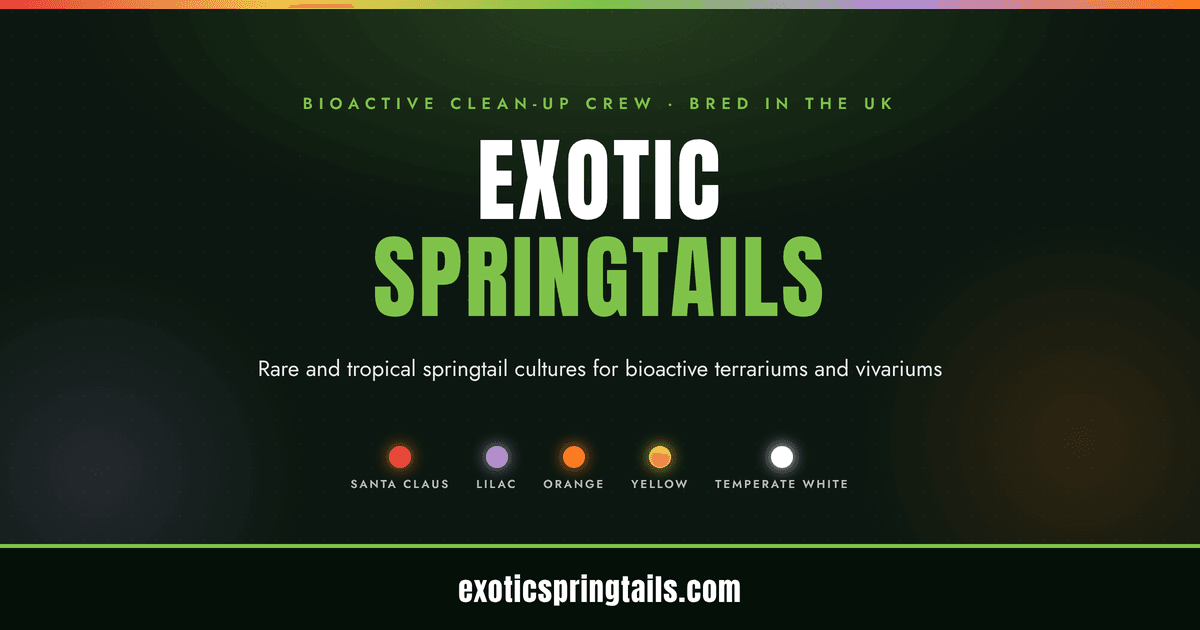
The range covers both the hardworking everyday species and several rare colour forms that are hard to find in the UK. You can browse the full range in the Exotic Springtails shop.
Temperate White Springtails (Folsomia candida)
This is the one most keepers start with, and for good reason. Temperate white springtails are a fast breeder, they tolerate a wide range of conditions, and they establish quickly in a new enclosure. They are sold as a scoop culture at 6.99 pounds, which makes them the cheapest way to get a bioactive setup running.
If you are seeding a first terrarium, this is the species to buy. They are forgiving of a setup that is still finding its balance, and a healthy colony will keep pace with whatever the enclosure throws at it.
Lilac Springtails (Ceratophysella)
Lilac springtails are one of the rarer offerings at 9.99 pounds, and the colour is the draw. A pale purple springtail moving across dark substrate is a striking thing in a display enclosure, and they are uncommon enough in the UK that most keepers have never seen them in person.
Yellow Springtails (Ceratophysella)
The yellow springtails are the same genus and the same price at 9.99 pounds, with a soft yellow colouring that shows up well against leaf litter and moss. Like the lilac, they work as a display species as much as a functional one.
Giant Orange Gummy (Yuukianura aphoruroides)
The orange springtails are the ones people tend to notice first. They are noticeably larger than the temperate whites, and a deep orange that is hard to miss. At 9.99 pounds they are the species that turns a clean-up crew into something you actually want to look at.
Santa Claus Springtails (Neanuridae sp.)
The Santa Claus springtails are the centrepiece of the range at 80 pounds, and they are described, accurately, as chunky red and white. These are a collector species rather than a starter culture. If you keep springtails because you find them interesting in their own right, rather than purely as tank maintenance, this is the one to look at.
Choosing between the species
If the job is purely functional, the temperate whites do it. They reproduce fast, they handle a range of temperatures and they establish in almost anything. For a working vivarium that you want running reliably, there is no argument for spending more.
The rarer forms earn their place for a different reason. In a display enclosure, where you are looking at the setup rather than just housing an animal in it, a visible springtail population adds something. Orange and lilac in particular show up against dark substrate in a way the whites never will, and the larger species are easier to actually watch.
There is also the collecting side of it, which is a real part of the hobby. Some keepers run cultures of several species side by side simply because they find the animals interesting, and the rarer colour forms are difficult to source in the UK without going through a specialist breeder.
Who is buying them
The customer base splits roughly three ways. Dart frog keepers are the most obvious group, because springtails are both clean-up crew and a food source for very small frogs. A thriving culture in the substrate means froglets have something to hunt between feeds, which is difficult to replicate any other way.
Reptile keepers are the second group. Crested geckos, leopard geckos and most of the commonly kept species do well in a bioactive setup, and springtails plus isopods are the standard pairing. The springtails deal with mould and the finer waste, the isopods handle the bulkier material.
The third group is keepers of invertebrates and anyone building a planted terrarium for its own sake, with no animal in it at all. A sealed planted jar still produces decaying matter, and it still grows mould. Springtails keep it stable.
Tarantula and mantis keepers use them for the same reason, with the added benefit that springtails will clear uneaten prey remains from an enclosure that is otherwise awkward to reach into. Anyone who has tried to retrieve a half eaten cricket from behind a web knows why that is useful.
There is a growing group of plant keepers too, people with no interest in animals at all, who run closed terrariums and bottle gardens. Mould on a new piece of hardscape is the single most common problem in that hobby, and a springtail colony solves it permanently rather than for a fortnight.
Starting and keeping a culture going
A springtail culture does not need much. A ventilated tub, a substrate that holds moisture, and something to feed on. Most keepers use charcoal or a coir and clay mix, kept damp but not waterlogged, with a pinch of dried yeast or fish flake every week or so.
The two mistakes that cause problems are overfeeding and letting it dry out. Too much food encourages mould faster than the springtails can graze it, and a dry culture crashes quickly. Damp, lightly fed and left alone is the formula.
When you seed an enclosure, give the colony time. A culture tipped into a new terrarium will seem to disappear for a few weeks while it spreads through the substrate and establishes. That is normal. Keep the leaf litter topped up and the population will build on its own.
Posted from the UK
Live cultures do not travel well over long distances, which is the practical argument for buying from a UK breeder rather than importing. Exotic Springtails breeds and posts from the UK, with free 1st Class Royal Mail delivery on orders over 25 pounds, so a culture spends a day or so in transit rather than a week.
You can read more about the business on the Exotic Springtails about page, or go straight to the full range.
Frequently Asked Questions
What do springtails do in a bioactive terrarium?
They eat decaying organic matter and mould. In practice that means they break down shed skin, droppings, spilled food and dead plant material, and they graze mould off wood and substrate before it can establish. A healthy population keeps an enclosure stable without the keeper needing to strip it down.
Do I need springtails as well as isopods?
Most keepers use both. Springtails deal with mould and the finer waste, isopods work through bulkier material like leaf litter and wood. They occupy different roles, so the two together cover more than either does alone.
Why does it matter that a culture is mite-free?
Grain mites are the most common reason a springtail culture fails. They outcompete the springtails, spread to other cultures nearby, and are difficult to clear once established in a collection. Exotic Springtails guarantees every culture is 100 percent mite-free.
Which springtails should I start with?
Temperate white springtails, Folsomia candida, are the usual starting point. They breed quickly, tolerate a range of conditions and establish well in a new enclosure. The rarer colour forms are better suited to keepers who already have a working setup.
Can springtails be used as food?
Dart frog keepers commonly use them that way, particularly for froglets and other very small amphibians that need prey smaller than fruit flies. A thriving culture in the substrate gives small frogs something to hunt between feeds.
How do live cultures arrive?
Exotic Springtails breeds and posts from the UK, with free 1st Class Royal Mail delivery on orders over 25 pounds. Shipping from within the UK means a culture is in transit for a short time rather than travelling internationally.
You can browse the full range of rare and tropical springtail cultures at exoticspringtails.com.