Wix Keyword Research Guide | Find Converting Terms

By Michael Andrews | Published: 2026-02-28 | Updated: 2026-03-08 | 8 min read
Learn the exact keyword research methodology I use for every Wix client, from initial discovery to topic cluster mapping and conversion-focused keyword prioritisation.
Keyword research is the foundation that every Wix SEO strategy must be built on. Get it wrong, and you'll spend months ranking for terms nobody searches for. Get it right, and every page you publish has a clear path to page-one visibility. Here's the exact framework I use for all my Wix SEO client projects.
Understanding Search Intent: The Most Important SEO Concept in 2026
Search intent (the reason behind a search query) is now the primary factor Google uses to determine which pages deserve top rankings. There are four types: informational, navigational, commercial, and transactional.
- Informational: "how to optimise Wix SEO", blog posts, guides
- Navigational: "Wix SEO expert UK", homepage, about page
- Commercial: "best Wix SEO services UK", service pages, comparison posts
- Transactional: "hire Wix SEO expert", service pages with clear CTAs
The 5-Step Keyword Research Process for Wix Websites
- Seed keyword brainstorm: list all services, topics, and problems you solve
- Competitor keyword gap analysis: find terms competitors rank for that you don't
- Search volume and difficulty assessment: prioritise by opportunity score
- Search intent mapping: match keywords to the right page type
- Topic cluster organisation: group related keywords into pillar + cluster structure
Expert Tip: Use Google's "People Also Ask" boxes and autocomplete suggestions as free keyword research tools. Pair them with Google Keyword Planner for search volume data. They show you exactly what your target audience is searching for in real-time.
Topic Clusters: The Structure That Wins in 2026
Topic clusters are groups of content pages that revolve around a central pillar page. Google rewards websites that demonstrate comprehensive topical authority, and topic clusters are the best way to establish that authority.
For a Wix SEO expert website, a topic cluster might include: a pillar page on "Wix SEO Services", with cluster pages covering "Wix Technical SEO", "Wix Keyword Research", "Wix Local SEO", "Wix Link Building", etc.
Long-Tail Keywords: Your Fastest Route to Rankings
Long-tail keywords (3-5 word phrases with lower search volume) offer the fastest path to rankings for new or lower-authority Wix websites. They're typically less competitive, more specific, and convert better because the searcher's intent is clearer.
Long-tail keywords make up the majority of all search queries and typically have significantly higher conversion rates than short-tail terms, Industry Research
Fix your Wix SEO from your dashboard
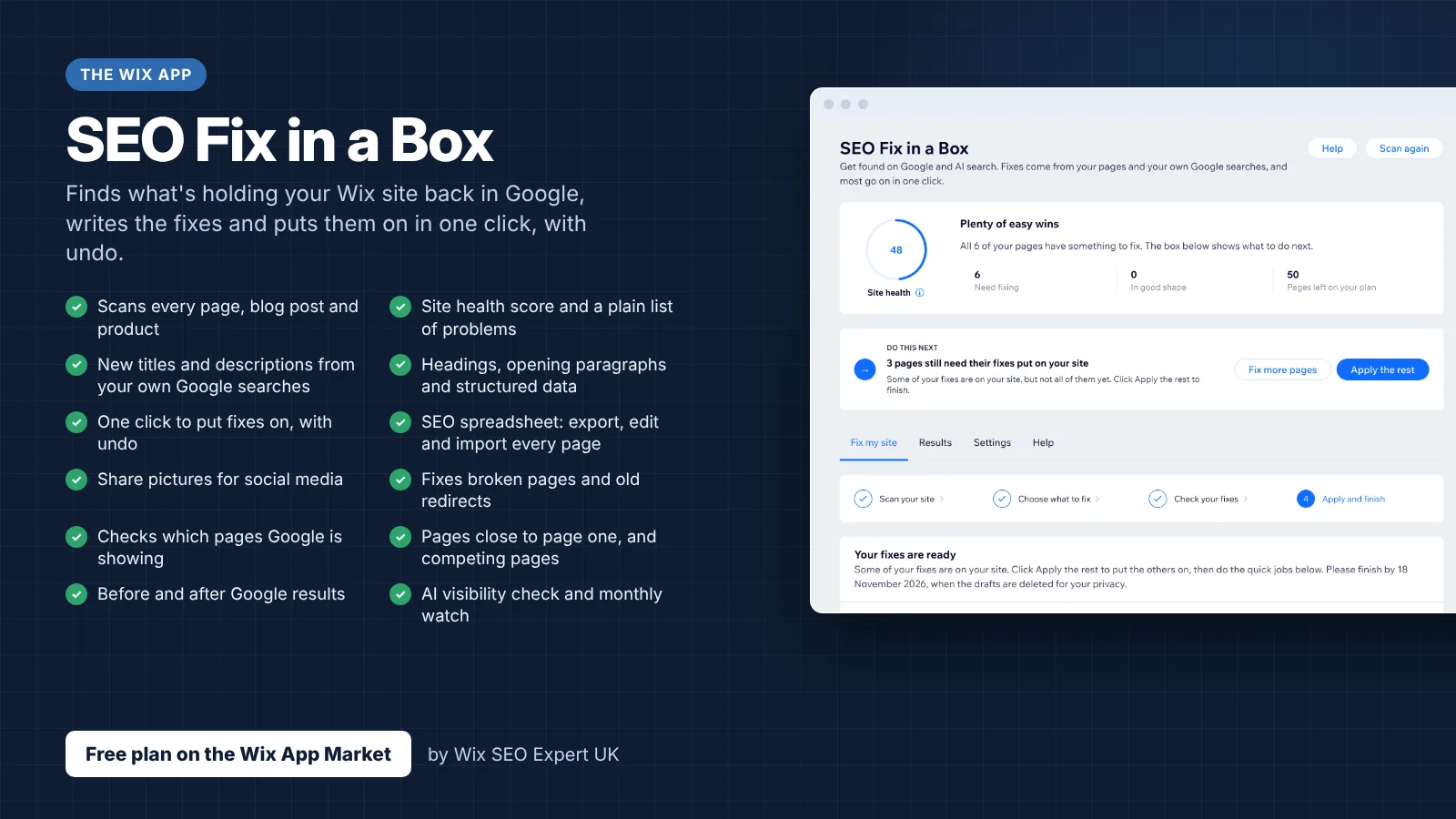
Wix SEO Fix in a Box scans every page, writes your fixes from your own Google searches and puts them on in one click, with undo. Start on the free plan.
Want this sorted on your own Wix site?
I have worked only on Wix for 14 years. Get Wix SEO Fix in a Box on the Wix App Market to find and fix what is holding your site back, or see my packages and prices if you would rather I did it all for you.
Frequently Asked Questions
What is the best free keyword research tool for Wix websites?
Google Search Console is the best free keyword research tool, it shows you which queries your pages already appear for and their click-through rates. Combine it with Google's "People Also Ask" boxes, autocomplete suggestions, and Google Keyword Planner for a comprehensive free keyword research setup.
How many keywords should I target on a single Wix page?
Target one primary keyword and 3–5 semantic variations per page. Trying to rank a single page for too many unrelated keywords dilutes your relevance signals. Instead, create separate pages for distinct keyword themes and interlink them to build topical authority.
What is a topic cluster and should my Wix website use one?
A topic cluster is a group of related content pages built around a central "pillar" page that covers a broad topic. Cluster pages cover specific subtopics and link back to the pillar. This structure signals comprehensive topical expertise to Google and is one of the most effective strategies for ranking competitive keywords on Wix websites.
How do I find keywords my competitors rank for?
Use tools like Ahrefs, Semrush, or Ubersuggest to enter your competitor's domain and view their organic keywords. Filter for keywords where they rank in positions 1–20 that you don't currently rank for, these represent your highest-opportunity keyword gaps.
What is search intent and why does it matter for Wix SEO?
Search intent is the underlying reason someone performs a search, whether they want information (informational), to navigate to a specific site (navigational), to research before buying (commercial), or to complete a purchase (transactional). Google's algorithms are very good at matching pages to intent, so your page type must match the dominant intent behind each target keyword.
Want a personalised keyword research strategy for your Wix website? Get in touch for a free consultation.