Wix vs Shopify SEO: Which Platform Ranks Better in 2026?

By Michael Andrews | Published: 2026-09-13 | Updated: 2026-09-13 | 8 min read
Wix and Shopify are built for different jobs, and that is the honest starting point. This comparison covers what actually matters for SEO on both platforms, with no hype and no filler.
Wix and Shopify are built for different jobs, and that is the honest starting point. Shopify is a dedicated ecommerce engine. Wix is an all-rounder that runs content, service and local sites as well as shops. Neither is penalised by Google, and both can rank well when the SEO is done properly. So the real question is not which platform ranks better in the abstract, it is which one fits how your business actually earns, and where each one helps or gets in the way of good SEO.
Can you rank on both Wix and Shopify?
Yes. Google does not rank or penalise a site for the platform it is built on, and it has said so repeatedly. Both Wix and Shopify render pages server-side, so Google can crawl and index them without waiting for JavaScript. On both platforms, rankings come down to the same things: useful content, a clean technical setup, a good page experience, and links from other sites. If a store is not ranking, the cause is almost always in the content and configuration, not the logo on the dashboard.
Where Shopify is stronger
Shopify is purpose-built for selling, and at scale that shows. It handles large catalogues, product variants, inventory and multi-channel selling more comfortably than Wix, and its checkout is one of the most trusted on the web. It is fully hosted with a global CDN and automatic SSL, so the platform itself is fast, and its product schema is generally good enough for rich product results out of the box. If your business is primarily a large or fast-growing online store, Shopify is doing the heavy commerce lifting that Wix is not designed for.
Where Wix is stronger for SEO
Wix gives you more direct control over the parts of SEO that sit outside the shopping cart. You get full control of title tags and meta descriptions, canonical tags, structured data, the redirect manager, and robots.txt, and its blog is a proper content platform with categories, tags, author pages and custom URLs. That matters, because a lot of ecommerce traffic now comes from informational content that leads to a sale, and content SEO is exactly where Shopify's native blog is weakest. Wix is also the stronger choice for local SEO and for hybrid businesses that are part shop, part service, part content.
The honest technical trade-offs
Shopify's structure is rigid in ways that affect SEO. It forces fixed URL prefixes, so products sit under /products/, collections under /collections/, and blog posts under /blogs/, and you cannot build a custom category hierarchy or root-level URLs. Products that belong to more than one collection can be reached at more than one URL, and while Shopify adds a canonical tag pointing to the main product URL, canonicals are hints rather than rules, so internal link value can still leak to duplicate paths. Title tags are capped at 70 characters, product variants share the same meta title and description unless you add custom code, and you cannot upload a custom sitemap or separate image and video sitemaps. Editing robots.txt is possible but needs Liquid.
Wix is not perfect either, and it is only fair to say so. Wix Stores puts products under a /product-page/ prefix, and for very large catalogues or advanced multi-channel operations it does not go as deep as Shopify. The difference is that Wix gives you more hands-on control over the on-page and technical SEO levers, while Shopify trades some of that control for a more powerful commerce engine. For the specifics on how to get product schema working for rich listings, the course lesson walks through it step by step.
So which should you choose?
Choose Shopify if you are first and foremost a shop, especially a large or scaling one, where catalogue size, variants, inventory and checkout matter more than fine-grained SEO control. Choose Wix if content, local search and service pages drive your sales as much as the products do, or if you run a small to mid-sized store and want maximum control over your titles, schema, redirects and blog. For a lot of small and mid-sized UK businesses that sell but also rank on advice and local intent, Wix is the more complete SEO home. Either way, the platform is rarely the reason a store wins or loses in search. The work is.
If you are weighing up other platforms too, the companion comparisons cover Wix vs WordPress for SEO and Wix vs Squarespace for SEO.
Fix your Wix SEO from your dashboard
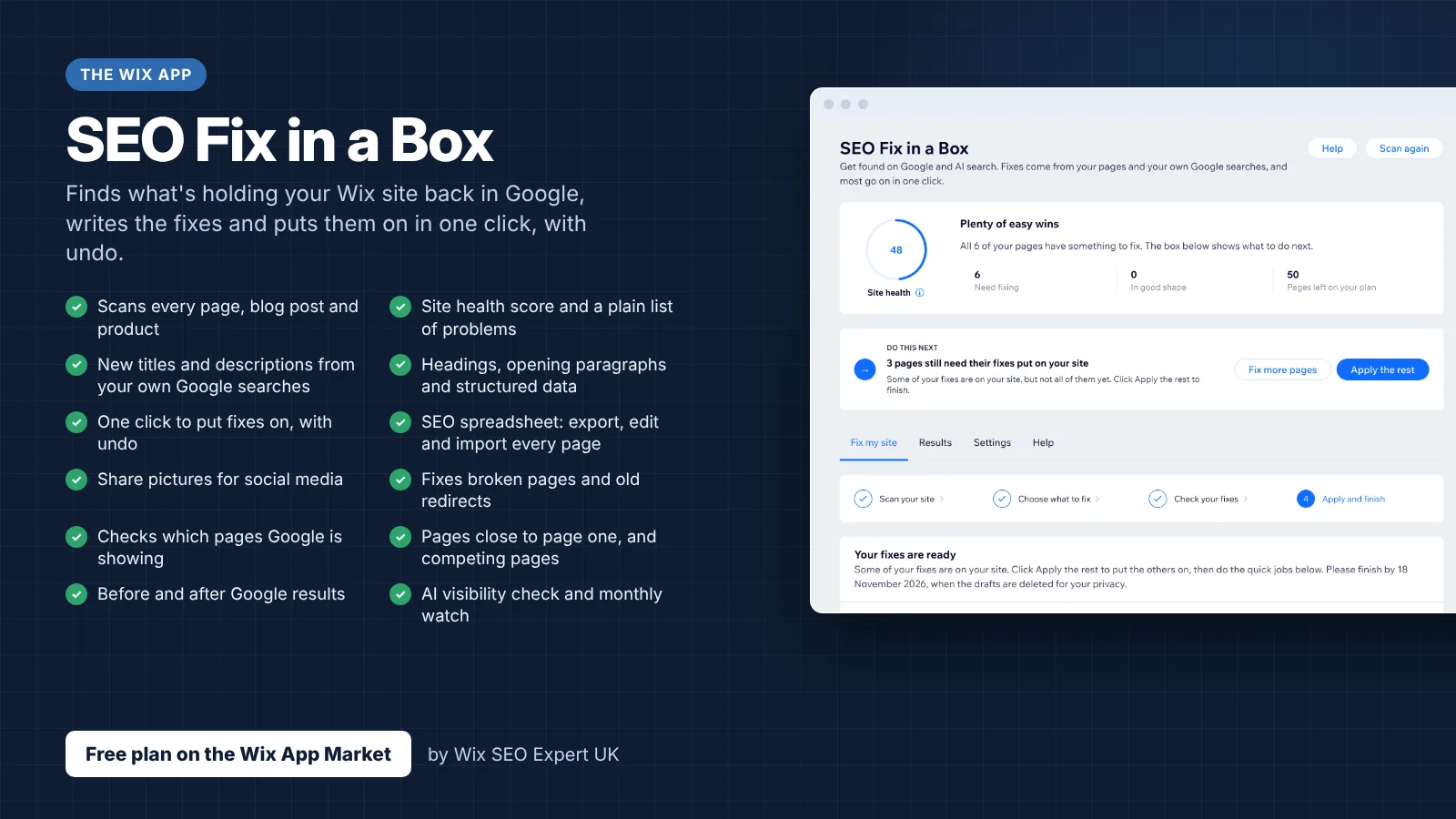
Wix SEO Fix in a Box scans every page, writes your fixes from your own Google searches and puts them on in one click, with undo. Start on the free plan.
Want this sorted on your own Wix site?
I have worked only on Wix for 14 years. Get Wix SEO Fix in a Box on the Wix App Market to find and fix what is holding your site back, or see my packages and prices if you would rather I did it all for you.
Frequently Asked Questions
Is Wix or Shopify better for SEO?
Neither is better in the abstract. Wix gives you more control over titles, meta, schema, redirects and blogging, which suits content-led and local businesses. Shopify is a stronger commerce engine for large stores. The better platform is the one that fits how your business earns.
Can you rank a Wix store as well as a Shopify store?
Yes. Both render server-side and both give Google what it needs to crawl and index. Rankings depend on content, technical health and links, not on whether the store runs on Wix or Shopify.
Does Shopify have SEO problems?
Shopify has some structural limits: fixed URL prefixes, duplicate collection paths where canonicals are only hints, a 70-character title cap, shared variant meta, and no custom or image sitemaps. None of these stop a store ranking, but they are real constraints worth knowing before you commit.
Should I move from Shopify to Wix for SEO alone?
Rarely. Migrating platforms risks losing rankings if redirects and content are not handled carefully, and SEO alone is seldom worth that risk. Move for the right commercial reasons, then do the SEO properly on whichever platform you land on.
Running a Wix store and want it ranking properly? Get expert Wix ecommerce SEO from Michael Andrews.