Wix eCommerce SEO: The Complete Guide to Ranking Your Wix Store

By Michael Andrews | Published: 2026-02-15 | Updated: 2026-02-28 | 11 min read
Everything you need to know about Wix eCommerce SEO, from product page optimisation and category structure to schema markup and technical performance for Wix stores.
Wix Stores has evolved into a capable eCommerce platform used by thousands of UK businesses. But out of the box, most Wix stores have significant SEO gaps that prevent them from competing with established retailers in organic search. This guide covers every SEO element that separates a Wix store that ranks from one that doesn't.
Wix eCommerce SEO: The Unique Challenges
eCommerce SEO on Wix presents unique challenges: thin product descriptions, duplicate content from variant pages, poor URL structures, and missing structured data. Each of these, left unaddressed, actively suppresses your organic visibility.
eCommerce websites with optimised product pages consistently receive significantly more organic traffic than those with thin descriptions, Industry Best Practice
Wix Product Page SEO: The 10-Point Checklist
- Unique product titles with primary keyword (avoid manufacturer duplicate titles)
- Comprehensive product descriptions: 300+ words with semantic keywords
- Custom URL slugs: clean, keyword-rich, no unnecessary parameters
- Optimised title tag and meta description for each product
- High-quality product images with descriptive alt text
- Product schema markup with price, availability, and review data
- Internal links to related products and category pages
- Customer reviews enabled and encouraged (UGC for SEO)
- Breadcrumb navigation implemented and schema-marked
- Page speed optimised: compress all images, minimise render-blocking scripts
Category Page SEO for Wix Stores
Category pages are often the highest-value pages in an eCommerce SEO strategy, they target high-volume, high-intent category keywords and funnel traffic to product pages. Yet most Wix stores have completely bare category pages with no SEO content.
Expert Tip: Add 150-300 words of unique, keyword-rich introductory content above the product grid on every category page. This gives Google something to index and rank beyond just the product listings.
Handling Duplicate Content in Wix Stores
Product variants (different sizes, colours) can create near-duplicate pages in Wix Stores. Use canonical tags to point all variant pages to the primary product URL, consolidating your ranking signals.
Fix your Wix SEO from your dashboard
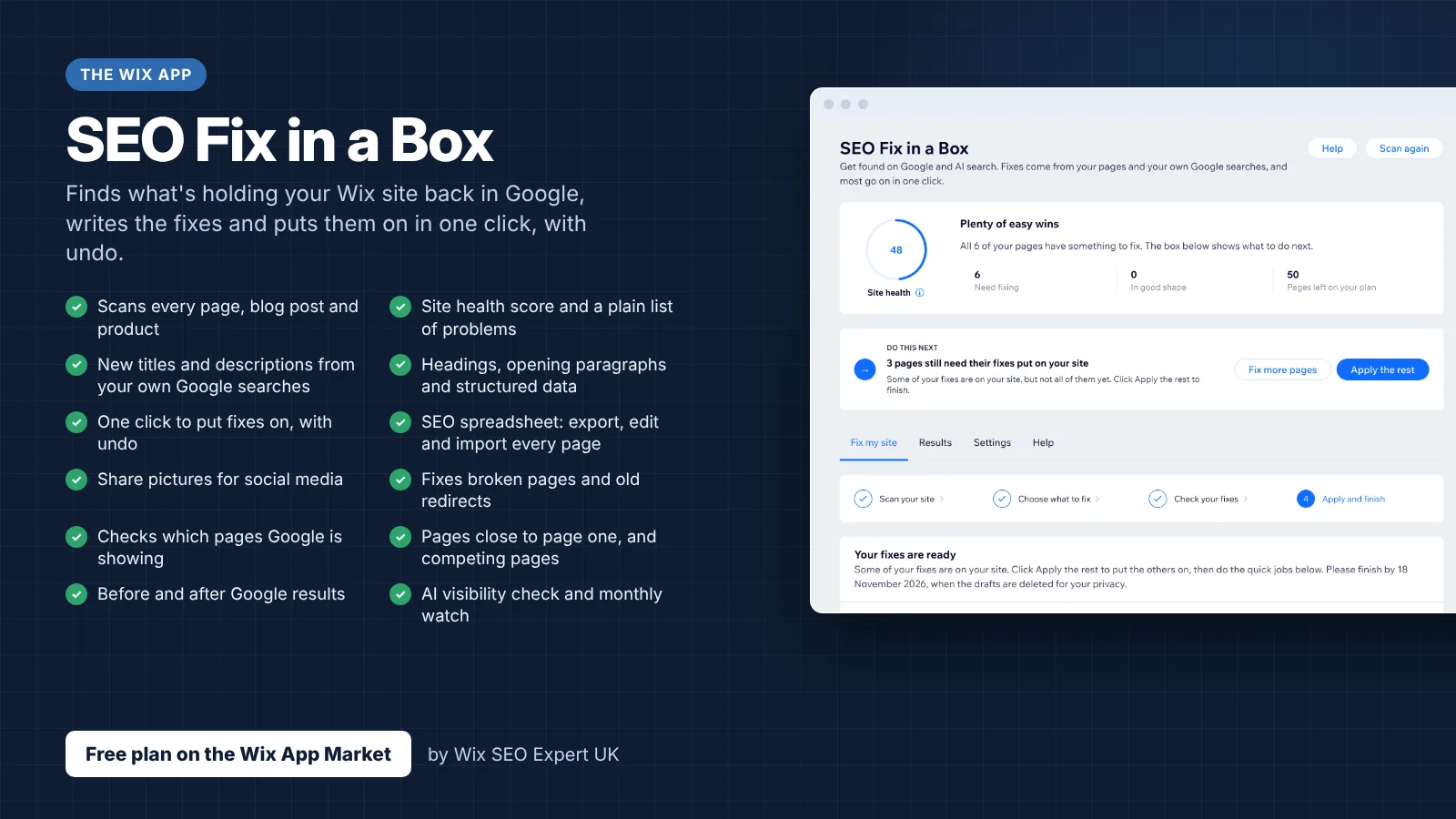
Wix SEO Fix in a Box scans every page, writes your fixes from your own Google searches and puts them on in one click, with undo. Start on the free plan.
Want this sorted on your own Wix site?
I have worked only on Wix for 14 years. Get Wix SEO Fix in a Box on the Wix App Market to find and fix what is holding your site back, or see my packages and prices if you would rather I did it all for you.
Frequently Asked Questions
Does Wix Stores support product schema markup for Google Shopping?
Yes. Wix Stores supports Product schema markup including price, availability, SKU, and review data. This enables your products to appear with rich results in Google, showing star ratings, price, and stock status directly in the search results. Properly implemented Product schema can increase click-through rates by 15–30% for eCommerce listings.
How do I optimise product pages on Wix for SEO?
Each Wix product page should have: a unique title (not copied from the manufacturer), a 300+ word description with semantic keywords, a custom URL slug, optimised image alt text, Product schema markup, internal links to related products and categories, and customer reviews enabled. Avoid thin descriptions or copying content from supplier feeds, this triggers duplicate content penalties.
Why are my Wix store category pages not ranking?
Category pages often underperform because they have no unique SEO content, just a product grid. Add 150–300 words of unique, keyword-rich introductory text above the product listings on every category page. Include your target category keyword naturally in the text, a heading, and ideally an FAQ section. This gives Google substantive content to evaluate and rank.
How do I handle duplicate content from Wix product variants?
Product variants (different sizes, colours) can create near-duplicate pages in Wix Stores. Set canonical tags on all variant pages pointing to the primary product URL. This tells Google to consolidate ranking signals on the main product page rather than splitting them across variants, which improves overall rankings for that product.
Is Wix Stores good for SEO compared to Shopify or WooCommerce?
Wix Stores is fully capable of competing with Shopify and WooCommerce for search rankings when properly optimised. All three platforms support the core SEO requirements. The differences lie in advanced technical flexibility, Shopify and WooCommerce offer more developer control, but for most small-to-medium eCommerce stores, Wix Stores provides everything needed to rank competitively.
Is your Wix store leaving organic traffic on the table? Get a comprehensive eCommerce SEO audit today.