Category taxonomy and internal linking architecture for Wix directories
Module 40: Wix SEO for Directories, Marketplaces & Multi-Vendor Sites | Lesson 457 of 683 | 48 min read
By Michael Andrews, Wix SEO Expert UK
The category taxonomy and internal linking architecture of a directory site determines how link equity flows, how Google understands your content hierarchy, and how easily users find what they need. A flat taxonomy with no hierarchy wastes link equity. An overly deep hierarchy buries listings too far from the homepage. This lesson teaches the optimal category structure and linking strategy for Wix directory sites.
Designing an SEO-Optimised Category Taxonomy
Your category taxonomy should mirror how users search. If people search for "plumbers in Manchester", your taxonomy needs both a service category (Plumbers) and a location dimension (Manchester). The ideal Wix directory taxonomy uses 2 dimensions maximum: a primary categorisation (service type, product type, or business type) and a secondary dimension (location, price tier, or rating). More than 2 dimensions creates navigation complexity that hurts both users and SEO.
- Primary categories should align with head keywords: "Plumbers", "Electricians", "Restaurants"
- Subcategories should target more specific long-tail keywords: "Emergency Plumbers", "Commercial Electricians"
- Location dimensions should match how users search: by city, by region, by postcode area
- Limit category depth to 2 levels maximum (Parent > Child) on Wix to keep crawl depth manageable
- Every category page should have unique introductory content (200+ words) describing that category
- Cross-linking between related categories distributes link equity across the taxonomy
The Hub-and-Spoke Internal Linking Model
Directory sites benefit from a hub-and-spoke linking model. The directory index page is the main hub, linking to all category pages. Each category page is a secondary hub, linking to all listings within that category. Individual listings link back to their category and to 3-5 related listings. This creates clear topical clusters that Google can follow and understand. Every page is within 3 clicks of the homepage.
Implement the hub-and-spoke linking model on your Wix directory
- Step 1: Create a directory index page (the main hub) at /directory/ that lists all categories with descriptions, listing counts, and links.
- Step 2: Ensure the main hub links prominently to every top-level category page. Use descriptive anchor text that includes the category keyword.
- Step 3: On each category page, display all listings within that category with links to individual listing pages.
- Step 4: Add a category description section at the top of each category page (200+ words) with naturally embedded links to related categories.
- Step 5: On each listing page, add a breadcrumb trail: Home > Directory > Category > Listing Name. Each breadcrumb segment should be a link.
- Step 6: Add a "Related Listings" section on each listing page showing 4-6 listings from the same category. Use Wix Velo to query the CMS for listings sharing the same category reference.
- Step 7: Add a "Related Categories" section on each category page linking to 3-4 semantically related categories.
- Step 8: Add the directory index page to your site main navigation header for maximum link equity flow.
- Step 9: Include category links in your site footer for sitewide internal link distribution.
- Step 10: Create an HTML sitemap page listing all categories and their listing counts as an additional internal linking resource.
Link Equity Distribution Across Hundreds of Listings
On a large directory, link equity from external backlinks must flow efficiently to listing pages. If your homepage has 100 backlinks, that authority needs to reach your 500 listing pages through internal links. The calculation is simple: the fewer clicks between your homepage and a listing page, the more equity reaches it. Category pages act as multipliers: one link from the homepage to a category page distributes authority to every listing linked from that category.
Featured and Premium Listings: Boosting Visibility Through Linking
Many directories offer featured or premium listings. From an SEO perspective, featuring a listing means giving it more internal links from higher-authority pages. A featured listing on the homepage receives direct link equity from every backlink pointing to your homepage. This is a genuine SEO benefit you can offer to paying listing owners while maintaining an honest, quality-driven approach.
Complete How-To Guide: Auditing and Optimising Your Directory Internal Link Architecture
Full internal link audit for Wix directories
- Step 1: Crawl your directory using Screaming Frog (free up to 500 URLs). Export the internal link data.
- Step 2: Check click depth: every listing page should be reachable within 3 clicks from the homepage. Flag any pages at 4+ clicks.
- Step 3: Check orphan pages: listings that have zero internal links pointing to them. These are invisible to Google.
- Step 4: Verify breadcrumbs are present and correctly structured on every dynamic page.
- Step 5: Check that every category page links to all its child listings. If pagination hides some listings, ensure paginated pages are crawlable.
- Step 6: Verify cross-category linking: each category page should link to 3-4 related categories.
- Step 7: Check the footer for directory category links. If not present, add the top 8-10 categories to the footer.
- Step 8: Review anchor text distribution. Category links should use the category name as anchor text. Listing links should use the business name plus category.
- Step 9: For directories with 200+ listings, create a location-based sub-navigation: /directory/manchester/, /directory/london/, etc., each linking to filtered listings for that location.
- Step 10: Re-crawl after changes and compare click depth distribution before and after optimisation.
Essential Tools for This Lesson
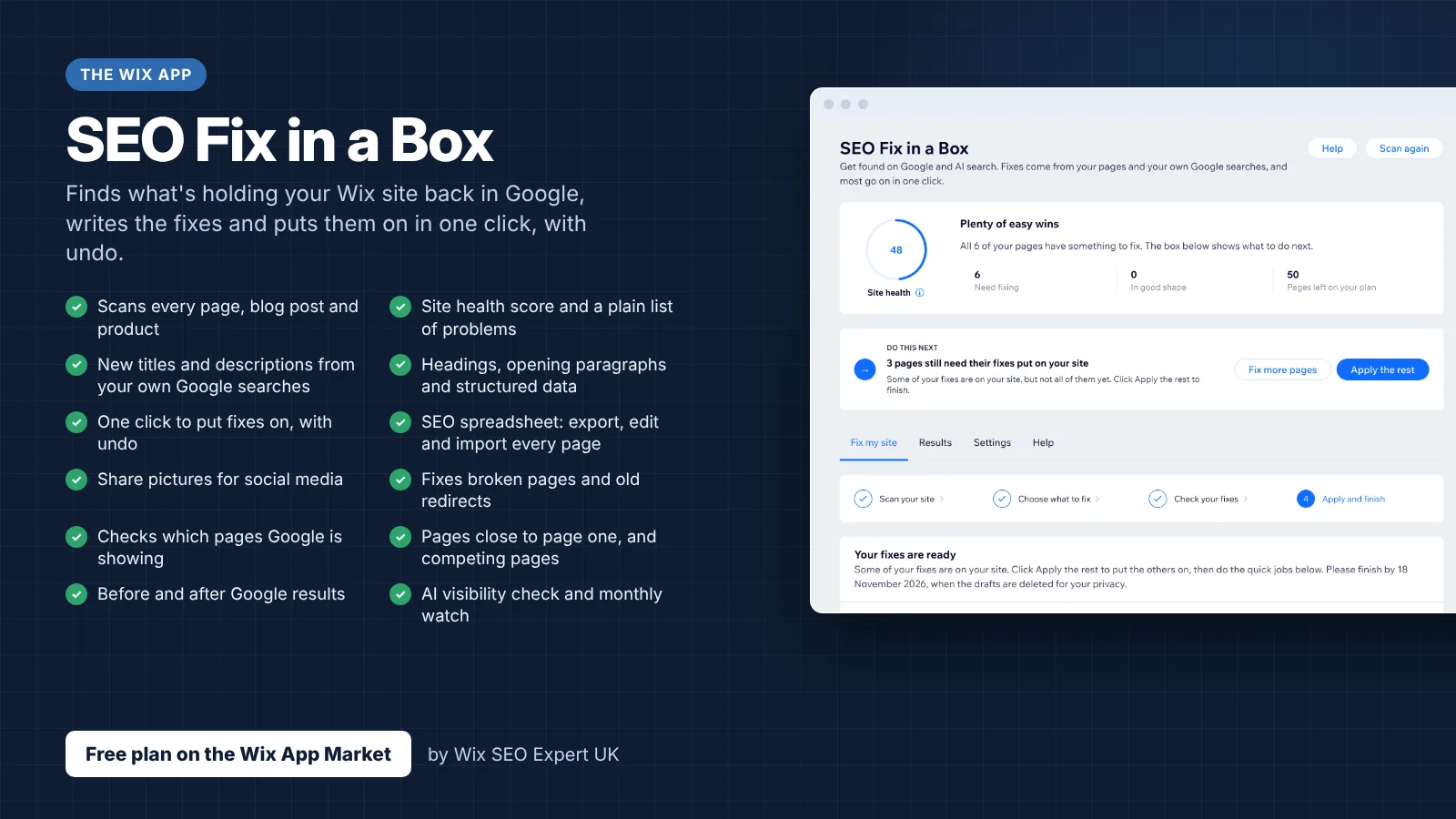
- SEO Fix in a Box: My Wix app. Free to install, it scans your site and shows what needs fixing, and paid plans write the fixes from your own Google searches
Was this lesson useful?
It takes 1 minute to tell me. The course is free and I want to keep it that way, and your feedback shows me what is working and helps other people find it.
This lesson on Category taxonomy and internal linking architecture for Wix directories is part of Module 40: Wix SEO for Directories, Marketplaces & Multi-Vendor Sites in The Most Comprehensive Complete Wix SEO Course in the World (2026 Edition). Created by Michael Andrews, a Wix Marketplace Legend Partner with 14 years of hands-on experience, 800 completed Wix SEO projects and 456 verified five-star reviews.