Wix Multilingual SEO: How to Rank in Multiple Languages

By Michael Andrews | Published: 2025-12-15 | Updated: 2026-02-10 | 9 min read
Wix offers a built-in multilingual feature that handles much of the technical SEO automatically. But there are still critical optimisation steps required to rank effectively in multiple languages on Google.
Wix's built-in Multilingual feature makes international SEO more accessible than ever. But the technical setup is only part of the challenge. Ranking a Wix website in multiple languages requires language-specific keyword research, quality translations, and content localisation that goes beyond word-for-word translation.
Setting Up Wix Multilingual for SEO
- In Wix Editor, click the Wix Multilingual button in the top bar
- Add your target language(s) from the language library
- Choose between manual and machine translation (manual recommended for SEO)
- Wix automatically creates language subdirectories: yoursite.com/de/, yoursite.com/fr/
- Wix adds hreflang tags automatically to each language version
- Submit each language version's pages to Google Search Console
Translating Content for SEO (Not Just Words)
Effective multilingual SEO is not just translation, it is localisation. Each language version needs content optimised for how speakers of that language actually search, not a word-for-word translation of the English version.
- Conduct separate keyword research in each target language
- Adapt examples, case studies, and cultural references for each market
- Localise pricing, shipping information, and legal content
- Use native speakers to review and improve machine translation output
- Adapt meta titles and descriptions for local search intent, not just translation
Hreflang Tags: Wix's Automatic Implementation
Wix Multilingual automatically adds hreflang tags to all pages when correctly configured. These tags tell Google which language version of a page to show to which users. Verify the implementation with Google's Rich Results Test or Screaming Frog's hreflang checker.
Fix your Wix SEO from your dashboard
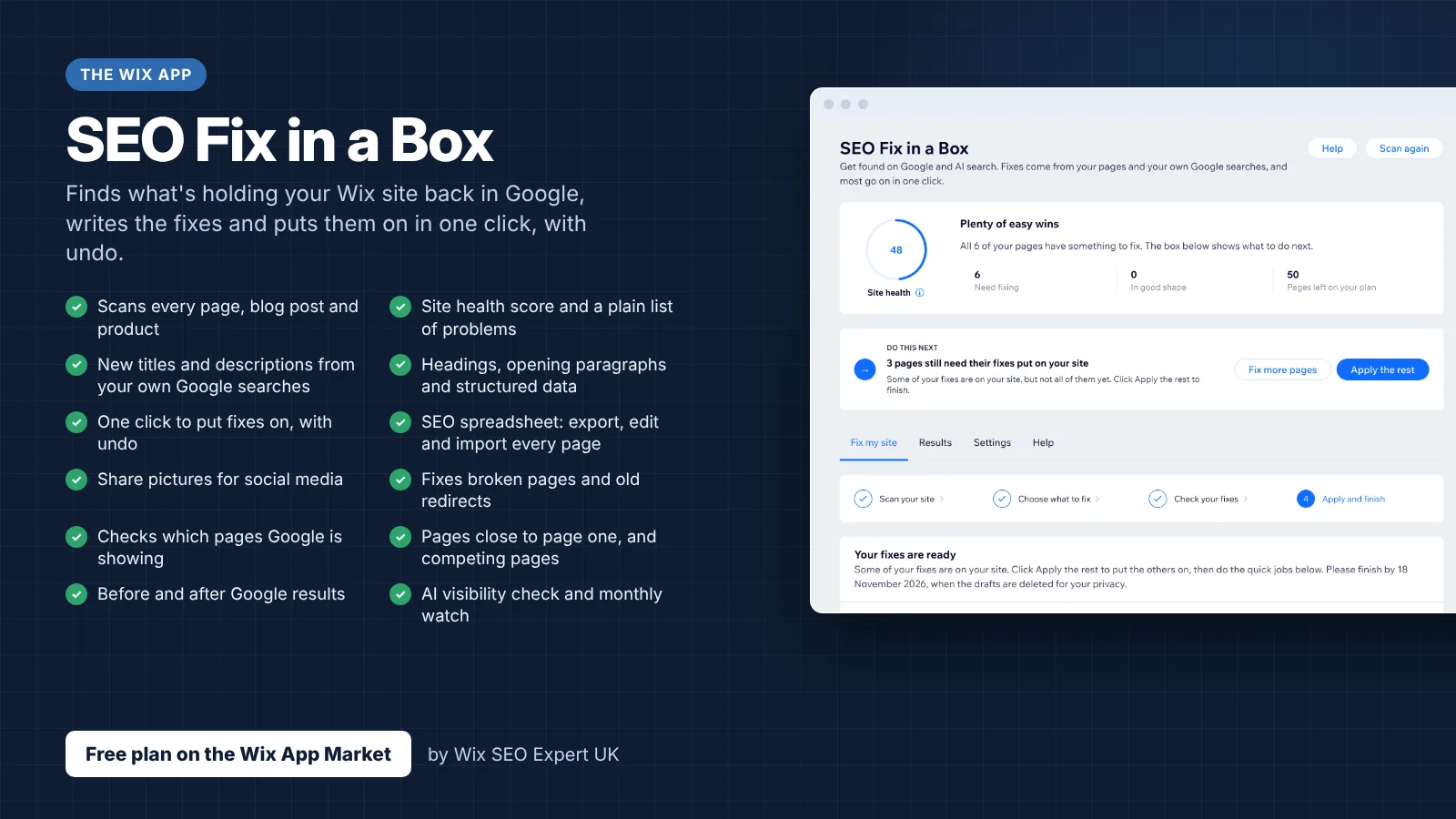
Wix SEO Fix in a Box scans every page, writes your fixes from your own Google searches and puts them on in one click, with undo. Start on the free plan.
Want this sorted on your own Wix site?
I have worked only on Wix for 14 years. Get Wix SEO Fix in a Box on the Wix App Market to find and fix what is holding your site back, or see my packages and prices if you would rather I did it all for you.
Frequently Asked Questions
Does Wix support all languages for multilingual SEO?
Wix Multilingual supports 180+ languages for the front-end display. For SEO purposes, the most important consideration is whether Google has search volume in your target language for your keywords, not whether Wix supports the language. For any language with significant Google search activity, Wix Multilingual with proper hreflang configuration provides a solid technical foundation.
How do I verify that Wix Multilingual has correctly implemented hreflang tags?
After enabling Wix Multilingual and adding your language versions, verify hreflang implementation using Screaming Frog SEO Spider (crawl your site and check the hreflang tab) or Ahrefs Site Audit's hreflang checker. Each page version should have hreflang attributes pointing to all other language versions, including an x-default pointing to your primary language. Common hreflang errors include: missing self-referencing hreflang (each page must reference itself), asymmetric tags (if page A points to page B, page B must point back to page A), and missing x-default attributes.
Should each language version of my Wix website have its own Google Search Console property?
Yes, if your Wix Multilingual site uses subdirectories (yoursite.com/de/, yoursite.com/fr/), you should set up a separate Search Console property for each language version, or use the domain-level property which captures data for all subdirectories. Separate properties allow you to submit language-specific sitemaps, monitor language-specific keyword performance, and identify crawl issues specific to each language version. Submit each language's sitemap (typically yoursite.com/sitemap-de.xml) in its respective Search Console property to ensure complete coverage.
Is machine translation sufficient for Wix Multilingual SEO, or does content need human review?
Machine translation alone is not sufficient for effective multilingual SEO. While machine translation tools like DeepL produce far better results than earlier tools, they miss cultural nuances, idiomatic phrases, and importantly, how speakers of that language actually search for products and services. A translated keyword is not always the equivalent search term. Human review by native speakers is essential for: title tags and meta descriptions (which must be compelling in the target language), service page content, and any content where accuracy critically matters. Machine translation can be used for initial drafts, but native review and keyword optimisation is non-negotiable.
Want your Wix website ranking internationally? Get expert multilingual SEO strategy from Michael Andrews.