Why backlinks still matter enormously in 2026
Module 10: Link Building & Off-Page SEO | Lesson 126 of 683 | 58 min read
By Michael Andrews, Wix SEO Expert UK
Every year, commentators predict that backlinks will stop being a ranking factor "soon." Every year, correlation studies, Google patent analyses, and real-world testing consistently demonstrate that backlinks remain one of the most powerful ranking signals in Google's algorithm. In 2026, with AI-generated content flooding the web at unprecedented scale, the value of genuine editorial backlinks has actually increased because they represent exactly the kind of human trust signal that algorithms struggle to fake. This lesson gives you a deep, evidence-based understanding of why links matter, how Google values different types, the metrics that separate impactful links from worthless ones, and how Wix sites can compete effectively in link-heavy niches without resorting to tactics that risk penalties.
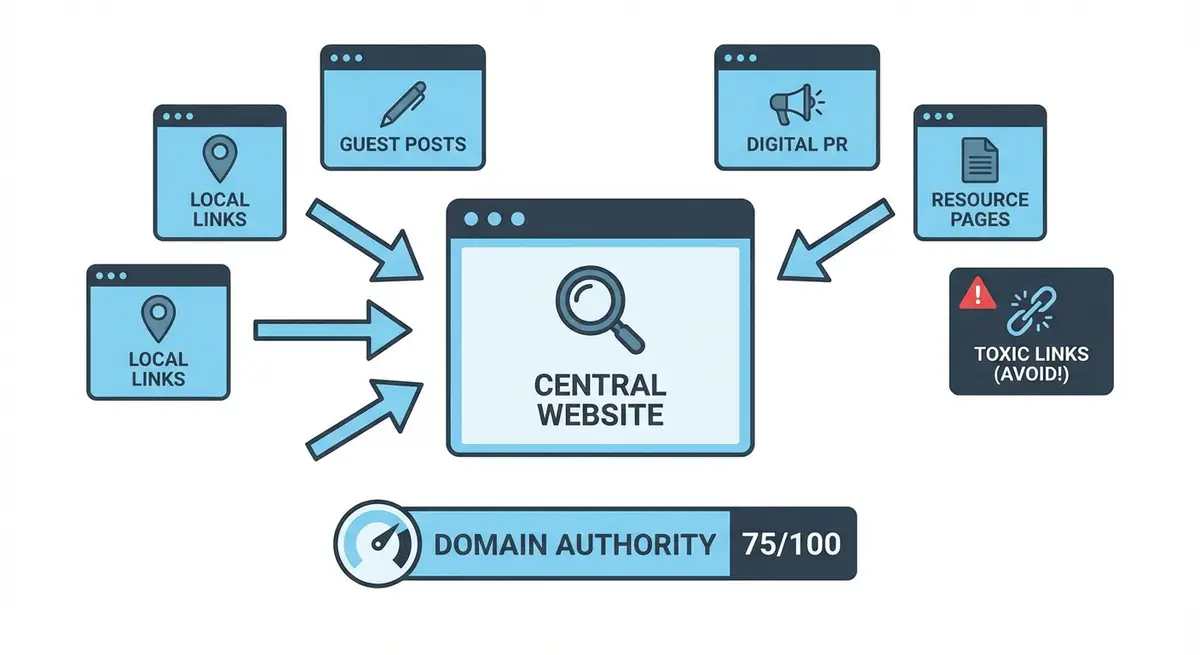
The Link Graph: How Google Uses Backlinks
Google's original breakthrough was PageRank, an algorithm created by Larry Page and Sergey Brin that treated backlinks as academic citations. Just as a research paper that is cited by many other papers is considered important, a webpage that receives links from many other pages is considered authoritative. The fundamental principle was elegant: a link from website A to website B is a vote of confidence from A to B. The more authoritative website A is, the more valuable its vote. This citation-based model was revolutionary because it made web search dramatically better than the keyword-matching systems that preceded it.
The original PageRank algorithm has evolved enormously over two decades, but its core principle remains embedded in Google's ranking systems. Modern Google uses what the industry calls "link equity" or "link juice," a simplified way of describing how authority flows through the link graph. When a high-authority page links to your Wix site, some of that authority transfers to your page. That authority then flows through your internal links to other pages on your site. This is why both external link acquisition and internal link architecture matter so much for SEO.
Google's leaked internal documents and patent filings reveal that the search engine uses multiple link-based signals simultaneously. These include the raw number of linking domains, the topical relevance of linking pages, the authority of linking domains, the position of the link within the page content, the anchor text used, and the freshness of the link. No single factor dominates; Google evaluates the entire link profile holistically to determine a page's authority and trustworthiness.
Domain Rating vs Page Authority: What Actually Matters
The SEO industry uses two primary metrics to evaluate link quality: Domain Rating (DR, from Ahrefs) and Domain Authority (DA, from Moz). These are third-party metrics, not Google metrics, but they approximate how Google might evaluate a domain's overall link strength. Understanding what these metrics mean and where they fall short is essential for making good link-building decisions.
- Domain Rating (DR) measures the overall strength of a website's entire backlink profile on a 0-100 logarithmic scale. A link from a DR 70 site is not simply twice as valuable as one from a DR 35 site; the logarithmic scale means the DR 70 link is exponentially more powerful.
- Domain Authority (DA) is Moz's equivalent metric, calculated using a different methodology that includes link counts, linking domains, and MozRank. DA and DR scores for the same domain often differ significantly.
- Page Authority (PA) and URL Rating (UR) measure the strength of a specific page rather than the entire domain. A link from a high-PA page on a moderate-DR domain can be more valuable than a link from a low-PA page on a high-DR domain.
- Neither DR nor DA are Google metrics. Google has repeatedly stated it does not use any third-party authority metric. However, these metrics correlate with ranking outcomes because they approximate similar signals.
- The most useful approach is to evaluate both domain-level and page-level authority, combined with relevance and traffic data, rather than relying on any single metric.
How Many Backlinks Do You Need to Rank? The Honest Answer
The question "how many backlinks do I need?" is asked constantly, and the honest answer is: it depends entirely on your competition. There is no universal number. A local plumber in a small town might rank with 10-20 quality referring domains. A national e-commerce site competing for "best running shoes" might need thousands. The only way to know is to analyse your specific competitive landscape.
How to determine your backlink target
- Identify the top 5 ranking pages for your target keyword in Google.
- Run each URL through Ahrefs or Moz to see the number of referring domains linking to that specific page.
- Note the average number of referring domains across all 5 ranking pages. This is your baseline target.
- Check the Domain Rating of the ranking domains. If they are all DR 60+ and your site is DR 20, you will need more links and higher quality links to compensate for the authority gap.
- Look at the rate of new links the ranking pages are acquiring. If they gain 5-10 new referring domains per month, you need to match or exceed that acquisition rate.
- Factor in content quality and on-page optimisation. If your content is significantly better and more comprehensive than what currently ranks, you may need fewer backlinks to outrank it.
For most small Wix sites targeting local or niche keywords, the realistic target is 3-5 new quality referring domains per month. This is achievable through consistent outreach and relationship building. Over 12 months, that gives you 36-60 new referring domains, which is enough to move the needle significantly for most low-to-medium competition keywords.
What Makes a Backlink Genuinely Valuable in 2026
Not all backlinks are created equal. A single link from a relevant, high-authority site can outweigh hundreds of links from low-quality directories. Understanding the factors that determine link value helps you prioritise your efforts and avoid wasting time on links that won't move your rankings.
- Relevance is the most important factor: a link from a website in your industry carries far more weight than a link from an unrelated site. Google's algorithms understand topical relationships and give more authority to contextually relevant links.
- Authority of the linking domain: a link from a DR 50+ domain with its own strong backlink profile passes more equity than a link from a brand-new site with no authority of its own.
- Authority of the specific linking page: a link from the homepage of a DR 40 site is worth more than a link from a deep, low-traffic archive page on a DR 70 site.
- Placement within content: links embedded in the main body content of an article carry more weight than links in sidebars, footers, author bios or navigation menus. Google treats editorially placed links as stronger endorsements.
- Anchor text: the clickable text of the link provides a topical signal to Google. Descriptive, keyword-relevant anchor text is more valuable than generic "click here" text, though over-optimised exact-match anchors can trigger penalties.
- Traffic to the linking page: links from pages that receive real organic traffic are worth more because they have been validated by Google as quality content. A link from a page with zero traffic provides minimal value.
- Freshness: newly acquired links provide a stronger ranking boost than old, stagnant links. Google values ongoing link acquisition as a signal that your content remains relevant and valued.
- Editorial intent: links that were placed by a human making a deliberate editorial choice (a journalist citing your research, a blogger recommending your tool) carry more weight than automated or self-placed links.
Follow vs Nofollow vs Sponsored vs UGC Links
In 2019, Google changed the way it handles link attributes, and the implications for link building in 2026 are significant. Understanding the four types of link attributes is essential for building a natural, penalty-free backlink profile.
- Followed links (no attribute): these are standard links with no special rel attribute. They pass the maximum amount of link equity and are the most valuable type of backlink.
- rel="nofollow": originally a directive telling Google not to follow the link. Since 2019, Google treats it as a "hint" rather than a directive, meaning Google may choose to follow it and pass some equity. Nofollow links from high-authority sites like Wikipedia, major news sites or forum platforms still have value.
- rel="sponsored": indicates a paid or sponsored link. Using this attribute for genuine sponsored content is important for compliance with Google guidelines. Google may still use these links as signals but assigns reduced or zero link equity.
- rel="ugc" (user-generated content): indicates links in comments, forum posts or user profiles. These carry the least direct link equity but can still drive referral traffic and brand visibility.
The practical takeaway for Wix site owners is this: prioritise acquiring followed editorial links, but do not dismiss nofollow links from high-authority, relevant sites. A nofollow link from the BBC, a major industry publication or a high-traffic forum still has genuine SEO value through the hint mechanism, brand exposure and referral traffic. A healthy backlink profile contains a natural mix of all link types.
Link Velocity: How Fast Should You Build Links?
Link velocity refers to the rate at which your site acquires new backlinks over time. Google monitors link velocity as part of its spam detection systems. A site that goes from zero backlinks to 500 backlinks overnight is almost certainly engaged in manipulative link building. Conversely, a site that acquires links at a steady, natural pace signals organic growth and genuine popularity.
For a typical Wix small business site, a natural link velocity looks like 2-10 new referring domains per month. Content that goes viral or gets significant press coverage can cause temporary spikes, which Google expects and handles gracefully. The red flag is sustained, unnatural velocity, such as acquiring 50 new referring domains every month for a site that has no viral content or media coverage to explain it.
How Wix Sites Can Compete in Link-Heavy Niches
A common concern for Wix users is that their site cannot compete for backlinks against WordPress sites, custom-built sites or large enterprises. This is largely a myth. The platform you build on has minimal impact on your ability to earn links. What matters is the quality of your content, the strength of your outreach and the value you provide to potential linkers.
- Create genuinely linkable content: original research, data studies, comprehensive guides, free tools or calculators that people want to reference and share.
- Build relationships before asking for links. Engage with industry bloggers, journalists and community leaders on social media and at events.
- Leverage your unique strengths as a small business: local connections, niche expertise, personal stories and customer relationships that large competitors cannot replicate.
- Focus on content formats that naturally attract links: "definitive guide" style content, infographics with original data, free tools, templates and calculators.
- Be consistent. Link building is a marathon, not a sprint. Small Wix sites that invest 2-3 hours per week in link building for 12 months consistently see dramatic results.
Measuring Backlink Impact on Rankings
Link building only matters if it moves your rankings and drives business results. Measuring the impact of individual links is challenging because Google uses hundreds of ranking factors simultaneously, but tracking your overall link building programme's effectiveness is straightforward with the right approach.
How to measure backlink impact
- Track your total referring domains monthly using Ahrefs, Moz or Google Search Console. Plot this on a graph alongside your total organic traffic to visualise the correlation.
- Monitor keyword rankings for your target terms weekly. Use a rank tracking tool or check Google Search Console Performance data. Note ranking improvements that coincide with new link acquisitions.
- Track referral traffic from backlinks in GA4. Navigate to Acquisition > Traffic Acquisition and filter by "Referral" to see which linking sites send the most traffic.
- Measure conversion rates from referral traffic. A high-authority backlink that drives 50 visitors who convert at 5% is more valuable than one that drives 500 visitors who bounce immediately.
- Monitor your Domain Rating or Domain Authority score quarterly. This is a lagging indicator that reflects your cumulative link building efforts over time.
- Track branded search volume in Google Search Console. As your link building and brand mentions increase, you should see growing searches for your business name, which is itself a ranking signal.
Complete How-To Guide: Assessing Your Backlink Profile and Building a Strategy
Before building new links, you need a clear picture of where you stand today, how you compare to competitors, and where the highest-impact opportunities lie. This step-by-step guide walks you through a complete backlink audit and strategy creation process.
Follow these steps to assess your backlink profile and build a strategy
- Step 1: Log into Google Search Console and navigate to the Links section. Click Export External Links to download a complete list of every website currently linking to your Wix site. Save this as your baseline backlink report.
- Step 2: Open the exported file in a spreadsheet and create columns for Referring Domain, Referring Page URL, Target Page on Your Site, Estimated Domain Authority, Link Type (editorial, directory, social, user-generated), and Follow Status (followed, nofollow, sponsored).
- Step 3: Run your domain through the free Ahrefs Backlink Checker at ahrefs.com/backlink-checker. This supplements the GSC data with Domain Rating scores, anchor text data and additional linking domains that GSC may not fully report.
- Step 4: Run your domain through Moz Link Explorer at moz.com/link-explorer to get Domain Authority scores and cross-reference with the Ahrefs data. Add any new referring domains to your master spreadsheet.
- Step 5: Analyse the domain authority distribution of your existing backlinks. Count how many links come from sites with DA under 20 (low quality), between 20-40 (moderate), between 40-60 (strong), and above 60 (very strong). Calculate the percentage in each bracket.
- Step 6: Review your anchor text distribution using the Ahrefs data. A healthy profile has a mix of branded anchors (your business name), URL anchors, generic anchors (click here, learn more), and keyword-rich anchors. If more than 30% of your anchors are exact-match keywords, this is a potential penalty risk.
- Step 7: Identify your top 3-5 organic search competitors by searching Google for your most important keywords and noting which domains consistently outrank you. These are the sites you need to match or exceed in link strength.
- Step 8: Run each competitor domain through Ahrefs and Moz to see their total referring domains, Domain Rating, and the types of sites linking to them. Record this data alongside your own metrics for direct comparison.
- Step 9: Calculate the link gap. Note the total referring domains each competitor has versus your own. Identify specific types of links they have that you are missing, such as press coverage, industry directory listings, guest post placements, or resource page mentions.
- Step 10: Set realistic monthly link acquisition targets based on the gap analysis. For most small Wix sites, 3-5 new quality referring domains per month is achievable. For larger gaps, you may need 5-10 per month with a dedicated outreach programme.
- Step 11: Categorise your target link opportunities into three buckets: Quick Wins (directories, profiles, and citations you can create yourself within hours), Medium Effort (guest posts, resource page suggestions, and partnership links requiring outreach), and High Effort (press coverage, editorial links, and influencer mentions requiring PR skills or existing relationships).
- Step 12: Create personalised outreach email templates for each category. Write a directory submission template, a guest post pitch, a resource page suggestion template, a partnership request, and a press pitch. Personalise each with specific references to the target site.
- Step 13: Build a link building calendar that schedules specific outreach activities each week. Example: Week 1 submit to 5 relevant directories, Week 2 send 5 guest post pitches, Week 3 identify and contact 5 resource page curators, Week 4 pitch 3 local press stories.
- Step 14: Set up monthly tracking by re-exporting your GSC backlink data on the first of each month. Compare new referring domains acquired, overall Domain Rating growth, and keyword ranking changes to measure the ROI of your link building efforts.
Essential Tools for This Lesson
- Google Search Console - Links Report: Export your complete backlink data and monitor new referring domains
- Ahrefs Free Backlink Checker: Check Domain Rating, referring domains and anchor text distribution for any URL
- Moz Link Explorer: Analyse Domain Authority, Page Authority and linking domains with 10 free queries per month
- Ubersuggest Backlink Tool: Free backlink data as a third cross-reference source for your audit
- Majestic SEO: Trust Flow and Citation Flow metrics for evaluating link quality and topical relevance
- SEO Fix in a Box: My Wix app. Free to install, it scans your site and shows what needs fixing, and paid plans write the fixes from your own Google searches
Was this lesson useful?
It takes 1 minute to tell me. The course is free and I want to keep it that way, and your feedback shows me what is working and helps other people find it.
This lesson on Why backlinks still matter enormously in 2026 is part of Module 10: Link Building & Off-Page SEO in The Most Comprehensive Complete Wix SEO Course in the World (2026 Edition). Created by Michael Andrews, a Wix Marketplace Legend Partner with 14 years of hands-on experience, 800 completed Wix SEO projects and 456 verified five-star reviews.