Wix Studio SEO Guide: Advanced Optimisation for Wix Studio Sites

By Michael Andrews | Published: 2025-11-20 | Updated: 2026-09-17 | 16 min read
Wix Studio is the advanced editor built for designers, agencies and developers who want more control. This comprehensive guide covers the full SEO toolkit you inherit from Wix and where Studio specifically lets you go further, along with the traps that catch people out.
Wix Studio is Wix's advanced editor, built for designers, agencies and developers who want more control over layout, responsiveness and code than the classic Editor gives them. Because of that reputation, a lot of people assume Wix Studio needs some separate, mysterious approach to SEO. It does not. The single most important thing to understand is that Wix Studio runs on the same underlying SEO engine as the rest of Wix. You get the same server-side rendering, the same SEO settings panel, the same sitemap generation, the same robots and canonical controls. What Studio adds is more design and development headroom on top of that foundation. So this guide does two things: it walks through the full SEO toolkit you inherit from Wix, and then it shows where Wix Studio specifically lets you go further, along with the traps that catch people out. I have worked on Wix and nothing else for years, so this is the practical version, not the brochure version.
Wix Studio SEO fundamentals: the same engine, more control
Let me settle the myth first, because it saves a lot of worry. For SEO, a Wix Studio site is not a different species from any other Wix site. Google renders your pages server-side, so it sees your content without waiting on the browser to build the page, which is exactly what you want. You edit every title tag and meta description in the SEO panel, both as site-wide defaults and page by page. You set your own URL slugs, and Wix updates the sitemap, canonical tags and redirects to match. You control indexing with robots meta tags and an editable robots file. None of that changes in Studio. What changes is that Studio hands designers and developers more control over the markup, the layout and the code around that engine, which is a good thing when used well and a liability when used carelessly. The rest of this guide is about using it well. If you want the platform-level view, I cover it in technical SEO for Wix and how Google crawls and indexes Wix pages.
The on-page controls you inherit
Before the clever Studio-specific work, get the basics right, because they carry most of the weight. In the SEO panel you can set default title and meta description patterns for whole sections of the site, then override any individual page. Titles should stay under about sixty characters and meta descriptions under about a hundred and fifty-five, written for the searcher rather than stuffed with keywords. You edit clean, readable URL slugs, and Wix keeps the sitemap and canonical tags in step. You control the social sharing preview, the Open Graph title, description and image, for every page, which is what people see when your link is shared. And you set the canonical tag, which by default Wix fills in for you, but which you can edit when you need to point several similar pages at one primary version. I go through the panel in detail in my Wix SEO settings guide.
Responsive and fluid design, done the SEO-safe way
This is Wix Studio's headline strength. Instead of a fixed layout, you design across breakpoints, work in pixels for precise control, and use fluid, AI-assisted responsive sections that adapt across screen sizes. From an SEO point of view this matters because Google indexes the mobile version of your site first, and Studio gives you one responsive URL rather than a separate mobile site, which is exactly the setup Google prefers. The freedom comes with responsibility, though. The most common mistakes I see on Studio sites are all about breakpoints. Content that is hidden at one breakpoint but not another can send mixed signals. Images sized generously for desktop but served unchanged to mobile hurt your load time. And layouts that shift as they load cause Cumulative Layout Shift, one of the Core Web Vitals. The rule is simple: design freely, then test every breakpoint as if it were its own page.
Core Web Vitals in Wix Studio
Core Web Vitals are the speed and stability signals Google measures from real users, and they are the area where Studio sites most often need attention, precisely because Studio lets you add so much. The three to watch are Largest Contentful Paint, how quickly the main content appears, Cumulative Layout Shift, how much the page jumps around as it loads, and Interaction to Next Paint, how responsive it feels to taps and clicks. On a Studio site the biggest wins are usually the same handful of things: let Wix serve images in modern formats like WebP and size them per breakpoint, lazy-load anything below the fold, keep heavy custom code and third-party embeds to a minimum, and reserve space for images and embeds so nothing shifts as it loads. Test on a real page with PageSpeed Insights and the field data, not just a lab score. I go deeper in my Wix Core Web Vitals guide and my Wix page speed guide.
Headings and semantic HTML
Wix Studio gives you proper control over your heading tags, and you should use it deliberately. Every page needs one clear H1 that says what the page is about, then H2s for the main sections and H3s beneath them, in logical order. The mistake to avoid is using a heading tag just because you like how big it looks, or a plain text element for something that is really a heading. Google reads your heading structure to understand the shape of your content, and screen readers rely on it too, so getting it right helps both your rankings and your accessibility. In Studio, set the tag by its role in the document, and style it separately. A tidy heading outline is one of the simplest, highest-value things you can get right on any page.
Structured data in Wix Studio
Structured data is the behind-the-scenes code that tells Google, and the AI answer engines, exactly what a page is. Wix adds structured data automatically to the obvious page types, blog posts, products, events and courses, so you get rich-result eligibility out of the box. Where Studio and Wix let you go further is custom structured data. You can add your own JSON-LD through custom code, and for sites built on the CMS you can generate schema in bulk using field variables, so every item in a collection gets correct, unique markup without hand-writing each one. This is where my dual-layer approach comes in: a first layer of standard schema.org markup for Google, and a second entity layer aimed at the AI engines like ChatGPT, Perplexity and Google AI Overviews. I explain the whole method in my Wix schema markup guide.
Dynamic pages and CMS SEO at scale
If Wix Studio has a true SEO superpower, this is it. Studio's CMS lets you build dynamic pages from a collection, one template that generates hundreds of pages from your data. Done properly, this is how you rank a large site without hand-building every page. For each dynamic page you can set the title tag, meta description, URL slug and social image from field variables, so every generated page is unique and optimised rather than a thin duplicate. You can produce structured data in bulk the same way, and Wix builds dynamic sitemaps, including image sitemaps, so new items get discovered. The care points are duplication and canonicals: if you have filtered or sorted views of the same collection, make sure they point to a single canonical version so you are not competing with yourself. Used well, dynamic CMS pages let a Studio site scale its SEO in a way a hand-built site simply cannot.
Custom code, Velo and the Studio IDE
Wix Studio opens up real development power: custom CSS, the Studio IDE, access to hundreds of APIs, a Git-based workflow, and an AI assistant to help write or fix code. For SEO specifically, the Velo SEO APIs let you set link tags, meta tags and structured data programmatically, which is how you apply logic-driven SEO across many pages at once. This is powerful and worth using when the panel alone cannot express what you need. The caution is discipline. Injecting tags with code that duplicate or conflict with what the SEO panel already outputs creates a mess for Google, and heavy client-side scripts drag down your Core Web Vitals. My rule is to do as much as possible in the panel, use code only where it genuinely adds control, and always check the rendered output to confirm there is exactly one title, one meta description and one canonical per page.
Images and media in Wix Studio
Images are often the heaviest thing on a page and one of the easiest SEO wins, and Wix Studio gives you what you need. Wix automatically serves images in modern formats like WebP and compresses them, but you still control the parts that matter most. Write descriptive alt text on every meaningful image, because it helps both accessibility and image search, and it is one of the signals the AI engines read too. Size images sensibly for each breakpoint rather than shipping a desktop-sized file to a phone, which is where a lot of mobile speed is quietly lost. Give files sensible names before you upload them rather than a string of camera digits. And let below-the-fold images lazy-load so they do not hold up the first paint. Wix also builds dynamic image sitemaps, so your visuals are discoverable in image search. I go through the detail in my Wix image SEO guide.
Site structure and internal linking
How your pages connect to each other tells Google what matters and helps it crawl everything, and it is easy to overlook on a design-led Studio build. Keep your navigation clean and your URL structure logical, so the path to any page is short and sensible. Link between related pages in your body content, not just in the menu, using descriptive anchor text rather than vague "click here" links. On CMS-driven sites this is doubly important: link out from your dynamic collections to related items and back to key hub pages, so newly generated pages are not left orphaned with nothing pointing at them. Breadcrumbs help both users and search engines understand where a page sits. A site where every important page is a click or two away, and is linked to from relevant content, gets crawled and understood far better than a flat pile of disconnected pages.
Redirects and safe migrations
Whenever you change a URL, restructure the site, or move onto Wix Studio from somewhere else, redirects are what protect your rankings. Wix gives you a URL Redirect Manager for permanent 301 redirects, and you can import them in bulk, up to five hundred at a time from a CSV, which makes a large migration manageable. The principle is straightforward: every old URL that had any value should 301 to its closest new equivalent, so the authority and the rankings carry across rather than dropping into a wall of 404s. If you are moving a site onto Wix or Wix Studio, plan the redirect map before you switch, not after. I walk through the whole process in my Wix SEO migration guide.
Multilingual and international SEO
If you serve more than one language, Wix Multilingual lets you optimise the SEO settings for each language version, and Wix handles the hreflang signalling that tells Google which version to show to whom. On a Studio site this sits neatly alongside the responsive design, so you are not maintaining separate sites. Set the title, meta and slug per language rather than relying on machine translation of your tags, because the words people search differ from market to market. I cover the detail in my Wix multilingual SEO guide.
Measuring, monitoring and indexation
Optimisation you cannot measure is guesswork, and Wix Studio gives you the tools to see what is actually happening. The Site Inspection tool integrates with Google Search Console so you can check the indexability of your pages, and you can verify your domain and submit your sitemap to Google straight from the dashboard. Wix also offers bot log reporting, so you can see how search engine crawlers are moving through your site and what response codes they are hitting, which is invaluable for spotting crawl problems early. There is an SEO setup checklist to keep you honest on the basics, and Wix Analytics pulls in Search Console data so your performance sits in one place. Connect Google Search Console properly from the start, because it is the single most useful window you have. My Wix Google Search Console guide covers the setup.
Local SEO on Wix Studio
If you serve a local area, Wix Studio supports the same local signals as any Wix site. You can create and manage a Google Business Profile from the Wix dashboard, and you should back it up on the site with clear, consistent name, address and phone details and proper LocalBusiness structured data. Local rankings come down to relevance, distance and prominence, and your site's job is to make your location and services unmistakable to Google. I go through the local side in my guide to local SEO for Wix and Google Business Profile.
Wix Studio and AI search
More people now ask ChatGPT, Perplexity or Google's AI Overviews for a recommendation instead of scrolling a page of blue links, and Wix Studio sites are well placed for this if you set them up for it. The foundations that help are the ones you already have: server-side rendering so the bots can read your content, clean semantic structure, and rich structured data. On top of that I add an entity layer of schema built specifically so the AI engines understand who you are and what you offer, which is the second half of my dual-layer method. Clear, well-structured answers to real questions are what get quoted. I cover this in my guide to AI search optimisation for Wix.
Common Wix Studio SEO mistakes
Because Studio gives you more rope, here are the ways people most often trip over it. First, using heading tags for their size rather than their meaning, which scrambles the page outline. Second, letting design freedom run ahead of performance, so heavy sections and unsized images wreck Core Web Vitals on mobile. Third, forgetting to check every breakpoint, so content is hidden or shifted on the version Google actually indexes. Fourth, building dynamic CMS pages without setting per-item titles, metas and canonicals, which leaves thin, near-duplicate pages. Fifth, adding custom code that duplicates the tags the panel already outputs. And sixth, leaving default meta descriptions in place so every page reads the same in search. None of these are hard to fix, and avoiding them puts you ahead of most Studio sites out there.
A quick Wix Studio SEO checklist
If you want a short list to work through on any Wix Studio site, start here:
- One clear H1 per page, with a logical H2 and H3 outline beneath it
- A unique, searcher-focused title tag and meta description on every page
- Clean, readable URL slugs, with 301 redirects for anything you change
- Images in modern formats, sized per breakpoint, with descriptive alt text
- Core Web Vitals tested on a real page across every breakpoint
- Structured data in place, automatic plus custom where it helps
- Per-item titles, metas and canonicals on all dynamic CMS pages
- Google Search Console connected, the sitemap submitted and indexation checked
The verdict, and how I help
Wix Studio gives you the full Wix SEO engine plus genuine design and development control, which makes it a strong choice for agencies and businesses that want a professional, scalable site. The platform is not the thing that holds a site back. Weak content, poor structure, ignored Core Web Vitals and missing structured data are, on any platform. If you have a Wix Studio site and you want it optimised properly, from the SEO panel and headings right through to dynamic CMS schema and AI visibility, that is exactly what I do, and I work on Wix and nothing else. You can also work through it yourself with my free Complete Wix SEO Course, or start with how to rank a Wix website on the first page of Google.
Fix your Wix SEO from your dashboard
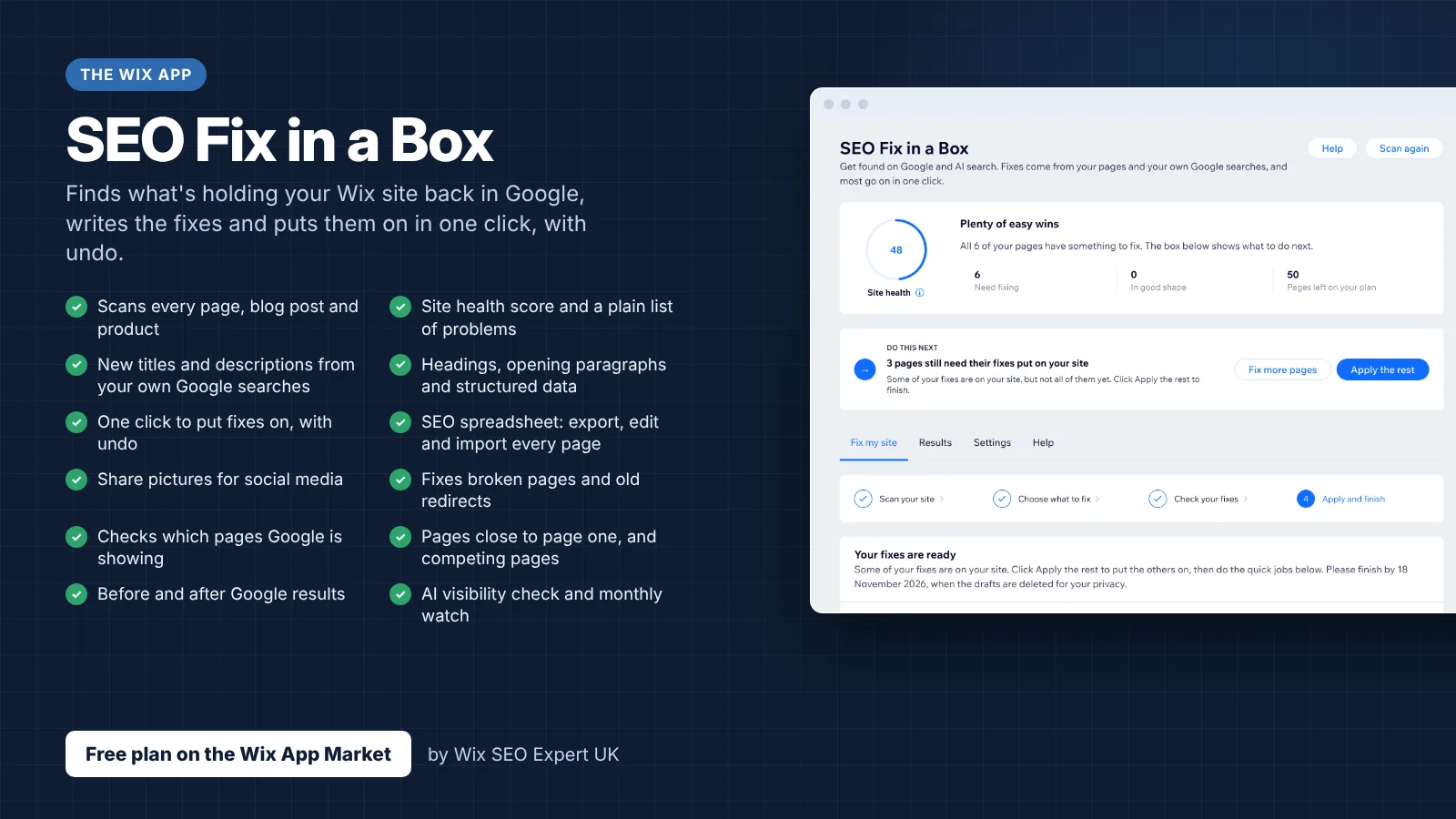
Wix SEO Fix in a Box scans every page, writes your fixes from your own Google searches and puts them on in one click, with undo. Start on the free plan.
Want this sorted on your own Wix site?
I have worked only on Wix for 14 years. Get Wix SEO Fix in a Box on the Wix App Market to find and fix what is holding your site back, or see my packages and prices if you would rather I did it all for you.
Frequently Asked Questions
Is Wix Studio better than standard Wix for SEO?
They share the same underlying SEO engine, so neither is inherently better at ranking. Wix Studio adds more design and development control, including breakpoints, custom code and dynamic CMS pages, which lets an experienced user do more advanced SEO work, especially on larger sites.
Does Wix Studio support custom schema markup?
Yes. Wix adds structured data automatically to blog posts, products, events and courses, and Wix Studio lets you add custom JSON-LD through custom code, plus generate schema in bulk from CMS field variables and through the Velo SEO APIs.
How do I fix Core Web Vitals issues on a Wix Studio site?
Serve images in modern formats and size them per breakpoint, lazy-load below-the-fold content, reserve space so nothing shifts as it loads, and keep heavy custom code and third-party embeds to a minimum. Then test a real page with PageSpeed Insights across every breakpoint.
Can Wix Velo improve SEO programmatically?
Yes. The Velo SEO APIs let you set link tags, meta tags and structured data with code, which is useful for applying logic-driven SEO across many pages at once. Use it to extend the SEO panel, not to duplicate the tags it already outputs.
Does Wix Studio handle dynamic pages and large sites well for SEO?
This is one of its real strengths. Studio's CMS builds dynamic pages from a collection, and you can set unique titles, metas, slugs and structured data per item using field variables, with dynamic sitemaps for discovery. Just point filtered or duplicate views at a single canonical version.
Do I need to redirect old URLs when moving to Wix Studio?
Yes. Use the URL Redirect Manager to 301 every old URL to its closest new equivalent, importing them in bulk if needed, so your rankings and authority carry across rather than dropping into 404s.
Have a Wix Studio site you want optimised properly, from headings to dynamic CMS schema and AI visibility? See how I help Wix businesses rank on Google and in AI search.