AI-powered keyword research and content gap analysis
Module 44: Wix AI Marketing Tools & SEO Automation | Lesson 496 of 683 | 48 min read
By Michael Andrews, Wix SEO Expert UK
Wix's AI tools can accelerate your keyword research workflow by suggesting related topics, identifying content gaps and generating keyword clusters. This lesson shows you how to combine Wix's built-in AI with external tools for a comprehensive keyword strategy.
Using Wix AI for Topic Discovery
The Wix AI Blog Writer starts by asking for a topic. Behind the scenes, it analyses related topics and subtopics. Use this as a brainstorming tool: enter your main keyword and examine the topics and angles the AI suggests. These often reveal search intents you may not have considered.

AI-Assisted Content Gap Identification
How to find and fill content gaps using AI and Wix
- Open Google Search Console and navigate to Performance > Search Results. Filter by your site and export the queries report. This gives you a real list of keywords you already appear for but may not rank well.
- In a spreadsheet, list your top 20 target keywords alongside your current ranking position and whether a dedicated page exists on your Wix site for each keyword.
- For keywords where no content exists, open your Wix dashboard and go to Blog > New Post. Click the AI Write button, enter the keyword as your topic and generate an outline to see what subtopics the AI surfaces.
- Search Google for each target keyword and open the top 5 results. Compare the headings and subtopics they cover against your AI-generated outline to identify sections your competitors cover that your outline misses.
- Identify unique angles that competitors consistently miss: personal case studies, local context, step-by-step processes, or data-backed comparisons. Add these as additional outline sections before creating content.
- Use Google Keyword Planner to look up monthly search volume for each gap keyword. Filter your list to prioritise gaps with search volume above 500 and low-to-medium competition.
- Score each content gap by multiplying estimated monthly search volume by your conversion rate to calculate potential traffic value. Rank your content calendar by this score to tackle highest-impact gaps first.
- For gaps that represent informational intent (how-to, what-is queries), create Wix blog posts targeting those keywords. For gaps representing transactional intent, create or optimise service or product pages instead.
- Use the Wix AI Text Creator to draft H2 headings and section bodies for each gap article. Review each section for accuracy and replace generic AI phrasing with specific examples from your own experience.
- After publishing gap content, add it to your Wix sitemap and submit the new URL via Google Search Console > URL Inspection > Request Indexing. Track ranking progress weekly for the first 60 days.
Building Keyword Clusters with AI
Input your seed keyword into the Wix AI text tools and examine the related phrases it naturally includes. These phrases reveal semantic relationships that Google uses for ranking. Group these into clusters: each cluster becomes a content pillar on your Wix site.
Combining Wix AI with External Keyword Tools
Wix AI is best for ideation and drafting. Pair it with dedicated keyword tools for data. Use Google Keyword Planner for search volume data, Ahrefs or Semrush for keyword difficulty scores, Google Trends for seasonal patterns, and Wix Analytics for your existing keyword performance.
How to Use Wix AI for Keyword Research and Content Gap Analysis
Use this structured process to combine Wix AI capabilities with external data to build a keyword strategy that targets your most valuable content gaps.
Using Wix AI tools alongside external data for comprehensive keyword and gap research
- Log in to your Wix Dashboard and go to Marketing & SEO > SEO Tools. Open the SEO Assistant and review the keyword suggestions under the Keywords section. Note any keywords Wix is already associating with your pages.
- Open Google Search Console in a separate tab and navigate to Performance > Search Results. Filter the date range to the last 3 months and export the full queries report as a CSV file.
- In your spreadsheet, create a pivot table from the exported CSV with three columns: Query, Impressions and Average Position. Filter to show only queries with average position between 5 and 20. These are your quick-win ranking opportunities.
- For each quick-win keyword, open your Wix dashboard and navigate to Blog > New Post. Click the AI Write button and enter the keyword as the topic. Generate an outline to see what subtopics and questions the AI surfaces around that keyword.
- Open Google and search each quick-win keyword. Open the top 3 ranking pages and compare their H2 headings against your AI-generated outline. List the topics competitors cover that are missing from your outline.
- In a new tab, go to answerthepublic.com and enter your seed keyword. Export the questions section. Cross-reference this with your AI outline and competitor comparison to build a comprehensive content brief for each target keyword.
- Return to your Wix Dashboard and navigate to Marketing & SEO > SEO Tools. Use the AI keyword suggestions to identify related long-tail variations of your main keywords. These represent additional targeting opportunities within the same content.
- Prioritise your content gap list by estimated search volume (from Google Keyword Planner) multiplied by your average conversion rate. Create a content calendar in a spreadsheet ordering topics from highest to lowest estimated value.
- For the top 5 priority gaps, use the Wix AI Blog Writer to generate a full draft for each. Save each draft as an unpublished Wix blog post. You now have 5 drafts ready for your editing and publishing workflow.
- After publishing each gap article, return to Google Search Console after 30 days and check whether the new page is appearing for the target keyword. If not ranking in the top 20 after 60 days, revise the content length, add more specificity or build internal links from stronger pages to the new article.
Keyword Research Tools
- Google Keyword Planner: Free keyword volume and competition data
- Ahrefs Keyword Explorer: Comprehensive keyword research with difficulty scores
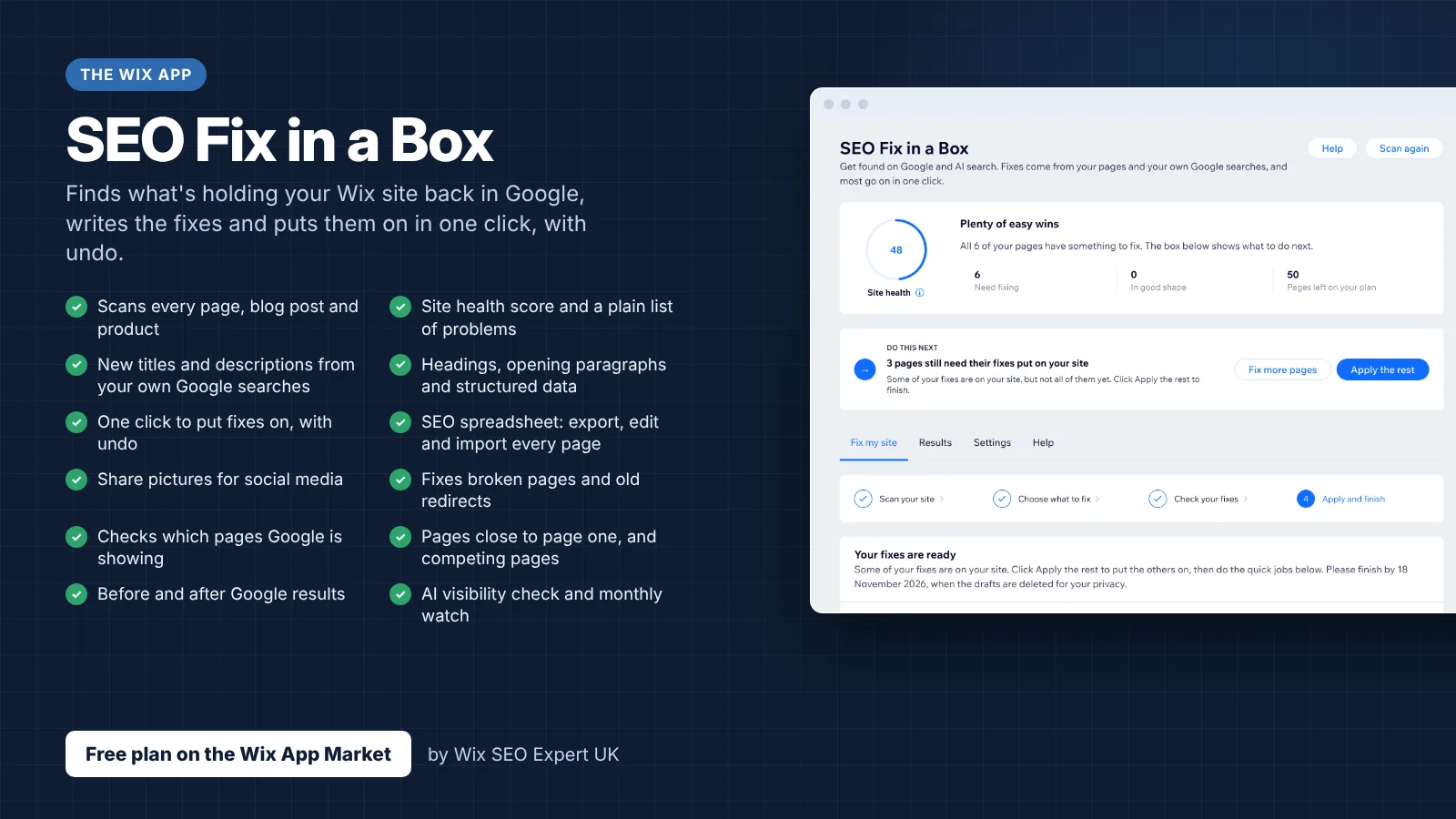
- SEO Fix in a Box: My Wix app. Free to install, it scans your site and shows what needs fixing, and paid plans write the fixes from your own Google searches
Was this lesson useful?
It takes 1 minute to tell me. The course is free and I want to keep it that way, and your feedback shows me what is working and helps other people find it.
This lesson on AI-powered keyword research and content gap analysis is part of Module 44: Wix AI Marketing Tools & SEO Automation in The Most Comprehensive Complete Wix SEO Course in the World (2026 Edition). Created by Michael Andrews, a Wix Marketplace Legend Partner with 14 years of hands-on experience, 800 completed Wix SEO projects and 456 verified five-star reviews.