AI-powered competitor analysis for Wix SEO strategy
Module 44: Wix AI Marketing Tools & SEO Automation | Lesson 501 of 683 | 46 min read
By Michael Andrews, Wix SEO Expert UK
AI tools have fundamentally changed what is possible in competitor analysis. Tasks that once required a full day of manual research can now be completed in under an hour. This lesson shows how to use AI, both within the Wix ecosystem and with external tools like ChatGPT and Claude, to systematically analyse your competitors' SEO strategies, reverse-engineer their content structures and identify the gaps they have left open for you to exploit. You will leave with a prioritised list of keyword opportunities and a 90-day content plan built on real competitive intelligence.
Identifying Your True SEO Competitors
Your SEO competitors are not necessarily your business competitors. They are whoever ranks on page one for the keywords you want to own. Before any AI analysis, you need to identify the right targets. Search your top five keywords in an incognito browser and note the non-paid organic results. These are your real SEO competitors, even if they operate in adjacent niches or serve different audience segments than you do.
Mapping your competitive landscape with AI
- Search your top 5 target keywords in incognito mode and record the top 5 organic results for each
- Compile a list of unique competitor domains (typically 8-15 unique sites across all keyword searches)
- Paste the list into ChatGPT or Claude with this prompt: "I am trying to rank for [keyword list]. These are the sites ranking for these terms: [competitor list]. Analyse what they likely have in common in terms of content strategy, authority level and content depth. What should I prioritise to compete?"
- Use Semrush or Ahrefs to export the top 50 ranking pages for each competitor
- Feed those page titles and URLs into an AI tool and ask it to identify content themes, topic clusters and patterns
- Note which competitor consistently appears across the most keywords. This is your primary benchmark

AI-Assisted Competitor Content Analysis
Use AI to analyse competitor content at scale in ways that would be impossible manually. The most powerful technique is feeding competitor blog posts or page content directly into an AI tool and asking targeted questions about their strategy. You can process a competitor's top 20 articles in minutes and extract actionable insights about what topics they cover thoroughly, where they are superficial and what unique angles they consistently miss.
Running a deep AI competitor content audit
- Identify your top competitor's 10 highest-traffic pages using Semrush or Ahrefs "Top Pages" report
- Open each page, copy the full text content and paste it into a Google Doc
- Open Claude or ChatGPT and upload the document or paste the content
- Use this prompt: "Analyse this content and tell me: (1) What topics are covered thoroughly? (2) What related topics are completely absent? (3) What questions does this content fail to answer? (4) What would make a superior version of this content?"
- Repeat for each of the 10 pages and compile the gap findings
- Feed the compiled gap list back into the AI and ask: "Which of these gaps represent the highest search intent value and would be easiest for a newer site to win?"
- The output gives you a prioritised list of content opportunities backed by competitive intelligence
Building a Competitor Gap Matrix with AI
Creating your competitive advantage map
- Export your top 5 competitors' keyword lists from Semrush or Ahrefs into separate CSV files
- Combine all competitor keyword data into a single spreadsheet
- Upload the spreadsheet to Claude or use the CSV analysis feature in ChatGPT
- Prompt: "Identify keyword clusters where multiple competitors rank but which have lower average domain authority in the SERP. These represent the best opportunities"
- Filter the AI output to keywords with search volume above 100 and where your site could realistically compete within 6 months
- Ask the AI to group the filtered keywords into content topic clusters of 5-8 related terms each
- Use the clusters to generate content briefs, one blog post or page per cluster
- Prioritise clusters by: (1) search volume (2) competitor content quality (3) your existing expertise
- Create a 90-day content calendar targeting the top 12 clusters, roughly one piece per week
AI Tools for SERP Analysis
Modern AI-powered SEO tools can analyse search results pages and identify patterns in what Google rewards for specific queries. They examine content length, heading structures, featured snippet formats, schema types used and rich result appearances. Tools like Surfer SEO, Frase and NeuronWriter perform this analysis automatically and output content recommendations you can apply directly in your Wix editor. Use these insights to structure your Wix pages with the content depth, heading patterns and entity coverage that match what Google is already rewarding for your target keyword.
Generating Content Briefs from Competitor Data Using AI
Creating AI-powered content briefs from competitive research
- Choose one keyword cluster from your gap matrix to brief first
- Search the primary keyword and open the top 5 ranking results
- Copy the headings (H1, H2, H3) from each competing page
- Paste all competitor heading structures into an AI tool with this prompt: "Here are the headings from the top 5 pages ranking for [keyword]. Create a superior content brief that covers all common angles, adds three unique sections none of them include, and targets featured snippet opportunities. Format as a detailed brief with: target keyword, secondary keywords, target word count, heading structure and notes for each section"
- Review the AI brief and add your own expertise, data sources and unique angles
- Use the finalised brief to write the content, either manually or with AI assistance with heavy editing
Competitor Analysis Tools
- Semrush Competitive Research: Compare SEO visibility and keyword overlap against competitors
- Ahrefs Content Gap: Find keywords competitors rank for that you do not, exportable for AI analysis
- Surfer SEO: AI-powered SERP analysis with direct content editor integration
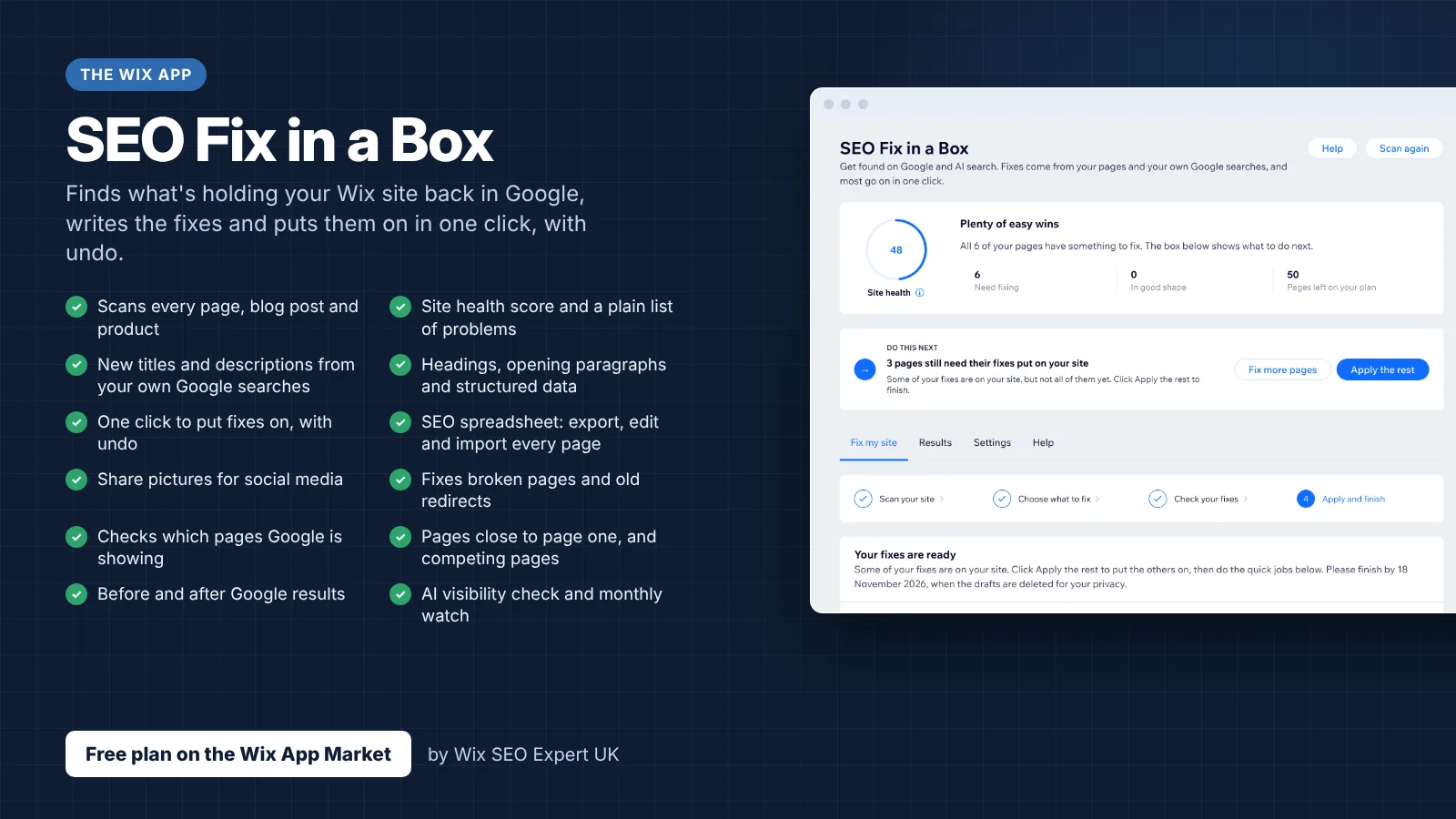
- SEO Fix in a Box: My Wix app. Free to install, it scans your site and shows what needs fixing, and paid plans write the fixes from your own Google searches
Was this lesson useful?
It takes 1 minute to tell me. The course is free and I want to keep it that way, and your feedback shows me what is working and helps other people find it.
This lesson on AI-powered competitor analysis for Wix SEO strategy is part of Module 44: Wix AI Marketing Tools & SEO Automation in The Most Comprehensive Complete Wix SEO Course in the World (2026 Edition). Created by Michael Andrews, a Wix Marketplace Legend Partner with 14 years of hands-on experience, 800 completed Wix SEO projects and 456 verified five-star reviews.