How Google handles gated and login-required content on Wix membership sites
Module 39: Wix SEO for Membership Sites, Gated Content & Digital Products | Lesson 443 of 683 | 45 min read
By Michael Andrews, Wix SEO Expert UK
If Googlebot cannot see your content, it cannot rank it. This fundamental truth creates a direct conflict for every Wix membership site owner: you want to protect premium content behind a login wall, but you also want Google to discover and rank that content so new members can find you. Understanding exactly how Google interacts with gated content on Wix is the foundation for every strategy in this module.

How Googlebot Interacts with Wix Members Area Pages
Googlebot does not have a username and password for your Wix site. When it encounters a page that requires login, it sees only what an unauthenticated visitor would see: the login prompt, any preview text displayed before the gate, and the page metadata. The actual premium content behind the wall is completely invisible to Google crawlers.
On Wix specifically, Members Area pages that require login return a 200 HTTP status code with the login form rendered. Googlebot will crawl this page but only index the publicly visible elements. If your membership page shows nothing but a login form, Google has no content to index, and the page will either not appear in search results or rank for nothing meaningful.
The Three Content Access Models
There are three fundamentally different approaches to managing content access for search engines, and each has dramatically different SEO implications.
Model 1: Fully Gated (Login Required)
All content sits behind a login wall. Google sees nothing except the login page. This model provides maximum content protection but zero organic search visibility for your premium content. This works only if you have strong alternative traffic sources like paid advertising, email lists, or existing brand recognition.
Model 2: Paywall with Preview (Flexible Sampling)
Google introduced Flexible Sampling specifically for publishers with paywalled content. Under this model, you show a meaningful preview of the content (typically the first 2-3 paragraphs) to all visitors including Googlebot, then gate the rest. Google can index and rank the preview content, and users see enough to decide whether to subscribe. The New York Times, Financial Times, and most major publishers use this model.
Model 3: Freemium (Full Free Content + Premium Extras)
Some content is entirely free and fully indexable, while premium content is gated. This is the most SEO-friendly model because Google can crawl, index and rank complete pieces of content. The free content drives organic traffic, establishes topical authority, and funnels visitors toward the premium membership offer. Spotify, Medium, and most successful SaaS platforms use variants of this model.
Common Wix Membership Indexing Mistakes
- Gating all content behind login with no free preview, leaving Google with nothing to index
- Using the same title and meta description for multiple gated pages, creating thin duplicate content signals
- Not submitting free content pages to sitemap while accidentally including gated pages
- Forgetting to add noindex to pure member-dashboard pages like account settings and billing
- Creating preview content that is too short (under 100 words) for Google to find meaningful ranking signals
- Using JavaScript-rendered preview content that Googlebot struggles to render on Wix
Google Flexible Sampling Implementation on Wix
Google Flexible Sampling requires specific structured data to tell Google your page has paywalled content. You need to add isAccessibleForFree and hasPart properties to your page schema, marking which sections are free and which require payment. On Wix, this requires adding custom JSON-LD through the page custom code section.
{
  "@context": "https://schema.org",
  "@type": "Article",
  "headline": "Complete Guide to Wix Membership SEO",
  "isAccessibleForFree": false,
  "hasPart": {
    "@type": "WebPageElement",
    "isAccessibleForFree": true,
    "cssSelector": ".free-preview"
  }
}Complete How-To Guide
Audit your Wix membership site content access
- List every page on your Wix site and categorise it as fully free, preview plus gate, or fully gated
- For fully gated pages, check what Googlebot sees by using the URL Inspection tool in GSC and clicking "View Crawled Page"
- Identify pages that are fully gated but should have free preview content for SEO value
- Check your robots.txt to ensure member dashboard pages (account, billing, settings) are blocked or noindexed
- Verify your XML sitemap includes all free and preview pages but excludes fully gated member-only pages
- Test each preview page to confirm at least 300 words of meaningful content is visible without login
- Decide which content access model (fully gated, flexible sampling, or freemium) best suits your business
- Create an implementation plan for transitioning pages to your chosen model
Setting Up Wix Members Area Pages for SEO Visibility
The Wix Members Area app creates several page types automatically: a login page, a member profile page, an account settings page, and any custom member pages you create. From an SEO perspective, you need to treat each of these differently. Login, profile, and account settings pages should be noindexed because they contain no unique, valuable content for search engines. Custom member pages that contain free preview content should be indexed and optimised.
Configure Wix Members Area pages for proper SEO treatment
- Open your Wix Editor and navigate to Pages & Menu in the left panel
- Click on the Members Area folder to see all member-related pages
- For each page, click the three-dot menu and select SEO Basics
- Set the Login page to noindex by toggling "Hide this page from search results" to ON
- Set the My Account and Profile pages to noindex using the same method
- For any custom member content pages that have a free preview, keep them indexed and write unique meta titles and descriptions
- Add relevant keywords to the title tags of indexed member pages following the pattern: [Topic] - [Content Type] | [Brand Name]
- Save your changes and verify in the Wix preview that the correct pages show the noindex tag in their source code
Configuring Robots Directives for Gated Wix Pages
Beyond the basic noindex toggle in the Wix SEO panel, you should understand how robots meta tags and X-Robots-Tag headers interact with your gated content. On Wix, the primary method is through the SEO panel noindex toggle, but you can also add custom robots directives through the page-level custom code section for more granular control.
<!-- Add to page custom code for advanced robots control -->
<meta name="robots" content="noindex, nofollow">
<!-- Use for pure member dashboard pages that should be completely hidden -->

<!-- For preview pages that should be indexed -->
<meta name="robots" content="index, follow, max-snippet:-1">
<!-- max-snippet:-1 tells Google it can show as much snippet text as it wants -->Testing What Google Actually Sees on Your Membership Pages
You should never assume what Googlebot sees matches what you expect. Wix uses JavaScript rendering, and Googlebot processes JavaScript in a two-pass system: first it crawls the raw HTML, then it renders the JavaScript. Your gated content might be visible in the raw HTML even if it is hidden by JavaScript on the frontend. Always verify using multiple testing methods.
Test what Google sees on every gated page
- Open Google Search Console and navigate to URL Inspection
- Enter the full URL of your gated membership page
- Click "Test Live URL" to see the most current version Google would crawl
- Click "View Crawled Page" then switch between the HTML tab and the Screenshot tab
- In the HTML tab, search for any premium content text that should be hidden - if you find it, your gate is leaking content to crawlers
- Check the Screenshot tab to see the visual render that Googlebot captures
- Open the same URL in an incognito browser window without logging in to see what a regular visitor sees
- Compare the GSC crawled page with the incognito view to identify any discrepancies
- Use Google Cache (search cache:yourpage.com/url) to see the last cached version Google stored
- If any premium content is visible to Googlebot that should not be, check your Wix code for server-side vs client-side rendering of the gate
Creating a Membership Content Access Audit Spreadsheet
A content access audit spreadsheet is the single most important planning document for membership site SEO. It maps every page on your site to its access level, indexing status, and SEO treatment. Without this document, you will inevitably have pages that are incorrectly indexed, incorrectly gated, or missing from your sitemap.
- Column A: Page URL - the full URL of every page on your site
- Column B: Page Type - free content, preview plus gate, fully gated, or member dashboard
- Column C: Index Status - indexed or noindexed, verified in GSC
- Column D: In Sitemap - yes or no, confirmed by checking your XML sitemap
- Column E: Meta Title - the current title tag of the page
- Column F: Meta Description - the current meta description
- Column G: Word Count (Visible) - how many words are visible without logging in
- Column H: Schema Type - which schema markup is applied (Article, Course, Product, none)
- Column I: Internal Links In - how many other pages link to this page
- Column J: Action Needed - any changes required based on your audit findings
Complete How-To Guide: Full Membership Site SEO Audit
Complete end-to-end membership site content access audit
- Step 1: Export a list of every page on your Wix site from the Pages & Menu panel in the Editor. Include all standard pages, blog posts, member pages, and dynamic CMS pages.
- Step 2: Open Google Search Console and check the Pages report (formerly Coverage). Note every URL that is indexed, excluded, or errored. Export this data into your audit spreadsheet.
- Step 3: Open your XML sitemap at yoursite.com/sitemap.xml and cross-reference every URL against your page list. Flag any pages that are in the sitemap but should not be, and any missing pages that should be included.
- Step 4: For every page marked as "fully gated" or "member dashboard", verify that it has noindex applied by checking the SEO panel in the Wix Editor and confirming with URL Inspection in GSC.
- Step 5: For every page marked as "preview plus gate", use URL Inspection to verify that at least 300 words of meaningful content are visible to Googlebot in the crawled page HTML.
- Step 6: Check that every preview page has Flexible Sampling structured data (isAccessibleForFree and hasPart properties) by testing with the Rich Results Test.
- Step 7: Verify that no premium content is leaking through to Googlebot by searching for unique phrases from your gated content in the URL Inspection crawled page view.
- Step 8: Review your internal linking to ensure free content pages have strong link paths from your homepage and navigation, while gated member pages are only linked from within the member area.
- Step 9: Check your meta titles and descriptions for all indexed pages. Free and preview pages should have keyword-optimised, compelling metadata that encourages clicks from search results.
- Step 10: Test all schema markup on indexed pages using the Rich Results Test. Fix any errors and add any missing recommended fields.
- Step 11: Create a content access map showing the intended journey: organic search to free content to membership sign-up to gated content. Verify this journey works by testing in an incognito browser.
- Step 12: Set up automated monitoring by creating a custom report in GSC that filters for your membership section URLs, checking weekly for any indexing status changes.
Essential Tools for This Lesson
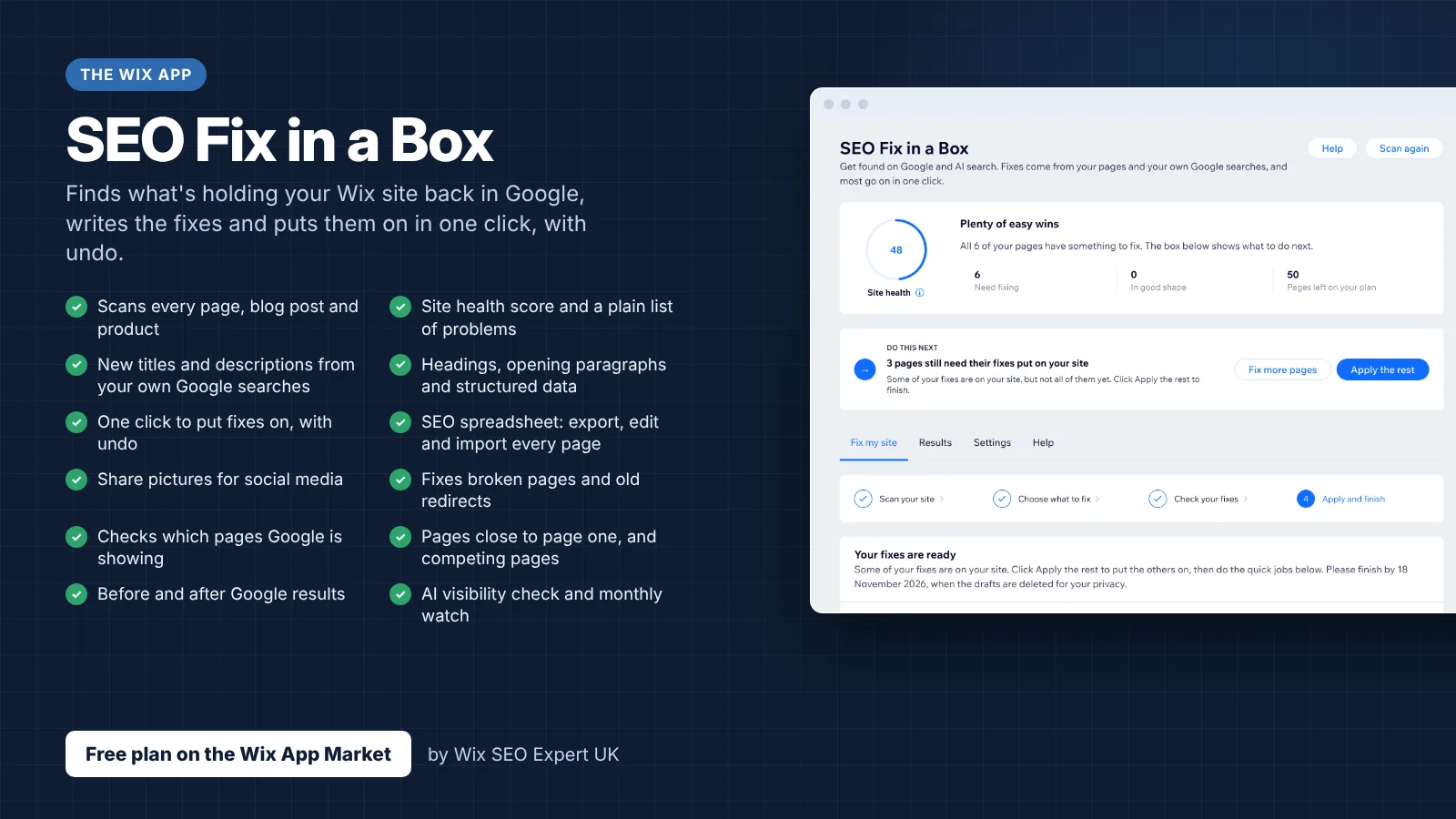
- SEO Fix in a Box: My Wix app. Free to install, it scans your site and shows what needs fixing, and paid plans write the fixes from your own Google searches
Was this lesson useful?
It takes 1 minute to tell me. The course is free and I want to keep it that way, and your feedback shows me what is working and helps other people find it.
This lesson on How Google handles gated and login-required content on Wix membership sites is part of Module 39: Wix SEO for Membership Sites, Gated Content & Digital Products in The Most Comprehensive Complete Wix SEO Course in the World (2026 Edition). Created by Michael Andrews, a Wix Marketplace Legend Partner with 14 years of hands-on experience, 800 completed Wix SEO projects and 456 verified five-star reviews.