Structured data for membership sites: Course, Product and CreativeWork schema on Wix
Module 39: Wix SEO for Membership Sites, Gated Content & Digital Products | Lesson 447 of 683 | 48 min read
By Michael Andrews, Wix SEO Expert UK
Membership sites selling courses, ebooks, templates, and digital products have access to some of the most powerful schema types available, yet most Wix site owners implement none of them. Course schema can trigger rich results showing course provider, description, and rating directly in search results. Product schema displays pricing and availability. CreativeWork schema helps Google understand your digital content library. This lesson covers every relevant schema type for membership sites on Wix.

Course Schema for Online Courses
Course schema tells Google that your page describes an educational course. When properly implemented, it can trigger Course rich results in Google Search, displaying the course name, provider, description, and rating. This is especially valuable for Wix-based course platforms competing against Udemy, Coursera, and Skillshare.
{
  "@context": "https://schema.org",
  "@type": "Course",
  "name": "Complete Wix SEO Mastery Course",
  "description": "50 modules covering every aspect of Wix SEO from beginner foundations to advanced technical optimisation.",
  "provider": {
    "@type": "Organization",
    "name": "Your Business Name",
    "sameAs": "https://yoursite.com"
  },
  "hasCourseInstance": {
    "@type": "CourseInstance",
    "courseMode": "online",
    "courseWorkload": "PT145H"
  },
  "aggregateRating": {
    "@type": "AggregateRating",
    "ratingValue": "4.9",
    "reviewCount": "128"
  },
  "offers": {
    "@type": "Offer",
    "price": "0",
    "priceCurrency": "GBP",
    "availability": "https://schema.org/InStock",
    "category": "Free"
  }
}
Product Schema for Digital Downloads
Templates, checklists, spreadsheets, and other downloadable products qualify for Product schema. The key fields for digital products are slightly different from physical goods. You do not need shipping or return information, but you should specify the file format, instant availability, and digital delivery method.
CreativeWork Schema for Ebooks and Guides
CreativeWork is a broad schema type that covers books, articles, guides, reports, and other creative content. For ebooks and comprehensive guides, the more specific Book type provides additional fields like numberOfPages, bookFormat (EBook), and isbn if applicable. This schema helps Google understand your digital content library and can influence how your products appear in search results.
{
  "@context": "https://schema.org",
  "@type": "Book",
  "name": "The Wix SEO Blueprint",
  "author": {
    "@type": "Person",
    "name": "Your Name"
  },
  "bookFormat": "https://schema.org/EBook",
  "numberOfPages": "185",
  "description": "A comprehensive guide to optimising your Wix website for search engines.",
  "offers": {
    "@type": "Offer",
    "price": "9.99",
    "priceCurrency": "GBP",
    "availability": "https://schema.org/InStock"
  }
}
EducationalOccupationalCredential for Certifications
If your membership programme offers certificates or credentials upon completion, EducationalOccupationalCredential schema tells Google that completing your course leads to a recognised qualification. This is particularly powerful for professional development courses and can help your course appear in Google education-related search features.
Testing and Validating Schema on Wix
Implement and validate membership site schema
- Choose the primary schema type for each page: Course for courses, Product for digital downloads, Book for ebooks
- Write the JSON-LD code following the templates above, customising for your specific content
- Add the JSON-LD to your Wix page using the Custom Code section in Page Settings under Advanced SEO
- Test each page using Google Rich Results Test to verify zero errors
- Check for warnings and resolve any missing recommended fields
- Monitor the Enhancements report in GSC for any schema validation issues
- Test on multiple pages to ensure consistent schema implementation across your membership site
Combining Multiple Schema Types on a Single Page
Some membership site pages qualify for multiple schema types simultaneously. A course landing page might have Course schema for the educational content, Product schema for the pricing and purchase information, FAQPage schema for the FAQ section, and BreadcrumbList schema for the navigation path. Each schema type can be added as a separate JSON-LD block in the Wix page custom code section. Google will read and validate each one independently.
<!-- Multiple schema blocks on one page -->
<script type="application/ld+json">
{
  "@context": "https://schema.org",
  "@type": "Course",
  "name": "Wix SEO Mastery",
  "provider": {"@type": "Organization", "name": "Your Brand"}
}
</script>

<script type="application/ld+json">
{
  "@context": "https://schema.org",
  "@type": "FAQPage",
  "mainEntity": [{"@type": "Question", "name": "...", "acceptedAnswer": {"@type": "Answer", "text": "..."}}]
}
</script>

<script type="application/ld+json">
{
  "@context": "https://schema.org",
  "@type": "BreadcrumbList",
  "itemListElement": [
    {"@type": "ListItem", "position": 1, "name": "Home", "item": "https://yoursite.com"},
    {"@type": "ListItem", "position": 2, "name": "Courses", "item": "https://yoursite.com/courses"},
    {"@type": "ListItem", "position": 3, "name": "Wix SEO Mastery"}
  ]
}
</script>
ItemList Schema for Course Module and Lesson Pages
When your course has a module overview page that lists individual lessons, ItemList schema tells Google this is a structured list of related items. This can trigger carousel-style rich results showing each lesson as a separate card in search results. For membership sites with extensive course catalogues, this is a powerful way to dominate additional SERP real estate.
{
  "@context": "https://schema.org",
  "@type": "ItemList",
  "name": "Module 1: SEO Foundations",
  "numberOfItems": 6,
  "itemListElement": [
    {
      "@type": "ListItem",
      "position": 1,
      "url": "https://yoursite.com/courses/seo/lesson-1",
      "name": "How Google Crawls, Indexes and Ranks Websites"
    },
    {
      "@type": "ListItem",
      "position": 2,
      "url": "https://yoursite.com/courses/seo/lesson-2",
      "name": "E-E-A-T: Experience, Expertise, Authority and Trust"
    }
  ]
}
Schema Validation Workflow for Membership Sites
With multiple schema types across dozens or hundreds of pages, you need a systematic validation workflow. Do not rely on testing individual pages manually. Create a schema validation routine that covers every page type in your membership site and runs on a regular schedule.
Establish a schema validation workflow
- Create a spreadsheet listing every page type on your membership site: course landing pages, module pages, lesson pages, digital product pages, and blog posts
- For each page type, document which schema types should be present: Course, Product, FAQPage, BreadcrumbList, Article, or CreativeWork
- Test one representative page from each type using Google Rich Results Test and note any errors or warnings
- Fix all errors across all pages of that type before moving to the next type
- After fixing, re-test to confirm zero errors and document the pass status in your spreadsheet
- Set up a monthly calendar reminder to re-validate schema on representative pages, especially after making site-wide changes
- Check the GSC Enhancements report weekly for any new schema validation errors across your site
Complete How-To Guide: Implementing Full Schema Coverage on Your Wix Membership Site
Complete step-by-step schema implementation for membership sites
- Step 1: Map every page type on your membership site to its appropriate schema types. Course landing pages get Course + FAQPage + BreadcrumbList. Digital product pages get Product + FAQPage. Ebook pages get Book. Blog posts get Article.
- Step 2: Write the JSON-LD for your Course landing page first. Include the name, description, provider (your Organisation), hasCourseInstance with courseMode "online" and courseWorkload duration, offers with price and currency, and aggregateRating if you have reviews.
- Step 3: Add the JSON-LD to your Wix course page by going to the page in the Editor, clicking the page menu, selecting Advanced SEO, and pasting the code into the Custom Code (Head) section.
- Step 4: Test the page immediately using Google Rich Results Test. Fix any errors, then re-test until the result shows zero errors and all expected rich result types are eligible.
- Step 5: Write the JSON-LD for your digital product pages using the Product schema template. Include name, description, image URL, price, currency, availability, and aggregateRating.
- Step 6: Add FAQPage schema to every page that has an FAQ section. Each question must be visible on the page as text that users can read.
- Step 7: Add BreadcrumbList schema to all pages that have a clear hierarchical path (Home > Courses > Module > Lesson). This helps Google understand your site structure.
- Step 8: For ebook or guide pages, add Book schema with bookFormat set to EBook, numberOfPages, author information, and Offer with pricing.
- Step 9: If your membership includes certification, add EducationalOccupationalCredential schema to the certification programme page.
- Step 10: Use Screaming Frog or a similar crawling tool to crawl your entire site and extract all structured data. Verify every page has the expected schema types applied.
- Step 11: Document all schema implementations in your membership site audit spreadsheet with the page URL, schema types applied, and last validation date.
- Step 12: Set up a monthly schema audit: check the GSC Enhancements report for errors, re-validate two representative pages from each type using Rich Results Test, and update your documentation.
Essential Tools for This Lesson
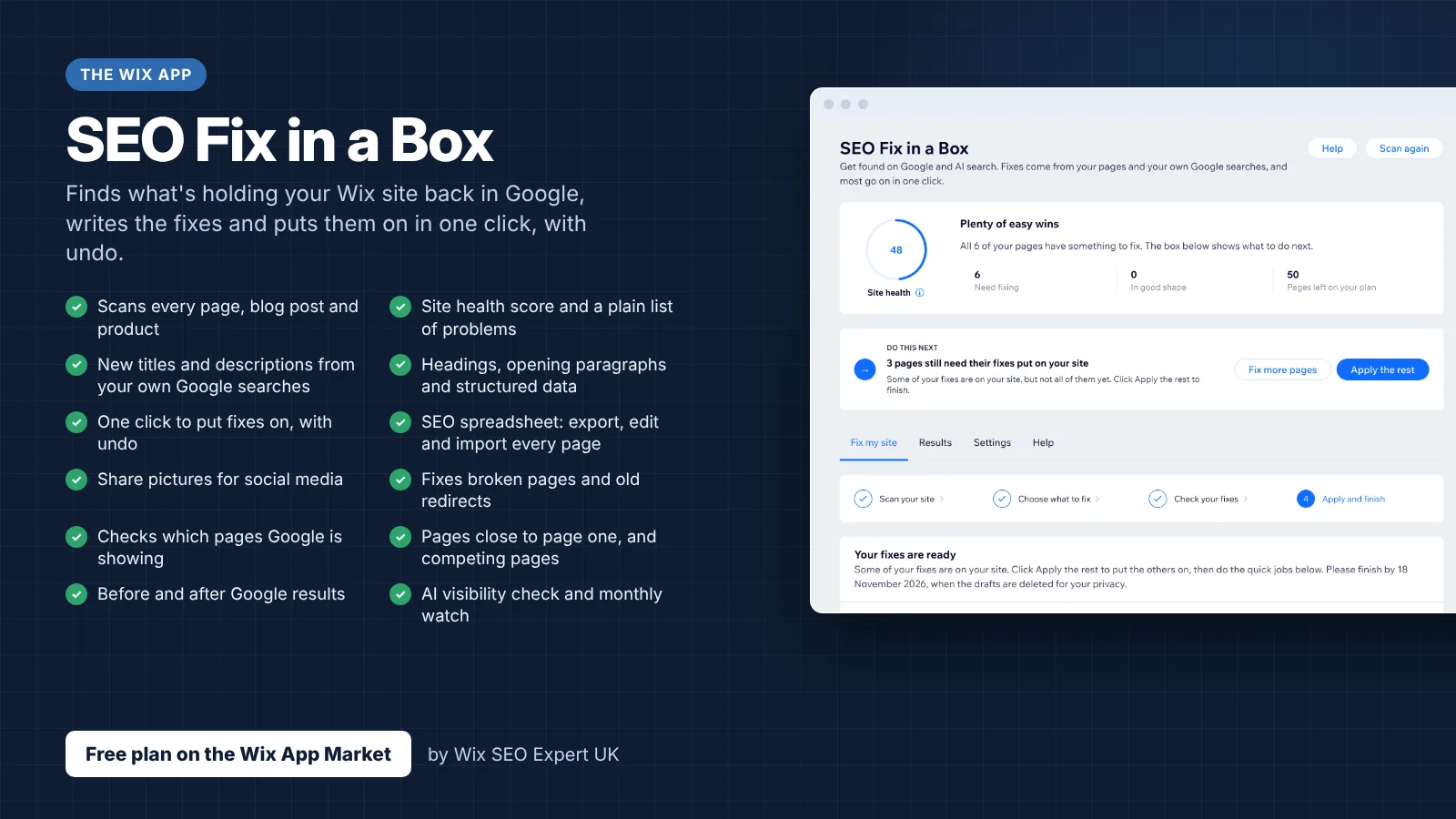
- SEO Fix in a Box: My Wix app. Free to install, it scans your site and shows what needs fixing, and paid plans write the fixes from your own Google searches
Was this lesson useful?
It takes 1 minute to tell me. The course is free and I want to keep it that way, and your feedback shows me what is working and helps other people find it.
This lesson on Structured data for membership sites: Course, Product and CreativeWork schema on Wix is part of Module 39: Wix SEO for Membership Sites, Gated Content & Digital Products in The Most Comprehensive Complete Wix SEO Course in the World (2026 Edition). Created by Michael Andrews, a Wix Marketplace Legend Partner with 14 years of hands-on experience, 800 completed Wix SEO projects and 456 verified five-star reviews.