Building topical authority with free content that drives membership signups on Wix
Module 39: Wix SEO for Membership Sites, Gated Content & Digital Products | Lesson 450 of 683 | 46 min read
By Michael Andrews, Wix SEO Expert UK
Your free content is simultaneously your SEO engine and your membership funnel. Every blog post, free tool, and public resource page that ranks in Google is both an authority signal to search engines and a potential entry point for new members. The most successful Wix membership sites do not treat free content as a loss leader. They treat it as a strategic asset that compounds in value over time, building topical authority that makes every page on the site rank better.

The Content Pyramid: Free Blog, Free Tools, Gated Premium
The content pyramid has three layers. The base is your free blog content: comprehensive guides, how-to articles, and industry insights that target informational keywords and build topical authority. The middle layer is free tools and resources: calculators, checklists, and templates that capture email addresses. The top is your premium membership content: deep implementation guides, video courses, and exclusive resources that members pay for.
Keyword Mapping Between Free and Premium Content
Every piece of free content should map directly to a related premium offering. If your free blog post covers "what is technical SEO for Wix", your premium content should offer "step-by-step technical SEO audit for Wix with templates". The free content handles the informational query; the premium content handles the implementation query. This mapping ensures your free content naturally funnels readers toward membership.
Internal Linking from Free Content to Membership CTAs
Strategic internal linking transforms your free content from standalone pages into a membership acquisition funnel. Every free blog post should contain 2-3 natural mentions of related premium content with clear CTAs. These should not be aggressive pop-ups or intrusive banners, but contextual mentions that feel like helpful recommendations.
- Contextual links within the content body: "For the complete implementation checklist, see our [Premium SEO Audit Guide]"
- End-of-article CTA box: "Want to go deeper? Our membership includes the full 50-point audit template"
- Sidebar or in-content callout: "This is covered in detail in Module 6 of our course"
- Related content sections that mix free and premium recommendations
Demonstrating Expertise Through Free Content
Your free content must be genuinely excellent. If readers find your free content mediocre, they will never pay for premium. Treat your free blog content as proof of the quality that awaits behind the membership gate. Include real data, case studies, actionable steps, and expert insights that demonstrate you know what you are talking about. This builds both SEO authority and reader trust simultaneously.
Build your topical authority content system
- Identify 5-10 core topics that your membership content covers in depth
- For each core topic, create 3-5 free blog posts targeting related informational keywords
- Ensure each free blog post naturally references and links to the relevant premium content
- Create at least one free tool or template for each core topic to capture emails
- Build topic cluster pages that link all related free content together
- Add membership CTAs to every free content page without being intrusive
- Track which free content pages drive the most membership signups and double down on those topics
- Publish new free content weekly to maintain freshness signals and steady organic traffic growth
Topic Cluster Architecture for Membership Sites
A topic cluster is a group of interlinked pages that collectively demonstrate comprehensive coverage of a subject. For membership sites, each cluster has a free pillar page (your most comprehensive piece on the topic), supported by 5-10 free cluster content pieces, with premium membership content as the deepest layer. Google rewards topic clusters with higher rankings across every page in the cluster because they demonstrate topical authority.
Build a topic cluster for your membership niche
- Identify your 3-5 core membership topics that represent the pillars of your expertise
- For each pillar, create one comprehensive free guide page of 3000+ words targeting a broad keyword
- Identify 5-10 supporting subtopics for each pillar using keyword research and People Also Ask questions
- Create free blog posts for each subtopic targeting specific long-tail keywords
- Link every cluster blog post to the pillar page using descriptive anchor text
- Link the pillar page to every cluster blog post
- Cross-link related blog posts within the same cluster
- Add membership CTAs on every pillar and cluster page linking to the premium content that goes deeper
- Track the pillar page keyword rankings over 90 days to measure the compounding effect of adding cluster content
Content Quality Standards for Authority Building
Free content that builds topical authority must meet a higher quality bar than generic blog content. Every free piece should include original insights, real data, actionable steps, and clear expertise signals. Generic content that summarises what everyone else says does not build authority because it does not demonstrate unique experience or expertise.
- Include at least one original data point, case study, or real-world example per post
- Add an author byline with a link to your About page showing your credentials
- Include screenshots, diagrams, or custom graphics that demonstrate hands-on experience
- Update content at least annually with fresh data and current best practices
- Add a "Last Updated" date that changes when you make substantive updates
- Reference specific tools and platforms you have used, not just general advice
- Include code snippets, templates, or step-by-step screenshots for implementation guides
Complete How-To Guide: Building Topical Authority for Your Wix Membership Site
Complete step-by-step topical authority building plan
- Step 1: Define your 3-5 core membership topics. These should be the broad subject areas your membership covers. Example: "Wix SEO", "Wix Website Design", "Wix E-commerce".
- Step 2: For each core topic, use Google Keyword Planner to find the highest-volume broad keyword. This becomes your pillar page target keyword.
- Step 3: Research 5-10 subtopics per pillar using Ahrefs Content Explorer, AnswerThePublic, or Google People Also Ask. Each subtopic becomes a free blog post.
- Step 4: Create a content map spreadsheet with columns for Pillar Topic, Cluster Post Title, Target Keyword, Search Volume, Status, and Premium Content Link.
- Step 5: Write your pillar page first. Aim for 3000+ words covering the full scope of the topic with sections that naturally introduce each cluster subtopic.
- Step 6: Write cluster posts at a pace of 1-2 per week. Each post should be 1500-2500 words and focus on one specific subtopic.
- Step 7: After publishing each cluster post, add internal links to and from the pillar page and to related cluster posts.
- Step 8: On every free content page, add two membership CTAs: one inline mention within the first 500 words and one end-of-article CTA panel.
- Step 9: Create a free resources hub page that lists all your free content organised by topic cluster. This page becomes another high-authority hub.
- Step 10: Track pillar page rankings weekly in GSC. You should see rankings improve as more cluster content is published and interlinked.
- Step 11: After completing one full topic cluster (pillar + 5-10 cluster posts), start on the next pillar topic.
- Step 12: Review conversion data monthly: which free posts drive the most email signups and membership trials? Prioritise creating more content on those topics.
Essential Tools for This Lesson
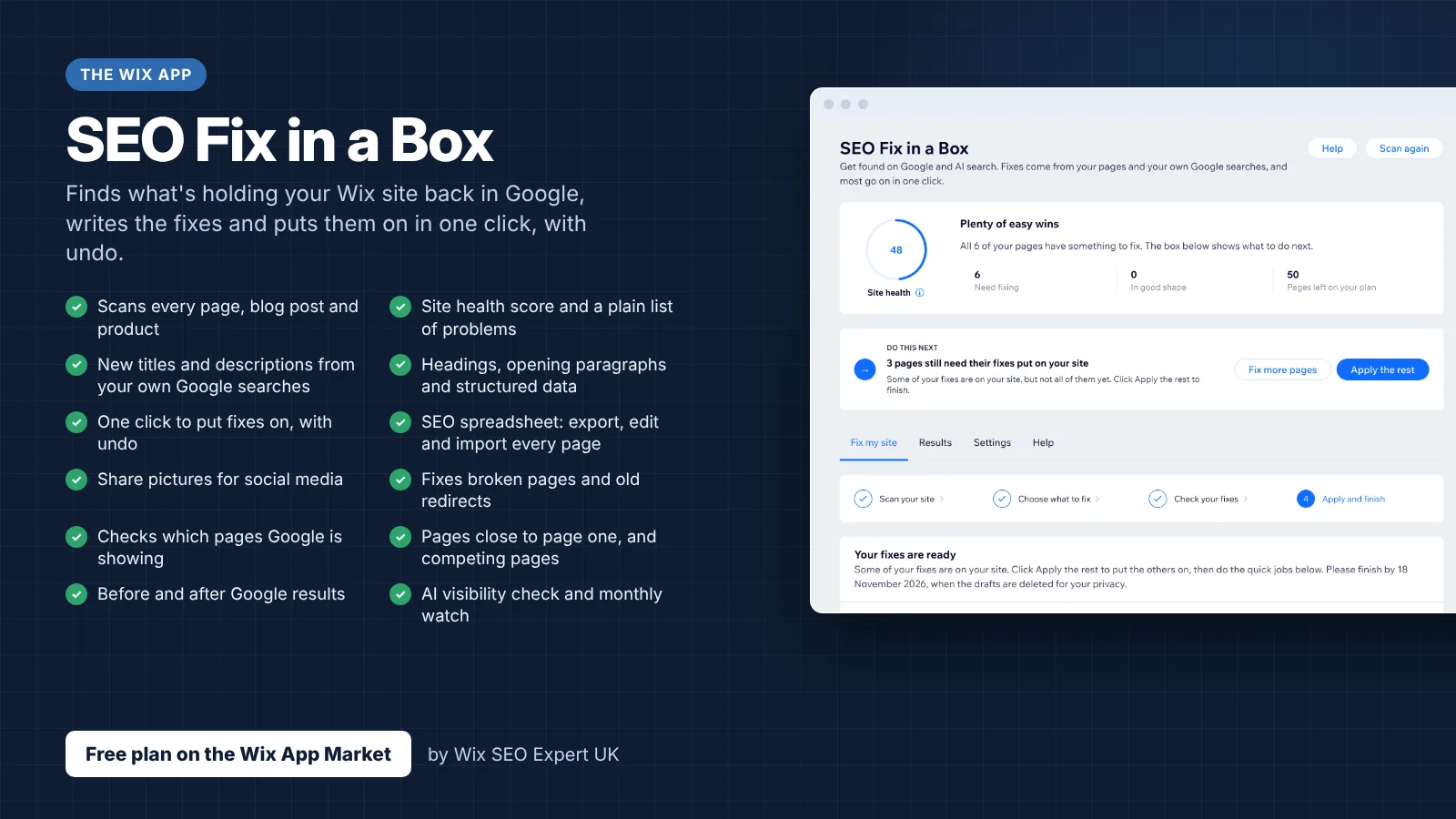
- SEO Fix in a Box: My Wix app. Free to install, it scans your site and shows what needs fixing, and paid plans write the fixes from your own Google searches
Was this lesson useful?
It takes 1 minute to tell me. The course is free and I want to keep it that way, and your feedback shows me what is working and helps other people find it.
This lesson on Building topical authority with free content that drives membership signups on Wix is part of Module 39: Wix SEO for Membership Sites, Gated Content & Digital Products in The Most Comprehensive Complete Wix SEO Course in the World (2026 Edition). Created by Michael Andrews, a Wix Marketplace Legend Partner with 14 years of hands-on experience, 800 completed Wix SEO projects and 456 verified five-star reviews.