AI Overviews and SGE optimisation: getting your Wix content cited in Google AI answers
Module 25: Zero-Click SEO & Answer Engine Strategy for Wix | Lesson 305 of 683 | 52 min read
By Michael Andrews, Wix SEO Expert UK
Google AI Overviews represent the most significant evolution in search since featured snippets. Instead of linking to websites, AI Overviews synthesise answers from multiple sources and present them directly on the SERP. For Wix site owners, the question is not whether AI Overviews will affect your traffic (they will), but whether your content will be one of the sources cited. This lesson covers the characteristics of content that AI Overviews prefer, structural formatting that increases citation probability, and strategies for ensuring your Wix site is included in AI-generated answers.

How AI Overviews Select Sources
Google AI Overviews draw from pages that already rank well in traditional search results. Being on page one is typically a prerequisite for AI Overview citation. Beyond ranking, AI Overviews prefer sources that demonstrate clear expertise (E-E-A-T signals), provide specific facts and data rather than vague generalisations, present information in structured formats that are easy to extract, and cover the topic comprehensively rather than superficially.
Content Characteristics AI Overviews Prefer
- Specific, quantified claims with data: "Wix sites load in 2.1 seconds on average" not "Wix sites load quickly"
- Clear definitions and explanations that can be extracted as standalone paragraphs
- Expert author attribution with verifiable credentials (E-E-A-T signals)
- Recent publication or update dates showing current, maintained content
- Comprehensive coverage of the topic rather than thin, surface-level treatment
- Structured formatting with clear headings, lists, and logical organisation
- Factual accuracy with references to authoritative sources where appropriate
The BLUF Writing Pattern
BLUF (Bottom Line Up Front) is the most effective writing pattern for AI citation. Start every section with the key fact or answer, then elaborate. AI systems extract the opening statement of each section, so leading with your conclusion ensures the most important information gets cited. Traditional writing that builds to a conclusion is less effective for AI extraction.
Structural Formatting for AI Citation
AI systems parse structured content more effectively than flowing prose. Use clear H2 headings that match common queries. Follow each heading with a concise answer paragraph. Use numbered lists for processes and bulleted lists for features. Include data tables for comparisons. This structured format makes your content machine-readable while remaining engaging for human readers.
Optimise your Wix content for AI Overview citation
- Identify your top 20 keywords and check which ones trigger AI Overviews
- For each AI Overview keyword, note which sources are currently cited
- Analyse the cited sources to identify content characteristics they share
- Rewrite your opening paragraphs to follow the BLUF pattern
- Add specific, quantified facts and data throughout your content
- Structure content with clear H2 headings matching common query formats
- Ensure author credentials are visible and schema-marked on every page
- Update publication dates to show content is current and maintained
- Monitor for AI Overview citations using manual searches and tracking tools
E-E-A-T Signals That AI Overviews Prioritise
AI Overviews appear to weight E-E-A-T signals more heavily than traditional organic results. Content from recognised experts, published on authoritative domains, with visible credentials and first-hand experience markers gets cited more frequently. On your Wix site, this means every piece of content should have a visible author byline, credentials, and links to the author About page.
Strengthen E-E-A-T signals for AI Overview citation
- Add a detailed author byline to every blog post and content page with name, title, and relevant qualifications
- Create a comprehensive author page linked from every byline showing credentials, experience, and published work
- Implement Person schema for the author and Article schema for content pages with the author property populated
- Include first-hand experience markers: screenshots of your own work, case study data from real clients, original research data
- Add a "Reviewed by" or "Fact-checked by" credit where applicable to demonstrate editorial rigour
- Update publication dates whenever you make substantive content updates to signal freshness
- Include specific, verifiable data points rather than vague claims throughout your content
Content Freshness and AI Overview Selection
AI Overviews strongly prefer content with recent publication or update dates. A page published in 2024 with no updates is less likely to be cited than a page updated in 2026, even if the information is identical. Implement a content freshness strategy: review and update your most important content quarterly, and change the visible publication or "last updated" date to reflect each substantive revision.
Complete How-To Guide: Optimising Wix Content for AI Overview Citation
Complete step-by-step AI Overview optimisation strategy
- Step 1: Identify which of your target keywords trigger AI Overviews by searching them in Google. Not all keywords trigger AI Overviews, so focus your effort where they appear.
- Step 2: For each AI Overview keyword, click the sources listed in the AI Overview and analyse what those pages have in common: formatting, expertise signals, data specificity, and content depth.
- Step 3: On your Wix pages targeting those keywords, rewrite every section opening paragraph to follow the BLUF pattern: start with the key fact or conclusion, then elaborate.
- Step 4: Replace vague statements with specific, quantified data throughout your content. "Wix sites load in an average of 2.1 seconds" is better than "Wix sites load quickly".
- Step 5: Add a visible author byline with credentials to every content page. Create an author page and link to it from every byline.
- Step 6: Implement Article or BlogPosting schema with the author, datePublished, and dateModified properties accurately set.
- Step 7: Structure your content with clear H2 headings that match common query formats. Follow each heading with an extractable answer paragraph of 40-60 words.
- Step 8: Add lists and structured data wherever possible. AI systems extract structured content more effectively than flowing prose.
- Step 9: Review and update your most important content pages to ensure the "last updated" date is within the past 6 months.
- Step 10: After optimising, check your target keywords weekly for AI Overview citation. Note when your content appears as a cited source.
- Step 11: For keywords where you rank top 5 but are not cited in the AI Overview, iterate: add more specific data, improve BLUF formatting, or strengthen E-E-A-T signals.
- Step 12: Set up quarterly content audits specifically focused on AI Overview readiness: check freshness dates, data accuracy, author attribution, and BLUF formatting across all key pages.
Essential Tools for This Lesson
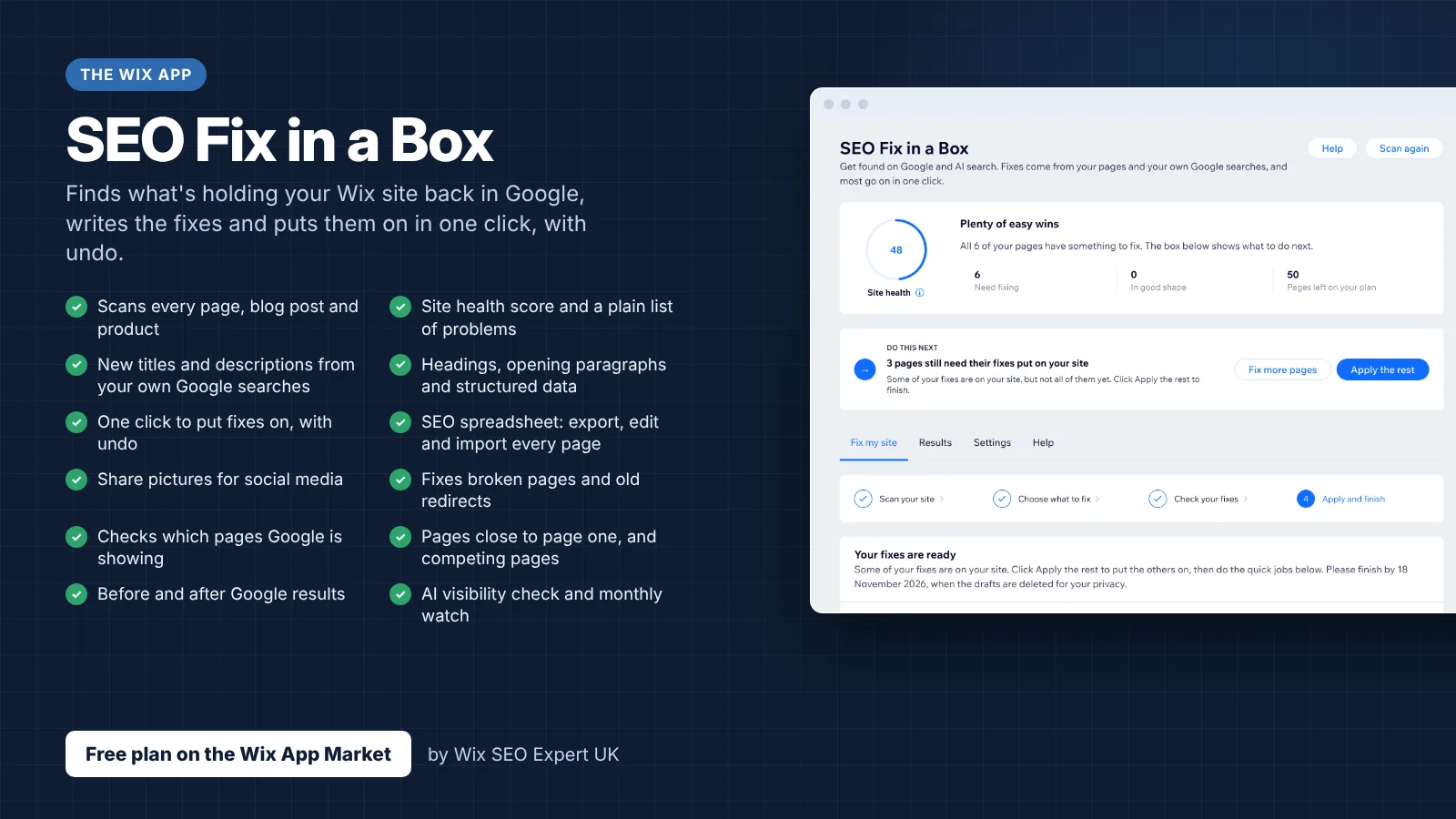
- SEO Fix in a Box: My Wix app. Free to install, it scans your site and shows what needs fixing, and paid plans write the fixes from your own Google searches
Was this lesson useful?
It takes 1 minute to tell me. The course is free and I want to keep it that way, and your feedback shows me what is working and helps other people find it.
This lesson on AI Overviews and SGE optimisation: getting your Wix content cited in Google AI answers is part of Module 25: Zero-Click SEO & Answer Engine Strategy for Wix in The Most Comprehensive Complete Wix SEO Course in the World (2026 Edition). Created by Michael Andrews, a Wix Marketplace Legend Partner with 14 years of hands-on experience, 800 completed Wix SEO projects and 456 verified five-star reviews.