How Do I Get Backlinks for a Wix Site?

By Michael Andrews | Published: 2026-09-16 | Updated: 2026-09-16 | 22 min read
Backlinks remain one of the strongest ranking signals in 2026. This guide explains how to earn them for a Wix site specifically, from digital PR and resource pages to local citations and content-led outreach.
If you run a Wix website and want it to rank higher in Google, you have almost certainly come across the word "backlinks." Every SEO guide mentions them. Every competitor seems to have them. And the question that keeps coming up is simple: how do I actually get them?
This guide answers that question in full. It is written specifically for Wix site owners, because while the principles of link building are the same on every platform, there are practical details, from how Wix handles URL structures to how you set up the content that attracts links, that are worth covering in a Wix-specific context.
I have built backlink profiles for Wix clients across dozens of industries, from tradespeople in Kent to e-commerce stores in Bristol. The methods below are what actually works, not theory, not outdated tactics, but the approaches I use in real client campaigns in 2026.
What Is a Backlink and Why Does It Matter?
A backlink is a link on someone else's website that points to a page on yours. When a local newspaper mentions your business and links to your homepage, that is a backlink. When a blogger reviews your product and links to your shop page, that is a backlink. When a directory lists your company with a clickable URL, that is a backlink.
Google treats backlinks as votes of confidence. The logic is straightforward: if other credible websites are willing to link to your page, the content on that page is probably worth showing to searchers. Backlinks have been a core part of how Google ranks pages since the search engine was invented, and in 2026 they remain one of the top three ranking factors alongside content quality and search intent match.
Not all backlinks are equal. A link from the BBC or a respected industry publication carries far more weight than a link from a brand new blog with no traffic. Google evaluates the authority of the linking site, the relevance of the linking page to your topic, and where on the page the link appears. A contextual link within a paragraph of relevant text is worth more than a link buried in a footer or a sidebar widget.
If this is your first time working on SEO for your Wix site, my guide to ranking a Wix website on page one covers the full picture, from on-page fundamentals through to backlinks and beyond.
Does Being on Wix Affect Your Ability to Get Backlinks?
No. This is one of the most common misconceptions I hear. Backlinks point to your URL, not to your platform. A journalist writing a piece does not check whether your site is built on Wix, WordPress, Squarespace or custom code before deciding whether to link to it. They link to it because the page is useful, credible and relevant to what they are writing about.
What does matter is whether your Wix site is set up properly. If your URLs are clean, your pages load fast, your content is well-structured and your site looks professional, you are on exactly the same footing as any other platform. If your site has broken pages, missing meta data and thin content, that will put people off linking to you, but that is a content and setup problem, not a Wix problem.
I have covered the "is Wix bad for SEO" question thoroughly in my honest 2026 assessment of Wix SEO. The short version: Wix is a fully capable SEO platform in 2026, and nothing about it limits your link building potential.
Get the Foundations Right Before You Start Building Links
Before you spend time on outreach, make sure the pages you want links pointing to are actually worth linking to. This is not just good practice, it directly affects your success rate. If someone clicks through to your page from an outreach email and finds a thin, poorly structured page, they will not link to it regardless of how good your pitch was.
Clean URL slugs
Wix lets you customise every URL slug. Use short, descriptive, keyword-relevant slugs. A URL like /services/kitchen-fitting-kent is far more linkable than /services/service-page-3. People are more likely to link to a URL that looks professional and tells them what the page is about.
Strong on-page SEO
Title tags, meta descriptions, H1 headings, internal links, image alt text. All of these should be in place before you ask anyone to link to the page. My guide to Wix SEO tools covers every built-in feature you can use.
Structured data
Adding schema markup to your Wix pages helps search engines understand your content and can earn you rich results in Google. It also signals to potential linkers that your site is professionally maintained. My Wix schema markup guide walks through adding it step by step.
Page speed and mobile experience
A slow, clunky page puts off visitors and linkers alike. Check your Core Web Vitals in Google Search Console and fix any issues before you start outreach. If you are not set up with Search Console yet, follow my Wix Google Search Console guide first.
Strategy 1: Local Citations and Business Directories
If you run a local or regional business, this is the easiest place to start. Local citations are mentions of your business name, address and phone number on directory sites, and most of them include a link back to your website.
Where to get listed
- Google Business Profile: the single most important local listing. Make sure your website URL is correct and your profile is fully completed
- Bing Places and Apple Business Connect: often overlooked, but they carry authority and feed data to voice assistants and map apps
- Industry-specific directories: every trade and profession has its own directories. A plumber should be on Checkatrade, Bark and TrustATrader. A solicitor should be on the Law Society directory. Find the ones relevant to your industry
- Local chambers of commerce: most chamber websites link to their members. If you are a member, make sure your listing is live and your URL is correct
- Yell, Thomson Local, Scoot, FreeIndex, Cylex: the general UK directories still pass value when your listing is complete and consistent
Expert Tip: Consistency matters. Your business name, address and phone number should be identical across every directory. Even small differences, like "St" versus "Street" or a missing postcode, can confuse search engines and dilute the value of your citations.
For a deeper look at local SEO strategy for Wix sites, including how citations fit into the bigger picture, see my case study for a gas engineer in Doncaster where local citations were a key part of the campaign.
Strategy 2: Create Linkable Content Assets
The most sustainable way to earn backlinks is to create content that people genuinely want to reference. This is not about writing blog posts for the sake of it. It is about creating specific types of content that have a track record of attracting links.
Types of content that earn links
- Original research and data: if you can survey your customers, analyse your industry data, or compile statistics that do not exist elsewhere, you create something journalists and bloggers will cite
- Comprehensive guides: a genuinely thorough guide on a topic in your field becomes a reference that other sites link to when they mention that topic. The guide you are reading now is an example of this approach
- Free tools and calculators: if you can build a simple tool that solves a problem in your niche, such as a cost calculator, a sizing guide or a compatibility checker, it becomes a permanent link magnet
- Infographics and visual assets: well-designed graphics that present data or processes visually get embedded on other sites with a credit link back to you
- Templates, checklists and downloads: practical resources that people find useful enough to bookmark and share with their own audiences
The key principle is this: the content needs to be genuinely useful to someone other than your direct customers. A page about your services is useful to potential buyers, but it is not something another website would link to. A comprehensive guide to choosing the right service, with comparison tables and honest advice, is something industry blogs and journalists would reference.
Wix's blog editor is well suited to creating long-form content assets. You get full control over headings, images, embedded media and formatting. If you are using the Wix blog for SEO, my complete Wix SEO guide covers how to structure posts for maximum search visibility.
Strategy 3: Digital PR
Digital PR is the process of getting your business featured in online publications, news sites, blogs and magazines, with a link back to your site. It is one of the most effective link building strategies because it earns links from high-authority domains that Google trusts.
How digital PR works in practice
- Identify a newsworthy angle: this could be original research, a strong opinion on an industry trend, a product launch, a local community initiative, or a data-driven story
- Find the right journalists: use Twitter, LinkedIn, publication staff pages and media databases to find journalists who cover your topic or area
- Write a concise pitch: journalists receive hundreds of emails a day. Your pitch needs to be short, lead with the story angle, and make it obvious why their readers would care
- Provide ready-to-use assets: include quotes, data points, images, and a link to a page on your site where they can find more detail. Make it easy for them to write the piece
- Follow up once, then move on: one polite follow-up after a few days is fine. More than that is counterproductive
I have written a dedicated guide to digital PR for Wix SEO that goes much deeper into the process, including how to find angles, write pitches that get responses, and measure the SEO impact of your coverage.
Strategy 4: Guest Posting
Guest posting means writing an article for someone else's website in exchange for a link back to yours, usually in the author bio or within the content itself. When done well, it is one of the most reliable ways to build high-quality backlinks.
Finding guest post opportunities
- Search Google for "[your industry] + write for us" or "[your topic] + guest post" to find sites that actively accept contributions
- Look at where your competitors have guest posted by checking their backlink profiles in Ahrefs or Semrush
- Reach out to industry blogs, trade publications and online magazines that cover topics you can write about with genuine expertise
- Check LinkedIn for editors and content managers at publications in your space, and build relationships before pitching
Rules for effective guest posting
- Only write for sites that are genuinely relevant to your industry. A plumber guest posting on a food blog is pointless
- Write content that is genuinely useful to the host site's audience, not a thinly veiled advert for your services
- Include your link naturally within the content where it adds value, or in a brief author bio
- Avoid sites that exist solely to sell guest posts. If they charge a fee for publishing and accept anything, the site probably has no editorial standards and Google may already be discounting its links
Common Mistake: Google is clear that large-scale guest posting with keyword-rich anchor text is a link scheme. A few thoughtful guest posts on relevant, editorially controlled sites is fine. A campaign of fifty guest posts on low-quality blogs with exact-match anchors will get you penalised.
Strategy 5: HARO, Connectively and Journalist Request Services
HARO (Help A Reporter Out) was the original platform for connecting sources with journalists. It has since been replaced by Connectively, and several alternatives have appeared, including Qwoted, SourceBottle, and the #journorequest hashtag on Twitter. The principle is the same across all of them: journalists post requests for expert quotes and sources, and you respond with a helpful answer and a link to your credentials.
How to succeed with journalist requests
- Sign up for Connectively, Qwoted, or whichever service is active in your region, and set alerts for topics you can speak on with genuine authority
- Respond quickly. Journalists work to deadlines and the first useful responses often get chosen
- Keep your response concise. Answer the specific question, provide a usable quote, mention your credentials in one line, and include a link to a relevant page on your site
- Be genuinely helpful. Do not use every response as a sales pitch. Journalists remember sources who make their job easier
This method works particularly well for building E-E-A-T signals. When Google sees that a named expert on your site is being quoted in established publications, it reinforces the expertise and authority of your content. I cover E-E-A-T in depth in my E-E-A-T guide for Wix websites.
Strategy 6: Resource Page Link Building
Many websites maintain resource pages, curated lists of useful links on a specific topic. University departments, libraries, government bodies, industry associations and educational sites all tend to have them. Getting your page listed on a relevant resource page earns you a strong, contextual backlink.
How to find and pitch resource pages
- Search Google for "[your topic] + resources", "[your topic] + useful links", or "[your industry] + recommended sites"
- Check that the page is actively maintained and has not been abandoned for years. Look at the last update date and whether the existing links still work
- Send a short, polite email to the site owner or page editor explaining what your resource is and why it would be useful to their audience. Be specific about which section of their page it fits
- If you have a genuinely useful guide, tool or dataset, mention that directly. Resource page owners are looking for quality additions, not sales pages
Expert Tip: Broken link building is a variant of this strategy. Use a tool like Ahrefs or Check My Links to find broken links on resource pages, then email the site owner to let them know about the broken link and suggest your content as a working replacement.
Strategy 7: Partnerships and Existing Relationships
You almost certainly have existing relationships that could produce backlinks without any cold outreach at all. These are the lowest effort, highest conversion links you can get.
- Suppliers and manufacturers: if you stock or use their products, many will list you as a stockist or approved installer on their website with a link
- Business partners and collaborators: if you work with other businesses, a mutual "partners" or "who we work with" page with links is natural and useful
- Professional associations and trade bodies: most list their members with website links. Make sure your membership listing is live and correct
- Clients and testimonials: if you provide a testimonial for a product or service you use, most companies will link to your site alongside the quote
- Event sponsors and speakers: if you sponsor a local event, speak at an industry conference, or support a charity, the organiser's website will usually link to you
Go through your contacts and business relationships systematically. Most small businesses have at least five to ten link opportunities sitting in their existing network that they have never acted on.
Strategy 8: Competitor Backlink Analysis
One of the smartest ways to find link opportunities is to look at who is linking to your competitors and ask: could I get a link from the same source?
How to do it
- Pick three to five competitors who rank above you for your target keywords
- Put their domain into Ahrefs, Semrush, or Moz and pull their backlink profile
- Filter for links that are dofollow, from relevant sites, and from pages that are still live
- Categorise the links: are they from directories you are not listed on? Guest posts on blogs you could approach? Resource pages? News coverage you could replicate with your own angle?
- Create a target list and work through it systematically. Not every link will be replicable, but many will be
This is not about copying your competitors. It is about understanding the link landscape in your niche so you can make informed decisions about where to focus your own outreach.
Strategy 9: Reclaiming Lost and Broken Links
If your Wix site has been live for a while, you may already have backlinks that are broken, pointing to old URLs that no longer work, or to pages that have moved. These are links you have already earned, and reclaiming them is far easier than building new ones.
How to find and fix them
- Check Google Search Console's Links report for pages that have backlinks but return 404 errors
- Use Ahrefs or Semrush to find backlinks pointing to broken URLs on your domain
- For each broken link, set up a 301 redirect in Wix's URL Redirect Manager so the old URL sends visitors and link value to the correct current page
- If the linking page has removed you entirely, contact the site owner and ask them to update the link to your new URL
If your site has gone through a migration or a major restructure, this is especially important. Broken backlinks after a migration are one of the most common causes of traffic loss. My Wix SEO migration guide covers the redirect process in detail.
If your Wix site is not showing up in Google at all, the problem may be deeper than backlinks. My troubleshooting guide for Wix sites not indexing walks through every possible cause and fix.
Strategy 10: Content-Led Outreach
This ties together several of the strategies above into one coordinated approach. The idea is simple: create a piece of content specifically designed to be linkable, then proactively reach out to the people most likely to link to it.
The process step by step
- Research what content in your niche already attracts links. Use Ahrefs Content Explorer or BuzzSumo to find the most-linked articles on your topic
- Identify a gap or an angle you can improve on. Can you make it more current, more detailed, more local, more visual, or more practical?
- Create the content on your Wix site. Make it the best piece available on that topic. Include original data, expert quotes, clear formatting and useful visuals
- Build a list of sites that linked to the competing content, plus journalists, bloggers and editors who cover the topic
- Send personalised outreach emails explaining what you have created and why it would be useful to their audience or worth adding to their existing article
This approach works because you are leading with value. You are not asking for a favour; you are showing someone a resource that genuinely helps their readers. The link is a natural byproduct of that value.
What About AI Search and Backlinks?
In 2026, a growing share of searches happen through AI-powered engines: Google AI Overviews, ChatGPT search, Perplexity, and others. These engines still rely on web content and they still use authority signals, including backlinks, to decide which sources to cite.
If your Wix site has a strong backlink profile and well-structured content with proper schema markup, you are more likely to be cited by AI engines when someone asks a question in your area of expertise. Backlinks, in this context, serve double duty: they help you rank in traditional search and they help AI engines trust your content enough to surface it in their answers.
I cover the intersection of AI search and Wix SEO in depth in my guide to AI search optimisation for Wix. If you want to understand how Google's AI features are changing search behaviour, my Google AI search guidance explains what Wix site owners need to know.
Link Building Mistakes to Avoid
Earning backlinks the right way takes time and effort. There are shortcuts that promise faster results, but every one of them carries real risk. Here are the practices to avoid completely.
Buying links
Paying for links, whether through a link broker, a Fiverr gig, or a "sponsored post" that is really just a paid link, violates Google's guidelines. If caught, you face a manual action that can drop your entire site from search results. The risk is not theoretical. I have seen Wix sites with manual actions that took months of disavow work and reconsideration requests to resolve.
Private blog networks
A PBN is a network of websites set up solely to provide backlinks to a target site. Google is extremely good at detecting these now. The sites share hosting, registration patterns and link structures that leave a clear footprint. When Google identifies a PBN, it devalues every link from it and often penalises the target site as well.
Automated link building tools
Any tool that promises to automatically generate hundreds of backlinks is creating spam. These tools post your URL in blog comments, forum profiles, web 2.0 sites and other low-value locations. Google ignores these links at best and penalises them at worst.
Irrelevant directory spam
Submitting your site to hundreds of generic, low-quality directories does not help. Focus on directories that are relevant to your industry, location, or audience. A listing on Checkatrade matters if you are a tradesperson. A listing on a random web directory that accepts every submission does not.
Exact-match anchor text manipulation
If every backlink to your site uses the exact same keyword as the clickable text, it looks unnatural to Google. Real backlinks have varied anchor text: your brand name, your URL, "click here", a sentence fragment, and sometimes the keyword. Let anchor text happen naturally; do not try to control it across every link.
How to Track Your Backlink Progress
Link building is a long-term effort. You need to track what you are earning so you can measure what is working and adjust your strategy over time.
Tools for monitoring backlinks
- Google Search Console: free, shows a sample of your links in the Links report. Check it regularly
- Ahrefs: the most comprehensive backlink database. Shows new and lost links, referring domains, anchor text distribution, and domain authority
- Semrush: strong backlink analytics with a useful Backlink Audit tool that flags potentially toxic links
- Moz Link Explorer: another solid option, especially useful for its Domain Authority metric and spam score
Metrics that matter
- Referring domains: the number of unique websites linking to you. This matters more than total link count, because ten links from one site count far less than one link each from ten different sites
- Domain authority of linking sites: higher authority sites pass more value. A single link from a site with a DA of 70 can outweigh dozens from DA 10 sites
- Link relevance: are the linking pages topically related to your content? Relevant links carry more weight
- Anchor text distribution: a healthy backlink profile has a natural mix of branded, URL, generic and keyword anchors
- New versus lost links: track your net link growth over time. A steady upward trend in referring domains is a strong signal
A Realistic Timeline for Link Building Results
Link building does not produce overnight results. Here is a realistic expectation for what a consistent, ethical link building campaign looks like over time.
| Timeframe | What to expect |
|---|---|
| Month 1 | Set up monitoring, complete local citations and directory listings, audit existing backlinks, identify and fix broken links, create your first linkable content asset |
| Months 2 to 3 | Start outreach campaigns: guest post pitches, journalist requests, resource page targets. First editorial links start appearing |
| Months 3 to 6 | Outreach produces regular results. Referring domain count grows steadily. Rankings for less competitive keywords begin to improve |
| Months 6 to 12 | Compounding effect: as your domain authority grows, new content ranks faster and attracts links more easily. Competitive keywords start moving |
| Ongoing | Link building never stops entirely. Maintain relationships, keep creating valuable content, and monitor your profile for new opportunities and lost links |
The businesses that succeed with link building are the ones that commit to it as an ongoing part of their marketing, not a one-off project. Every link you earn stays working for you, building your authority month after month.
Putting It All Together: Your Link Building Action Plan
If you are starting from scratch with a Wix site and want to build a real backlink profile, here is the order I recommend.
- Fix the foundations: make sure your key pages have clean URLs, strong on-page SEO, structured data and fast load times
- Claim your local citations: Google Business Profile, Bing Places, Apple Business Connect, industry directories and local chambers
- Audit your existing links: find and redirect any broken backlinks. Check what you have already earned
- Map your network: list every supplier, partner, association and contact that could link to you. Reach out to each one
- Analyse your competitors: identify where their links come from and which opportunities you can replicate
- Create one linkable content asset: a comprehensive guide, a piece of original research, a useful tool. Something that earns links on its own merits
- Start outreach: pitch guest posts, respond to journalist requests, target resource pages. Aim for consistency over volume
- Track and iterate: review your backlink profile monthly, double down on what is working, and drop what is not
If you want to go deeper on any of the topics covered in this guide, my Wix link building strategy guide covers advanced tactics, and the complete Wix SEO course walks through every aspect of Wix SEO from scratch.
Fix your Wix SEO from your dashboard
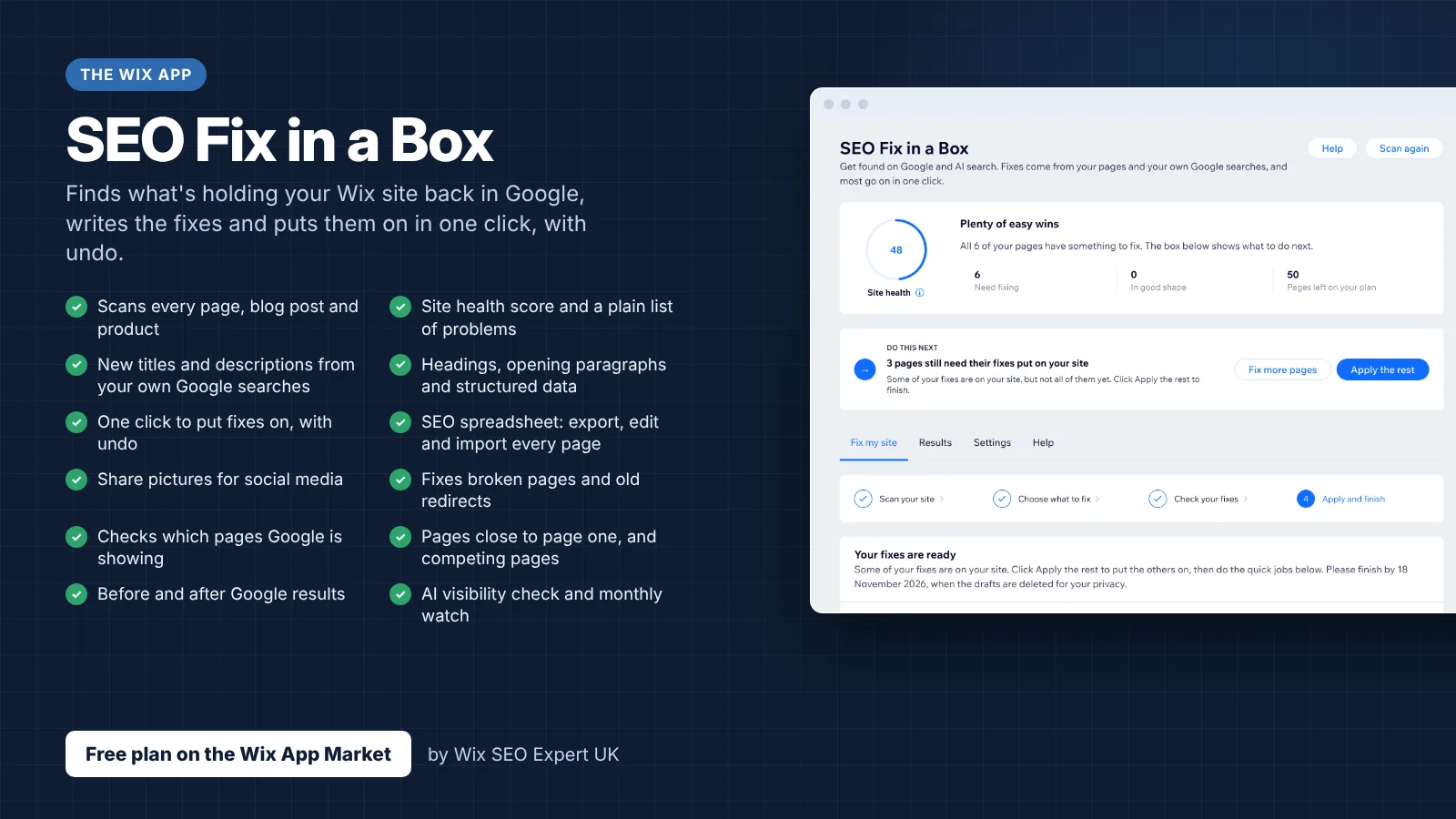
Wix SEO Fix in a Box scans every page, writes your fixes from your own Google searches and puts them on in one click, with undo. Start on the free plan.
Want this sorted on your own Wix site?
I have worked only on Wix for 14 years. Get Wix SEO Fix in a Box on the Wix App Market to find and fix what is holding your site back, or see my packages and prices if you would rather I did it all for you.
Frequently Asked Questions
Frequently Asked Questions
Does Wix hurt my chances of getting backlinks?
No. Backlinks point to your URL, not to a platform. A journalist, blogger or directory does not check whether you built your site on Wix, WordPress or Squarespace before linking to it. What matters is whether the page they land on is useful, credible and well-presented. Wix gives you full control over URL slugs, meta tags, structured data and page speed, so there is nothing platform-specific that would put off a potential linker.
How many backlinks do I need to rank on page one?
There is no fixed number. It depends on how competitive your target keyword is, the authority of the sites linking to you, and the quality of your on-page SEO. A local plumber in a small town might reach page one with a handful of strong local citations and one or two editorial links. A national e-commerce brand competing for broad terms might need hundreds. Focus on earning relevant, high-quality links rather than hitting an arbitrary count.
Is buying backlinks safe?
No. Google explicitly penalises paid link schemes. If you buy links from a link farm, a private blog network, or a freelancer offering hundreds of links for a flat fee, you risk a manual action or an algorithmic demotion that can take months to recover from. The only safe approach is earning links through content, outreach, PR and genuine relationships.
What is the fastest way to get backlinks for a new Wix site?
Start with your existing network. List every business association, supplier, partner, local chamber of commerce and industry directory where you have a legitimate presence and submit your site. Set up your Google Business Profile, Bing Places and Apple Business Connect listings. Then create one genuinely useful content asset, a guide, a tool, a piece of original research, and do targeted outreach to people who would find it valuable. These steps can produce your first real backlinks within weeks.
Can I see who links to my Wix site?
Yes. Google Search Console shows a sample of your backlinks under the Links report. For a more complete picture, use a dedicated tool like Ahrefs, Semrush or Moz, which crawl the web independently and track far more links than Search Console reports. Checking your backlink profile regularly helps you spot new opportunities, find broken links you can reclaim, and catch any spammy links you may need to disavow.
Do social media links count as backlinks?
Social media links are almost always nofollow, which means they do not pass ranking value directly. However, they still matter. A post that gets widely shared puts your content in front of journalists, bloggers and site owners who might then link to it from their own sites. Social links also drive referral traffic and help search engines discover your pages faster. Think of social sharing as the spark that can lead to real editorial backlinks, not as a backlink itself.