Is SEO Worth It for a Small Business on Wix? An Honest 2026 Answer

By Michael Andrews | Published: 2026-09-30 | Updated: 2026-09-30 | 18 min read
For most small businesses on Wix, yes, SEO is worth it, as long as people actually search for what you sell and you are willing to give it a few months. An honest look at when it pays, what your options really cost, and how to tell whether the money and time paid off.
For most small businesses on Wix, yes, SEO is worth it, as long as people actually search for what you sell and you are willing to give it a few months. It is not worth it if nobody searches for your service yet, if you need customers by next week, or if you will never look at the numbers to see whether it worked.
That is the honest answer I give every business owner who asks me, after 14 years working only on Wix sites and 800 completed projects. The rest of this post will help you work out which side of that line you are on, what your options really cost, and how to tell whether the money and time paid off.
The short answer
SEO is usually worth it for you if:
- People search on Google for the service or product you offer
- You need a steady flow of new customers, not just the odd referral
- You can wait a few months for the return
- Your competitors show up in Google and you do not
It is probably not worth it yet if:
- You have invented something nobody searches for yet
- You need sales this week, not this season
- Your site is about to be rebuilt or moved to a new platform
The reason SEO is worth it for most businesses is the same reason it frustrates people. It is slow, but once a page ranks, the visitors keep arriving without you paying for each click. Ads stop the moment you stop paying. A page that ranks well can keep bringing in enquiries for years.
What SEO actually does for a small Wix business
SEO is not a trick and it is not something you buy from Google. Google is clear that it never takes money to rank sites in its normal results, and appearing there costs nothing. What you are paying for, whether with your own time or someone else's, is the work that helps Google understand your site and trust it enough to show it.
In practice that work comes down to four things:
- Being understood. Google needs to know what you do, who you do it for and where. That comes from clear page titles, sensible headings, and pages that each have one clear job.
- Matching what people type. Your customers do not search for your business name. They search for the problem they have, like "emergency plumber near me" or "anxiety therapist online". Your pages need to use the words your customers use.
- Nothing getting in the way. Pages that are hidden from Google, broken redirects, or duplicate pages competing with each other can quietly hold a site back.
- Being worth recommending. Other sites linking to you, genuine reviews and useful content are how Google decides you are a safe bet to show.
The same groundwork now matters for AI answers too. ChatGPT, Perplexity and Google's AI Overviews all lean on pages that are clear, well structured and trustworthy. If you want the detail, I have written up what Google says about AI search and what actually works.
What SEO will not do is fix a weak offer, make up for bad reviews, or guarantee you the top spot. Anyone who promises you that is guessing, or worse.
Signs SEO is worth it for your business
These are the situations where I see SEO pay back fastest on Wix sites.
You already get impressions but hardly any clicks. Open Google Search Console and look at the Performance report. If Google is showing your pages hundreds of times a month but very few people click, Google already thinks you are relevant. The fix is often your page titles and descriptions, or moving a page from the bottom of page one to the top. This is usually the cheapest win there is. If you have never used Search Console, my Google Search Console guide walks you through it.
You sit on page two for the searches that bring you work. Page two gets very few clicks. Moving a page from position 12 to position 6 can make a real difference to enquiries, and it usually takes less work than starting from nothing.
Your customers search before they buy. Trades, therapists, clinics, coaches, tutors and online shops all fall into this group. If your customers normally Google before they pick up the phone, being findable is not optional.
Your competitors are small too. In a lot of local markets and niches, the businesses ranking above you are not huge brands. They are other small businesses that simply did the basics first. If you are just starting out, see how startups and small businesses on Wix can compete with bigger brands.
You are paying for every click with ads. If you already spend money on Google Ads, SEO is how you start earning some of those clicks for free.
When SEO probably is not worth it yet
I would rather tell you this now than take your money and watch you get frustrated.
Nobody searches for it yet. If you have created a brand new kind of product, there may be no searches to rank for. Build awareness through social media, partnerships and PR first, then use SEO once people start looking for you by name or by category.
You need results in days. SEO takes time. If you need bookings this week, ads, referrals and your existing customers are faster routes. Come back to SEO once the urgent problem is solved.
Your site is about to be rebuilt or moved. Do the SEO as part of the rebuild, not before it. Google's own advice is that a redesign or new launch is one of the best times to bring SEO into the project, because you build it in from the start instead of patching it later. If you are moving an existing site onto Wix, read my guide to moving to Wix without losing rankings first.
You will not act on it. An audit or report that sits in an inbox is money wasted. SEO only pays when the changes actually get made.
Is Wix the problem?
Usually, no. This is the question I get asked most, so it is worth clearing up.
Wix handles the technical basics well. It creates your sitemap, gives you SSL, lets you edit every page title and meta description, supports redirects, and lets you add structured data through custom code. Google ranks Wix sites every day.
When a Wix site does not rank, the cause is almost always something ordinary: vague page titles, thin pages with a couple of lines of text, one page trying to rank for everything, or no reason for any other website to link to it. None of that is Wix's fault, and all of it can be fixed. I go into more detail in Is Wix good for SEO? and in my list of common Wix SEO mistakes.
What Google says about getting help
Google has a page on this exact question, called Google's "Do you need an SEO?", and it is refreshingly honest. In short, it says:
- If you run a small local business, you can probably do much of the work yourself, starting with Google's SEO Starter Guide.
- Hiring help can improve your visibility and save you time, but an irresponsible SEO can damage your site and your reputation.
- A great time to hire is before a redesign or a new launch, though a good SEO can also improve an existing site.
- No one can guarantee a number one ranking on Google.
I agree with every point, and I say that as someone who charges for SEO. The right choice depends on your time, your budget and how competitive your market is. So let's look at the three real options.
Your three options, and what each one costs
Option 1: Do it yourself (free, but it costs your time)
If your site is fairly simple and your market is not crowded, you can get a long way on your own. Here is how I would do it:
- Learn the basics. My free Wix SEO course has 683 lessons across 68 modules. There is no sign-up and nothing is gated, so you can dip into just the parts you need.
- Check where you stand. Try the free plan of Wix SEO Fix in a Box on the Wix App Market, which scans every page of your Wix site.
- Work through a list. My 95-point Wix SEO checklist takes you through everything in order, so you are not guessing what to do next.
- Measure it. Connect Google Search Console and check it once a month.
Best for: owners with some spare time, a simple site and not much local competition.
Watch out for: spending weekends on things that do not matter, like chasing a perfect score in a built-in checklist, while missing the one page that would actually bring in customers. The hardest part of DIY SEO is not the doing. It is knowing what to do first.
Option 2: Get the exact fixes and apply them yourself (low cost)
This option sits in the middle, and it exists because a lot of owners told me the same thing: they were happy to make the changes, they just did not want to spend months learning what the changes should be.
Wix SEO Fix in a Box, available on the Wix App Market, scans every page of your site, writes SEO fixes from your own Google searches and puts them on in one click, with undo. It has a free plan, with paid plans for 20, 60 or 200 pages a year.
Best for: owners who are comfortable clicking around the Wix editor but do not want to learn SEO from scratch, and agencies that are short on time.
The honest limit: it fixes what is on your pages. It does not build links or authority for you. For a lot of small sites, the on-page fixes are exactly what is missing. For sites in very competitive markets, they are a strong start rather than the whole job.
Option 3: Have it done for you
If your time is worth more spent running your business, or your market is competitive, the sensible route is to hand it over. With my done-for-you Wix SEO, I make the changes directly on your site, from page titles and content structure to structured data and technical fixes, and explain what I changed and why.
The cost depends on the size of the site and how competitive your market is, so there is no honest single price. There is a broader guide to how much SEO costs in 2026 if you are comparing providers.
Best for: busy owners, competitive local markets, online shops and larger sites with lots of pages.
How to tell if SEO has paid off
This is the question that matters most, and it is simpler than people think.
Start with what one new customer is worth to you. Then compare the extra customers that come from Google against what you spent, including your own time if you went the DIY route.
Here is a made-up example to show the sum. Say a new customer is worth £300 to you. If better rankings bring in two extra customers a month, that is £600 a month. If you spent £250 on fixes, it has paid for itself in the first month those customers turn up, and everything after that is profit. Put in your own numbers and the answer usually becomes obvious.
To track it:
- Use Google Search Console to watch clicks, impressions and average position for the searches that matter to you.
- Ask every new enquiry how they found you. It is low-tech and it works.
- Look at months, not days. Rankings move around from day to day. The trend over three to six months is what counts.
I go into this properly in my guide to measuring Wix SEO ROI.
How long does SEO take?
Honestly, it depends, and anyone who gives you an exact date is guessing.
Small on-page changes, like better titles and descriptions, can start to show up in Search Console within a few weeks, once Google has recrawled the pages. You can speed that up by using the URL Inspection tool in Search Console to ask Google to look again. Bigger gains, like ranking for competitive searches, usually build over several months as your content improves and other sites start linking to you. If you want to know more about that side of things, I have written about getting backlinks for a Wix site.
The good news is that the early changes are often the ones that make the biggest difference to small sites, because they fix the things that were holding the site back in the first place.
If you do hire help: questions to ask and red flags to avoid
Whether you hire me or someone else, these questions will help you choose well. Several of them come straight from Google's own advice.
Questions to ask:
- How often do you work on Wix sites? Someone who works on Wix every day will know its settings and workarounds. Someone who works on it now and then will be learning on your time. I have written more on choosing between a specialist or general agency.
- Can I see reviews I can check for myself? Look for reviews on a platform the provider does not control. You can read the 456 five-star reviews on my Wix Marketplace profile, for example.
- Will you explain every change you make, and why? You should never be left wondering what was done to your site.
- What results do you expect, and how will you measure them? Good answers talk about clicks, enquiries and positions for the searches that matter, not vague promises.
- What access do you need? For an audit, read-only access to Search Console is enough. Google specifically advises not giving write access at that stage.
- Do you follow Google's guidelines? And if they offer AI search or GEO work, does their advice line up with Google's own guidance on AI search?
Red flags:
- A guaranteed number one ranking. Google says plainly that nobody can promise this.
- Talk of a "special relationship" with Google.
- Cold emails telling you your site is not listed on Google.
- Refusing to explain what they are doing, or being vague about it.
- Asking you to link to their website as part of the deal.
- Offering to submit your site to thousands of directories.
- Judging success only by a checklist score rather than by clicks and enquiries.
My honest take
I have spent 14 years working only on Wix sites, and the businesses that get the most from SEO are not the ones with the biggest budgets. They are the ones whose owners know their customers well and make their website answer those customers' questions clearly. Most of my job is helping people do that faster, and knowing which changes actually matter on Wix.
So here is how I would decide. If your site is simple and your market is quiet, start with the free course and do it yourself. If you want a head start without a big bill, the SEO Fix in a Box app writes the fixes for you. If you would rather hand it over completely, that is what the done-for-you service is for.
Whichever you choose, start by running your site through the free audit tool. It takes a couple of minutes, it costs nothing, and it will tell you straight away whether there is low-hanging fruit waiting to be picked.
Fix your Wix SEO from your dashboard
Wix SEO Fix in a Box scans every page, writes your fixes from your own Google searches and puts them on in one click, with undo. Start on the free plan.
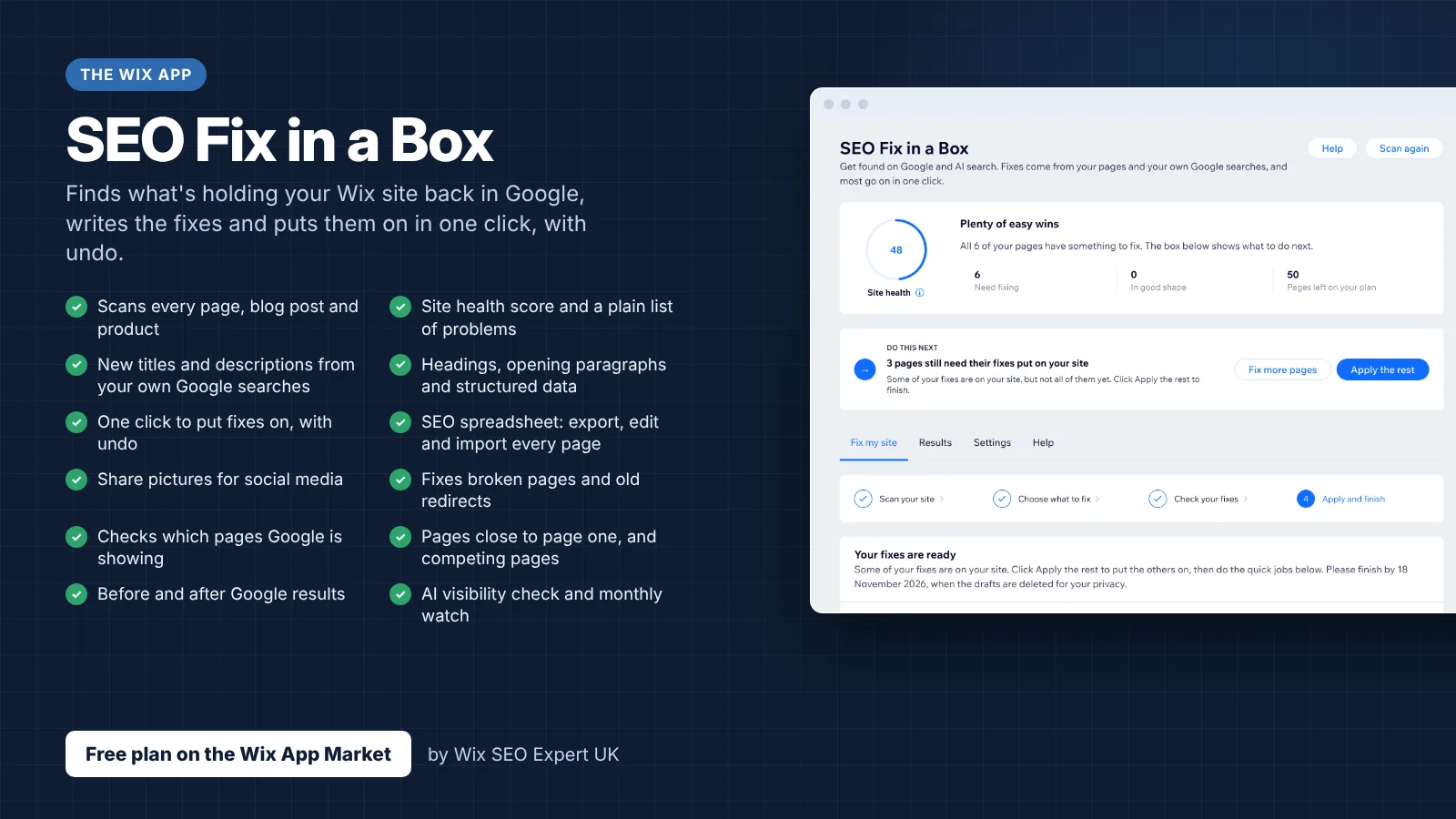
Want this sorted on your own Wix site?
I have worked only on Wix for 14 years. Get Wix SEO Fix in a Box on the Wix App Market to find and fix what is holding your site back, or see my packages and prices if you would rather I did it all for you.
Frequently Asked Questions
Is SEO worth it for a small business?
For most small businesses, yes. If people search on Google for what you sell and you can wait a few months for results, SEO is one of the few marketing channels that keeps bringing in customers after the work is done. It is less worth it if nobody searches for your service yet or you need customers immediately.
Can I do SEO on Wix myself?
Yes. Google itself says small local businesses can probably do much of the work themselves. Wix gives you control over page titles, descriptions, headings, redirects and structured data, and my free Wix SEO course walks you through all of it with no sign-up.
How much does SEO cost for a Wix website?
It ranges from free, if you do it yourself, through to done-for-you work priced on the size of your site and how competitive your market is. If you want help doing it yourself, the SEO Fix in a Box app for Wix has a free plan, with paid plans for 20, 60 or 200 pages a year.
How long does SEO take to work on Wix?
Small changes like better page titles can start showing in Google Search Console within a few weeks of Google recrawling your pages. Bigger ranking gains in competitive markets usually build over several months.
Is SEO better than Google Ads for a small business?
They do different jobs. Ads bring visitors straight away but stop when you stop paying. SEO is slower to start but keeps working without paying for each click. Many small businesses use ads for quick wins while their SEO builds up.
Can anyone guarantee a first page ranking on Google?
No. Google states that no one can guarantee a number one ranking. Treat any provider who promises one with caution, and ask how they will measure real results like clicks and enquiries instead.