The AI Features Built Into Wix, and What They're Actually Good For

By Michael Andrews | Published: 2026-08-24 | Updated: 2026-08-24 | 14 min read
An honest practitioner assessment of every AI feature built into Wix in 2026, covering Wix Harmony, Aria, Kleo, the AI Structured Data Generator, AI SEO Setup, blog AI writing tools, and the AI Image Creator. What each one actually does, where it falls short, and whether you can rely on them.
Wix has genuine AI features built into the platform, not just marketing language. I work inside Wix every day, so here is what each one actually does, what it is good for, and where it falls short, rather than a generic list of third-party apps.
Most articles about "Wix AI tools" are actually roundups of third-party SEO apps you can bolt onto Wix. That is a different topic. This post covers only the AI features that Wix itself has built into the platform, features that every Wix user has access to without installing anything extra. I have tested each one across client sites and my own projects, and I will be honest about what works, what is limited, and what is genuinely useful for SEO.
As of August 2026, Wix has seven AI features that are relevant to SEO and content creation. Some are excellent. Some are useful starting points. None of them replace a proper strategy. Here is each one, assessed individually.
Wix Harmony: The AI Website Builder
Wix Harmony launched in early 2026 as the platform's new default website builder and editor. It replaces the classic Wix Editor for new accounts and represents a fundamental shift in how Wix sites are built. You describe what you want in natural language, and Harmony generates a complete site with pages, sections, layouts, and content.
From an SEO perspective, Harmony is a significant improvement over the classic editor. It uses a section-based layout system built on CSS Flexbox and Grid, producing cleaner HTML and genuinely responsive pages with true CSS breakpoints. This matters for Core Web Vitals and mobile-first indexing because the same DOM elements exist on every viewport, and layouts adapt through CSS rules rather than separate positioning data. Nothing gets hidden from Googlebot because there is only one version of each page.
What Harmony is actually good for
Getting a structurally sound website up quickly. Harmony generates pages with proper heading hierarchy, semantic sections, and responsive layouts that pass Core Web Vitals checks without needing manual performance fixes. For someone starting from scratch, this is a genuine time-saver compared to building in the classic editor where responsive issues were common and required careful manual adjustment.
The layout quality is also noticeably better than what the old ADI (Artificial Design Intelligence) tool produced. ADI, the previous AI site builder, created functional but basic sites. Harmony produces layouts that look and perform more like professionally designed pages. If you are wondering whether ADI still exists, it has effectively been replaced by Harmony for all new accounts.
Where Harmony falls short
Harmony builds layouts, not SEO strategies. It does not research your competitors, identify keyword gaps, plan your content architecture, or decide which pages your site actually needs to rank for your target terms. A Harmony-generated site looks professional and loads fast, but it arrives with generic placeholder content, no structured data beyond defaults, no internal linking strategy, and meta titles and descriptions that are placeholders at best.
Treat a Harmony-generated site as a well-built foundation that needs proper SEO work on top. The technical base is sound. Everything above that, content strategy, keyword targeting, schema markup, internal linking, needs doing manually or with the help of the other AI tools described below. For what Wix's AI site builder means for getting found on Google, see Wix Symphony and SEO.
While Wix's AI features streamline website building through tools like Harmony, job seekers can similarly expedite resume customisation using an AI resume builder to tailor applications efficiently.
Aria: The AI Agent Inside the Editor
Aria is an AI agent that lives inside the Wix Harmony Editor. You interact with it through a chat interface, describing what you want in plain language, and Aria executes changes to your site. It can build new pages, create sections, write text content, customise designs, adjust layouts, and help with site structure and settings.
According to Wix's own documentation, Aria "can help with anything related to your site design, such as building pages, writing content, and customizing designs" and also assists "with structure, settings, SEO, or site apps." You access it by clicking Ask Aria on the action bar in the editor, and it gives instant suggestions for refining content, simplifying language, adjusting length, or changing tone.
What Aria is actually good for
Quick content iterations and layout changes. If you need to rewrite a section in a different tone, add a new page based on a description, or restructure a layout, Aria handles these tasks faster than doing them manually through the editor interface. It is particularly useful for generating first-draft text for new pages when you need something on the page quickly.
Aria can also generate images from text prompts directly within the editor. This is helpful for quickly adding visuals to pages without needing to source stock photography separately, though the quality varies and the images are obviously AI-generated.
Where Aria falls short
Aria produces generic content. It writes competently but without genuine expertise, specific examples, or the kind of first-hand experience that Google values through E-E-A-T (Experience, Expertise, Authoritativeness, Trustworthiness). If you ask Aria to write a service page for a plumbing company, it will produce something that reads like every other plumbing company's service page. It will not mention your specific service area, your qualifications, your pricing approach, or anything that differentiates you.
For SEO, this matters. Google is increasingly rewarding content that demonstrates genuine expertise and first-hand experience. Aria-generated content, used as-is, does not demonstrate either. Use it as a starting framework, then rewrite substantially with your own knowledge, specific details, and professional perspective.
Kleo: The AI Marketing Agent
Kleo is a separate AI agent from Aria, focused on marketing rather than site building. Kleo analyses your website to create an overview of your business, which it then uses as a brief to generate marketing materials. It operates from the Wix dashboard rather than inside the editor.
Kleo can help with SEO suggestions, social media content, blog ideas, email campaigns, and paid ad copy. The key distinction from Aria is scope: Aria edits your website, Kleo creates marketing content and strategy suggestions that span beyond your site.
What Kleo is actually good for
Generating marketing content at speed. If you need social media posts, email subject lines, or blog topic ideas, Kleo produces reasonable first drafts quickly. Its SEO suggestions can point you toward optimisation opportunities you might have missed, particularly around meta descriptions and page titles across your site.
The business analysis step is genuinely useful. Kleo reads your site content to understand what your business does, then uses that context when generating materials. This means its output is at least relevant to your business, unlike a generic AI writing tool that knows nothing about you.
Where Kleo falls short
Kleo is only as good as the information it can extract from your site. If your site content is thin or vague, Kleo's business brief will be thin and vague, and everything it generates will reflect that. It also cannot access your analytics, your competitors' data, or your specific market positioning. Its SEO suggestions are based on what it reads on your pages, not on competitive keyword research or search volume data.
Think of Kleo as a capable but junior marketing assistant: it can produce work quickly, but it needs direction and cannot make strategic decisions about where to focus your efforts.

The AI Structured Data Generator
This is one of the most genuinely useful AI features Wix has introduced. The AI Structured Data Generator analyses your published blog posts and automatically creates relevant Schema.org structured data for them. It can generate Article, FAQPage, Recipe, HowTo, and other schema types depending on what it detects in your blog content.
On Wix Harmony (the default for new accounts), this feature is enabled automatically for blog posts. On the classic editor, existing users need to opt in through SEO Settings in the dashboard. Once active, every new or updated blog post automatically receives structured data based on its actual content. The feature is documented on Wix's support site under "Using AI-Generated Structured Data for Blog Posts."
What the AI Structured Data Generator is actually good for
Automating blog post schema without needing to understand JSON-LD. For site owners who would never manually add structured data, this feature means their blog posts get schema markup that they would otherwise go without. It analyses the content intelligently, so a blog post with a clear question-and-answer format gets FAQPage markup, and a recipe post gets Recipe markup. This is a meaningful step forward.
The generated markup is read-only, meaning you cannot edit it directly. If you need custom control over your schema, you create separate manual markup through Custom Code or SEO Settings, which takes precedence.
Where the AI Structured Data Generator falls short
It applies only to blog posts. Not to your homepage, not to service pages, not to contact pages, not to landing pages, and not to any other page type. For most business websites, the pages that would benefit most from structured data, your homepage with LocalBusiness schema, your service pages with Service schema, your FAQ page with FAQPage schema, are exactly the pages this tool does not cover.
I have written a detailed guide to adding schema markup to Wix that covers the manual methods for every page type, including worked examples. If you are relying solely on the AI generator, you are leaving the most valuable schema opportunities on the table.
AI SEO Setup: The Optimize with AI Button
Inside the Wix SEO Setup workflow (the guided process that replaced the older SEO Wiz), there is an "Optimize with AI" button. When you click it, Harmony analyses your entire site, taking into account your business details, page content, and focus areas, then conducts keyword research to match relevant search terms to each page. It generates optimised meta titles and descriptions based on this analysis.
What AI SEO Setup is actually good for
Getting meta titles and descriptions populated across every page of your site. Many Wix sites launch with default or blank meta tags, which is worse than having AI-generated ones. The keyword research step, while automated, does identify relevant terms and attempts to match them logically to your pages. For a small business owner who would otherwise have no meta titles at all, this is a genuine improvement.
The step-by-step guided format is also helpful. It walks you through connecting Google Search Console, verifying your business details, and optimising each page in sequence. For someone unfamiliar with SEO, this structure prevents the common problem of not knowing where to start.
Where AI SEO Setup falls short
The automated keyword matching is broad rather than strategic. It identifies keywords that are relevant to your content but does not assess competition, search intent alignment, or whether those keywords represent realistic ranking opportunities for your site. A local plumber in Maidstone might get suggested keywords that global plumbing brands already dominate, with no indication that targeting those terms is unrealistic.
The generated meta titles and descriptions are also functional but generic. They tend to follow predictable patterns and rarely capture the specific value proposition that would make someone click your result over the nine others on the same page. After running AI SEO Setup, treat every meta title and description as a draft that needs rewriting with your actual selling points.
Blog AI Writing Tools
The Wix blog editor includes AI writing tools that can generate outlines, title ideas, full draft posts, SEO titles, meta descriptions, and image alt text. These are available directly within the blog post editor, so you can access them while writing without switching to a separate tool.
What the blog AI writing tools are actually good for
Overcoming blank page paralysis. If you know what topic you want to cover but cannot get started, the outline generator gives you a structure to work from. The title suggestions can spark ideas even if you do not use them verbatim. The alt text generator is particularly useful because writing image alt text is the kind of task that most people skip entirely, and having AI-generated alt text is significantly better than having none.
For meta descriptions specifically, the AI tool saves time on a task that is tedious but important. A decent AI-generated meta description that you then adjust is faster than writing one from scratch for every post.
Where the blog AI writing tools fall short
Full draft posts are the weakest output. They read like what they are: AI-generated content that covers a topic broadly without depth, specificity, or genuine insight. In a landscape where Google explicitly values content that demonstrates first-hand experience, publishing AI drafts without substantial rewriting is a poor strategy. The content will be grammatically correct and topically relevant, but it will not rank against competitors who are publishing genuine expertise.
The titles and outlines tend toward the same patterns you see across every AI writing tool: "The Ultimate Guide to X," "10 Ways to Y," "Everything You Need to Know About Z." These are not bad formats, but they are not differentiated either. Use the AI to generate options, then apply your own angle and perspective.
AI Image Creator and Editor
Wix Harmony includes an AI image creator that generates original images from text prompts, and an AI image editor that can modify, enhance, or regenerate existing visuals. You describe the image you want, choose a style, and Aria generates it directly within the editor for immediate placement on your page.
What the AI Image Creator is actually good for
Filling image gaps quickly. Not every page needs professional photography, and for decorative or illustrative images, AI generation can produce something adequate faster than sourcing stock photography. It is particularly useful for blog post headers or section backgrounds where a relevant visual is better than no visual, even if it is not a photograph.
Where the AI Image Creator falls short
AI-generated images are increasingly recognisable. They tend to have a particular smoothness and lighting style that experienced web users identify immediately. For client-facing pages where trust matters, such as service pages, about pages, and case studies, real photography is still clearly superior. AI images can also create unexpected file sizes if not optimised, which affects page speed.
There is also no direct SEO benefit to AI-generated images over stock photography or original photos. Google does not reward or penalise based on how an image was created. The SEO considerations are the same regardless: descriptive alt text, appropriate file size, proper dimensions, and relevance to the surrounding content.
What Wix AI Tools Do Not Do
Being honest about the gaps matters more than listing features. Here is what none of these tools cover, and what still requires either manual work or professional help.
- Genuine keyword research based on search volume, competition, and intent alignment. The AI SEO Setup identifies relevant terms but does not assess whether you can realistically rank for them.
- Competitive analysis. None of these tools look at what your competitors are doing, what keywords they rank for, or where gaps exist in your market.
- Entity-level structured data strategy. The AI Structured Data Generator handles blog posts, but building a connected schema graph across your entire site with proper @id references, linking your business entity to services, locations, and credentials, requires manual implementation.
- Backlink building. No AI tool built into any website platform can earn you links from other websites. Link building remains a fundamentally human activity that depends on relationships, content quality, and outreach.
- Content strategy and topical authority. AI tools can write individual pieces, but they cannot plan a content architecture that builds topical depth across dozens of related pages, which is what actually moves rankings for competitive terms.
- Local SEO beyond basics. Google Business Profile optimisation, citation building, review strategy, and local link building are all outside the scope of any on-platform AI tool.
If your site needs any of these, and virtually every business site does, the AI tools are a starting point, not a destination. Professional SEO work fills the gaps that platform tools cannot reach.
Should You Rely on Wix AI Tools Alone?
No, but you should use them. That is not a contradiction.
Wix AI tools are genuinely useful for getting the basics done faster and better than doing nothing at all. A site built with Harmony loads faster than most sites built in the classic editor. AI-generated meta titles are better than blank meta titles. AI-generated blog schema is better than no schema. Kleo's marketing suggestions are better than having no marketing plan whatsoever.
The problem comes when people treat these tools as the complete solution. They are not. They handle the foundational layer of SEO competently, but every site competing for meaningful search visibility needs work above that foundation: strategic keyword targeting, content that demonstrates genuine expertise, structured data that covers the whole site, a link profile that signals authority, and technical optimisation that goes deeper than what any automated tool touches.
Use the AI tools for what they are good at. Save your time and effort for the strategic work that only a human, ideally one who understands your business and your market, can do properly. If you want to go further than Wix's own AI tools, see my guide on how to use Claude AI with Wix.
A Note on Orion
You may see references to Orion as another Wix AI agent. Orion is a personal assistant in the Wix dashboard that helps with account management, billing queries, and general guidance. It is not an SEO tool and does not affect your site's search performance. I mention it here only because it appears in some "complete list of Wix AI tools" articles and I want to be clear that it is not relevant to your search rankings.
Fix your Wix SEO from your dashboard
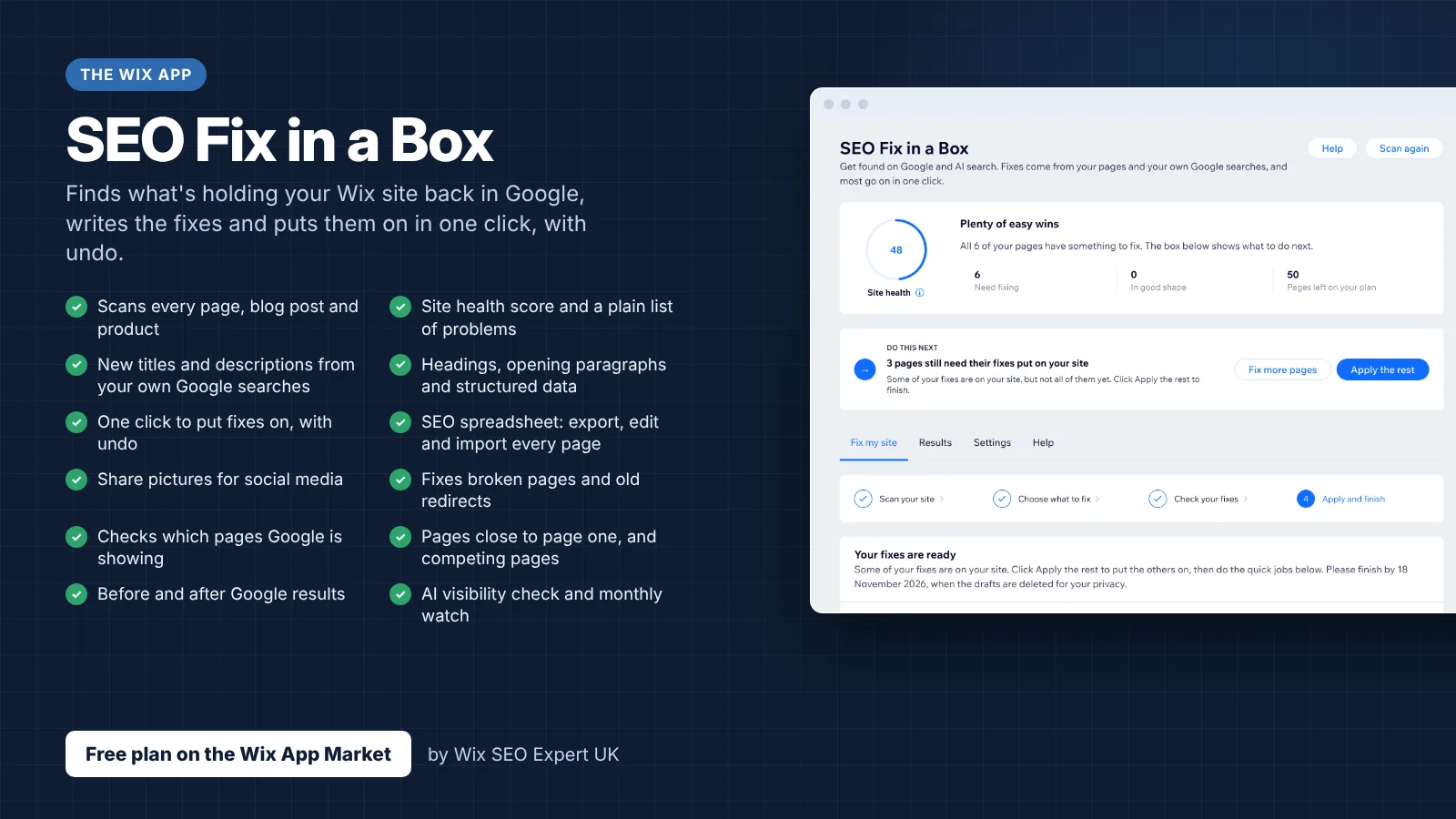
Wix SEO Fix in a Box scans every page, writes your fixes from your own Google searches and puts them on in one click, with undo. Start on the free plan.
Want this sorted on your own Wix site?
I have worked only on Wix for 14 years. Get Wix SEO Fix in a Box on the Wix App Market to find and fix what is holding your site back, or see my packages and prices if you would rather I did it all for you.
Common Questions
Frequently Asked Questions
Does Wix have AI SEO tools built in?
Yes. Wix has several AI tools built directly into the platform that are relevant to SEO. These include the AI SEO Setup with its Optimize with AI button for meta titles and descriptions, the AI Structured Data Generator for blog post schema markup, Kleo the AI marketing agent for broader SEO suggestions, and AI-assisted content writing tools in the blog editor. These are genuine platform features, not third-party add-ons.
Is the Wix AI Structured Data Generator any good?
It is genuinely useful for blog posts. It analyses your published blog content and automatically generates relevant schema types including Article, FAQPage, Recipe and HowTo markup. However, it only applies to blog posts, not to service pages, homepages, landing pages, or any other page type. If your site needs LocalBusiness, Service, or custom schema on non-blog pages, you still need to add that manually.
Can AI tools replace an SEO strategy?
No. Wix AI tools are useful starting points and time-savers for specific tasks, but they do not replace a proper SEO strategy. They cannot conduct competitive analysis, build topical authority, earn backlinks, develop entity-level structured data across your whole site, or make strategic decisions about which keywords to target. Think of them as assistants that handle routine tasks, not strategists that plan the work.
Do I need to check AI-generated content or schema afterward?
Yes, always. AI-generated meta titles and descriptions can be generic or miss your actual value proposition. AI-generated blog content needs editorial review for accuracy, tone, and genuine expertise signals. AI-generated structured data should be validated using Google Rich Results Test and Schema Markup Validator. Treat AI output as a first draft that needs human review, not a finished product.
Does Wix Harmony affect SEO differently to the classic editor?
Yes. Wix Harmony uses a section-based layout with true CSS breakpoints and Flexbox, which produces cleaner, more responsive HTML than the classic editor. This is better for Core Web Vitals and mobile-first indexing. Harmony also integrates AI features more deeply, with Aria available throughout the editor and the AI Structured Data Generator enabled by default for blog posts. Sites on the classic editor need to opt in to the AI Structured Data Generator separately via SEO Settings.
Will Wix add more AI features in future?
Very likely. Wix has been releasing AI features at a steady pace throughout 2025 and 2026, with Harmony, Aria, Kleo, and the AI Structured Data Generator all launching within this period. The platform is clearly investing in AI as a core part of its editor and dashboard. However, future features are unannounced, so any specific predictions would be speculation. I will update this post as new features are confirmed and tested.
Is Kleo the same as Aria?
No. Aria is the AI agent inside the Wix Harmony Editor, focused on building and editing your website through natural language prompts. Kleo is a separate AI marketing agent that analyses your business and creates marketing materials including SEO suggestions, social media content, blog ideas, and email campaigns. Aria works inside the editor; Kleo works across your broader marketing from the dashboard.
Can Aria write SEO-optimised content for my Wix site?
Aria can generate text content and help with writing within the editor, and the blog AI tools can produce outlines, titles, and full draft posts. However, the output is first-draft quality and tends toward generic phrasing. It does not demonstrate genuine expertise or experience, which are the signals Google values through E-E-A-T. Use it as a starting point, then rewrite with your own knowledge, specific examples, and professional perspective.