International technical SEO for Wix: CDN, server location, page speed and crawling
Module 35: Wix SEO for Non-English Markets & Alternative Search Engines | Lesson 412 of 683 | 44 min read
By Michael Andrews, Wix SEO Expert UK
Serving international audiences from a Wix site introduces technical challenges that do not affect single-market sites. Page speed varies by geographic distance from Wix servers, different search engine crawlers have different requirements, character encoding for non-Latin scripts needs careful handling, and crawl budget must be managed across multiple language versions. This lesson covers the technical foundations for successful international SEO on Wix.
How Wix CDN Handles International Content
Wix uses a global CDN (Content Delivery Network) that serves your site from edge servers distributed worldwide. This means visitors in Europe, Asia, and the Americas receive your content from a nearby server, reducing latency. However, CDN performance varies by region. European and North American coverage is excellent. Coverage in parts of Africa, South America, and Asia may be less consistent. Test your page speed from each target market using tools that allow location-specific testing.
Page Speed for Different Regions
Run Google PageSpeed Insights and WebPageTest from servers in each of your target countries. A page that loads in 1.5 seconds from London might take 4 seconds from Seoul or 6 seconds from Buenos Aires. If page speed is significantly worse in a target market, consider reducing image sizes, minimising custom code, and ensuring critical content loads first for those regions.
Character Encoding for Non-Latin Scripts
Wix uses UTF-8 encoding by default, which supports all major writing systems including Chinese, Japanese, Korean, Arabic, Hebrew, Cyrillic, and Devanagari. This means character encoding is rarely an issue on Wix. However, ensure any custom code, embed widgets, or third-party integrations also use UTF-8 to prevent character rendering issues in non-Latin content.
Crawl Budget for Multilingual Sites
A multilingual Wix site with 5 language versions has 5x the pages of a single-language site. This directly impacts crawl budget. Google, Yandex, Baidu, and other engines must crawl each language version separately. To manage crawl budget effectively, ensure your hreflang tags are correct (so engines do not waste crawl budget on the wrong language), keep your sitemap clean, and prioritise indexation of your most important language versions.
Structured Data Localisation
Structured data on multilingual pages should be localised. Organization schema should include the local address, phone number, and operating hours for each market. Product schema should use local currency and pricing. Review schema should reflect reviews in the relevant language. Each language version of a page should have its own localised structured data, not just a copy of the English version.
Optimise technical SEO for international audiences
- Test page speed from each target country using WebPageTest with location-specific servers
- If speed is poor in a target region, optimise images and reduce custom code for those pages
- Verify UTF-8 encoding is working correctly by checking non-Latin content renders properly
- Check crawl budget usage in GSC to ensure all language versions are being crawled
- Ensure hreflang tags are correct so crawlers do not waste budget on wrong language pages
- Localise structured data on each language version with correct currency, address and phone formats
- Submit separate sitemaps for each language version to the relevant search engine webmaster tools
- Monitor indexation rates for each language version independently
Testing Page Load Speed from Target Regions
Page load speed varies dramatically by geographic location. Your Wix site may load in 1.5 seconds from the UK but 4.5 seconds from Australia or 6 seconds from South Korea. Test load times from every target region because local search engines (especially Baidu and Naver) heavily penalise slow-loading foreign sites. Wix uses a CDN that caches content globally, but third-party scripts, unoptimised images, and embeds can negate CDN benefits.
Test and optimise page load speed from target regions
- Test your homepage and top 3 pages using GTmetrix with test locations set to each target region.
- Record the fully loaded time and LCP (Largest Contentful Paint) for each region. Create a baseline spreadsheet.
- Identify resources that load slowly from specific regions. GTmetrix waterfall charts show exactly which resources add latency.
- Optimise images on pages targeting distant regions. Use WebP format and compress to under 100KB each where possible.
- Remove or defer any third-party scripts not essential for user experience. Each external script adds latency, especially from geographically distant CDNs.
- Test again after optimisation. Document the improvement for each region.
Language-Specific Schema Markup
Each language version of your Wix site should have schema markup with the correct language property. The inLanguage property in your schema tells search engines which language the content is written in, helping them serve the right version to the right users. Additionally, some schema properties like addressCountry, currency, and geographic coordinates should be localised to match each market.
{
  "@context": "https://schema.org",
  "@type": "WebPage",
  "inLanguage": "fr-FR",
  "name": "Nos Services SEO pour Wix",
  "description": "Services d'optimisation SEO pour les sites Wix en France",
  "isPartOf": {
    "@type": "WebSite",
    "name": "Votre Entreprise",
    "url": "https://www.example.com/fr/",
    "inLanguage": "fr-FR"
  }
}
International Sitemap Configuration
Your Wix site generates a single sitemap that includes all language versions with hreflang annotations. Verify this sitemap is correctly structured by checking that every URL has corresponding hreflang entries for all language versions. Submit this sitemap to every search engine webmaster tool you use: GSC, Bing Webmaster Tools, Yandex Webmaster, and Naver Search Advisor.
- Check your sitemap at yourdomain.com/sitemap.xml. Verify all language versions of each page are listed.
- Each URL entry should have xhtml:link hreflang annotations for every language version including itself.
- Submit the sitemap URL to Google Search Console (submit once, it covers all language versions).
- Submit the same sitemap to Bing Webmaster Tools.
- If targeting Russia, submit to Yandex Webmaster.
- If targeting Korea, submit to Naver Search Advisor.
- Monitor sitemap status in each webmaster tool monthly. Check for errors and indexation counts.
Complete How-To Guide: International Technical SEO Setup for Wix
Complete step-by-step international technical SEO configuration
- Step 1: Verify hreflang tags on your top 5 pages by viewing page source. Each page must have hreflang tags for every language version including a self-referencing tag. Use the Hreflang Tags Testing Tool to validate.
- Step 2: Run your hreflang implementation through a cross-page validator. Each hreflang tag must have a matching reciprocal tag on the target page. Missing reciprocals cause hreflang to be ignored.
- Step 3: Test page load speed from every target region using GTmetrix. Record baseline LCP and fully loaded time for each region.
- Step 4: Optimise images and remove non-essential third-party scripts on pages with load times above 3 seconds from target regions.
- Step 5: Verify your sitemap includes all language versions with correct hreflang annotations. Check yourdomain.com/sitemap.xml directly.
- Step 6: Submit your sitemap to every search engine webmaster tool: GSC, Bing Webmaster Tools, and any regional engines you target (Yandex, Naver).
- Step 7: Add language-specific schema markup to each language version. Set the inLanguage property to the correct language-region code (e.g., fr-FR, de-DE, ja-JP).
- Step 8: Verify schema markup on each language version using the Google Rich Results Test. Fix any errors.
- Step 9: Check character encoding on all language versions. View page source and verify the meta charset tag shows UTF-8. Test that all special characters (accents, umlauts, CJK characters) render correctly.
- Step 10: Test your Wix site with JavaScript disabled to verify that hreflang tags and language-specific content are present in the initial HTML response. Some search engines do not execute JavaScript.
- Step 11: Set up separate GSC properties for each language subdirectory. This provides language-specific performance data and crawl error monitoring.
- Step 12: Create a monthly international technical SEO checklist: verify hreflang integrity, check regional page speed, monitor indexation counts per language in each webmaster tool, review schema validation, and address any new crawl errors.
Essential Tools for This Lesson
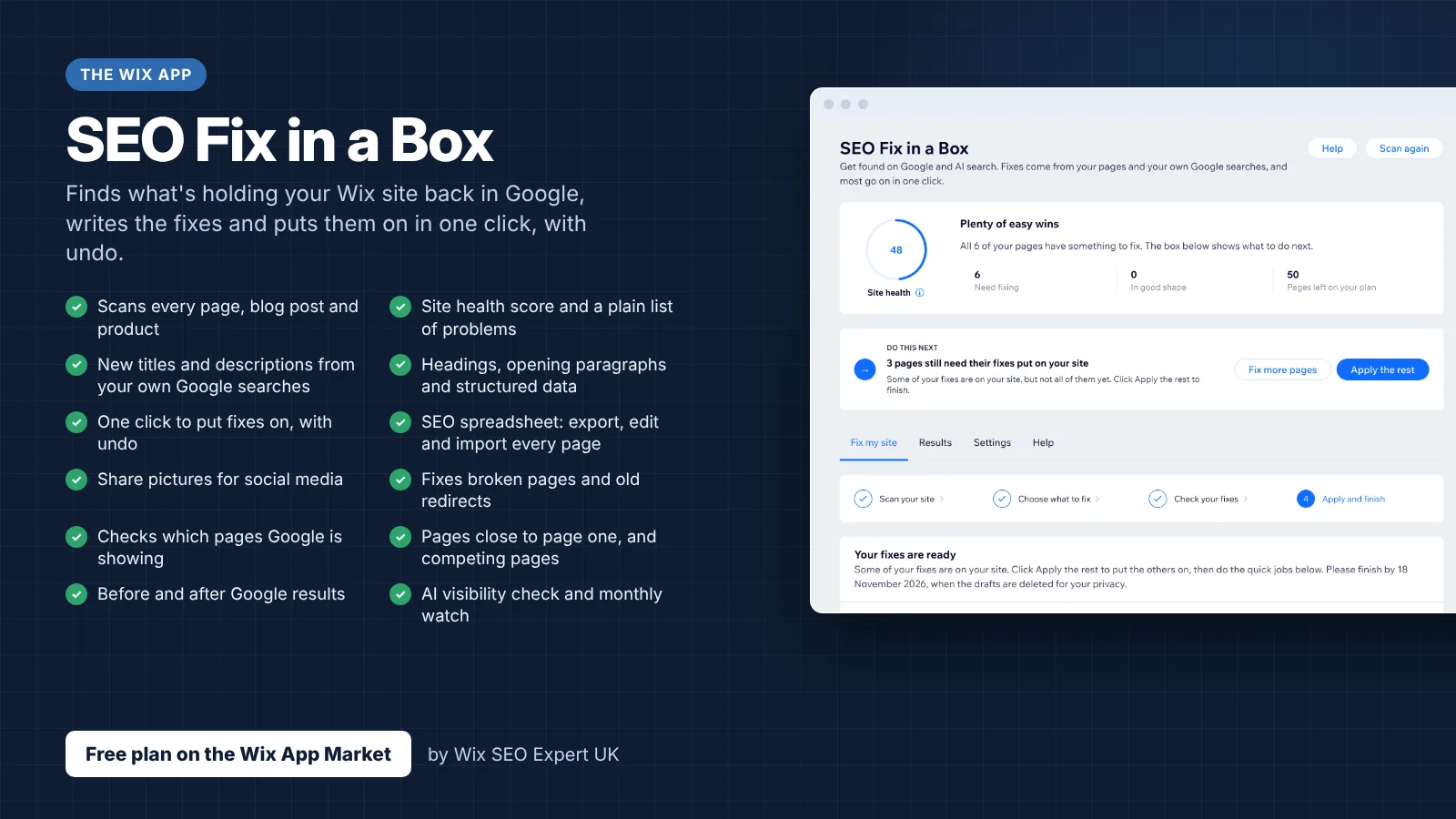
- SEO Fix in a Box: My Wix app. Free to install, it scans your site and shows what needs fixing, and paid plans write the fixes from your own Google searches
Was this lesson useful?
It takes 1 minute to tell me. The course is free and I want to keep it that way, and your feedback shows me what is working and helps other people find it.
This lesson on International technical SEO for Wix: CDN, server location, page speed and crawling is part of Module 35: Wix SEO for Non-English Markets & Alternative Search Engines in The Most Comprehensive Complete Wix SEO Course in the World (2026 Edition). Created by Michael Andrews, a Wix Marketplace Legend Partner with 14 years of hands-on experience, 800 completed Wix SEO projects and 456 verified five-star reviews.