Complete Wix international SEO and alternative search engine audit checklist
Module 35: Wix SEO for Non-English Markets & Alternative Search Engines | Lesson 413 of 683 | 50 min read
By Michael Andrews, Wix SEO Expert UK
This capstone lesson combines every international and alternative search engine technique from this module into a comprehensive 50-point audit checklist. Use this quarterly to assess your Wix site international SEO readiness, identify gaps in your multilingual and multi-engine coverage, and prioritise improvements. Score each item as Pass (2 points), Partial (1 point), or Fail (0 points) for a maximum score of 100.

Section 1: Multilingual Technical Setup (10 Points)
- Wix Multilingual enabled with all target languages configured
- Hreflang tags correctly generated and verified in page source
- URL slugs translated into native language for each language version
- Language switcher functioning correctly and accessible from all pages
- Self-referencing hreflang tag present on every page
- X-default hreflang set for your primary language version
- Each language version has its own unique title tags and meta descriptions
- Image alt text translated for each language version
- Robots.txt allows crawling of all language version directories
- Separate sitemaps submitted for each language version to relevant search engines
Section 2: Search Engine Registration (8 Points)
- Google Search Console: all language versions verified and monitored
- Bing Webmaster Tools: site registered with sitemap submitted
- Yandex Webmaster: site registered if targeting Russian-speaking markets
- Naver Search Advisor: site registered if targeting South Korean market
- Baidu Webmaster Tools: site registered if targeting Chinese-speaking audiences
- Target region correctly set in each search engine webmaster tool
- Sitemaps submitted and accepted in each relevant webmaster tool
- Crawl errors resolved across all registered search engines
Section 3: Keyword Research and Content (10 Points)
- Native-language keyword research conducted (not just translations)
- Keywords validated by native speakers from target countries
- Bilingual keyword maps created for each target language
- Cultural search behaviour differences documented and accounted for
- Content written or reviewed by native speakers (not machine-only translation)
- Localisation style guide created for each target language
- Content culturally adapted with local examples and references
- FAQs and blog content created in native languages targeting local questions
- Content freshness maintained with regular updates in each language version
- No thin or low-quality machine-translated content published
Section 4: Content Localisation Quality (8 Points)
- Currency formats correct for each target market
- Date formats correct for each target market
- Phone numbers include correct country codes and local formatting
- Addresses formatted correctly for each target country
- Local trust signals displayed (company registration numbers, regulatory information)
- Culturally appropriate imagery used for each market
- Legal requirements met for each target country (e.g., Impressum for Germany)
- Tone and formality level appropriate for each cultural context
Section 5: Technical SEO (8 Points)
- Page speed tested and acceptable from each target country
- UTF-8 encoding rendering correctly for all non-Latin scripts
- Crawl budget managed efficiently across language versions
- Structured data localised with correct currency and address for each market
- No duplicate content between language versions (hreflang handling duplicates correctly)
- Core Web Vitals passing for each language version
- Mobile usability verified for each language version (some scripts require different mobile handling)
- Custom code and integrations working correctly with non-Latin characters
Section 6: Market-Specific Optimisations (6 Points)
- Naver Blog and Cafe presence established for Korean market
- Yandex Metrica installed for Russian market analytics
- Bing optimisation applied for DuckDuckGo visibility in privacy-focused markets
- Local business directories registered in each target country
- Google Business Profile configured for each country with local information
- Social media presence established on locally dominant platforms (VKontakte, WeChat, KakaoTalk)
How to Set Up Wix Multilingual for Your First Non-English Market
Wix Multilingual is the fastest way to expand into non-English markets with correct hreflang implementation and translated URL slugs. This step-by-step guide walks you through the complete setup process for adding your first additional language to your Wix site.
Set up Wix Multilingual for your first non-English target market
- In your Wix Dashboard, go to Settings > Multilingual. If you do not see this option, go to Add Apps and install the Wix Multilingual app. Once installed, click "Go to Multilingual" to access the setup panel.
- Click "Add a Language" and select your target language from the dropdown list (e.g., French, German, Spanish). Wix supports over 180 languages. Set the flag, language name display, and the URL structure. For SEO, select "Subdirectory" URL format (e.g., yourdomain.com/fr/) rather than subdomain, as subdirectory URLs share domain authority.
- After adding the language, Wix creates a machine-translated copy of your site. Go to the Multilingual panel and click "Translate" for each page. Do not publish machine translations directly. Use this as a starting point only.
- Export the translation strings to CSV by clicking the export icon in the Multilingual panel. Send this CSV to a native-speaking human translator (use Fiverr, PeoplePerHour, or professional translation services). The CSV contains all on-page text, title tags, meta descriptions, and button labels.
- After receiving translated content from your human translator, import the CSV back into Wix Multilingual. Review each page in the translated language by clicking "Preview" next to each language in the panel. Check that no English text remains on the page and that all images have translated alt text.
- In the Wix Multilingual panel, translate URL slugs for each page into the native language. This is critical for local SEO. For example, a page at /services/teeth-whitening should become /fr/services/blanchiment-des-dents in French. Navigate to each page, click "Edit URL Slug" and enter the native-language slug.
- Verify hreflang tags are correctly implemented by viewing the page source of any page (Ctrl+U) and searching for "hreflang". You should see: one hreflang tag for each language version, a self-referencing hreflang for the current page, and an x-default hreflang pointing to your primary language version.
- Register the new language version with Google Search Console by adding it as a new property or checking that your existing property is tracking subdirectory traffic. Go to GSC > Settings > International Targeting and confirm the language targeting settings align with your setup.
- Submit a language-specific XML sitemap for the new language version. In Wix, your multilingual sitemap is at yourdomain.com/sitemap.xml and automatically includes all language versions. Submit this sitemap URL in Google Search Console > Sitemaps for your primary domain property.
- After the translated site is live, monitor the new language version in Google Search Console by filtering the Performance report by page URL containing "/fr/" (or your language prefix). After 4-8 weeks you should see impressions growing for native-language queries in your target market.
Scoring Guide
Total your score out of 100. Score 80-100: Excellent international SEO foundation. Score 60-79: Good foundation with gaps in specific markets. Score 40-59: Significant improvements needed across multiple areas. Score below 40: Major gaps in international readiness requiring immediate attention.
Run the complete international SEO audit
- Block 4-5 hours for the full audit (more complex than single-market audits)
- Work through each section systematically for each target language and market
- Score each item per language version (a Partial on German does not affect French score)
- Prioritise Section 1 (multilingual setup) first as the technical foundation
- Then address Section 3 (keyword research and content) for the most impactful improvements
- Next tackle Section 2 (search engine registration) for each target market
- Create market-specific action plans for each target country
- Schedule quarterly re-audits and track improvement by market
Essential Tools for This Lesson
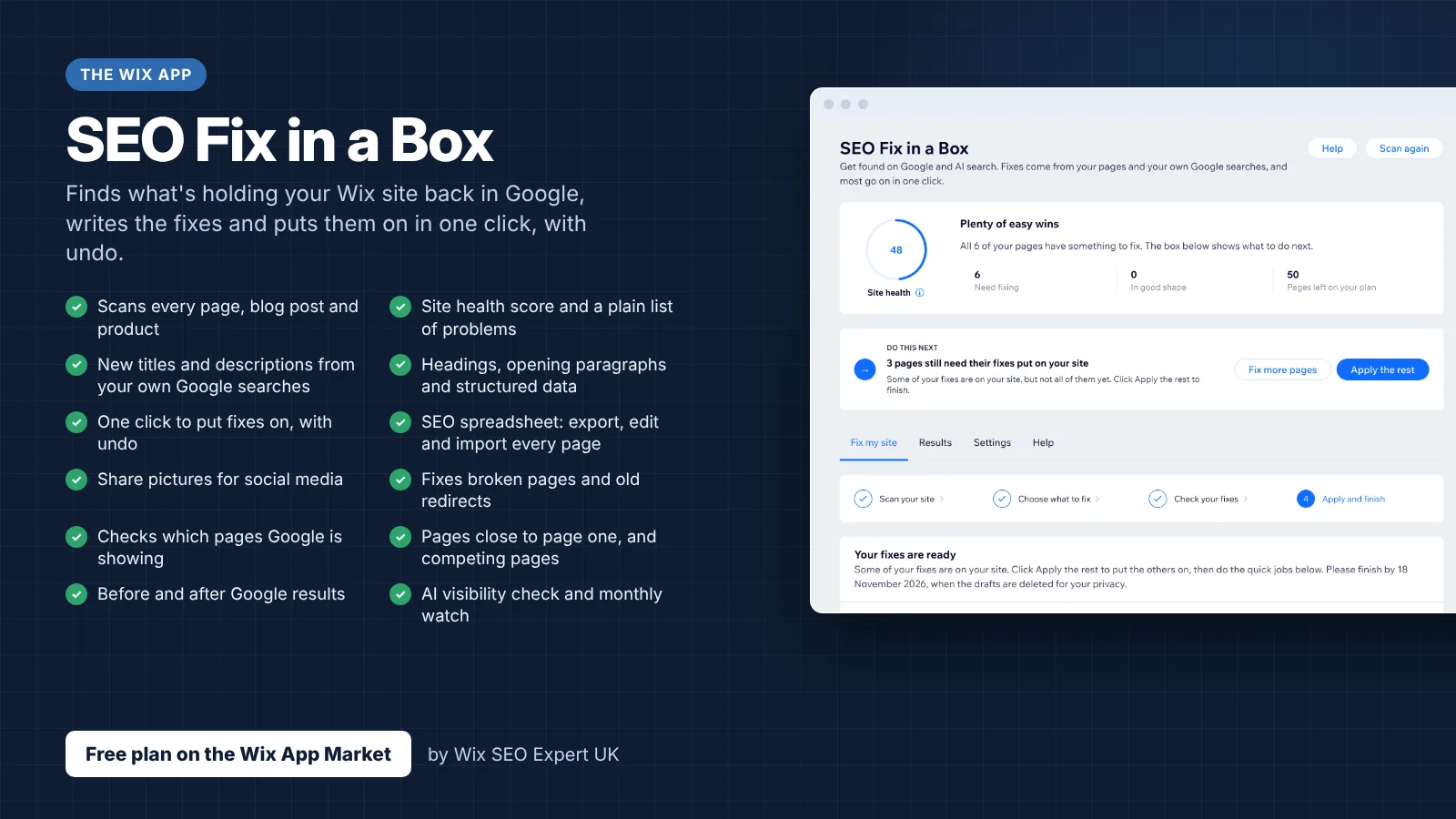
- SEO Fix in a Box: My Wix app. Free to install, it scans your site and shows what needs fixing, and paid plans write the fixes from your own Google searches
Was this lesson useful?
It takes 1 minute to tell me. The course is free and I want to keep it that way, and your feedback shows me what is working and helps other people find it.
This lesson on Complete Wix international SEO and alternative search engine audit checklist is part of Module 35: Wix SEO for Non-English Markets & Alternative Search Engines in The Most Comprehensive Complete Wix SEO Course in the World (2026 Edition). Created by Michael Andrews, a Wix Marketplace Legend Partner with 14 years of hands-on experience, 800 completed Wix SEO projects and 456 verified five-star reviews.