Wix multilingual SEO foundations: hreflang, language settings and URL structures
Module 35: Wix SEO for Non-English Markets & Alternative Search Engines | Lesson 405 of 683 | 52 min read
By Michael Andrews, Wix SEO Expert UK
Wix Multilingual is the built-in feature for creating multi-language versions of your site. It handles hreflang tags automatically, creates language-specific URLs, and manages the language switcher. However, simply enabling Wix Multilingual and machine-translating your content is not an SEO strategy. Proper multilingual SEO requires understanding how hreflang works, choosing the right URL structure, ensuring translation quality, and configuring each language version for its target search engine. This lesson covers the technical foundations every Wix multilingual site needs.

How Wix Multilingual Handles Hreflang
When you add a language in Wix Multilingual, Wix automatically generates hreflang tags on every page, telling Google which language version to show to which users. The hreflang tag format is: <link rel="alternate" hreflang="fr" href="https://yoursite.com/fr/page-name">. Wix adds these to every page automatically, including the self-referencing hreflang for the primary language. This automation removes one of the most error-prone aspects of multilingual SEO.
URL Structure Options
Subdirectories (Wix Default)
Wix Multilingual uses subdirectories by default: yoursite.com/fr/ for French, yoursite.com/de/ for German. This is the recommended approach because all language versions share the same domain authority, and it is the simplest to manage. Every backlink to any language version strengthens the entire domain.
Country-Code Top-Level Domains (ccTLDs)
Some businesses use separate domains: yoursite.fr, yoursite.de. This provides the strongest geo-targeting signal but requires building domain authority separately for each country domain. Wix does not support ccTLDs natively through Multilingual, so this approach requires managing separate Wix sites.
Subdomains
Subdomains like fr.yoursite.com are an intermediate option. Wix does not support language subdomains through Multilingual, and Google may treat subdomains as separate entities for authority purposes. This is generally not recommended for Wix sites.
Translation Quality for SEO
Machine translation has improved dramatically, but it still produces content that reads unnaturally and misses cultural nuances. For SEO purposes, machine-translated content is treated as lower quality by Google. Human translation or human-reviewed machine translation is essential for any language version you want to rank competitively. The minimum standard is machine translation reviewed and edited by a native speaker.
Common Wix Multilingual SEO Mistakes
- Using machine translation without human review for important landing pages
- Not translating metadata (title tags and meta descriptions) separately from page content
- Forgetting to translate image alt text for each language version
- Not localising keywords: directly translating English keywords instead of researching native search terms
- Leaving the URL slug in English for translated pages instead of using native-language slugs
- Not submitting separate sitemaps for each language version to GSC
- Ignoring language-specific search engines: only targeting Google for non-English markets
Set up Wix Multilingual for SEO
- Enable Wix Multilingual in your site settings and add your target languages
- For each language, research target keywords in the native language (not just translations)
- Translate your most important pages first: homepage, service pages, contact page
- Use human translators or have native speakers review machine translations
- Translate and localise all metadata: title tags, meta descriptions, and URL slugs
- Translate all image alt text for each language version
- Verify hreflang tags are correctly generated by checking page source
- Submit each language version URL to GSC for indexing verification
Verifying Hreflang Implementation on Wix
Even though Wix generates hreflang tags automatically, verification is essential because errors in hreflang implementation are one of the most common causes of multilingual SEO problems. An incorrect hreflang tag can cause Google to show the wrong language version to users, or to ignore your language targeting entirely. Verify hreflang on your top 5 pages immediately after enabling Wix Multilingual.
Verify hreflang tags are correctly implemented
- Open your homepage in a browser. Right-click and select "View Page Source".
- Search (Ctrl+F) for "hreflang" in the source code.
- Verify there is a hreflang tag for EACH language version, including the current page language (self-referencing).
- Check that each hreflang tag has the correct language code (e.g., "en" for English, "fr" for French, "de" for German).
- Verify the URLs in each hreflang tag point to the correct language version of the page.
- Repeat this check on at least 3 different pages to confirm consistency across your site.
- If any tags are missing or incorrect, check your Wix Multilingual settings and ensure all language versions are published.
Native-Language URL Slugs and Metadata
One of the most impactful multilingual SEO actions is translating your URL slugs into the native language. A French page at /fr/services is far less optimised than /fr/nos-services. Similarly, translating metadata (title tags and meta descriptions) separately from page content ensures they are optimised for native search terms rather than being auto-generated translations. Treat each language version metadata as an independent SEO exercise.
Translate and optimise URL slugs and metadata for each language
- Open your Wix Multilingual dashboard. For each language, navigate to the Pages section.
- For every page, click on the URL slug field and replace the English slug with a native-language equivalent using your keyword research.
- Translate title tags manually for each page. Do not rely on auto-translation. Use your native-language target keywords.
- Write unique meta descriptions in each language. These should be compelling in the native language, not direct translations of the English version.
- Translate all image alt text for each language version. Go through each page and update alt text to the native language equivalent.
- Verify all metadata changes by viewing the page source for each language version.
Submitting Language Versions to Search Engines
Each language version of your Wix site should be verified and submitted separately in Google Search Console. While Wix submits a single sitemap that includes all language URLs, adding each language subdirectory as a separate property in GSC gives you language-specific performance data. This lets you track which keywords drive traffic in each language independently.
- Add your primary domain as a Domain property in GSC (covers all language versions)
- Add each language subdirectory as a URL-prefix property: yoursite.com/fr/, yoursite.com/de/, etc.
- Submit the full sitemap URL to the Domain property (it includes all language URLs)
- Monitor the Performance report for each language property independently
- Check indexation status for each language version in the Pages report
- If targeting Bing, submit your sitemap to Bing Webmaster Tools as well (covers DuckDuckGo)
Complete How-To Guide: Setting Up Wix Multilingual for SEO
Complete step-by-step multilingual SEO setup for Wix
- Step 1: Before enabling Wix Multilingual, research target keywords in each language using native-language keyword tools. Do not translate English keywords directly.
- Step 2: Enable Wix Multilingual in your Wix dashboard under Site Settings. Add each target language one at a time.
- Step 3: Prioritise translation of your most important pages first: homepage, top service pages, and contact page. Use professional translators or native speakers, not machine translation alone.
- Step 4: For each translated page, manually set the URL slug to a native-language keyword. Do not leave the default English slug.
- Step 5: Write unique, native-language title tags for every translated page. Include your target keyword for that language and keep under 60 characters.
- Step 6: Write unique meta descriptions for every translated page in the native language. Keep under 155 characters with a compelling reason to click.
- Step 7: Translate all image alt text on every page for each language version.
- Step 8: Verify hreflang tags by viewing page source on your homepage and 3 key pages. Confirm self-referencing tags and correct language codes for all versions.
- Step 9: Add each language subdirectory as a URL-prefix property in Google Search Console.
- Step 10: Submit your sitemap to GSC and verify all language versions are being discovered and indexed.
- Step 11: If targeting non-Google search engines, register each language version with the relevant webmaster tool (Bing, Yandex, Naver).
- Step 12: Set up monthly monitoring. Check GSC Performance for each language property. Verify indexation rates. Update translations when content on the English version changes.
Essential Tools for This Lesson
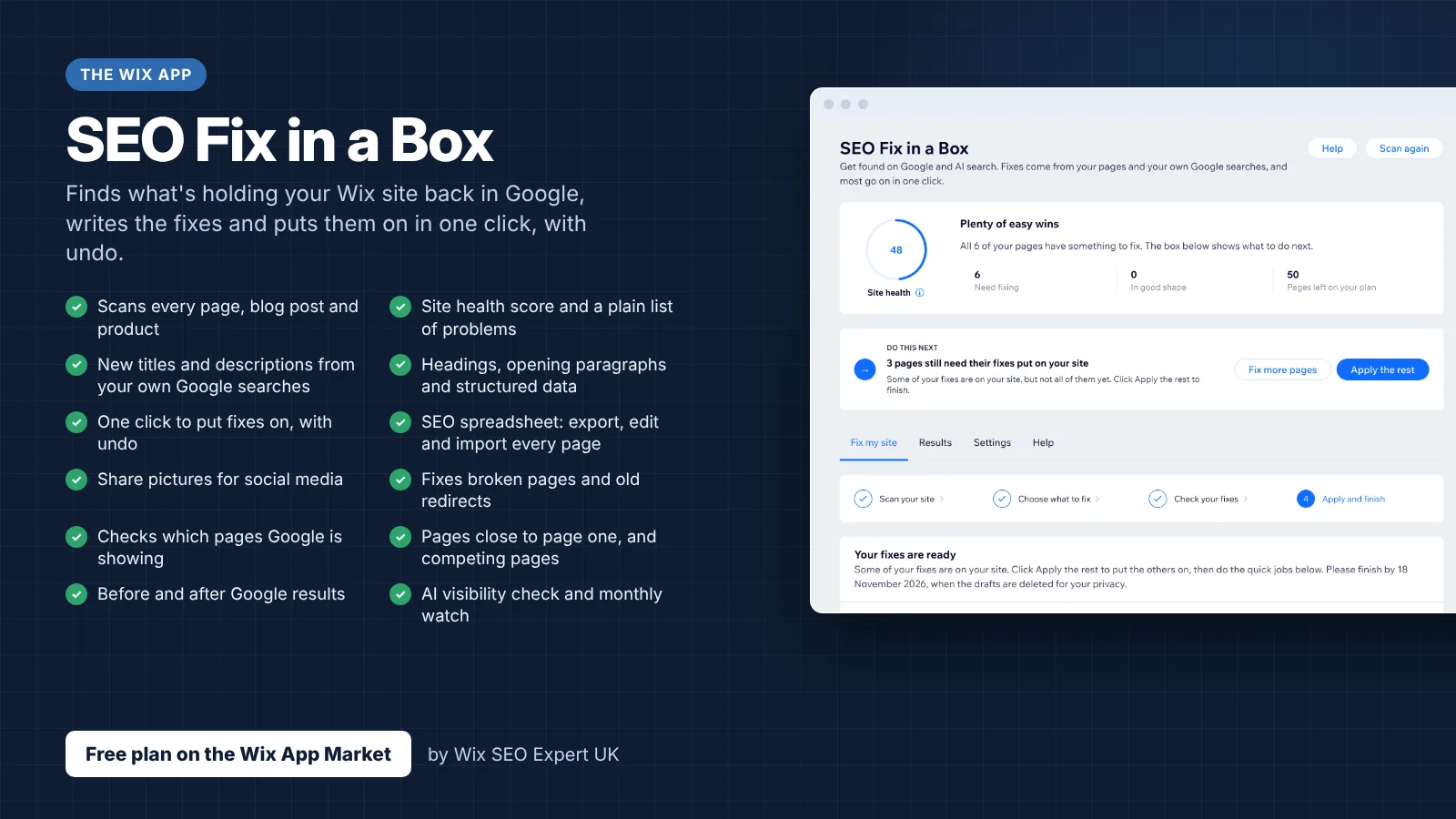
- SEO Fix in a Box: My Wix app. Free to install, it scans your site and shows what needs fixing, and paid plans write the fixes from your own Google searches
Was this lesson useful?
It takes 1 minute to tell me. The course is free and I want to keep it that way, and your feedback shows me what is working and helps other people find it.
This lesson on Wix multilingual SEO foundations: hreflang, language settings and URL structures is part of Module 35: Wix SEO for Non-English Markets & Alternative Search Engines in The Most Comprehensive Complete Wix SEO Course in the World (2026 Edition). Created by Michael Andrews, a Wix Marketplace Legend Partner with 14 years of hands-on experience, 800 completed Wix SEO projects and 456 verified five-star reviews.