Wix Headless: What It Is and How to Use It

By Michael Andrews | Published: 2026-09-17 | Updated: 2026-09-17 | 22 min read
You keep the Wix business tools you rely on and build your own front end on top. Here is what Wix Headless really is, and how to use it, in plain English.
Every so often a phrase escapes from the developer world and starts landing in questions from ordinary Wix owners. "Headless" is one of those phrases. People hear that Wix has a headless option, they read that it is faster, more flexible and more powerful, and then they hit a wall of jargon that assumes you already write code for a living. So they close the tab none the wiser.
I want to fix that here. I am Michael Andrews. Wix is the only thing I do, and I have done it for fourteen years across more than 800 projects, with 456 five-star reviews on the Wix Marketplace to show for it. I am going to explain what Wix Headless actually is, what it is for, the tools it gives you, and how you use it, in plain English first and then in proper detail. By the end you will know whether it is something you need, or something you can happily ignore.
Let me start with the word itself, because that is where most of the confusion lives.
Key Takeaway: Wix Headless is Wix with the front door removed, so you can fit your own. You keep the store, the bookings, the events, the CMS, the members and the payments, all managed by Wix, and you build a completely custom front end on top.
What "headless" actually means
Every website has two halves. There is the part you see, and there is the part that does the work behind it.
Wix describes this better than most. In their own words, "the front end is the head: the pages, design and everything a visitor sees and clicks. The back end is the body: the content, data and business logic." The head is the colours, the fonts, the layout, the buttons, the animation when you hover over a price. The body is your product catalogue, your bookings calendar, your customer accounts, your orders, your blog posts sitting in a database.
On a normal website builder, the head and the body are joined together and sold as one thing. You design your pages inside the Wix Editor, and Wix draws those exact pages for your visitors. The design and the data are locked together. That is fine, and for most businesses it is exactly what they want.
A headless website breaks that join. As Wix puts it, "a headless website is a site built so the front end is decoupled from the back end." You remove the head. The body carries on doing its job in the background, storing your products and taking your bookings and holding your content, and it hands that information out through a doorway called an API. You then build a brand new head of your own, in whatever technology you like, and you ask the body for what you need through that doorway.
That is the whole idea. Keep the powerful body. Replace the head with one you build yourself. "Headless" simply means the body is running without the standard head attached.
So what is Wix Headless?
Wix Headless is Wix letting you do exactly that with a Wix business.
Here is how Wix describes it on their own product page: it is "a way to use Wix business solutions, like stores, bookings, events, a CMS and payments, outside the Wix editor." You "build your frontend however you like and connect it to a fully managed Wix backend."
Read that carefully, because it is the part people miss. You are not throwing Wix away. You are keeping the engine. Everything Wix is genuinely good at, the online store with real inventory and checkout, the bookings system with staff and availability, the events with ticketing, the CMS, the payments, the customer records, all of that keeps running inside Wix, managed by Wix, on Wix's servers. What changes is that you stop using the Wix Editor to build the pages your visitors see. Instead you build those pages yourself, in a coding framework of your choice, and you plug them into your Wix backend.
Wix makes a point of what you do not have to do. "No servers to run and no backend to engineer." You do not stand up a database. You do not write a payment system. You do not build a bookings engine from scratch. Those are hard, expensive, slow things to build well, and Wix has already built them. You borrow them, and you spend your effort on the front end instead.
It is free to connect. You pay standard Wix pricing when you are ready to sell, and a premium plan is what unlocks payments, analytics and a custom domain. There is no separate developer tariff or API fee sitting on top.
So the short version is this. Wix Headless is the Wix business platform with the front door taken off, so a developer can attach a completely custom front door and still use everything inside.
Headless versus a normal Wix site
The natural question is why anyone would want to do this, when the standard Wix Editor already builds beautiful sites without a line of code. It is a fair question, and the honest answer is that most people should not bother. But there are real reasons the option exists.
A normal Wix site gives you speed and simplicity. You get a visual editor, hundreds of templates, drag and drop, and a site live in an afternoon. Your design is shaped by what the Editor and the templates allow, which in 2026 is a very great deal, but it is still the Wix rendering system drawing your pages. For the overwhelming majority of businesses this is the right choice, and I say that as someone who could easily talk you into something more complicated and does not.
A headless build gives you three things a standard site cannot.
The first is total control of the front end. You are writing the code that renders every pixel, so there is no template ceiling. If your brand needs an interface that behaves in an unusual way, or a level of custom interactivity that a normal builder cannot reach, headless removes the ceiling entirely.
The second is one backend feeding many places at once. Wix makes this point directly: "one content source can feed a website, an app, a kiosk or a smart display." Because your data comes out through an API rather than being welded to one set of pages, the same product catalogue can power your website, your phone app and an in store screen at the same time, all reading from the same source. You update the price once and it changes everywhere.
The third is the technology choice itself. A developer who lives in React, Vue, Svelte or Solid can build in the tools they know best and still use Wix as the engine underneath.
Wix is refreshingly blunt about the trade. Headless "requires developer integration" and takes more effort to set up than a template. And they say plainly that "a simple single-page site with one editor and no plans to expand is usually better served by a traditional website builder." That is the truth. Headless is a power tool. If you do not have a reason that needs it, the standard Editor will serve you better, faster and cheaper.
The business tools you can use headless
This is the part that makes Wix Headless worth taking seriously, because the list of what you get to borrow is long. These are the same business solutions that power ordinary Wix sites, and Wix says most headless projects use the following.
Stores gives you product catalogues, inventory and collections. eCommerce adds the cart, the checkout and order management on top. Between them you have a full shop, with real stock control and a hosted checkout that handles the payment and the tax, without you building any of it.
CMS, built on Wix Data, gives you custom collections and content modelling. This is your structured content, the place where your case studies, your property listings, your recipes or your team members live as data you can query and lay out however you want.
Members gives you site member profiles and accounts, so your visitors can register, log in and have a personalised area. Pricing Plans sits alongside it to sell paid memberships and subscriptions and to gate content behind them.
Bookings gives you service bookings, availability and scheduling, with staff, sessions and reminders. If you run a clinic, a salon, a studio or any appointment based business, this is a genuinely deep system you would not want to rebuild.
Events gives you events, ticketing and RSVPs. Blog gives you posts, drafts, categories and tags, with the content living in Wix and rendered by your front end. Forms gives you custom forms and submission management for enquiries, sign ups, applications and the like.
Then there are the tools that support the rest. Contacts gives you contact list and CRM management. Gift Cards gives you gift card products, balances and redemption. Loyalty gives you points and rewards programmes for customer retention. Restaurants gives you menus, online orders and reservations. And Marketing Tags lets you drop in tracking tags for analytics and ad conversions.
Wix is clear that this is not even the full extent of it. As their documentation says, "Wix offers many more business APIs beyond this list." The point to take away is that going headless does not mean giving up the business features. You keep almost all of them. You are only replacing the presentation.
The two ways to go headless with Wix
There is a fork in the road early on, and it matters, so I will lay both paths out clearly. The difference is about who runs the hosting and how much Wix looks after for you.
Wix-managed headless
This is the path Wix recommends, and for good reason. With Wix-managed headless, Wix hosts and runs your front end for you. In their words, Wix "hosts and runs your frontend, connects it to Wix business solutions, and handles deployments, scaling, and security." Your project even appears in your Wix dashboard next to your normal sites. You get managed hosting on a global content delivery network, automatic SSL, deploy previews and infrastructure that scales itself.
Within the managed path there are two levels of integration, and the level depends on the framework you choose.
Full integration is for Astro, and it is the recommended setup. When you build on Astro, Wix handles authentication, SEO, analytics, monitoring, secrets management and extensions for you. This is the smoothest experience by a wide margin. It is the option I would steer almost anyone towards, because so much of the fiddly plumbing is handled without you having to think about it. I have built on exactly this setup, and the authentication in particular just works in the background rather than being something you wire up by hand.
Limited integration is for the other frameworks, such as Next.js, React and Vue. Here Wix still hosts and runs your site, but you build locally and you set up authentication yourself. You get the hosting benefits without the full automatic layer that Astro enjoys.
Self-managed headless
The second path is self-managed. Here you use any framework you like and you host it yourself, on a provider such as Vercel, Netlify or AWS. Wix supplies the backend and the APIs, and everything else is on you. As Wix puts it, self-managed "supports any framework but requires you to handle hosting and deployment." Scaling, security and deployment all become your responsibility.
The choice comes down to a simple question. If you want Wix to carry the infrastructure so you can focus on building, go Wix-managed, and ideally on Astro. If you have a specific reason to control your own hosting stack, or you need a framework Wix does not host, go self-managed and accept the extra work that comes with it.
The tools that connect it all together
Whichever path you take, the connection between your front end and your Wix backend is made with the same small set of tools. You do not need to memorise these, but knowing the names makes every tutorial you read afterwards far less intimidating.
The Wix JavaScript SDK is the main way you talk to Wix from a JavaScript or TypeScript project. It is a set of ready made functions for the business solutions, so you can ask for products, list available booking slots or create a cart with clean, typed calls rather than raw web requests. If your project is in a language other than JavaScript, you use the Wix REST APIs instead, which is the same data reached over plain web requests. One important detail from Wix's own documentation is that the front end SDK modules used inside normal Wix sites are not supported in headless projects, so in a headless build you use the headless SDK and REST APIs rather than the ones you may have seen in Velo.
Authentication is the part that trips people up, so here is the plain version. There are two kinds of access, and they exist for safety. One kind acts on behalf of your visitors and members, using OAuth and a public client ID. This is what your website uses to show products, take a booking or let a member log in, and it is deliberately limited to the things a visitor should be allowed to do. The other kind performs administrative operations, using an API key, and it can do the powerful things a shop owner does behind the scenes. The rule of thumb is straightforward. The public client ID is for the visitor facing site. The API key is for trusted admin work and must never be exposed in the browser. Keeping those two apart is most of what backend security means in a headless build.
The Wix CLI is the command line tool that ties the workflow together. It lets you preview, release and manage your project from the terminal, and Wix built it to suit both people typing commands by hand and AI coding agents doing it for them. The commands you will meet most are the ones to log in, to pull your project's environment settings down to your machine, to build the site and to release it live.
How to build and use a Wix Headless site, step by step
Now the practical part. The exact commands vary a little by framework, so rather than pretend there is one universal script, I will walk through the shape of it so you know what actually happens and in what order. I have run this process, and the sequence below is how it really goes.
Step one: create the project
Wix gives you three ways in on the managed Astro path. You can let an AI coding agent scaffold and deploy the whole thing from a description of what you want, which is the least setup of all. You can scaffold a fresh Astro project from the terminal with the Wix CLI. Or you can connect an Astro project you already have. For the other frameworks there are matching options, including deploying a front end you already built and even uploading a static site without touching the terminal.
If you are not a developer at all, that first option matters. Wix is explicit that you do not have to code to get started. As their help centre says, "Not a developer? You can still get started with Wix Headless using an AI agent or vibe coding platform." Tools such as Claude Code, Cursor, Codex and Gemini CLI, and platforms such as Base44, can drive the whole build, guided by a setup prompt that Wix publishes for the purpose.
Step two: install the business apps you need
A headless project only exposes the business solutions you have actually added. If you want a shop, you install Stores and eCommerce. If you want appointments, you install Bookings. If you want gated content, you install Members and Pricing Plans. You do this once, and from then on those solutions are available to your front end through the SDK. It is worth deciding this up front, because it shapes everything you build next.
Step three: connect your project to Wix
This is where your front end gets its credentials to talk to the backend. You log in through the CLI, and you pull your project's environment settings down to your machine so that your public client ID is available to the code. On the managed Astro setup this environment step is easy to forget and is the single most common reason a first build fails, so do it before you try to build. Once your project knows its client ID, it can authenticate as a visitor and start requesting data.
Step four: build the front end and wire in the data
Now you design and build your pages in your chosen framework, exactly as you would any modern site, and wherever you need real data you call Wix. You fetch your product list from Stores and render it as a grid. You ask Bookings for the available slots for a service and show them as a calendar. You pull posts from Blog and lay them out as your journal. You render whatever you like, however you like, because this head is entirely yours. The only rule is that the live business data comes from Wix through the SDK or the REST API rather than being typed in by hand.
Step five: preview, release and connect a domain
When it is ready you preview it, then release it. On the managed path Wix deploys it to its global content delivery network with SSL already handled, and gives you deploy previews so you can check a version before it goes live. Connecting your own custom domain is part of a premium plan, along with payments and analytics. From that point you have a live, custom built site running on a fully managed Wix backend, and you manage the business side, the orders, the bookings, the content, from the same Wix dashboard you would use for any Wix site.
A concrete example, so it is not abstract
Theory only takes you so far, so picture a real business and how the pieces fit. Say you run a small aesthetics clinic. You want a distinctive, brand led website with an unusual booking experience that no template quite delivers, and you also want a shop for your skincare range and a journal for your articles. You decide a headless build is worth it.
Inside Wix you install Bookings, Stores, eCommerce, Blog and Contacts. That is your backend. In Bookings you set up your treatments, your practitioners, your session lengths, your availability and your reminders, exactly as any Wix clinic would. In Stores you load your products, your prices and your stock. In Blog you write your articles. None of that involves a single line of code, and you manage it all from the normal Wix dashboard.
Now you build your front end. You choose the managed Astro path so Wix carries the hosting and the authentication. You design your pages the way you want them, with your own layout, your own motion, your own booking flow. Where you need real information, you call Wix. On your treatments page you ask Bookings for the live list of services and render each as a card. When a visitor picks a treatment, you ask Bookings for the available slots for that service and lay them out as your own custom calendar. When they choose a time, you create the booking, hand the visitor to the hosted Wix checkout to pay, and Wix records the appointment. On your shop page you pull the product list from Stores and render your grid, then use the hosted cart and checkout so you never touch card details yourself. On your journal you pull posts from Blog and lay them out to match your brand.
Every one of those calls uses the public client ID, because they are all things a visitor is allowed to do. The powerful admin actions, refunding an order or editing a service, stay inside the Wix dashboard behind the API key, where they belong. You never rebuilt a bookings engine, a payment system or a stock manager. You borrowed all three and spent your effort on the experience.
That is the shape of a real headless project. The custom front end is the part you can see and be proud of. The Wix backend is the heavy machinery humming away underneath, and the SDK is the set of wires between them. Once you have pictured it this way, the tutorials and the documentation stop feeling abstract, because you can see where each piece slots in.
What headless means for your SEO
This is my field, so I will not skip it, and it is the part where I see the most avoidable mistakes.
Here is the double edged truth. On a normal Wix site, Wix does a large amount of your technical SEO automatically. It renders your pages so Google can read them, generates your sitemap, handles canonical tags, produces structured data for many content types and gives you a full panel of controls for titles, descriptions and redirects. When you go headless, you are the one building the front end, which means all of that becomes your responsibility. Nothing is done for you unless you do it. Headless can produce a faster, cleaner, better ranking site than a template ever could, and it can just as easily produce an invisible one if the SEO basics are skipped.
The single most important decision is rendering. Because the classic knock on early Wix was that its pages leaned on JavaScript and were hard for search engines to read, you must not walk straight back into that trap with your own build. You want server side rendering or static generation so that your titles, your headings, your body copy and your links arrive in the raw HTML, present the moment a crawler looks, not painted in later by the browser. This is the biggest reason Wix recommends Astro for the managed path, since it renders on the server by default. Get this right and headless is a genuine SEO advantage. Get it wrong and you rebuild the exact problem people wrongly still blame Wix for.
After rendering, everything else is the familiar SEO discipline, just now hand built. You own your page titles and meta descriptions, so you set them per page. You own your headings, so you keep one clear H1 and a sensible structure. You own your structured data, so you output your schema yourself in a script tag. You own your Core Web Vitals, which on a custom front end you can make superb with the right image handling and code loading, or ruin with careless bundles. You own your internal linking, your canonical tags, your sitemap and your international setup if you serve more than one region.
I teach all of this properly, because it is exactly where headless projects win or lose their rankings. There is a full module on it inside my free course. If you want to go deeper, start with Module 43, Wix Headless SEO, which is the hub for the whole subject. From there, the lesson on headless Wix Core Web Vitals and performance covers making a custom front end genuinely fast, the lesson on headless Wix blog SEO and CMS content strategy covers rendering your Wix content so it ranks, and the lesson on headless Wix internationalisation and multi-region SEO covers serving more than one country cleanly. All of it is free, and all of it sits inside the complete Wix SEO course.
Who should go headless, and who should not
Let me be as straight with you as I would be on a call, because this matters more than any technical detail.
You are a good candidate for headless if you have a developer or an agency building your site, if you need a level of design or interactivity a template genuinely cannot reach, if you want one Wix backend to feed a website and an app and other surfaces at the same time, or if you are building something at a scale where owning the front end is worth the extra work. In those cases headless is a serious, capable option, and the fact that it sits on top of Wix's business tools means you get enterprise grade features without building them.
You are not a good candidate if you are a small business owner who wants a smart site live soon, without hiring a developer, and without maintaining code. There is no shame in that. It is most businesses. For you the standard Wix Editor or Wix Studio will give you a faster, cheaper, easier result that ranks perfectly well when it is optimised properly. Going headless would add cost and complexity and buy you nothing you need. Wix say the same thing themselves, and I agree with them.
The mistake I want you to avoid is choosing headless because it sounds advanced. Advanced is not the goal. The right tool for your situation is the goal.
The honest trade-offs
Nothing is free, so here is what you take on when you go headless.
You take on development. Someone has to build and maintain the front end, and that is a real, ongoing cost in a way that editing a template is not. You take on the SEO work that a normal Wix site would have handled for you, as I covered above. On the self-managed path you also take on hosting, scaling and security, which is why I nudge people towards the managed path unless they have a firm reason not to. And you take on a longer path from idea to launch, since a hand built front end simply takes more time than dragging blocks onto a page.
Against all of that you get control, flexibility, speed potential and a multi channel backend. Whether that trade is worth it depends entirely on your project. For the right project it is clearly worth it. For the wrong one it is effort spent solving a problem you did not have.
The bottom line
Wix Headless is Wix with the front door removed, so you can fit your own. You keep the store, the bookings, the events, the CMS, the members, the payments and the rest, all managed by Wix, and you build a completely custom front end on top using the framework you prefer. You connect the two with the Wix SDK or REST API, you authenticate visitors with a public client ID and keep admin work behind an API key, and you can let Wix host and manage the whole thing on the recommended Astro setup or run it yourself if you need to.
It is a genuinely powerful option, and it is the right one for developers, agencies and ambitious builds. It is the wrong one for most small businesses, who are better served by the standard Editor. And whichever route a site takes, the SEO still has to be done deliberately, because headless rewards good technical work and quietly punishes its absence.
If you are weighing up whether headless is right for what you are building, you can learn more about me or get in touch for a free look at your site. And if you would rather learn it yourself, the whole thing is in the course, for free.
Fix your Wix SEO from your dashboard
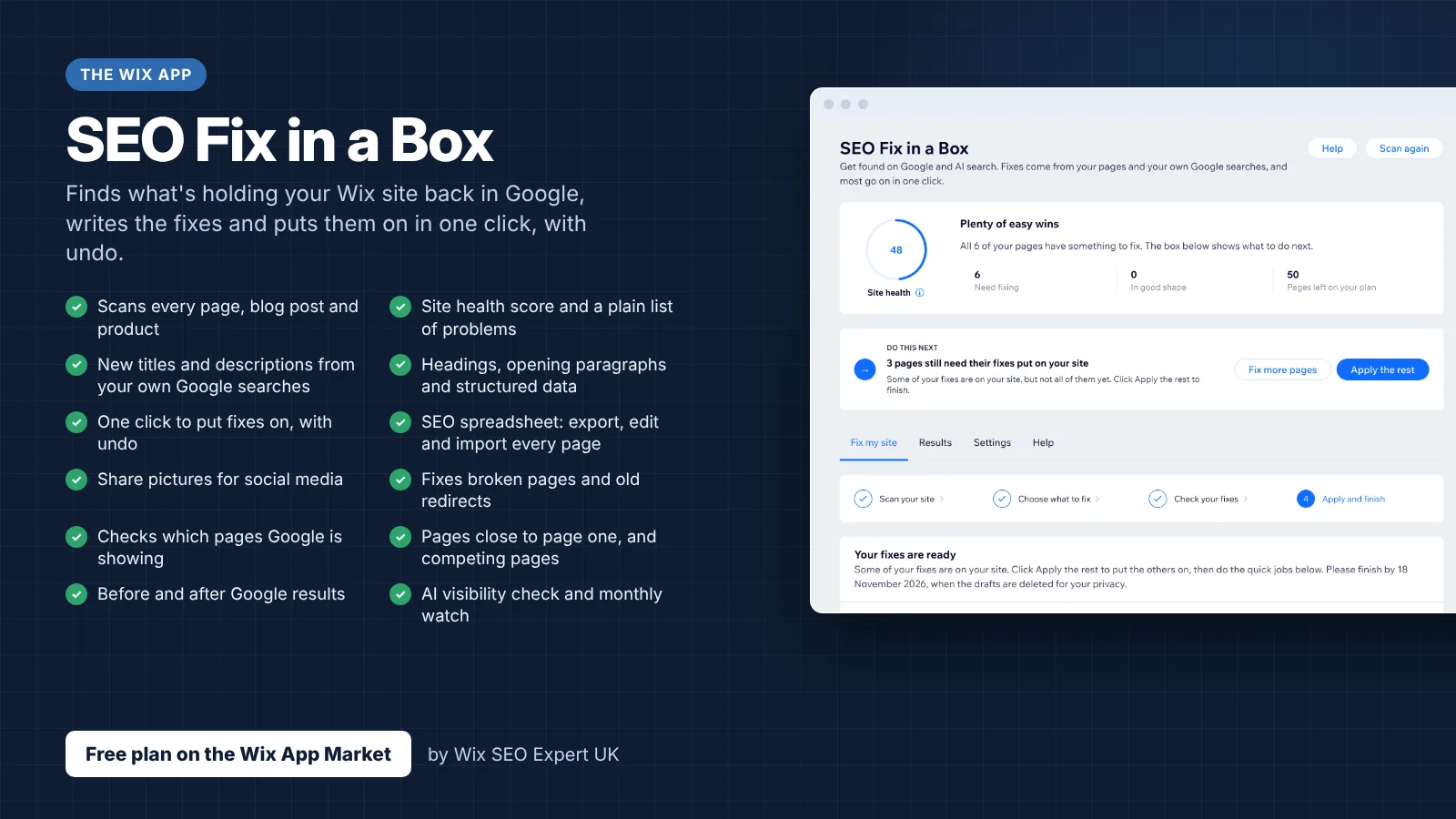
Wix SEO Fix in a Box scans every page, writes your fixes from your own Google searches and puts them on in one click, with undo. Start on the free plan.
Want this sorted on your own Wix site?
I have worked only on Wix for 14 years. Get Wix SEO Fix in a Box on the Wix App Market to find and fix what is holding your site back, or see my packages and prices if you would rather I did it all for you.
Frequently Asked Questions
What is Wix Headless in simple terms?
Wix Headless is a way to use Wix business tools such as stores, bookings, events, a CMS and payments outside the Wix Editor. Wix runs the backend, and you build your own custom front end in a coding framework of your choice and connect it to that backend. You keep the powerful business features and replace only the pages your visitors see.
Is Wix Headless free?
It is free to connect a headless project. You pay standard Wix pricing when you are ready to sell, and a premium plan is what unlocks payments, analytics and a custom domain. There is no separate developer fee or API charge on top of normal Wix pricing.
Do I need to be a developer to use Wix Headless?
To build headless the traditional way, yes, you need development skills or someone who has them. But Wix now lets non developers get started using an AI coding agent or a vibe coding platform such as Base44, guided by a setup prompt, so it is no longer strictly limited to people who write code by hand.
What frameworks does Wix Headless support?
On the Wix-managed path, Astro gets full integration and is recommended, while other frameworks such as Next.js, React and Vue get a more limited managed integration. On the self-managed path you can use any framework and host it yourself on a provider such as Vercel, Netlify or AWS. Wix also lists React, Vue, Svelte and Solid as supported front end frameworks.
Is a headless Wix site better for SEO?
It can be, but it is not automatic. A headless build lets you control rendering, speed and structured data, so a well built one can be faster and rank better than a template. The catch is that Wix no longer handles that SEO for you, so you must render pages on the server, set your own titles and schema, and manage your Core Web Vitals. Done carelessly it can rank worse, so the SEO has to be deliberate.
What is the difference between Wix-managed and self-managed headless?
With Wix-managed headless, Wix hosts and runs your front end, handles deployments, scaling and security, and on Astro also handles authentication, SEO and analytics for you. With self-managed headless you can use any framework but you host and deploy it yourself and take on scaling and security. Wix-managed is recommended for most people, and self-managed suits those who need their own hosting stack.
Can I use Wix Bookings and Wix Stores with a headless front end?
Yes. Bookings, Stores and eCommerce are among the core solutions built for headless, along with CMS, Members, Pricing Plans, Events, Blog, Forms, Contacts, Gift Cards, Loyalty, Restaurants and Marketing Tags. You install the solutions you need and reach them from your front end through the Wix SDK or REST API.
Considering a headless Wix build? Get expert guidance from Michael Andrews, with 14 years of Wix-only experience and 800 completed projects.