Wix Schema Markup Not Ranking? Troubleshooting

By Michael Andrews | Published: 2026-08-24 | Updated: 2026-08-24 | 9 min read
If you have built a schema markup page for your Wix site and it is not showing up for "wix schema markup" or similar searches, you are not alone. It is almost always about what is actually competing for that search, and how much depth it takes to compete with it. This happened on my own site. Here is what I found.
If you have built a schema markup page for your Wix site and it is not showing up for "wix schema markup" or similar searches, you are not alone, and it is rarely because the markup itself is wrong. In my experience, it is almost always about what is actually competing for that search, and how much depth it takes to compete with it.
I will be honest, this happened on my own site. Here is what I found when I looked properly, and what I would check on yours.
What is actually ranking for "wix schema markup"
I searched this term in August 2026, and the results tell a clear story. The entire first page is dominated by two kinds of content: automated JSON-LD schema generator apps (like the one in the Wix App Market) and long-form how-to guides explaining what schema is and how to add it to a Wix site step by step.
Specifically, the top results include the official Wix Help Center article on adding structured data, several YouTube tutorials walking through the process, a Wix SEO Learn resource on structured data, and community forum threads answering implementation questions.
What is NOT ranking: commercial service pages selling schema markup as a paid service, however well written they are. Not mine. Not anyone else's that I could find. The search results are entirely educational or tool-based.
That pattern tells you something important about how Google reads this search. It does not interpret "wix schema markup" as someone ready to buy. It reads it as someone wanting to understand.
Why a service page struggles against a guide
A page built to sell a service and a page built to teach the whole topic are answering two different questions. Google is trying to match the search to intent, and "wix schema markup" reads as an informational query, someone wanting to understand the topic, not a transactional one.
A thin commercial page, however well the copy converts once someone lands on it, does not answer that informational question. So it does not get the chance to be seen by the person who eventually needs the paid service. The page might be perfectly good at what it does, but what it does is convert, not educate. Google rewards the educator for this search.
This is not a criticism of commercial pages. It is a recognition that different page types serve different search intents, and you cannot force a conversion page into an informational ranking slot.
What I found on my own service page
My schema markup service page is well optimised commercially. The title tag is clear, the meta description sells the service accurately, and the page does what a service page should: explain what you get, how it works, and what it costs.
But the visible body content, excluding FAQ accordions, runs to roughly 560 words. The how-to guides that currently rank for "wix schema markup" are running well over a thousand words of visible, crawlable educational content. My page has 12 detailed FAQ answers that add substantial depth, but they sit behind expandable UI elements, which means crawlers may or may not weight them as primary content.
This is not a mistake unique to this niche. It is a mismatch between page type and search intent that is easy to miss when you are focused on conversion copy. The page does its job for people who arrive there. It just cannot win the search that would send those people there in the first place.
What actually works
The realistic fix is not necessarily rewriting the service page itself. It is publishing a genuinely deep, free guide that does what the informational search is actually asking for.
That guide needs to answer the real question in full: what schema markup is, what Wix already does automatically, where the gaps are, and how to add custom JSON-LD properly. It needs to be the kind of resource someone could bookmark and follow without paying anyone. I have already published one: the Wix schema markup guide covers the implementation step by step.
The strategy is two pages working together. The guide earns the ranking for the informational search. It answers the question comprehensively enough that Google considers it the best match for what the searcher wants. Then, for the reader who reaches the end and decides they would rather have it done properly than do it themselves, a natural link through to the service page closes the loop.
This is not a trick. It is how content marketing is supposed to work: earn the attention by being genuinely useful, then offer the service to those who want it.

How to add schema markup to your Wix site
Wix generates basic structured data automatically for your pages. This includes page type markup, breadcrumbs, and some product data if you use Wix Stores. It is a starting point, but it does not cover everything that matters for rich results or AI citation.
The gaps are significant. Wix does not automatically generate LocalBusiness schema with your full business details, does not create FAQ schema for your question and answer content, does not build Article or BlogPosting markup with proper author attribution, and does not connect all of this into a single coherent entity graph that machines can parse as one business.
To add custom schema, you use the Custom Code feature available on any paid Wix plan. This lets you inject JSON-LD into the head of your pages without touching your visible design. The process is: write or generate the JSON-LD, add it through your site settings under Custom Code, specify which pages it should apply to, and publish.
You can apply markup site-wide for things like your Organization schema, or page-by-page for specific content like FAQ, HowTo, or Product markup. After publishing, validate it using Google's Rich Results Test to confirm it parses correctly.
For the full step-by-step walkthrough, including what to put in each schema type and how to avoid the mistakes that break validation, the JSON-LD schema lesson in the course covers everything in detail.
What to check if your own schema page is not ranking
- Word count relative to what is currently ranking for your target term. If the top results are 1,500 word guides and your page is 500 words of sales copy, the gap is clear.
- Whether the page answers the search intent or just sells to it. Search your target term and look at what Google shows. If the results are all educational, your commercial page is mismatched to the intent.
- Whether the page has been submitted for indexing through Google Search Console. A page that has not been crawled cannot rank, regardless of its quality.
- How long the page has actually had to rank. New pages on new topics take time. If it has been live for less than a month, it may simply need patience rather than changes.
- Whether the content that adds depth, like FAQ answers or expandable sections, is actually present in the static HTML that crawlers see, or whether it only appears after JavaScript interaction.
Expert Tip: Search your target keyword and study the first page honestly. If every result is a guide, tutorial, or tool, that is Google telling you the intent is informational. You will not outrank those with a service page, no matter how good it is. You need to match the intent first, then link through to the commercial page.
Fix your Wix SEO from your dashboard
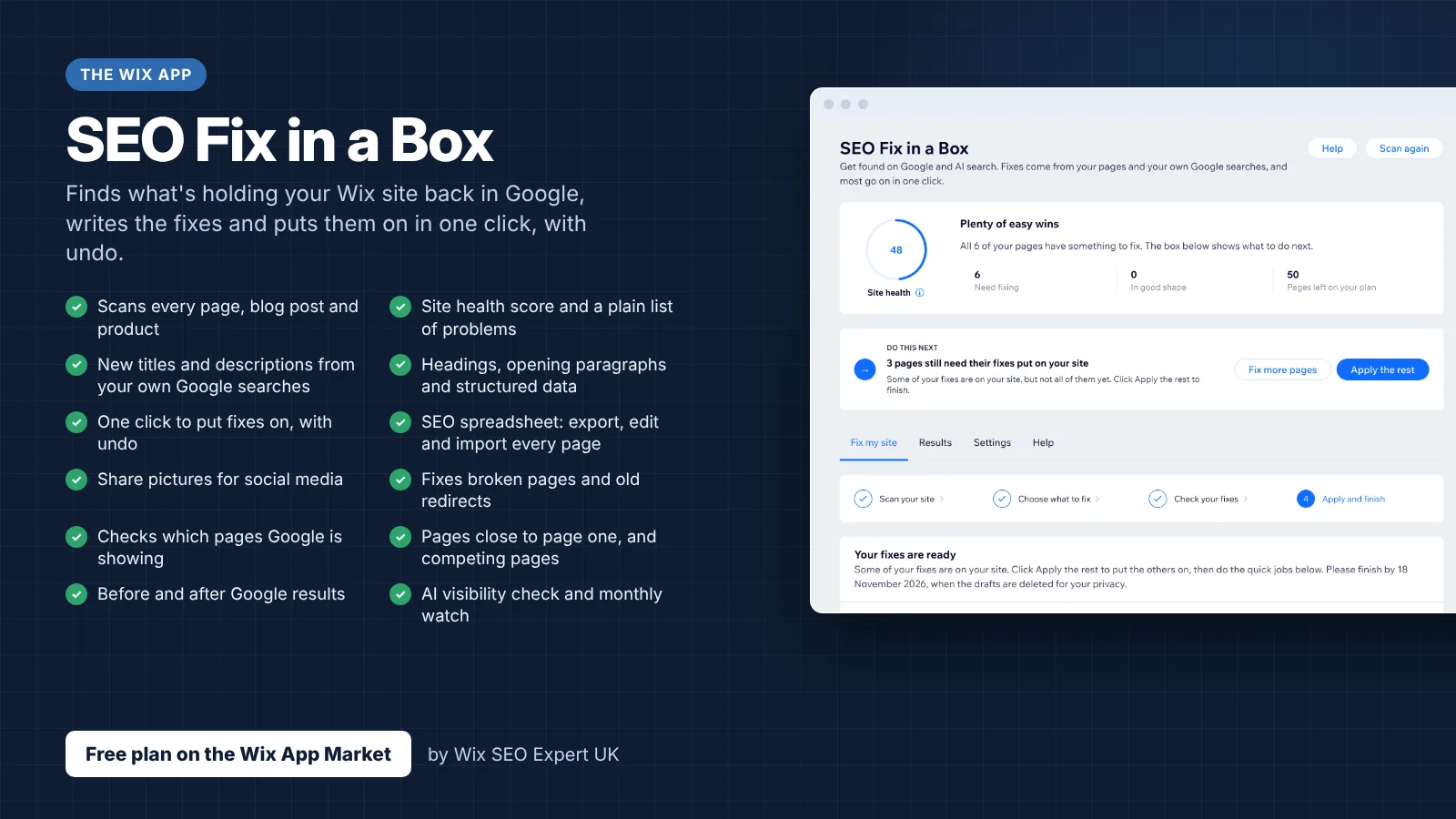
Wix SEO Fix in a Box scans every page, writes your fixes from your own Google searches and puts them on in one click, with undo. Start on the free plan.
Want this sorted on your own Wix site?
I have worked only on Wix for 14 years. Get Wix SEO Fix in a Box on the Wix App Market to find and fix what is holding your site back, or see my packages and prices if you would rather I did it all for you.
Common questions
Frequently Asked Questions
Why isn't my schema markup page ranking on Google?
Most likely because the search term you are targeting is informational in intent, and your page is commercial in nature. Google matches pages to what it believes the searcher wants. If someone searches "wix schema markup", Google interprets that as someone wanting to learn about the topic, not buy a service. A service page, however well written, does not answer that informational question, so it does not rank for it.
Does Wix add schema markup automatically?
Yes, Wix adds basic structured data to your pages automatically. This covers page types, breadcrumbs, and some product data. However, it does not describe your business as a distinct entity, does not connect your schema nodes into a single graph with @id references, and does not include the signals that generative AI systems look for when deciding which businesses to cite. The auto-generated markup is a starting point, not a complete solution.
How long should a schema markup guide be to rank well?
There is no magic word count, but looking at what currently ranks for schema-related searches on Wix, the guides that appear on page one typically run well over a thousand words and cover the topic from first principles through to implementation. They explain what schema is, what Wix handles automatically, where the gaps are, and how to add custom markup step by step. Depth and completeness matter more than length for its own sake.
Is a service page enough on its own, or do I need a guide too?
For informational searches, a service page alone is unlikely to rank. The realistic strategy is two pages: a guide that answers the informational question in full and earns the ranking, and a service page that converts the reader who reaches the end and wants the work done professionally. The guide earns the visibility. The service page earns the sale.
How do I add custom schema markup to a Wix site?
On any paid Wix plan, you can add custom JSON-LD schema through the Custom Code feature in your site settings. This injects code into the head of your pages without affecting your visible design. You write or generate the JSON-LD, paste it into the custom code section, choose which pages it applies to, and publish. Google typically picks up the new markup within days to a few weeks, especially if you resubmit the URL through Search Console.
How long does it take for a new page to start ranking?
It varies. A new page on an established domain with good internal linking can start appearing in search within a few weeks. For competitive informational queries, reaching page one often takes longer as Google assesses the page against established competitors. There is no guaranteed timeline. What you can control is the depth of the content, whether it genuinely answers the search question, and whether it is properly indexed and internally linked.