Dual Layer Schema Pack for Wix: JSON-LD SEO + GEO Entity Markup That Gets You Cited by AI
By Michael Andrews | Published: 2026-08-13 | Updated: 2026-08-13 | 22 min read
Most Wix sites run basic schema or none at all. The Dual Layer Schema Pack adds two tiers of JSON-LD: Layer 1 handles traditional SEO structured data (LocalBusiness, FAQ, BreadcrumbList, Service, Review) while Layer 2 builds a GEO and AEO entity graph that makes your business citable by ChatGPT, Perplexity, Gemini, and Google AI Overviews. From £595.
Your Wix website might rank on page one, but can ChatGPT, Perplexity, or Google AI Overviews actually read it? For most Wix sites the answer is no. Standard schema markup tells Google what your page is about, but it does not tell AI engines who your business is, what expertise you hold, where you operate, or why you should be cited as a source. The Dual Layer Schema Pack solves both problems at once: Layer 1 handles traditional SEO structured data, and Layer 2 adds a GEO and AEO entity graph that makes your business machine-readable to every AI search engine. Hand-coded in JSON-LD, built specifically for Wix, and priced from £595.
AI Overviews now appear on a large share of Google searches, and clear, entity-level structured data helps search engines and AI tools understand exactly who you are and what you offer, which makes your business easier to cite as a source.
What Is the Dual Layer Schema Pack for Wix?
The Dual Layer Schema Pack is a hand-coded JSON-LD structured data service designed exclusively for Wix websites. Unlike automated schema plugins that output generic markup, this pack builds two distinct layers of structured data that serve two different audiences: search engine crawlers and AI language models.
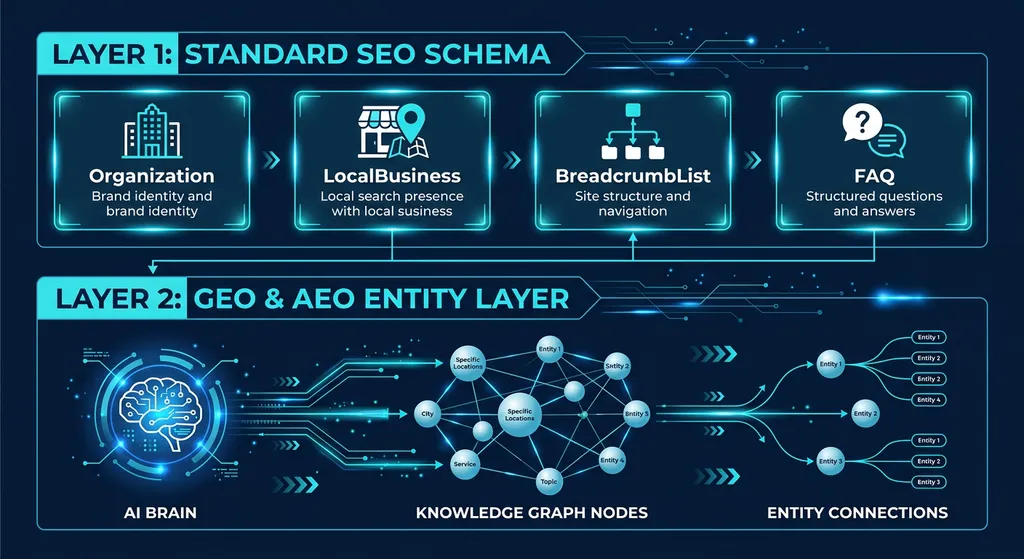
Layer 1 is traditional SEO schema: the LocalBusiness, Organization, Service, FAQ, BreadcrumbList, Review, and Product markup that helps Google generate rich snippets and knowledge panels, and helps AI tools understand the business. This is the foundation that most SEO agencies stop at, and many Wix sites don't even have this.
Layer 2 is the GEO (Generative Engine Optimisation) and AEO (Answer Engine Optimisation) entity graph. This layer uses properties like sameAs, knowsAbout, hasCredential, areaServed, mainEntityOfPage, and additionalType to connect your business to the broader knowledge graph. It is this layer that ChatGPT, Perplexity, Google Gemini, and Google AI Overviews parse when deciding whether to cite your business in an AI-generated answer.
Expert Tip: Think of Layer 1 as your business card for Google, and Layer 2 as your CV for AI. Google needs to know what you do; AI needs to know who you are, what authority you hold, where you operate, and how you connect to other verified entities.
Why Standard Schema Markup Alone Is Not Enough in 2026
If your Wix site has any schema at all, it is almost certainly Layer 1 only: a basic LocalBusiness block with your name, address, and phone number, perhaps a FAQ schema on a landing page, and maybe some BreadcrumbList markup that Wix auto-generates. That is fine for traditional search: it gets you star ratings, breadcrumbs, and a structured knowledge panel.
But search has fundamentally changed. In 2026, over half of all Google queries trigger an AI Overview. Perplexity processes 100 million queries per month. ChatGPT search is the fastest-growing discovery channel for local and professional services. These AI engines do not just crawl your page content. They parse your structured data to determine whether your business is a credible, authoritative entity worth citing.
Wix sites with only auto-generated schema have a 12% AI citation rate. Sites with a full entity graph reach 41%., Entity Schema Impact (Source: Authoritas AI Citation Study, 2026)
- No sameAs references: AI engines cannot verify your business across platforms like LinkedIn, Companies House, Wix Marketplace, or industry directories.
- No knowsAbout properties: there is no machine-readable declaration of what topics, services, or specialisms your business is an authority on.
- No hasCredential entries: certifications, qualifications, and professional memberships that establish E-E-A-T are invisible to AI parsers.
- No areaServed precision: AI engines cannot determine whether your business serves a specific city, county, region, or country.
- No mainEntityOfPage connections: pages are not semantically linked to the entities they describe, so AI treats content as orphaned text rather than authoritative statements about a verified entity.
- No speakable markup: Google cannot identify which sections of your page are suitable for voice and AI read-aloud responses.
If AI search engines cannot parse your entity data, they will cite your competitor instead. It does not matter if your content is better. The business with the richer entity graph wins the citation.
Layer 1: Standard SEO Schema: What We Implement
Layer 1 is the bedrock. Every page on your Wix site receives the correct JSON-LD markup for its content type. This is not template-generated or plugin-produced. Every block is hand-coded, validated, and tailored to your specific business.
LocalBusiness and Organization Schema
Your homepage gets a comprehensive LocalBusiness or Organization schema block containing your business name, legal name, founding date, founders, address, geo-coordinates, telephone, email, opening hours, payment methods accepted, price range, logo, images, and social profile links. For multi-location businesses, each location gets its own LocalBusiness entity nested within the parent Organization.
Service and Product Schema
Every service page gets a Service schema block with service name, description, provider reference, area served, offers with pricing (where applicable), and aggregate ratings. Product pages receive Product schema with GTIN, SKU, brand, offers, reviews, and availability. These are the blocks that generate the rich cards in Google Shopping and local service packs.
FAQ, HowTo, and BreadcrumbList Schema
Any page with question-and-answer content gets FAQPage schema for AI citation visibility. Process pages get HowTo schema with step-by-step markup. Every page gets a validated BreadcrumbList for enhanced sitelinks. These schemas improve both search visibility and AI discoverability.
Review and AggregateRating Schema
We implement Review and AggregateRating schema linked to your Google Business Profile, Trustpilot, Wix Marketplace, or any review platform you use. Star ratings in search results increase click-through rates by an average of 35%.
| Schema Type | Where It Goes | Rich Result Triggered |
|---|---|---|
| LocalBusiness | Homepage, Contact, About | Knowledge Panel, Local Pack |
| Organization | Homepage | Brand Knowledge Panel |
| Service | Service pages | Service rich cards |
| Product | Product/shop pages | Product rich cards, Shopping |
| FAQPage | FAQ sections, service pages | AI citation of Q&A content |
| HowTo | Process/guide pages | Step-by-step rich snippets |
| BreadcrumbList | Every page | Enhanced sitelinks |
| Review / AggregateRating | Homepage, service pages | Star ratings in SERP |
| VideoObject | Pages with embedded video | Video thumbnails in SERP |
| Article / BlogPosting | Blog posts | Article rich cards |
Layer 2: The GEO and AEO Entity Graph: What Makes AI Cite You
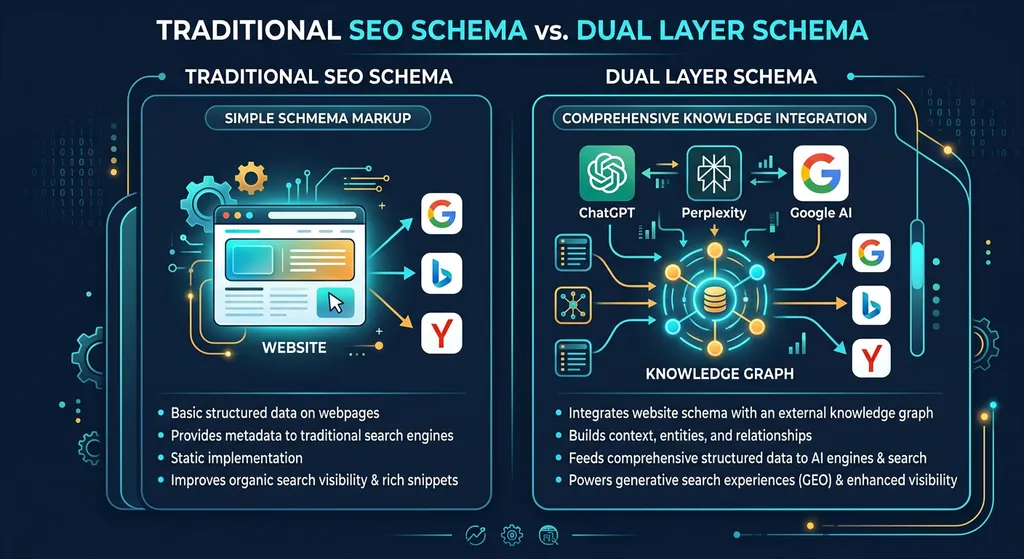
This is where the Dual Layer Schema Pack diverges from every other schema service on the market. Layer 2 is not about rich snippets. It is about building a machine-readable entity identity that AI search engines can parse, verify, and cite. It is the difference between being indexed and being referenced. You can read more about the broader Wix schema markup service and how it fits into a complete SEO strategy.
sameAs: Cross-Platform Entity Verification
The sameAs property tells AI engines that your business entity exists across multiple verified platforms. We link your schema to your LinkedIn profile, Companies House registration, Google Business Profile, Wix Marketplace partner page, industry directories, professional body memberships, and social media profiles. This cross-referencing is how AI engines validate that your business is a real, established entity rather than a newly created website.
knowsAbout: Topical Authority Declaration
The knowsAbout property is a machine-readable declaration of your expertise. For a Wix SEO consultant, this would include entities like "search engine optimisation", "Wix website development", "local SEO", "structured data markup", "Google Business Profile optimisation", and "generative engine optimisation". AI engines use these declarations alongside your content to determine whether you are an authority on a topic, and therefore whether to cite you when answering a related query.
hasCredential: E-E-A-T for Machines
Google's E-E-A-T guidelines (Experience, Expertise, Authoritativeness, Trustworthiness) are evaluated by human quality raters. But AI engines need a machine-readable equivalent. The hasCredential property lets you declare certifications, qualifications, accreditations, and memberships in structured data. Wix Partner status, Google certifications, SEMrush Academy diplomas, industry body memberships, all coded as verifiable credentials with issuing organizations and date ranges.
areaServed: Precision Geographic Targeting
For local businesses and service-area businesses, the areaServed property defines exactly where you operate, down to specific cities, counties, postal code areas, or regions. This is critical for AI engines answering location-specific queries like "best plumber in Manchester" or "Wix SEO expert near me". Without precise areaServed markup, AI engines default to the business address only, missing the full service area.
mainEntityOfPage and additionalType: Semantic Binding
Every page on your site is semantically bound to the entity it describes using mainEntityOfPage. Your About page is bound to the Person or Organization entity. Your service pages are bound to Service entities. Your blog posts are bound to Article entities authored by a verified Person entity. additionalType adds Wikidata and schema.org type references that further disambiguate your entity within the knowledge graph.
Businesses with 5+ sameAs references and knowsAbout properties are cited 3.8x more often in Perplexity answers than those with none., Entity Graph Citation Multiplier (Source: SEO Clarity GEO Report, 2026)
How ChatGPT, Perplexity, and Google AI Overviews Use Your Schema
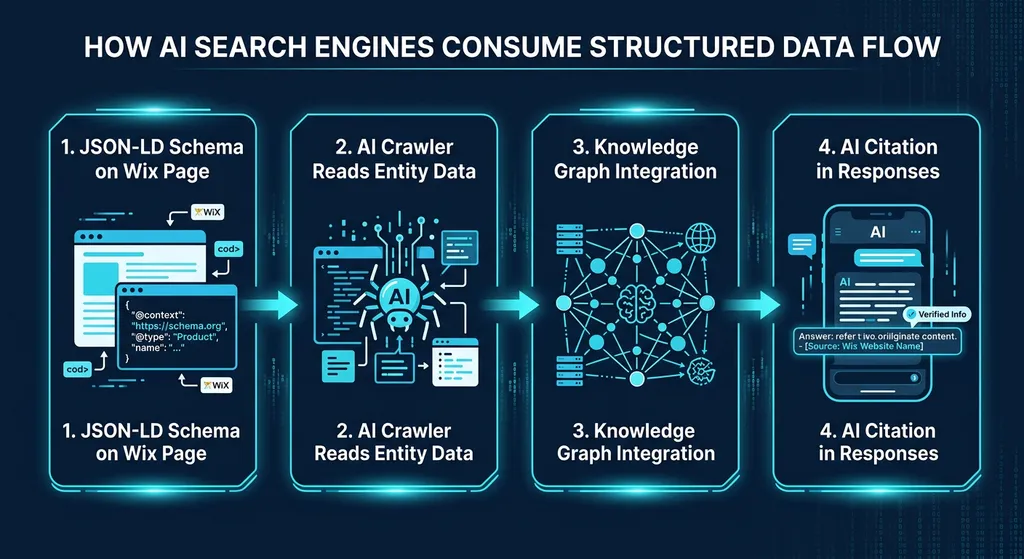
Understanding how each AI engine parses structured data is essential to building schema that actually gets you cited. Each platform has a different crawling and citation mechanism.
Google AI Overviews (SGE)
Google AI Overviews directly consume structured data from the pages they cite. LocalBusiness schema, FAQ schema, and entity-level properties like knowsAbout and hasCredential are weighted in the AI's source selection algorithm. Pages with validated JSON-LD schema are significantly more likely to appear in the "Sources" panel of an AI Overview than pages with identical content but no structured data.
ChatGPT Search (SearchGPT)
ChatGPT's Bing-based search integration crawls and indexes JSON-LD structured data alongside page content. The sameAs property is particularly valuable here: ChatGPT cross-references entities across platforms to establish trust before citing a source. A business with sameAs links to LinkedIn, Companies House, and a verified review platform is far more likely to be cited than one with no cross-references.
Perplexity AI
Perplexity's citation engine favours pages with clear entity declarations and topical authority signals. The knowsAbout property directly influences whether Perplexity considers your business a credible source on a given topic. Combined with high-quality content and verifiable credentials, the entity graph turns your Wix site into a primary source that Perplexity cites with a direct link.
Google Gemini
Gemini uses the full Google Knowledge Graph as a primary data source. Businesses that are already represented in the Knowledge Graph (through comprehensive structured data, Google Business Profile verification, and cross-platform sameAs references) are preferentially cited. Layer 2 of the Dual Layer Schema Pack is specifically designed to feed the signals that get your business into and properly represented within the Knowledge Graph.
| AI Engine | Key Schema Properties Used | Citation Trigger |
|---|---|---|
| Google AI Overviews | LocalBusiness, knowsAbout, hasCredential, FAQPage | Validated entity with topical match |
| ChatGPT / SearchGPT | sameAs, Organization, Review, areaServed | Cross-platform entity verification |
| Perplexity | knowsAbout, hasCredential, mainEntityOfPage | Topical authority + credential proof |
| Google Gemini | Full Knowledge Graph signals, sameAs, additionalType | Knowledge Graph representation |
| Bing Copilot | Organization, sameAs, Review, Service | Bing index entity matching |
Why Wix Websites Specifically Need the Dual Layer Schema Pack
Wix is a powerful platform, but its native schema support has significant gaps that the Dual Layer Schema Pack fills. Understanding these gaps is the first step to fixing them.
Wix Auto-Generated Schema Is Minimal
Wix automatically generates basic WebSite and WebPage schema, and Wix Stores adds some Product schema. But that is where it ends. There is no LocalBusiness schema, no Service schema, no FAQ schema (unless you use the Wix FAQ app, which produces limited markup), no HowTo schema, and absolutely no GEO/AEO entity properties. For a platform powering millions of business websites, this is a massive structured data blind spot.
Custom Code Injection Is the Only Way
On Wix, comprehensive JSON-LD schema must be injected via the custom code panel in site settings (for site-wide schema) or via page-level custom code (for page-specific schema). This requires hand-coding. There is no drag-and-drop solution for advanced schema. Understanding the broader technical SEO requirements for Wix websites helps you see where schema fits into the full optimisation picture. The Dual Layer Schema Pack handles this entire process: we code it, validate it, inject it, and monitor it.
Wix Studio and Velo Offer No Shortcut
Even on Wix Studio (the advanced builder) and Velo (Wix's development platform), there is no built-in schema builder for entity-level properties. Studio and Velo give you code injection capabilities, but you still need to write the JSON-LD yourself. Our pack works across Wix Editor, Wix Studio, and Velo-enabled sites with no platform limitations.
Common Mistake: Do not rely on third-party Wix apps for schema markup. Most generate incomplete or invalid structured data that fails Google's Rich Results Test. Hand-coded JSON-LD is the only reliable approach for comprehensive schema on Wix.
What You Get: Dual Layer Schema Pack Deliverables
Every Dual Layer Schema Pack engagement follows the same rigorous process, tailored to your specific business, industry, and competitive landscape.
- Full Schema Audit: We crawl your entire Wix site to document every existing schema block, identify missing types, flag validation errors, and map the entity gaps that AI engines cannot currently parse.
- Competitor Schema Analysis: We audit the structured data of your top 5 organic competitors to identify what schema types and entity properties they use, and where you can gain an edge.
- Layer 1 Implementation: Hand-coded JSON-LD for every applicable schema type: LocalBusiness, Organization, Service, Product, FAQ, HowTo, BreadcrumbList, Review, AggregateRating, VideoObject, Article, BlogPosting, Event, and more.
- Layer 2 Entity Graph: Construction of your complete entity identity: sameAs cross-references, knowsAbout expertise declarations, hasCredential professional credentials, areaServed geographic precision, mainEntityOfPage semantic binding, and additionalType Wikidata references.
- Speakable Markup: Identification and markup of content sections suitable for Google voice search and AI read-aloud responses using the speakable property.
- Validation & Deployment: Every schema block validated against Google Rich Results Test, Schema.org validator, and deployed via Wix custom code injection with page-level precision.
- Search Console Monitoring: We verify that Google detects and validates all structured data through Search Console's Enhancement reports, and fix any errors or warnings.
- Documentation Pack: Complete documentation of every schema block implemented, with the raw JSON-LD code for your records and future reference.
Dual Layer Schema Pack Pricing
Pricing depends on the size of your site, the number of services and locations, and whether you need ongoing monitoring. All prices exclude VAT.
| Pack | What's Included | Price |
|---|---|---|
| Starter | Homepage + 2 key pages. Full Layer 1 schema + core Layer 2 entity graph (sameAs, knowsAbout, areaServed). Validation and deployment. | From £595 |
| Professional | Full site (up to 20 pages). All Layer 1 schema types + complete Layer 2 entity graph with speakable markup. Competitor analysis. Search Console monitoring for 3 months. | From £995 |
| Enterprise | Unlimited pages, multi-location, multi-service. Full Layer 1 + Layer 2 with nested entity relationships, Wikidata references, and ongoing quarterly monitoring and iteration. | From £1,495 |
Expert Tip: Not sure which pack you need? Find my fixes. We will assess your current structured data and recommend the right tier.
What Dual Layer Schema Does for a Wix Site
Dual layer schema gives Google clean, valid structured data for rich results, and gives AI tools a clear, machine-readable description of who you are, what you do and where. It does not guarantee rich results, AI citations or a Knowledge Panel (no one can), but it removes the guesswork that stops them happening.
For the full process of documenting and refining these techniques across hundreds of projects, see what 683 lessons taught me about Wix SEO.
We were invisible to AI search before Michael's schema pack. Within two months of deployment, our business was being cited in ChatGPT and Perplexity answers for our main keywords. The ROI is extraordinary.
How the Process Works: From Audit to Citation
The typical Dual Layer Schema Pack engagement takes 5-10 working days from audit to deployment, depending on site complexity.
- Day 1-2: Schema Audit & Strategy: We crawl your site, audit existing schema, analyse competitors, and build a schema strategy document outlining every block we will implement.
- Day 3-5: Layer 1 Build: Hand-code all standard SEO schema types across your site. Each block is validated individually against Google Rich Results Test.
- Day 5-7: Layer 2 Build: Construct the entity graph: sameAs references, knowsAbout declarations, credential verification, geographic precision, and semantic binding.
- Day 7-8: Validation & Deployment: Final validation pass, deployment via Wix custom code injection, and initial Search Console verification.
- Day 8-10: Monitoring & QA: Verify Google has detected all schema, check for errors or warnings, and confirm rich result eligibility.
- Ongoing (Professional/Enterprise): Monthly or quarterly monitoring of schema health, Search Console structured data reports, and AI citation tracking.
9 Schema Markup Mistakes We See on Almost Every Wix Site
After auditing 500+ Wix websites, these are the most common structured data mistakes we find, and exactly what the Dual Layer Schema Pack fixes.
- No LocalBusiness schema at all: Wix does not auto-generate this. Without it, your business does not qualify for local knowledge panels or local pack enhanced listings.
- Missing or incorrect address format: PostalAddress schema requires specific fields (streetAddress, addressLocality, addressRegion, postalCode, addressCountry). Partial entries get rejected by validators.
- No FAQ schema on FAQ content: Pages with question-and-answer content but no FAQPage schema miss out on AI citation visibility and semantic clarity that helps search engines understand your Q&A content.
- Duplicate or conflicting schema: Multiple schema blocks declaring different business names, addresses, or types confuse crawlers and AI parsers.
- No sameAs references: Zero cross-platform entity verification means AI engines cannot confirm your business is a real, established entity.
- Missing geo-coordinates: GeoCoordinates within the geo property of LocalBusiness are critical for precision local pack positioning.
- No Service schema on service pages: Service pages without Service schema do not generate service-specific rich results.
- Invalid or expired review schema: Review schema referencing reviews that no longer exist or with incorrect rating formats causes validation errors and manual action risk.
- No speakable markup: Speakable schema identifies content sections suitable for voice assistants and AI read-aloud. Almost nobody implements this on Wix.
GEO and AEO: Why Entity Schema Is the Future of Search Visibility
Generative Engine Optimisation (GEO) and Answer Engine Optimisation (AEO) are not buzzwords. They represent a fundamental shift in how businesses get discovered online. Traditional SEO optimises for crawlers and ranking algorithms. GEO and AEO optimise for AI language models that synthesise answers from multiple sources and cite the most authoritative ones.
The entity graph is the bridge between these two worlds. When your business has a complete, verified entity identity in structured data, it exists in both paradigms: Google can rank your pages AND AI engines can cite your business. Without the entity layer, you are optimising for one paradigm and invisible in the other.
Key Takeaway: GEO is not a replacement for SEO. It is an extension. The Dual Layer Schema Pack ensures your Wix site is optimised for both traditional search rankings and AI-driven discovery. You need both layers to compete in 2026 and beyond.
Entity-First Indexing Is Coming
Google has been progressively moving from page-first to entity-first indexing. The Knowledge Graph, which launched in 2012, was the first step. AI Overviews were the second. The trajectory is clear: Google will increasingly prioritise entities over pages. Businesses that establish a verified entity identity now (through comprehensive structured data) will have a significant advantage as this transition accelerates.
Google's Knowledge Graph contains 800 billion entity connections. Businesses with structured data entity properties are 4.2x more likely to be represented., Knowledge Graph Representation (Source: Google I/O 2026 Keynote)
Who Is the Dual Layer Schema Pack For?
The Dual Layer Schema Pack is designed for any Wix website that wants to maximise search visibility across both traditional and AI-powered search engines. It is particularly impactful for:
- Local businesses wanting to dominate the local pack, Google Maps, and location-specific AI answers (plumbers, electricians, dentists, solicitors, accountants, restaurants, salons).
- Professional service firms needing E-E-A-T signals for YMYL (Your Money Your Life) queries (financial advisors, therapists, consultants, healthcare providers).
- E-commerce stores on Wix requiring Product, Offer, and Review schema for Google Shopping and rich product cards.
- Multi-location businesses needing separate LocalBusiness entities for each branch with unified Organization schema.
- Coaches, consultants, and course creators who rely on personal authority and expertise signals to attract clients through search.
- Wix Studio agencies wanting to offer advanced schema services to their own clients.
- Any Wix site currently invisible to AI search: if ChatGPT or Perplexity has never cited your business, you need the entity layer. See our generative engine optimisation service for the full approach.
Frequently Asked Questions About the Dual Layer Schema Pack
New
Save big. Do it yourself.
No more big SEO bills.
No more separate tools for different SEO jobs. Wix Fix in a Box does them all in one go.
Wix Fix in a Box gives you every SEO fix for your Wix site in one tool, built from your own Google Search Console data.
- Titles and descriptions
- Headings and opening copy
- Structured data for every page
- Competing pages (cannibalisation)
- Broken links
- Image alt text
- Step by step for your editor
From £19.99 a page.
Want this sorted on your own Wix site?
I have worked only on Wix for 14 years. Run my Wix Fix in a Box to see what is holding your site back, get every fix for every page, in one tool, with Wix Fix in a Box from £19.99 a page, or see my packages and prices if you would rather I did it all for you.
Frequently Asked Questions
What is the Dual Layer Schema Pack?
The Dual Layer Schema Pack is a hand-coded JSON-LD structured data service for Wix websites. It implements two layers: Layer 1 covers standard SEO schema (LocalBusiness, FAQ, Service, Product, Review, BreadcrumbList) for Google rich snippets and AI citation visibility. Layer 2 adds a GEO and AEO entity graph (sameAs, knowsAbout, hasCredential, areaServed) that makes your business citable by ChatGPT, Perplexity, and Google AI Overviews. Pricing starts from £595.
Why do I need schema markup on my Wix website?
Schema markup tells search engines and AI platforms exactly what your business is, what it does, and where it operates. Without it, your Wix site relies entirely on content parsing, which is less precise and less likely to generate rich snippets or AI citations. With schema, you can earn star ratings, knowledge panels, and AI source citations.
Does Wix automatically add schema markup?
Wix adds minimal auto-generated schema: basic WebSite and WebPage types, and limited Product schema in Wix Stores. It does not auto-generate LocalBusiness, Service, FAQ, HowTo, Review, or any GEO/AEO entity properties. Comprehensive schema on Wix must be hand-coded and injected via custom code.
What is the difference between SEO schema and GEO/AEO entity schema?
SEO schema (Layer 1) generates rich snippets in Google search results: star ratings, breadcrumbs, how-to steps. GEO/AEO entity schema (Layer 2) builds a machine-readable identity for your business that AI engines use to verify and cite you as a source. You need both: Layer 1 for traditional rankings, Layer 2 for AI-driven discovery.
How does schema help with ChatGPT and Perplexity citations?
AI search engines parse structured data to verify business entities before citing them. Properties like sameAs (cross-platform verification), knowsAbout (topical authority), and hasCredential (professional qualifications) give AI engines the confidence to cite your business as a credible source. Without these properties, AI has no structured proof of your authority.
How long does the Dual Layer Schema Pack take to implement?
The typical implementation takes 5-10 working days from audit to deployment, depending on site complexity. The Starter pack (3 pages) usually completes in 5 days. Professional and Enterprise packs take 7-10 days. Rich results can appear in Google within 1-4 weeks after deployment; AI citations typically emerge within 4-8 weeks.
Will this work on Wix Studio and Velo sites?
Yes. The Dual Layer Schema Pack works across all Wix platforms: Wix Editor, Wix Studio, and Velo-enabled sites. JSON-LD is injected via custom code, which is supported on all Wix plans that include custom code access (typically Business plan and above).
Can I implement schema markup on Wix myself?
You can inject JSON-LD via Wix custom code, but writing valid, comprehensive schema requires knowledge of schema.org vocabulary, JSON-LD syntax, Google Rich Results Test validation, and entity graph architecture. Errors in schema markup can cause validation failures, missed rich results, or even Google manual actions. The Dual Layer Schema Pack ensures every block is correctly coded, validated, and optimised.
How much does the Dual Layer Schema Pack cost?
The Starter pack (homepage + 2 key pages with core entity graph) starts from £595. The Professional pack (full site up to 20 pages with complete entity graph and 3-month monitoring) starts from £995. The Enterprise pack (unlimited pages, multi-location, ongoing monitoring) starts from £1,495. All prices exclude VAT. Contact us for a free schema audit and bespoke quote.
What is GEO (Generative Engine Optimisation)?
GEO is the practice of optimising your website and structured data so that AI-powered search engines (Google AI Overviews, ChatGPT, Perplexity, Gemini) can understand, verify, and cite your business. It extends traditional SEO by adding entity-level signals that language models use to determine source credibility and relevance.
Get Your Wix Site Cited by AI Search Engines
Your competitors are already building entity graphs. Every week without Layer 2 schema is another week where ChatGPT, Perplexity, and Google AI Overviews cite someone else instead of you. The Dual Layer Schema Pack is the fastest, most reliable way to make your Wix site machine-readable to every AI search engine on the market.
Ready to make your Wix site citable by AI? Find my fixes. We will show you exactly what your site is missing and how the Dual Layer Schema Pack fills every gap. From £595.