SEO workflow templates: repeatable processes for Wix businesses
Module 45: Wix SEO Automation & Workflows at Scale | Lesson 514 of 683 | 44 min read
By Michael Andrews, Wix SEO Expert UK
The most successful SEO practitioners do not reinvent the wheel for every task. They build repeatable workflows with documented steps, quality checkpoints, and measurable outcomes. Ad hoc SEO produces inconsistent results because critical steps get skipped under time pressure, different team members follow different processes, and there is no baseline to compare against when something goes wrong. This lesson provides ready-to-use SEO workflow templates for the most common Wix SEO tasks: new page publication, content updates, technical audits, monthly reporting, and quarterly strategy reviews, with automation integration points built into each.
Workflow 1: New Page Publication SEO Checklist
Automated new page SEO verification workflow
- Step 1: Before publishing, verify: title tag (50-60 chars, includes keyword), meta description (130-155 chars, includes CTA), H1 heading (matches target keyword), URL slug (short, keyword-rich, hyphenated).
- Step 2: Check content quality: minimum 800 words for service pages, 1,500 for blog posts. At least 2 internal links and 1 external link.
- Step 3: Verify images: all have descriptive alt text, compressed under 200KB, relevant filenames.
- Step 4: Check schema markup: appropriate type (Article, LocalBusiness, Product, etc.) with required properties.
- Step 5: Verify mobile layout: preview on mobile, check button sizes, text readability, no horizontal scroll.
- Step 6: Publish the page.
- Step 7: Automation: Zapier submits the new URL to GSC for indexing.
- Step 8: Automation: Wix Automation sends notification confirming all SEO elements are present.
- Step 9: Share the page on social media channels within 24 hours for initial traffic and social signals.
- Step 10: After 7 days, check GSC URL Inspection to verify the page is indexed.
Workflow 2: Monthly SEO Reporting Process
Automated monthly SEO reporting workflow
- Step 1: Automation: Google Sheets pulls GSC data for the past month via Search Analytics for Sheets add-on.
- Step 2: Automation: Spreadsheet formulas calculate month-over-month changes in clicks, impressions, average position, and CTR.
- Step 3: Manual review: identify top gaining and declining keywords. Note any significant changes.
- Step 4: Manual review: check GA4 for organic traffic, goal completions, and revenue from organic search.
- Step 5: Manual review: check GSC Coverage for any new indexation issues.
- Step 6: Automation: Apps Script generates a PDF report and emails it to stakeholders.
- Step 7: Document 3 key insights and 3 priority actions for the next month.
- Step 8: Update the SEO action plan with new tasks based on the month data.
Workflow 3: Quarterly Technical SEO Audit
Quarterly technical audit workflow with automation support
- Step 1: Run Screaming Frog crawl of the full site. Export results.
- Step 2: Check: all pages have unique title tags and meta descriptions (no duplicates).
- Step 3: Check: no broken internal or external links (should be caught by automated monitoring, but verify).
- Step 4: Check: all pages indexed in GSC (compare crawled pages vs indexed pages).
- Step 5: Check: Core Web Vitals passing on mobile and desktop for all templates.
- Step 6: Check: schema markup valid on all page types (test 3 of each in Rich Results Test).
- Step 7: Check: XML sitemap up to date and only contains indexable pages.
- Step 8: Check: robots.txt not blocking important resources.
- Step 9: Document all issues found with priority ratings.
- Step 10: Create tasks for each issue and schedule fixes within 2 weeks.
Workflow 4: Content Update Process
When a page is flagged for content update (via the freshness automation), follow this standardised process: review current content for accuracy, update statistics and data with 2026 figures, refresh screenshots and images, check and fix any broken links, update the Last Updated date in CMS, request re-crawling in GSC, and monitor the page traffic for 30 days to measure update impact. Documenting the before-and-after for each update creates a library of case studies that demonstrates the value of ongoing SEO maintenance to stakeholders.
Workflow 5: New CMS Collection Launch
When adding a new CMS collection to your Wix site (a new listing type, a new blog category, or a new product line), follow this launch workflow. First, define the CMS schema including all SEO fields: title, slug, meta title, meta description, and schema type. Second, configure the dynamic page template with correct H1 binding, breadcrumbs, and related content sections. Third, populate at least 10 items before launching to avoid a thin collection. Fourth, configure the sitemap to include the new collection URLs. Fifth, submit the sitemap to GSC. Sixth, monitor GSC Coverage weekly for the first month to verify indexation of new collection pages.
Documenting and Scaling Your Workflow Library
Workflow templates only deliver value if they are used consistently. Store all workflow documents in a shared team location: Google Drive, Notion, or Confluence. Create a workflow index listing every available template with links to the full document. Review the workflow library quarterly: remove steps that add no value, add steps for processes that are frequently missed, and update tool names or platform details when your stack changes. Train every new team member on the workflows during onboarding so that SEO processes are consistent from their first day.
Complete How-To Guide: Implementing All Four Workflows on Your Wix Site
Full implementation of the workflow system
- Step 1: Create a "Workflows" folder in your Google Drive or Notion workspace.
- Step 2: Copy each workflow template above into a separate document. Customise the specific fields and thresholds for your Wix site.
- Step 3: Set up the automations required by each workflow: Zapier for indexing submissions, Google Sheets for reporting, Wix Automations for content freshness.
- Step 4: Assign ownership: who is responsible for each workflow? Document names and backup contacts.
- Step 5: Set calendar reminders: monthly for the reporting workflow, quarterly for the technical audit.
- Step 6: Create a shared checklist (Google Sheets or Notion template) for each workflow that can be duplicated each time it runs.
- Step 7: Run each workflow once manually to verify all steps work and all automations trigger correctly.
- Step 8: After 3 months of using the workflows, review and refine: remove steps that add no value, add steps that you found yourself doing manually.
- Step 9: If you manage SEO for multiple Wix sites, parameterise the workflows so they can be applied to any site with minimal customisation.
- Step 10: Train team members on the workflows so SEO processes continue consistently even when you are unavailable.
Essential Tools for This Lesson
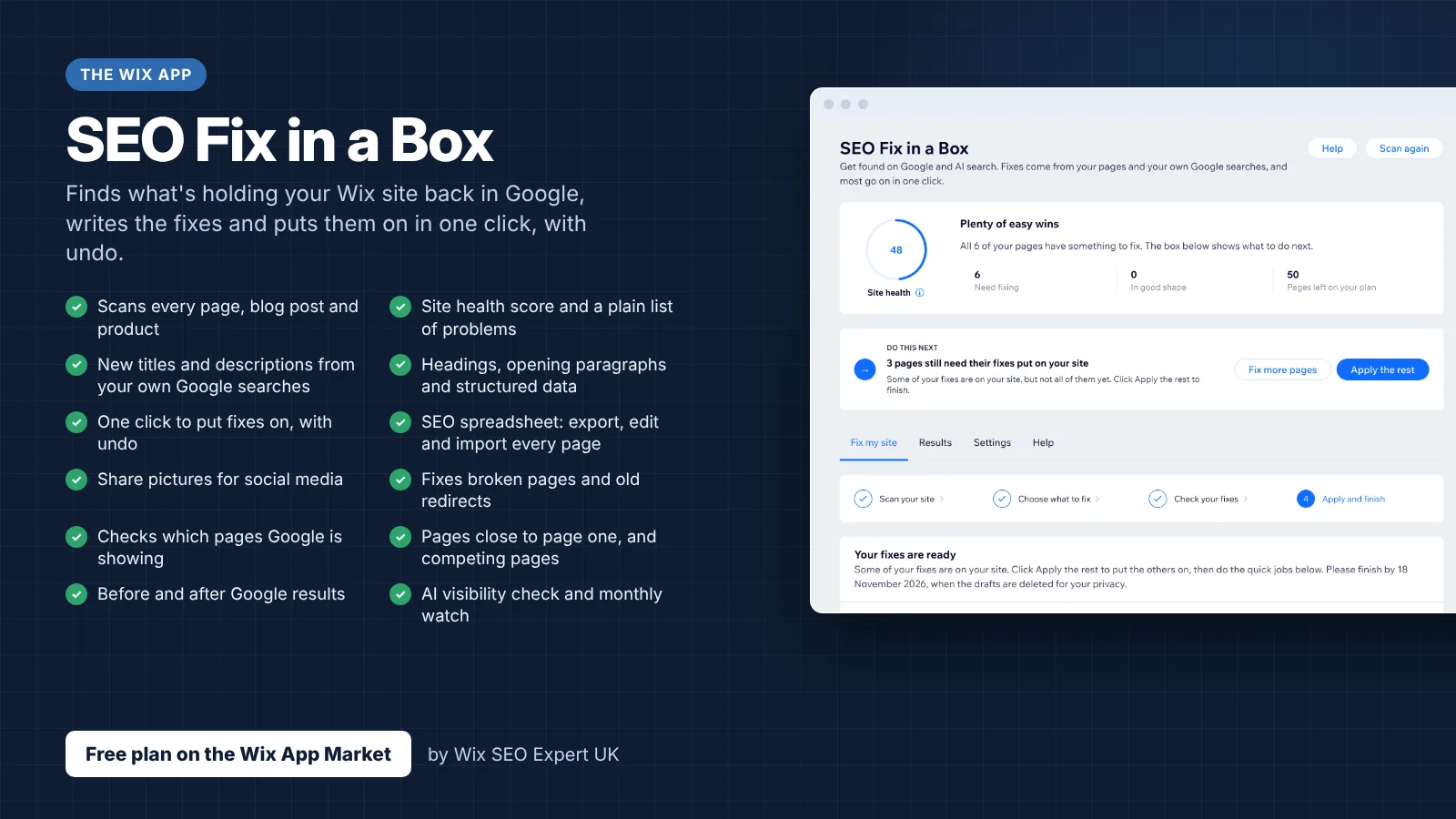
- SEO Fix in a Box: My Wix app. Free to install, it scans your site and shows what needs fixing, and paid plans write the fixes from your own Google searches
Was this lesson useful?
It takes 1 minute to tell me. The course is free and I want to keep it that way, and your feedback shows me what is working and helps other people find it.
This lesson on SEO workflow templates: repeatable processes for Wix businesses is part of Module 45: Wix SEO Automation & Workflows at Scale in The Most Comprehensive Complete Wix SEO Course in the World (2026 Edition). Created by Michael Andrews, a Wix Marketplace Legend Partner with 14 years of hands-on experience, 800 completed Wix SEO projects and 456 verified five-star reviews.