Wix Category Page SEO: Turn Collections Into Traffic Drivers

By Michael Andrews | Published: 2026-02-15 | Updated: 2026-03-10 | 8 min read
Wix Store category pages are the most underoptimised assets in e-commerce SEO. This guide covers how to turn collection pages into high-ranking traffic drivers with category content, schema, and technical optimisation.
Category pages are the most neglected SEO asset on most Wix stores. While product pages target specific product searches, category pages target broad, high-volume category searches, often with much higher purchase intent. Optimising them correctly can deliver a significant increase in organic traffic and revenue.
Keyword Targeting for Wix Store Category Pages
Each category page should target a specific, high-volume category keyword. Research what your target customers type when browsing for the type of product your category contains.
- Research category-level keywords (e.g., "bamboo yoga mats" not "non-slip bamboo yoga mat 4mm")
- Look at competitor category page titles to understand targeting patterns
- Target one primary category keyword + 2–3 semantic variations
- Include location in category keyword if targeting local search (e.g., "handmade candles UK")
Adding Category Content to Wix Store Collection Pages
Most Wix Store category pages contain only product listings, no text content. Adding 150–300 words of unique, keyword-rich descriptive content to each category page dramatically improves its SEO potential. This content should explain what the category contains, who it is for, and what differentiates your offering.
Expert Tip: In Wix Editor, you can add a Text element above or below your product grid on collection pages. This is where your category description goes. Place it above the grid for maximum impact, Google weights content earlier on the page more heavily.
Category Page On-Page SEO Checklist
- Title tag: [Category Name], [Brief differentiator] | [Brand]
- Meta description: Describe what the category contains with a call to action
- H1: Category name containing the primary keyword
- Category description: 150–300 words of unique content
- Breadcrumbs: Home > Shop > Category (Wix auto-generates these)
- Internal links: Link from homepage and related categories
- Schema: Add ItemList structured data listing the products in the category
Handling Filtered Category Pages (Avoid Duplicate Content)
When shoppers filter a category (e.g., by colour, size, or price), Wix may generate new URLs with query parameters or additional path segments. These filtered pages can cause duplicate content issues. Use canonical tags pointing all filtered variations back to the main category page URL. Category pages are one part of the picture. See my full Wix ecommerce SEO strategy.
Fix your Wix SEO from your dashboard
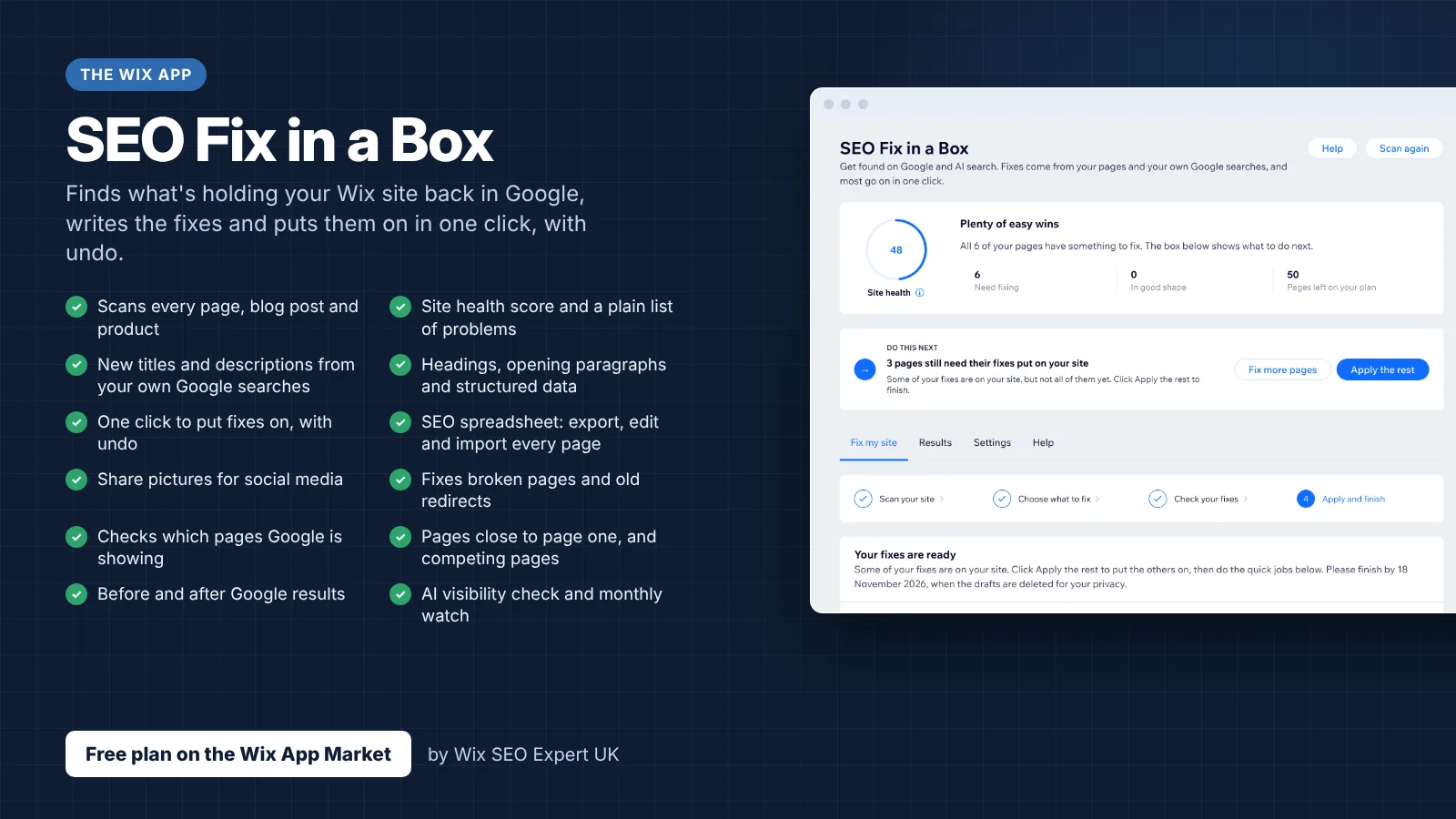
Wix SEO Fix in a Box scans every page, writes your fixes from your own Google searches and puts them on in one click, with undo. Start on the free plan.
Want this sorted on your own Wix site?
I have worked only on Wix for 14 years. Get Wix SEO Fix in a Box on the Wix App Market to find and fix what is holding your site back, or see my packages and prices if you would rather I did it all for you.
Frequently Asked Questions
Should Wix Store category pages rank or product pages rank?
Both should rank, but for different keywords. Category pages should rank for broad, high-volume category searches (e.g., "yoga mats UK"). Product pages should rank for specific product searches (e.g., "4mm bamboo yoga mat"). This two-tier structure is the most effective e-commerce keyword architecture and drives significantly more total organic traffic than relying on product pages alone.
How do I add category description content to a Wix Store collection page?
In the Wix Editor, open your collection page and add a Text element above your product grid. This is where your category description content goes. For best SEO results, place the text above the product grid so it appears earlier in the page HTML. Write 150–300 words of unique, keyword-rich content that describes the category, who it is for, and what differentiates your products. Include your primary category keyword naturally in the first sentence and in at least one subheading. This content addition alone can significantly improve a category page's ranking potential as it gives Google substantive text to evaluate for relevance.
How do filtered category pages on Wix Store cause duplicate content issues?
When shoppers filter a Wix Store category page (by colour, size, price, or brand), Wix may generate new, indexable URLs with query parameters or additional path segments representing the filter state. If Google indexes both the unfiltered category page and its filtered variations, it sees nearly identical content at multiple URLs, a classic duplicate content problem. The solution is to add a canonical tag to all filtered page variations pointing back to the main unfiltered category URL. This tells Google that the main category page is the definitive version, consolidating all ranking signals to one URL.
What internal linking strategy works best for Wix Store category pages?
Category pages should sit at the centre of your Wix Store internal linking structure. Link to each category page from: the main navigation menu, the homepage (featured categories section), relevant blog posts that discuss the category topic, and related category pages (cross-linking between complementary categories). From each category page, link to the top-performing individual products and to any relevant buying guide blog posts. This bidirectional linking signals to Google that category pages are important hub pages on your site, strengthening their ability to rank for broad category keywords.
Want expert Wix Store e-commerce SEO? Get professional optimisation for your Wix shop from the UK's dedicated Wix SEO specialist.