Enterprise SEO strategy: scaling Wix for large organisations
Module 42: Enterprise SEO Strategy on Wix | Lesson 474 of 683 | 40 min read
By Michael Andrews, Wix SEO Expert UK
Enterprise SEO is fundamentally different from small business SEO. When a Wix site serves hundreds of pages, multiple departments, several locations or large product catalogues, the SEO challenges shift from individual page optimisation to systematic, scalable processes. This lesson covers the strategic framework for managing SEO at enterprise scale on the Wix platform, including governance structures, cross-team alignment and the infrastructure decisions that determine whether your SEO effort compounds or collapses.
What Makes Enterprise SEO Different
Enterprise SEO operates at a scale where manual, page-by-page optimisation is no longer viable. A small business might optimise 20 pages individually, but an enterprise Wix site with 500 or 2,000 pages needs templated approaches, automated checks and governance systems. The technical debt of a single missed redirect or duplicate content issue multiplies across hundreds of pages, making systematic processes essential rather than optional.
The organisational complexity is equally challenging. Enterprise SEO requires alignment between marketing, IT, product, content, legal and executive teams. A blog post that takes a freelancer 30 minutes to publish can take an enterprise three weeks when it requires legal review, brand approval, accessibility checks and multi-stakeholder sign-off. Building efficient workflows that maintain quality without creating bottlenecks is the core skill of enterprise SEO management.
Building an Enterprise SEO Governance Framework
- Define clear ownership: assign an SEO lead who has authority to approve or block changes that affect search performance
- Create an SEO approval workflow: all new pages, URL changes, content updates and technical changes must be reviewed for SEO impact before deployment
- Establish SEO standards documentation: a living document covering title tag formats, meta description templates, heading hierarchy rules, image requirements and schema markup standards
- Implement regular SEO audits: quarterly full-site crawls with automated alerting for critical issues like broken pages, missing titles or noindex errors
- Set up cross-team communication channels: a dedicated Slack channel or Teams channel where SEO-impacting changes are flagged before they go live
- Create an SEO change log: document every significant change made to the site for correlation with ranking and traffic shifts
Stakeholder Alignment and Executive Buy-In
Enterprise SEO fails without executive support. The most common reason enterprise SEO initiatives stall is that other departments do not understand the revenue impact of SEO and therefore deprioritise it. Build your case with data: correlate organic traffic to revenue, demonstrate the cost per acquisition compared to paid channels, and show competitors winning traffic you should own. Present SEO metrics in business terms, never in technical jargon.
How to build executive buy-in for enterprise SEO
- Calculate the current monthly revenue attributable to organic search using Google Analytics e-commerce or goal tracking data.
- Compare your organic cost-per-acquisition to paid search CPA to demonstrate efficiency.
- Identify three to five high-value keywords where competitors outrank you and estimate the lost revenue using search volume and conversion rate data.
- Create a one-page executive summary showing current organic revenue, growth opportunity, required investment and projected ROI.
- Present quarterly SEO performance reviews to leadership with clear revenue attribution, not just traffic numbers.
Enterprise SEO Technology Stack on Wix
- Wix Enterprise plan for advanced site management, increased storage and premium support
- Wix Studio for agencies managing multiple enterprise Wix sites with shared design systems
- Screaming Frog or Sitebulb for scheduled technical crawls of large Wix sites
- Lumar (formerly DeepCrawl) for enterprise-grade crawl monitoring with automated alerting
- Semrush or Ahrefs enterprise plans for keyword tracking, competitor monitoring and backlink analysis at scale
- Google Search Console API integration for automated reporting across multiple properties
- Looker Studio (Data Studio) for executive-facing SEO dashboards pulling from GSC, GA4 and third-party tools
- ContentKing or Little Warden for real-time change detection and monitoring across hundreds of pages
Complete How-To Guide: Building an Enterprise SEO Programme on Wix
Step-by-step process for establishing enterprise SEO governance
- Step 1: Audit your current Wix site infrastructure. Document total page count, content types, URL structure, existing redirects and current technical SEO health using a full Screaming Frog crawl.
- Step 2: Map stakeholders across your organisation who influence website content, structure or functionality. Create a RACI matrix defining who is Responsible, Accountable, Consulted and Informed for SEO decisions.
- Step 3: Draft your SEO standards document covering title tag formats (brand name position, character limits), meta description templates, heading hierarchy rules, image naming and alt text conventions, and URL slug formatting.
- Step 4: Establish an SEO change request process. Create a simple form or ticket template that requires anyone changing URLs, page titles, navigation structure or content to submit for SEO review before deployment.
- Step 5: Set up automated monitoring. Configure Screaming Frog scheduled crawls, Google Search Console email alerts, and a real-time monitoring tool like ContentKing to catch SEO-breaking changes within hours rather than weeks.
- Step 6: Build your executive reporting dashboard in Looker Studio connecting Google Search Console, Google Analytics 4 and your rank tracking tool. Include organic revenue, organic sessions, keyword visibility score and top opportunity keywords.
- Step 7: Schedule quarterly SEO reviews with all stakeholders. Present performance data, upcoming opportunities, risks from planned site changes, and resource requirements for the next quarter.
- Step 8: Create a content production workflow that includes SEO requirements at the briefing stage rather than retrofitting SEO after content is written. Every content brief should include target keyword, search intent, competing pages to outrank, internal linking targets and schema markup requirements.
Essential Resources
- Ahrefs: Enterprise SEO platform for backlink analysis, keyword research and site audits
- Semrush: Comprehensive SEO toolkit for enterprise keyword tracking and competitive analysis
- Google Search Console: Monitor search performance, indexing and technical issues at scale
- Screaming Frog SEO Spider: Technical crawling tool for enterprise site audits and monitoring
Essential Resources
- Ahrefs: Enterprise SEO platform for backlink analysis, keyword research and site audits
- Semrush: Comprehensive SEO toolkit for enterprise keyword tracking and competitive analysis
- Google Search Console: Monitor search performance, indexing and technical issues at scale
- Screaming Frog SEO Spider: Technical crawling tool for enterprise site audits and monitoring
Essential Resources
- Semrush: Enterprise-grade keyword tracking, competitor analysis and site auditing
- Google Search Console: Foundation for enterprise organic performance monitoring and reporting
- Google Looker Studio: Build executive SEO dashboards with revenue attribution
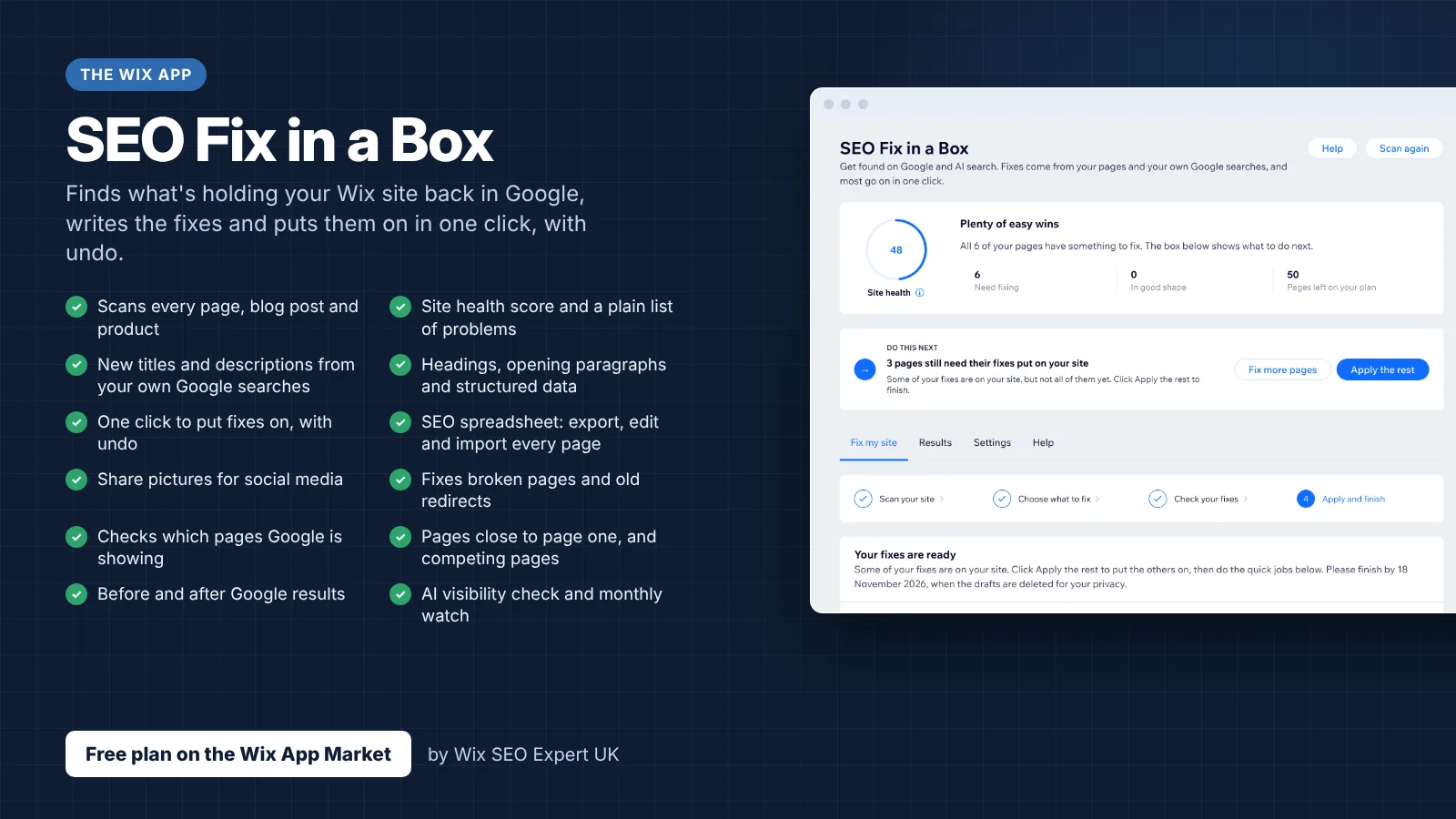
- SEO Fix in a Box: My Wix app. Free to install, it scans your site and shows what needs fixing, and paid plans write the fixes from your own Google searches
Was this lesson useful?
It takes 1 minute to tell me. The course is free and I want to keep it that way, and your feedback shows me what is working and helps other people find it.
This lesson on Enterprise SEO strategy: scaling Wix for large organisations is part of Module 42: Enterprise SEO Strategy on Wix in The Most Comprehensive Complete Wix SEO Course in the World (2026 Edition). Created by Michael Andrews, a Wix Marketplace Legend Partner with 14 years of hands-on experience, 800 completed Wix SEO projects and 456 verified five-star reviews.