Enterprise content strategy and programmatic SEO on Wix
Module 42: Enterprise SEO Strategy on Wix | Lesson 475 of 683 | 38 min read
By Michael Andrews, Wix SEO Expert UK
At enterprise scale, content strategy shifts from writing individual pages to building content systems. Programmatic SEO, template-driven content creation and content hubs become essential when you need to target hundreds or thousands of keyword variations. This lesson covers how to build scalable content architectures on Wix that capture long-tail search demand without sacrificing quality or triggering thin content penalties.
Programmatic SEO on Wix
Programmatic SEO creates pages at scale by combining templates with structured data. A service business with 50 service types across 20 locations needs 1,000 unique pages. Writing each manually is impractical. Instead, you build a template and populate it with location-specific and service-specific data, unique imagery and localised testimonials. The key to successful programmatic SEO is ensuring every generated page provides genuine unique value rather than being a thin, auto-generated shell.
Building Content Hubs and Topic Clusters at Scale
Enterprise content hubs organise hundreds of pieces of content around core topics. A pillar page covers the broad topic comprehensively, and dozens of cluster pages address specific subtopics, all interlinked systematically. On Wix, you build this structure using a combination of static pages for pillars and Wix Blog for cluster content, connected through strategic internal linking.
How to build an enterprise content hub on Wix
- Identify your five to ten core topics that represent your primary business offerings and highest-value keyword clusters.
- For each core topic, create a comprehensive pillar page (2,500+ words) covering the topic breadth on a static Wix page with a clean URL like /topic-name.
- Map 15 to 30 subtopic keywords for each pillar using keyword research tools. Each subtopic becomes a cluster article.
- Create cluster articles on Wix Blog targeting each subtopic with detailed, specific content that links back to the pillar page.
- Add contextual internal links from every cluster article to the pillar page and to two or three related cluster articles.
- Add a dynamic content section on each pillar page that displays related blog posts using Wix Blog categories.
- Update pillar pages quarterly with new data, insights and links to recently published cluster content.
Enterprise Content Workflows and Production at Scale
- Standardise content briefs with SEO requirements: target keyword, search intent, word count range, heading structure, internal link targets and schema type
- Implement editorial calendars with SEO priority scoring based on keyword difficulty, search volume and business value
- Create content templates in Wix for each content type: blog posts, service pages, location pages, case studies and FAQs
- Build a review workflow: writer creates draft, SEO reviews for keyword targeting and technical requirements, editor reviews for quality, stakeholder approves for accuracy
- Track content performance at scale using a spreadsheet or tool linking each URL to its target keyword, current ranking, organic traffic and conversion data
- Implement content refresh cycles: review and update top-performing content quarterly, audit underperforming content monthly for improvement or consolidation
Essential Resources
- Ahrefs: Enterprise SEO platform for backlink analysis, keyword research and site audits
- Semrush: Comprehensive SEO toolkit for enterprise keyword tracking and competitive analysis
- Google Search Console: Monitor search performance, indexing and technical issues at scale
- Screaming Frog SEO Spider: Technical crawling tool for enterprise site audits and monitoring
Complete How-To Guide: Enterprise Content System on Wix
Build a scalable content production system
- Step 1: Audit your existing content inventory. Export all URLs from Screaming Frog, match with Google Analytics traffic data and Google Search Console keyword data. Identify content gaps, cannibalisation issues and underperforming pages.
- Step 2: Build your content matrix. Create a spreadsheet mapping every target keyword to a content type (pillar, cluster, product, location), assigned writer, status, publish date, target URL and performance metrics.
- Step 3: Create standardised content brief templates. Include target keyword, secondary keywords, search intent classification, competitor URLs to outrank, required heading structure, internal linking targets, word count range, schema markup type and image requirements.
- Step 4: Build Wix page templates for each content type. Set up default SEO settings, schema markup, heading structures and layout sections that writers populate with content.
- Step 5: Establish your editorial calendar with SEO priority scoring. Score each content piece on search volume (1-5), keyword difficulty (1-5 inverse), business value (1-5) and competitive gap (1-5). Prioritise highest total scores.
- Step 6: Implement content performance tracking. Set up a Looker Studio dashboard pulling GA4 and GSC data, filtered by content type and publication date, showing traffic trajectory, keyword rankings and conversion rates for each piece.
- Step 7: Schedule monthly content audits reviewing the bottom 20 percent of pages by organic traffic. Decide for each: improve with updated content and better targeting, consolidate with a similar page via redirect, or remove if it adds no value.
- Step 8: Build a content refresh workflow. Quarterly, review your top 50 pages by traffic. Update statistics, add new sections, refresh screenshots, update internal links to recent content, and modify the dateModified schema.
Essential Resources
- Screaming Frog: Crawl large Wix sites to audit content inventory and identify gaps
- Google Search Console: Identify content cannibalisation and underperforming pages at scale
- Semrush: Content gap analysis and programmatic keyword research for enterprise sites
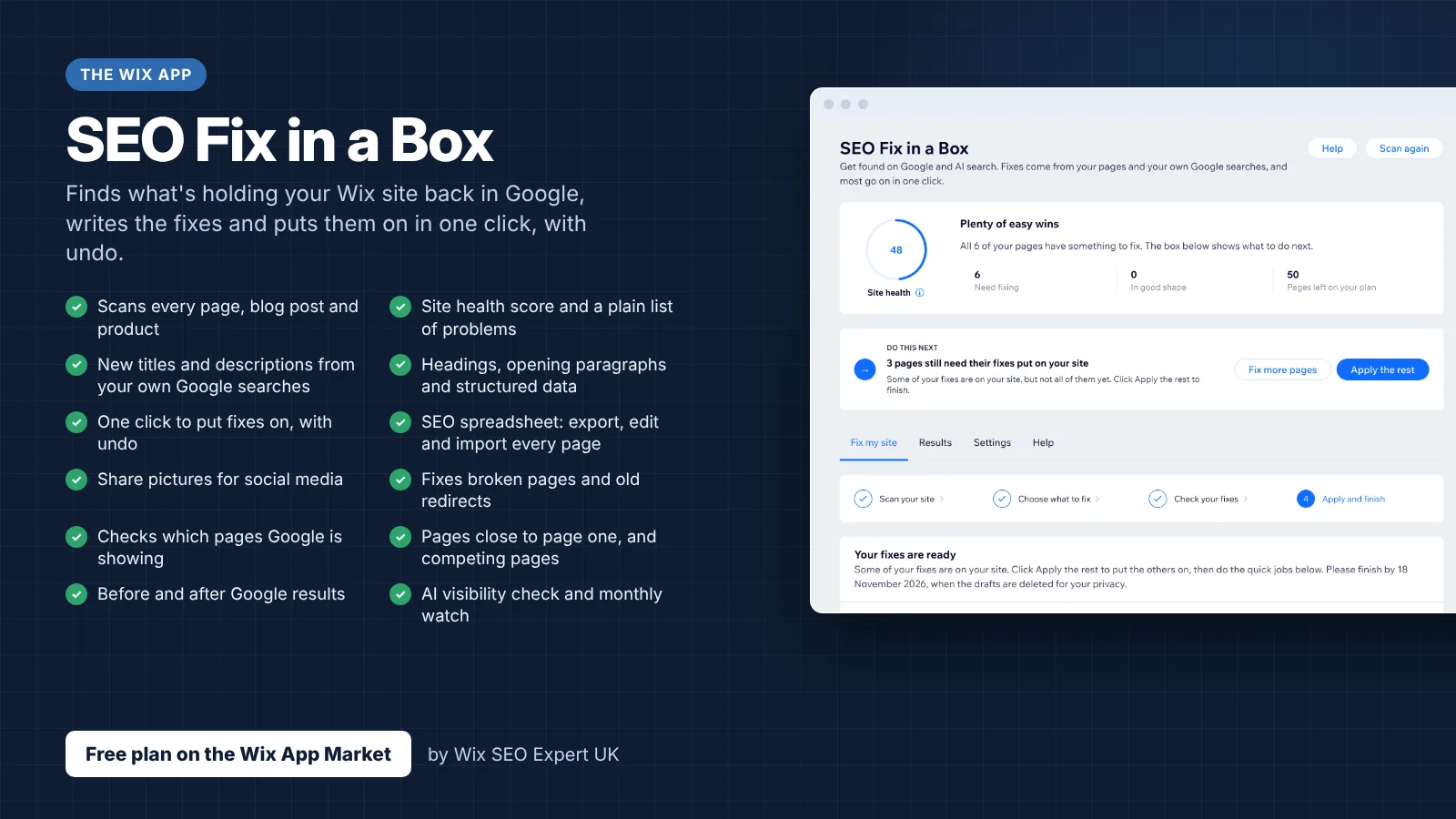
- SEO Fix in a Box: My Wix app. Free to install, it scans your site and shows what needs fixing, and paid plans write the fixes from your own Google searches
Was this lesson useful?
It takes 1 minute to tell me. The course is free and I want to keep it that way, and your feedback shows me what is working and helps other people find it.
This lesson on Enterprise content strategy and programmatic SEO on Wix is part of Module 42: Enterprise SEO Strategy on Wix in The Most Comprehensive Complete Wix SEO Course in the World (2026 Edition). Created by Michael Andrews, a Wix Marketplace Legend Partner with 14 years of hands-on experience, 800 completed Wix SEO projects and 456 verified five-star reviews.