Cross-platform brand consistency, NAP alignment and content workflow
Module 30: Social Media Setup for Wix SEO | Lesson 361 of 683 | 55 min read
By Michael Andrews, Wix SEO Expert UK
Having profiles on 9+ social platforms is only valuable if they present a consistent, professional brand that reinforces your SEO signals. Inconsistencies in your business name, address, phone number, branding, messaging or content quality actively damage your search rankings by sending conflicting entity signals. This lesson covers the complete systems, workflows, audit processes and tools that ensure cross-platform consistency at scale, with data showing exactly how inconsistencies impact rankings.
The Cost of Inconsistency: The Data
Infographic: How NAP Inconsistencies Impact Rankings
Complete How-To: NAP Consistency Audit and Correction
Full NAP audit process
- Create your Master NAP Document. Open a spreadsheet with columns: Platform, Business Name, Address, Phone, Website URL, Status (Correct/Incorrect), Notes. This is your single source of truth.
- Define your canonical NAP. Write your exact business name, complete address (including floor, suite, building name if applicable), and phone number in the exact format you want everywhere. For UK businesses: "Bedford Garden Rooms, 12 Example Street, Bedford, MK40 1AA, United Kingdom" and "01234 000000".
- Audit your Wix website. Check your footer, contact page, about page, and any location pages. Every instance of your NAP must match your canonical version exactly. Check the schema markup too.
- Audit Google Business Profile. Log in to business.google.com and verify every field matches your canonical NAP. Pay special attention to business name formatting, address punctuation, and phone number format.
- Audit Facebook Business Page. Check: Page Name, About section, Contact Information, Location. Update any discrepancies.
- Audit Instagram Business. Check: Name field, Contact Options (email, phone, address). Update any discrepancies.
- Audit LinkedIn Company Page. Check: Company Name, About section, Contact Info, Location. Update any discrepancies.
- Audit X/Twitter Profile. Check: Display Name, Bio, Location. Update any discrepancies.
- Audit YouTube Channel. Check: Channel Name, About section, Links. Update any discrepancies.
- Audit Pinterest Business. Check: Profile Name, Description, Website. Update any discrepancies.
- Audit TikTok Business. Check: Display Name, Bio, Contact Info. Update any discrepancies.
- Audit Threads Profile. Check: Display Name, Bio, Link. Update any discrepancies.
- Audit major business directories. Check: Yelp, Yell, Thomson Local, Bing Places, Apple Maps, Foursquare/Factual, Scoot, 118, and any industry-specific directories. Correct discrepancies through each platform's claiming/editing process.
- Record everything in your Master NAP spreadsheet. Mark each platform as Correct or Incorrect with specific notes on what needs changing.
- Fix all discrepancies immediately. Work through your spreadsheet systematically, updating each incorrect platform.
- Set a quarterly calendar reminder to re-audit. NAP data can change or be overwritten by third-party data sources. Regular audits prevent drift.
Infographic: Brand Consistency Checklist Across All Platforms
Use this checklist to audit and correct your brand presentation across all social media profiles.
- Business name is IDENTICAL on all platforms (same capitalisation, spacing, legal suffix)
- Profile photo (logo) is the SAME image on all platforms (same crop, same version)
- Bio/description communicates the same core message adapted for character limits
- Website URL links to the correct page and is not broken on any platform
- Phone number is in the SAME format on all platforms
- Address uses IDENTICAL formatting and punctuation on all platforms
- Cover/banner images use consistent brand colours and messaging
- Business categories are aligned across Facebook, GBP, LinkedIn, and Instagram
- Contact email is the same professional address on all platforms
- Call-to-action buttons link to the correct, working Wix pages
- Business hours are identical across all platforms that show them
- Posting cadence is maintained: no platforms abandoned or dormant
Complete How-To: The 1-to-9 Content Repurposing Workflow
Managing 9+ social platforms sounds overwhelming, but with the right workflow, it takes 3-5 hours per week. The key is creating one piece of core content and repurposing it across platforms in format-appropriate ways. Here is the exact step-by-step process.
Weekly content repurposing workflow
- STEP 1: Create your core content piece. Write a detailed blog post (1,500-2,000 words) on your Wix site. This is the foundation that all other content is derived from. Publish it on your Wix blog with proper SEO optimisation.
- STEP 2: LinkedIn Article. Take the key points from your blog post and create a 800-1,200 word LinkedIn article. Adapt the tone for a professional audience. Include a prominent link back to the full post on your Wix site with "Read the complete guide with screenshots and templates on our website."
- STEP 3: X/Twitter Thread. Extract the 7-10 most valuable points from the blog post. Write each as a standalone tweet in a thread. Keep each tweet to 240-280 characters. End the thread with a link to the full blog post.
- STEP 4: Instagram Carousel. Identify 8-10 key takeaways from the blog post. Design a Canva carousel with your brand colours: title slide, one slide per takeaway (large text + icon), and a final CTA slide ("Full guide on our website - link in bio"). Write a keyword-rich caption with 10 relevant hashtags.
- STEP 5: TikTok Video. Record a 60-90 second video covering the top 3 tips from the blog post. Use on-screen text, speak your keywords naturally, add a trending sound at low volume, write a keyword-rich caption, and pin a comment with your Wix URL.
- STEP 6: YouTube Shorts. Repurpose your TikTok video as a YouTube Short (or create a variation). Add your channel branding, descriptive title, and include a link to the blog post in the Short's description.
- STEP 7: Pinterest Infographic. Create a tall infographic Pin (1000x2100px) in Canva that visually summarises the blog post. Use numbered sections, icons, and your brand colours. Link the Pin to the blog post URL.
- STEP 8: Facebook Post. Share the blog post link on your Facebook Business Page with a 150-250 word introduction that hooks readers and encourages clicks. Ask a question to promote comments.
- STEP 9: Threads Post. Write a text-based insight from the blog post. Share a single powerful takeaway or statistic that stands alone as valuable content. Add your website link.
- BONUS: Stories. Share the carousel slides as Instagram Stories (with link sticker), post the blog link as a Facebook Story, and share the TikTok video to your Instagram Stories.
Schema Markup: Connecting Everything with sameAs
The sameAs property in your Wix site's Organization or LocalBusiness schema markup explicitly tells Google which social media profiles belong to your business entity. This is one of the most powerful yet underused SEO techniques.
{
  "@context": "https://schema.org",
  "@type": "LocalBusiness",
  "name": "Your Business Name",
  "url": "https://www.yourdomain.com",
  "sameAs": [
    "https://www.facebook.com/yourbusiness",
    "https://www.instagram.com/yourbusiness",
    "https://www.linkedin.com/company/yourbusiness",
    "https://www.youtube.com/@yourbusiness",
    "https://x.com/yourbusiness",
    "https://www.pinterest.com/yourbusiness",
    "https://www.tiktok.com/@yourbusiness",
    "https://www.threads.net/@yourbusiness"
  ]
}Consistency and Workflow Tools
- Buffer: Schedule and publish content across multiple social platforms from one dashboard
- Hootsuite: Enterprise social media management with team collaboration and analytics
- BrightLocal: Audit NAP consistency across citations, directories and social profiles
- Canva Brand Kit: Store your brand assets, colours, fonts and templates for consistent content creation
- Google Sheets: Create your Master NAP Document and content calendar in a shared spreadsheet
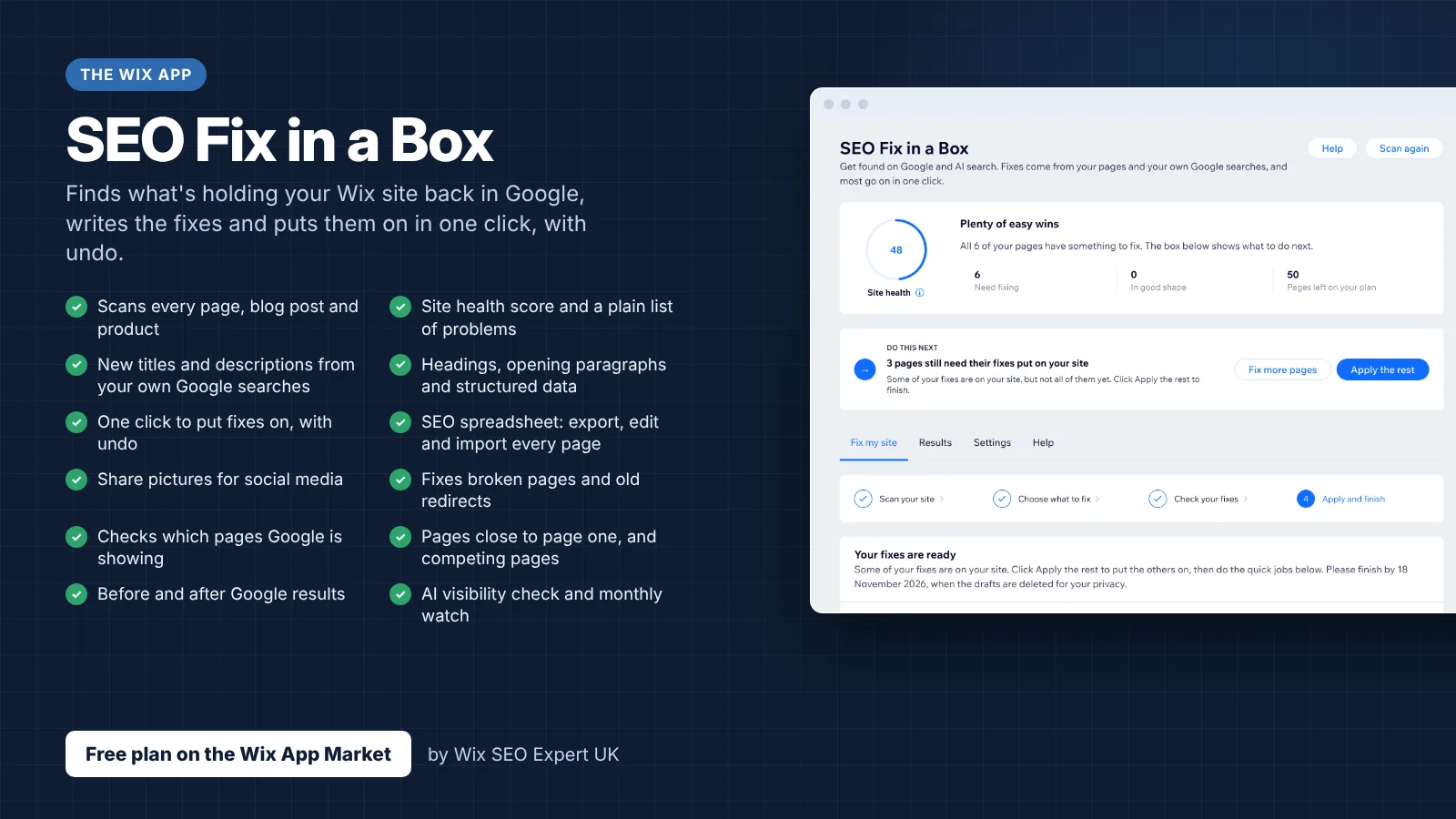
- SEO Fix in a Box: My Wix app. Free to install, it scans your site and shows what needs fixing, and paid plans write the fixes from your own Google searches
Was this lesson useful?
It takes 1 minute to tell me. The course is free and I want to keep it that way, and your feedback shows me what is working and helps other people find it.
This lesson on Cross-platform brand consistency, NAP alignment and content workflow is part of Module 30: Social Media Setup for Wix SEO in The Most Comprehensive Complete Wix SEO Course in the World (2026 Edition). Created by Michael Andrews, a Wix Marketplace Legend Partner with 14 years of hands-on experience, 800 completed Wix SEO projects and 456 verified five-star reviews.