Crawl budget management for large Wix directory sites
Module 40: Wix SEO for Directories, Marketplaces & Multi-Vendor Sites | Lesson 459 of 683 | 45 min read
By Michael Andrews, Wix SEO Expert UK
Crawl budget is the number of pages Google will crawl on your site within a given period. For a standard Wix business site with 30 pages, crawl budget is irrelevant. For a directory with 500+ listing pages, category pages, filtered views, and paginated results, crawl budget becomes a critical SEO factor. If Google wastes crawl budget on low-value pages, your most important listings may not be crawled frequently enough to maintain rankings. This lesson covers crawl budget management specifically for large Wix directory sites, including how to audit waste, implement noindex rules, and structure your sitemap to signal priority.
How Google Allocates Crawl Budget to Wix Sites
Google determines crawl budget based on two factors: crawl rate limit (how fast it can crawl without overloading the server) and crawl demand (how much Google wants to crawl based on popularity and freshness). Wix hosting handles the rate limit well, but crawl demand depends on your site authority and content freshness. A new directory with low authority may only get 50-100 pages crawled per day. A well-established directory may get thousands. Understanding this means you must make every crawled page count by ensuring low-value URLs are excluded from crawling altogether.
Identifying Crawl Budget Waste on Your Directory
Audit your Wix directory for crawl budget waste
- Step 1: Check Google Search Console > Settings > Crawl Stats. Note the total pages crawled per day and the crawl response codes.
- Step 2: In GSC Coverage report, check how many pages are "Discovered - currently not indexed" and "Crawled - currently not indexed". High numbers indicate crawl budget issues.
- Step 3: Review the list of excluded pages in GSC. Look for patterns: filtered URLs, pagination pages, and parameter-based URLs that should not be crawled.
- Step 4: If your directory uses URL-based filtering, count the total number of filter combination URLs. If this exceeds 5x your listing count, you have a crawl budget problem.
- Step 5: Check for soft 404 pages: listing pages that exist but have minimal content. Google may crawl these repeatedly trying to index them.
- Step 6: Verify your robots.txt at yourdomain.com/robots.txt. Ensure it does not block CSS, JavaScript, or important directory paths that Google needs to render pages.
- Step 7: Check for redirect chains: listings that have been moved or renamed may create redirect chains that waste crawl budget.
Sitemap Strategy for Large Directories
Wix auto-generates a sitemap, but for large directories you need to ensure it only includes valuable pages. Your sitemap should contain: the homepage, the directory index page, all category pages with unique content, all listing pages that meet your content quality threshold, and key static pages. It should exclude: filter combination URLs, sort variant URLs, pagination pages beyond page 1, and thin listing pages awaiting enrichment. Consider creating a custom sitemap index using Wix Velo that generates separate sitemaps for listings, categories, and location pages, making it easier for Google to identify and prioritise high-value content.
Content Freshness Signals for Directory Pages
Google crawls pages more frequently if they change regularly. Directory listings that never update after initial publication will be crawled less frequently over time. Encourage listing owners to update their information, add new photos, and respond to reviews. Each update signals freshness to Google and increases crawl frequency for that listing page. You can also add automated freshness signals: display the date of the most recent review, update a "Recently verified" date field monthly, and show a "Profile completeness" score that changes as listing owners add information.
Noindex Strategy for Filter and Utility Pages
Faceted navigation creates the largest source of crawl waste on directory sites. A directory with 10 categories, 5 location filters, and 4 sort options can generate thousands of unique URLs. Pages that exist only as filter combinations and have no unique editorial content should be noindexed. In Wix, use Velo to detect URL parameters and inject meta robots noindex tags dynamically. Alternatively, modify your filtering implementation to use JavaScript state rather than URL changes, keeping all filtering invisible to Google entirely.
Complete How-To Guide: Optimising Crawl Budget for a 500+ Listing Wix Directory
Full crawl budget optimisation implementation
- Step 1: Export your full URL list from Screaming Frog or GSC. Categorise every URL as: listing page, category page, filter page, pagination page, or static page.
- Step 2: For each category, count: total URLs, indexed URLs (from GSC), and URLs with organic traffic (from GA4). This shows where crawl budget is being wasted on pages that never receive traffic.
- Step 3: Create an "Index Priority" classification: Priority 1 (always index: listings with 300+ words, category pages with unique content), Priority 2 (conditional index: listings with 150-300 words), Priority 3 (noindex: thin listings, filter pages, utility pages).
- Step 4: Implement noindex tags on all Priority 3 pages. In Wix, use the page SEO settings or Velo to set meta robots dynamically based on content quality thresholds.
- Step 5: Remove Priority 3 URLs from your XML sitemap. For Wix, you may need to use Velo to conditionally exclude pages from the dynamic sitemap or create a custom sitemap.
- Step 6: Fix all redirect chains. Use GSC or Screaming Frog to identify chains and update links to point directly to the final destination.
- Step 7: Implement a content freshness strategy: set up automated emails to listing owners every 90 days prompting them to update their listing information.
- Step 8: Monitor GSC Crawl Stats weekly for 4 weeks after changes. Verify that crawl budget shifts toward Priority 1 pages.
- Step 9: Check indexation rates monthly: the percentage of Priority 1 pages that are indexed should approach 95%.
- Step 10: Repeat the full audit quarterly as your directory grows.
Essential Tools for This Lesson
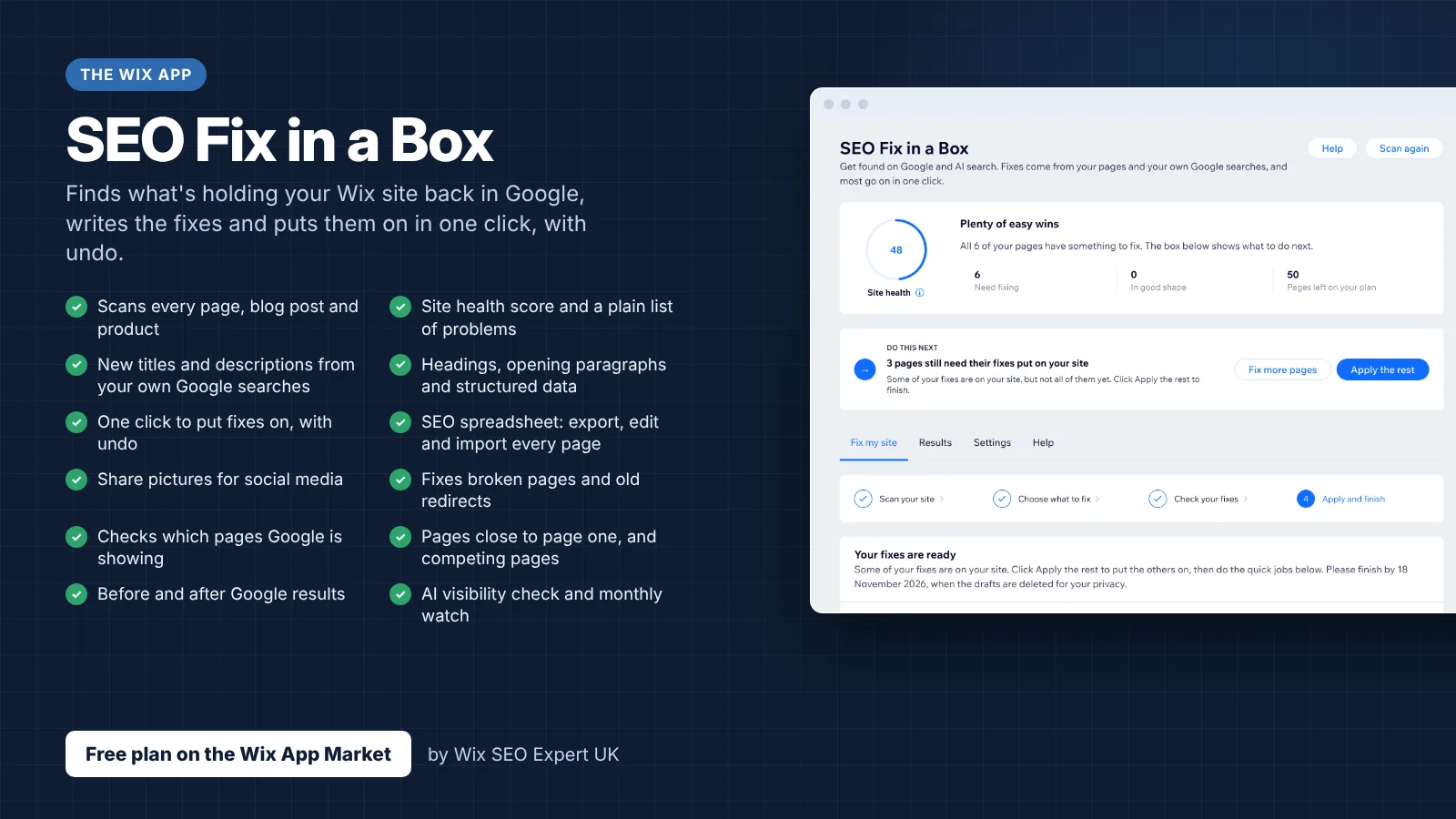
- SEO Fix in a Box: My Wix app. Free to install, it scans your site and shows what needs fixing, and paid plans write the fixes from your own Google searches
Was this lesson useful?
It takes 1 minute to tell me. The course is free and I want to keep it that way, and your feedback shows me what is working and helps other people find it.
This lesson on Crawl budget management for large Wix directory sites is part of Module 40: Wix SEO for Directories, Marketplaces & Multi-Vendor Sites in The Most Comprehensive Complete Wix SEO Course in the World (2026 Edition). Created by Michael Andrews, a Wix Marketplace Legend Partner with 14 years of hands-on experience, 800 completed Wix SEO projects and 456 verified five-star reviews.