Local SEO for multi-location Wix directory sites
Module 40: Wix SEO for Directories, Marketplaces & Multi-Vendor Sites | Lesson 460 of 683 | 46 min read
By Michael Andrews, Wix SEO Expert UK
Most directory sites serve multiple locations. A UK business directory might cover every major city. A service marketplace might target specific regions. Local SEO for directories is fundamentally different from local SEO for a single business: you need location-specific landing pages with substantive content, local schema for each geographic area, and a strategy for appearing in map pack results across multiple geographies simultaneously. Getting this right requires a CMS-driven architecture on Wix that scales to dozens or hundreds of location pages without sacrificing content quality. This lesson covers the complete local SEO strategy for multi-location Wix directories.
Creating Location-Specific Landing Pages on Wix
Each location your directory covers deserves its own landing page with unique content. A page for "Plumbers in Manchester" should include: a unique introduction about the Manchester plumbing market (200+ words), filtered listings of plumbers in Manchester, local statistics and context, and location-specific schema markup. These pages target "[service] in [city]" keywords that have high commercial intent and are among the most valuable search queries a directory can rank for. Generic location pages with no unique content beyond a list of listings will not rank competitively.
Build SEO-optimised location pages for your Wix directory
- Step 1: Create a Locations CMS collection with fields: City Name, Region, Country, Slug, Description (200+ words unique to each city), Population, Key Industries, Map Embed Code.
- Step 2: Create dynamic pages at /directory/[location-slug]/ showing all listings filtered by that location.
- Step 3: Write unique introductory content for each location page. Cover: the local market context, number of listed businesses, popular categories in that area, and local demand trends.
- Step 4: Set dynamic SEO tags: title as "Best [Directory Type] in [City Name] - [Directory Brand]" and meta description summarising the local offering.
- Step 5: Add LocalBusiness schema to each location page with the geographic area specified.
- Step 6: Create cross-links between related locations: "Also serving: Salford, Stockport, Bolton" with links to those location pages.
- Step 7: Add location-specific testimonials or case studies if available.
- Step 8: Include a Google Maps embed showing the geographic area covered.
- Step 9: Link each location page from the directory index and from a dedicated "Locations" page accessible from the main navigation.
- Step 10: Submit each location page URL to GSC for indexing verification.
Google Business Profile for Directory Sites
If your directory has a physical office or operates as a recognised local business, claim a Google Business Profile. Your GBP should list your directory as a "Business directory" or "Internet marketing service" depending on your model. This gives your directory site an additional presence in Google and establishes it as a legitimate local resource. However, do not create GBP listings for every location your directory covers unless you have a physical presence there. Creating listings for locations where you have no presence violates Google guidelines and can result in GBP suspensions.
Competing with Google Maps and Aggregators
Your directory competes directly with Google Maps, Yelp, TripAdvisor, and other aggregators. To win traffic, your directory must provide value these platforms do not: deeper reviews, niche specialisation, curated recommendations, editorial content, and local expertise. Your location pages should demonstrate this unique value prominently. Consider adding a "Local Expert" section on each location page with editorial commentary from someone who knows the area, or a "Community Picks" section highlighting businesses endorsed by local residents.
Structured Data for Multi-Location Directories
Location pages should carry two types of schema: a WebSite or Organisation schema for the directory brand itself, and an AreaServed property on the service or directory schema indicating the geographic coverage. For each listing within a location page, dynamically render LocalBusiness schema with the geo coordinates and address fields populated from the CMS. This enables Google to accurately represent the geographic scope of both your directory brand and each individual listing in its Knowledge Graph.
NAP Consistency Across Location Pages
NAP stands for Name, Address, Phone. For individual listings within your directory, NAP consistency across your site and the web is a foundational local SEO signal. Ensure your CMS stores address data in a standardised format. Inconsistent spellings like "St." versus "Street" or "Rd" versus "Road" create conflicting signals. Run a quarterly NAP audit on your top listings by comparing the address shown on your directory listing page against the listing owner Google Business Profile and any other directory citations they appear in.
Complete How-To Guide: Multi-Location Local SEO Strategy for Wix Directories
Full multi-location local SEO implementation
- Step 1: Identify every location your directory serves. Prioritise the top 10 locations by listing count and search demand.
- Step 2: Research "[your directory type] in [city]" keywords for each location using Google Keyword Planner. Record monthly search volumes.
- Step 3: Create your Locations CMS collection and populate it with the top 10 locations first.
- Step 4: Write 200+ words of unique content for each location page. Include local statistics, market context, and why users should use your directory for that area.
- Step 5: Build dynamic location pages and configure SEO settings with location-targeted title tags and meta descriptions.
- Step 6: Implement LocalBusiness schema on location pages with areaServed specifying the geographic region.
- Step 7: Build internal links from each listing to its location page and from each location page to its listings.
- Step 8: Create a "Browse by Location" section on your directory homepage linking to all location pages.
- Step 9: Build local backlinks for priority locations: submit your directory to local business associations, chambers of commerce, and community websites in each target city.
- Step 10: Track rankings for "[directory type] in [city]" keywords monthly for each location page. Prioritise content improvements for pages not ranking on page 1.
Essential Tools for This Lesson
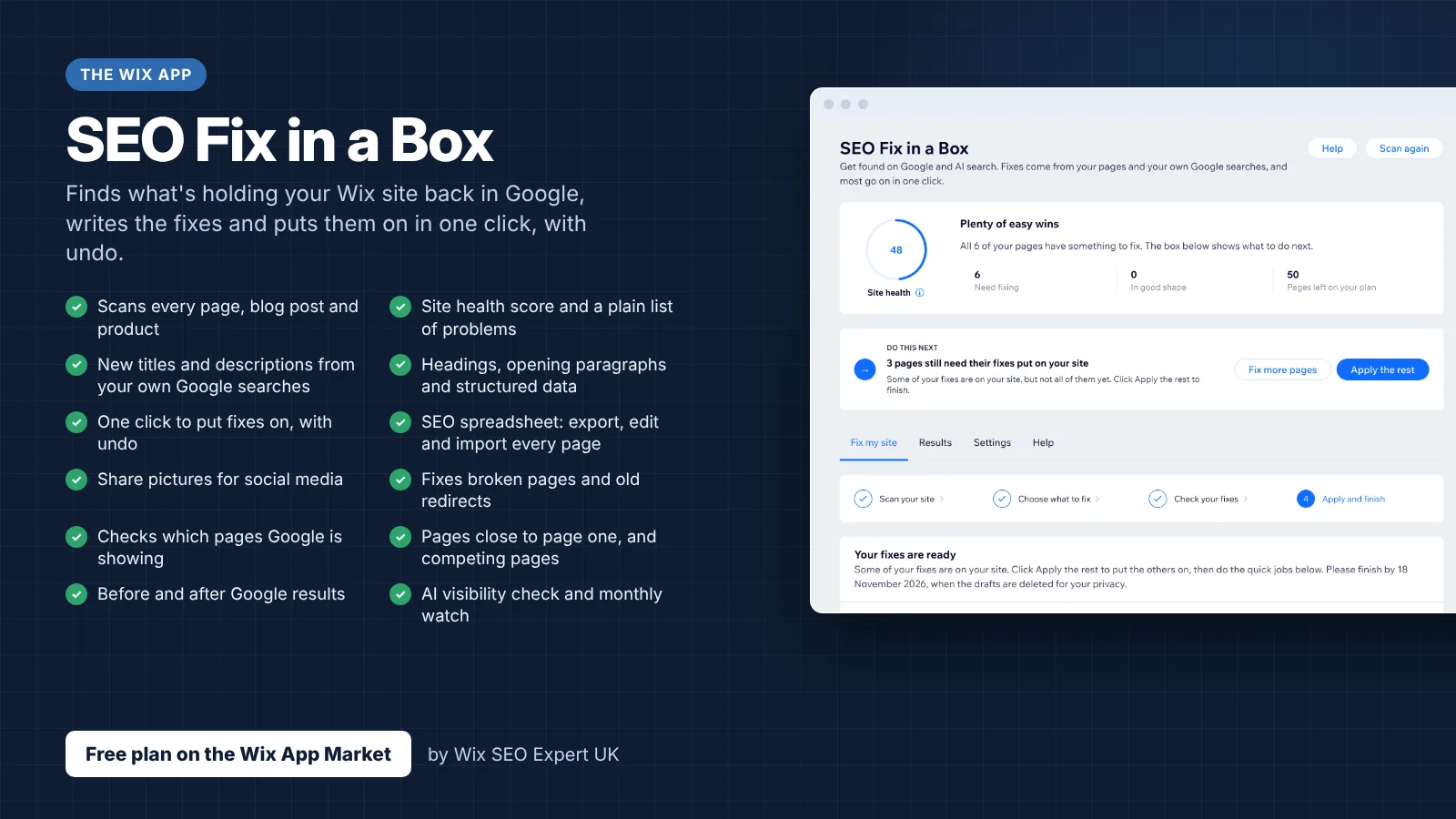
- SEO Fix in a Box: My Wix app. Free to install, it scans your site and shows what needs fixing, and paid plans write the fixes from your own Google searches
Was this lesson useful?
It takes 1 minute to tell me. The course is free and I want to keep it that way, and your feedback shows me what is working and helps other people find it.
This lesson on Local SEO for multi-location Wix directory sites is part of Module 40: Wix SEO for Directories, Marketplaces & Multi-Vendor Sites in The Most Comprehensive Complete Wix SEO Course in the World (2026 Edition). Created by Michael Andrews, a Wix Marketplace Legend Partner with 14 years of hands-on experience, 800 completed Wix SEO projects and 456 verified five-star reviews.