Enterprise site architecture and URL strategy on Wix
Module 42: Enterprise SEO Strategy on Wix | Lesson 480 of 683 | 32 min read
By Michael Andrews, Wix SEO Expert UK
Enterprise site architecture determines whether search engines can efficiently crawl, understand and rank your content. A poorly structured Wix site with hundreds of pages buried deep in navigation, inconsistent URL patterns and unclear hierarchy will underperform regardless of how good the content is. This lesson covers how to design and maintain a site architecture that scales efficiently on Wix, ensuring every page is discoverable, properly categorised and positioned to rank.
Flat Architecture vs Deep Architecture on Wix
Enterprise Wix sites must balance two competing needs: keeping important pages close to the homepage (flat architecture) while maintaining logical categorisation for hundreds of pages (deep architecture). The optimal approach is a hybrid: a flat navigation structure for your most important pages combined with logical subfolder categorisation for content at scale. On Wix, this means your primary service pages sit at the root level while blog content, case studies and secondary pages live in organised subfolders.
- Top-level pages (1 click from homepage): core services, products, about, contact, main location pages
- Second-level pages (2 clicks): individual service details, product categories, team members, key resources
- Third-level pages (3 clicks): blog posts, case studies, FAQ pages, secondary location pages
- Avoid going deeper than 3 clicks from the homepage for any page you want to rank
- Use internal linking to create shortcuts that reduce click depth for important deeper pages
Enterprise URL Strategy on Wix
Your URL structure at enterprise scale must be systematic, predictable and consistent. Every content type should follow a clear URL pattern that both users and search engines can understand. On Wix, you control URL slugs for static pages and blog posts. Establish naming conventions that all content creators follow.
Enterprise URL standards
- Define URL patterns for each content type: /services/[service-name], /blog/[post-title], /locations/[city-name], /case-studies/[client-industry].
- Keep URLs short, descriptive and keyword-inclusive. Remove stop words but keep URLs readable.
- Use hyphens to separate words. Never use underscores, spaces or special characters.
- Enforce lowercase URLs consistently. Wix handles this by default but verify in your redirect rules.
- Document your URL conventions in your SEO standards guide so all team members follow the same patterns.
- Before creating any new section or content type, define the URL pattern first and get it approved through your SEO governance process.
Internal Linking at Enterprise Scale
Internal linking at enterprise scale requires automation and systematic approaches. Manual internal linking across hundreds of pages is unsustainable and inevitably leads to orphan pages and inconsistent link distribution. Build internal linking into your content templates, create automated related content sections and conduct regular internal link audits to maintain a healthy link graph.
Complete How-To Guide: Enterprise Site Architecture on Wix
Design and implement enterprise site architecture
- Step 1: Map your current site architecture. Use Screaming Frog to crawl your entire site and export the site structure as a tree visualisation. Identify pages deeper than 3 clicks from the homepage.
- Step 2: Categorise all pages by content type: service pages, product pages, blog posts, location pages, resource pages, legal pages and utility pages.
- Step 3: Design your ideal URL structure with patterns for each content type. Document this in your SEO standards guide.
- Step 4: Identify orphan pages (pages with no internal links pointing to them) and create a plan to integrate them into the site structure.
- Step 5: Build your navigation hierarchy in Wix. Use the Pages panel to organise pages into logical groups. Ensure every important page is accessible within 3 clicks from the homepage.
- Step 6: Create content hub pages that serve as navigation centres for each major topic area. Link from these hub pages to all related content.
- Step 7: Implement breadcrumb navigation on all pages using Wix built-in breadcrumbs or custom implementation. Add BreadcrumbList schema markup.
- Step 8: Set up quarterly internal link audits using Screaming Frog. Track orphan pages, pages with excessive outgoing links and internal link distribution across your key page groups.
Essential Tools for This Lesson
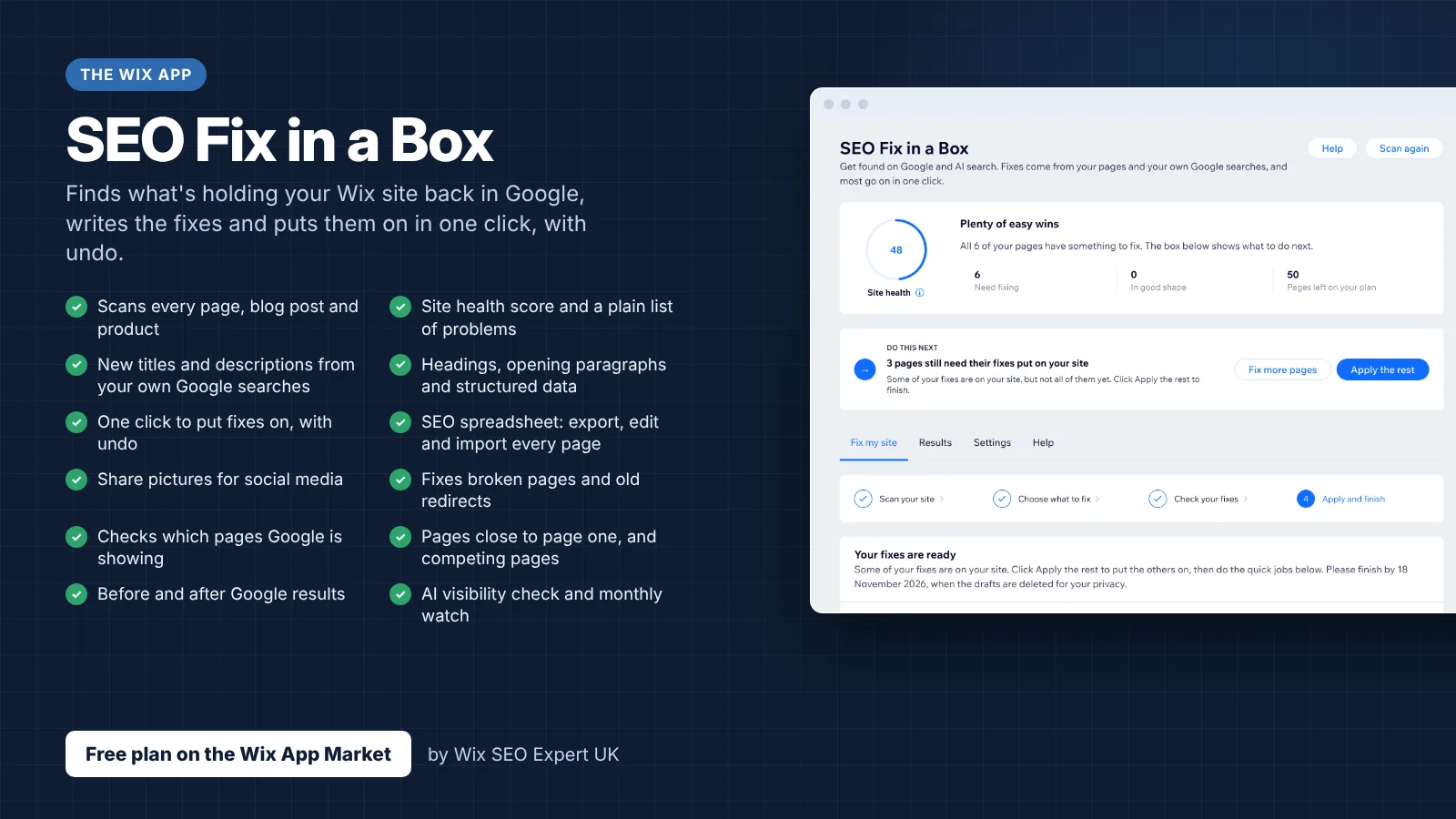
- SEO Fix in a Box: My Wix app. Free to install, it scans your site and shows what needs fixing, and paid plans write the fixes from your own Google searches
Was this lesson useful?
It takes 1 minute to tell me. The course is free and I want to keep it that way, and your feedback shows me what is working and helps other people find it.
This lesson on Enterprise site architecture and URL strategy on Wix is part of Module 42: Enterprise SEO Strategy on Wix in The Most Comprehensive Complete Wix SEO Course in the World (2026 Edition). Created by Michael Andrews, a Wix Marketplace Legend Partner with 14 years of hands-on experience, 800 completed Wix SEO projects and 456 verified five-star reviews.