Content formatting for AI Overview citations: structure, length and phrasing
Module 64: AI Overviews (SGE) Optimisation for Wix | Lesson 657 of 683 | 28 min read
By Michael Andrews, Wix SEO Expert UK
The way you format content on your Wix pages has a direct impact on whether Google AI Overviews select and cite your content. Unlike traditional SEO where keyword density and meta tags are the primary levers, AI citation depends heavily on how clearly your content is structured, how directly it answers questions, and how machine-readable your HTML is. This lesson covers the specific formatting patterns that consistently appear in AI Overview cited sources.
The Inverted Pyramid: Answer First, Context Second
AI Overview generation models tend to favour content that places the direct answer at the beginning of each section. This is the opposite of how many blog posts are written, where context and background precede the actual answer. For AI citation purposes, open every major section with one or two sentences that directly and completely answer the implied question of that heading, then follow with supporting detail, examples, and evidence.
On your Wix blog or service pages, this means restructuring sections so the value is front-loaded. If your H2 reads "How to optimise Wix images for SEO", the first sentence under that heading should directly state the core method, not introduce why image optimisation matters.
Heading Structure That Matches AI Query Patterns
- Write H2 headings as questions or as direct statement answers ("What is X" / "X means Y")
- Use H3 subheadings for specific sub-topics within each H2 section
- Keep heading text concise - under 70 characters performs best for AI parsing
- Avoid clever or vague headings; AI models cannot infer meaning from clever wordplay
- Mirror the exact language users type into Google rather than using industry jargon
- Use consistent heading depth - do not jump from H2 to H4, maintain H2/H3/H4 hierarchy
Paragraph Length and Sentence Structure
Short, declarative paragraphs of two to four sentences are cited more frequently in AI Overviews than dense walls of text. Each paragraph should make one clear point. The first sentence of every paragraph is the most important - it is what the AI model evaluates to decide whether the paragraph is relevant to the query. In the Wix Blog editor, use the paragraph spacing settings to visually separate your ideas, which also creates clear HTML paragraph tags in the underlying code.
Using Lists and Tables for AI-Friendly Content
Bulleted and numbered lists are extracted by AI Overview systems at a higher rate than equivalent information written as prose. When you have a set of steps, features, options, or factors, always format them as a list in the Wix editor rather than embedding them in a paragraph. Wix creates clean HTML list markup for its built-in list elements, which is exactly what AI parsing systems need.
Formatting Checklist for AI Overview Optimisation on Wix
Apply these formatting standards to your most important Wix pages
- Open each target page in the Wix editor and review every H2 heading - does it state or imply a specific question?
- Check the first sentence under each H2 - does it directly answer that implied question?
- Identify any long paragraphs (more than 5 sentences) and split them into focused, single-point paragraphs.
- Convert any inline lists written as "A, B, C, and D" into proper bulleted lists using the Wix list element.
- Add a dedicated FAQ section at the bottom of key pages using proper H3 question headings followed by concise answers.
- Review the meta title and description to ensure they reflect the direct answer format, not just the topic.
- Check that any structured data (FAQ, HowTo, or Article schema) is correctly applied through the Wix SEO settings.
How to Format Wix Content to Maximise AI Overview Citation Chances
Applying the right formatting standards to your Wix pages is a practical, repeatable process that you can work through systematically across your most important content.
A complete formatting workflow to improve AI Overview citation rates on your Wix site
- Open your Wix Editor and select the page you want to optimise for AI Overview citation.
- Review every H2 heading on the page - rewrite any that are vague or clever so they state or clearly imply a specific question.
- Under each H2, write or rewrite the opening sentence to directly answer the implied question in 40 to 60 words.
- Scan for any paragraphs longer than five sentences and split them into focused, single-point paragraphs of two to four sentences.
- Find any inline lists written as comma-separated items in a paragraph and convert them to proper bulleted lists using the Wix list element.
- Add an FAQ section at the bottom of each key page using H3 question headings followed by concise direct answers.
- Review your meta title and description to confirm they reflect a direct answer format rather than a topic-only description.
- Check that any HowTo, FAQ, or Article structured data is correctly applied via the Wix SEO Advanced settings for this page.
- Publish the page and view the page source to confirm that heading tags, paragraph tags, and list markup are cleanly output.
- Test the page by asking ChatGPT or Perplexity the question your page targets to see whether your content is cited.
- Record the pre- and post-optimisation citation status for this page in your tracking spreadsheet.
Essential Tools for This Lesson
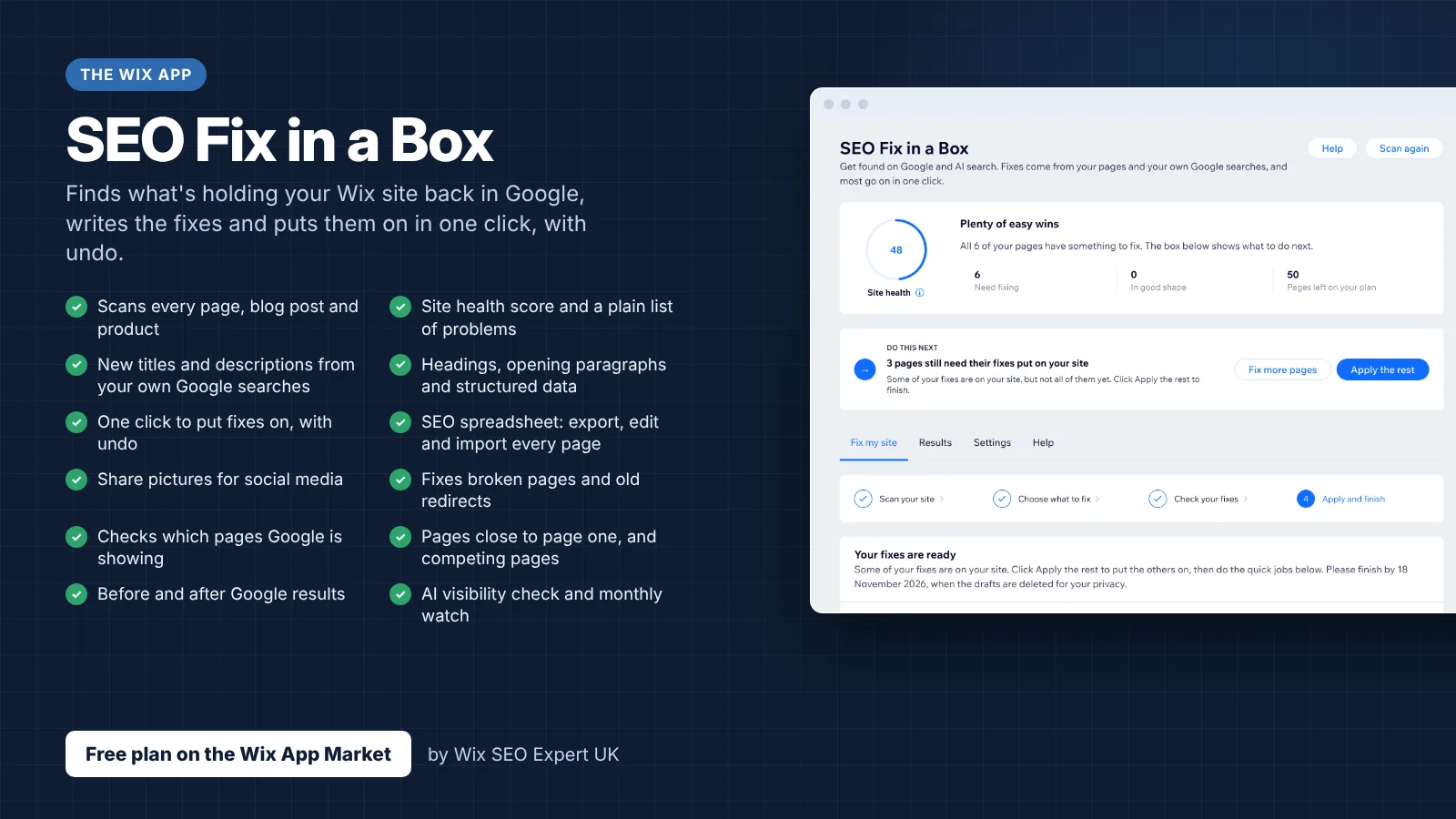
- SEO Fix in a Box: My Wix app. Free to install, it scans your site and shows what needs fixing, and paid plans write the fixes from your own Google searches
Was this lesson useful?
It takes 1 minute to tell me. The course is free and I want to keep it that way, and your feedback shows me what is working and helps other people find it.
This lesson on Content formatting for AI Overview citations: structure, length and phrasing is part of Module 64: AI Overviews (SGE) Optimisation for Wix in The Most Comprehensive Complete Wix SEO Course in the World (2026 Edition). Created by Michael Andrews, a Wix Marketplace Legend Partner with 14 years of hands-on experience, 800 completed Wix SEO projects and 456 verified five-star reviews.