How to Build Topical Authority on Wix (2026)

By Michael Andrews | Published: 2026-03-05 | Updated: 2026-03-14 | 10 min read
Topical authority, being recognised by Google as the most comprehensive resource on a subject, is the most powerful content SEO strategy for 2026. Here is how to build it on your Wix website.
In 2026, the content strategy that delivers the most consistent, long-term SEO results is topical authority. Rather than creating individual pieces of content and hoping they rank, topical authority is about becoming the most comprehensive, trustworthy resource on a specific subject, and having Google recognise you as such.
Websites with strong topical authority recover faster from Google algorithm updates and show 3× more ranking stability than sites with scattered, low-depth content strategies, SEMrush Content Study 2025 (Source: Semrush: Content Marketing Statistics)
What is Topical Authority and Why It Matters for Wix Websites
Topical authority is Google's assessment of how comprehensive and trustworthy your website is on a given subject. A website that covers every aspect of a topic, from beginner introductions to advanced techniques, signals to Google that it is the best resource to send searchers to. This leads to higher rankings across all related keywords, not just the ones you directly target.
Building a Pillar and Cluster Content Structure on Wix
The pillar-cluster model is the most effective structure for topical authority:
- Pillar page: A comprehensive guide to the broad topic (2,000–5,000 words)
- Cluster pages: Detailed articles covering specific subtopics in depth
- Internal links: Pillar page links to all clusters; clusters link back to pillar
- Common pillar: One topic → 8–15 cluster pages is a typical authority-building target
Creating a Topic Map for Your Wix Website
Start with a topic map, a visual or spreadsheet representation of every subtopic within your main subject area. For a Wix SEO specialist, the core topic is "Wix SEO" and subtopics include technical Wix SEO, Wix local SEO, Wix keyword research, Wix schema markup, and so on.
- List your core topic (e.g., "Wix SEO")
- Brainstorm 20–30 subtopics that fall under the core topic
- Map each subtopic to a potential page type (blog post, service page, guide)
- Identify which subtopics you have already covered
- Prioritise gaps by search volume and business relevance
- Create a content calendar to close the gaps systematically
Internal Linking: The Engine of Topical Authority
Without strong internal linking, your content cluster is just a collection of disconnected pages. Internal links create the context signals that tell Google pages are related and part of a topical cluster.
Expert Tip: When writing any new Wix blog post or page, manually link to at least 3–5 existing related pages on your site. More importantly, go back to older related posts and add links to the new page. This two-way linking creates the cluster structure Google recognises as topical authority.
Fix your Wix SEO from your dashboard
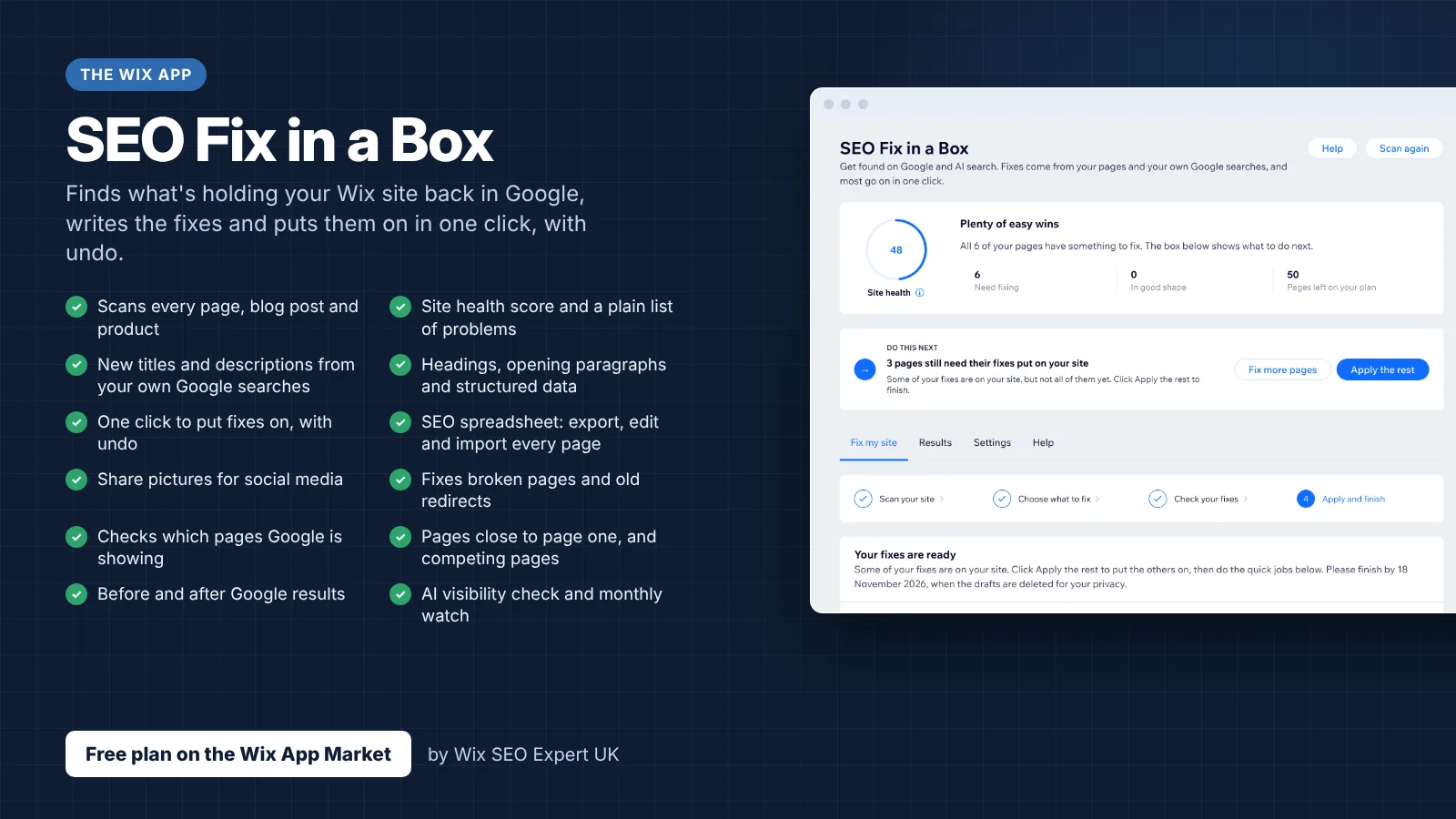
Wix SEO Fix in a Box scans every page, writes your fixes from your own Google searches and puts them on in one click, with undo. Start on the free plan.
Want this sorted on your own Wix site?
I have worked only on Wix for 14 years. Get Wix SEO Fix in a Box on the Wix App Market to find and fix what is holding your site back, or see my packages and prices if you would rather I did it all for you.
Frequently Asked Questions
How many pages do I need to establish topical authority on Wix?
There is no magic number, but covering a topic with 15–30 quality, unique pieces of content is typically sufficient to begin establishing topical authority in most niches. High-competition topics (healthcare, finance, legal) require more depth. The most important factor is genuine coverage, Google can identify when content is superficial versus when it demonstrates real expertise.
Can a small Wix website compete on topical authority?
Yes. Topical authority can be established in a niche, not just a broad topic. A small Wix website focused entirely on, say, wedding confetti SEO can establish greater topical authority in that niche than a large general SEO agency website. Focus creates authority, broad, shallow coverage does not.
How does internal linking contribute to topical authority on a Wix website?
Internal linking is the technical mechanism that communicates topical cluster structure to Google. When your pillar page links to all cluster articles, and all cluster articles link back to the pillar and to each other where relevant, you create a dense interconnected network of topically related content. Google interprets this linking structure as evidence of deep subject expertise. Without proper internal linking, even a large volume of related content may not be recognised as a coherent topic cluster. Every time you publish new Wix content, audit your existing related pages and add contextual links to the new post using descriptive anchor text.
What is the fastest way to build topical authority on a brand new Wix website?
The fastest approach for a new Wix website is to focus on a very narrow niche and build comprehensive coverage of it before expanding. Choose a niche narrow enough that 15–20 pieces of content cover it thoroughly. Publish a cornerstone pillar page and 8–12 supporting cluster articles within the first 3–4 months. Then build 5–10 high-quality backlinks specifically to the pillar page. This focused approach typically begins showing topical authority signals in Google Search Console (ranking for cluster keywords) within 4–6 months, significantly faster than the same volume of unfocused content spread across unrelated topics.
Want a tailored topical authority content strategy for your Wix website? Get expert content planning from the UK's dedicated Wix SEO specialist.