What is GEO and how AI search engines work differently from Google
Module 27: GEO: Generative Engine Optimisation for Wix | Lesson 320 of 683 | 28 min read
By Michael Andrews, Wix SEO Expert UK
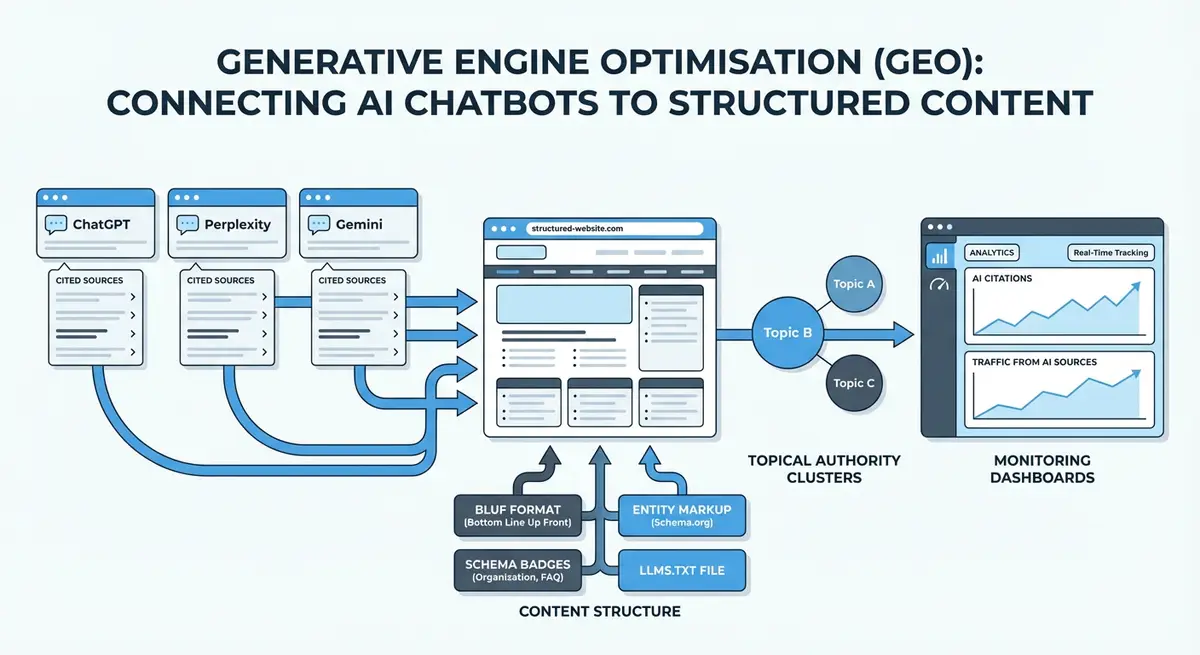
For over two decades, SEO meant one thing: rank higher in a list of ten blue links. In 2026, the game has fundamentally changed. When someone asks ChatGPT "what is the best way to improve SEO on a Wix website?" or asks Perplexity "who is the top Wix SEO expert?", the answer is not a list of links. It is a direct, AI-generated answer that cites specific sources. Generative Engine Optimisation (GEO) is the discipline of making your Wix website one of those cited sources.
Traditional Search vs Generative AI Search
In traditional Google search, a user types a query and receives a ranked list of web pages. The user clicks a link, visits your site, and you earn traffic. The entire model is built around clicks and rankings. In generative AI search, the user asks a question and receives a synthesised answer drawn from multiple sources. The AI engine decides which sources to cite, and the user may never click through to your site at all. Your visibility is determined not by your rank in a list, but by whether the AI considers your content trustworthy enough to reference.
- Traditional search: user searches, clicks a link, visits your site. You earn traffic.
- AI search: user asks a question, AI reads your content, synthesises an answer, and may cite you as a source. You earn authority and sometimes a click.
- Traditional search rewards: keyword relevance, backlinks, page speed, user experience.
- AI search rewards: factual accuracy, direct answers, entity recognition, structured data, topical authority.
How AI Search Engines Actually Work
When a user asks ChatGPT Search, Perplexity, or Google AI Overviews a question, the system performs several steps. First, it interprets the query to understand the intent. Then it searches its index or the live web for relevant sources. It reads and evaluates multiple pages, assessing each one for accuracy, depth, authority and relevance. Finally, it synthesises an answer and attributes specific claims to specific sources through inline citations.
This is fundamentally different from Google ranking, where PageRank and backlinks heavily influence which pages appear first. AI engines care less about how many links point to your page and more about whether your content contains the specific, accurate, well-structured information needed to answer the question.
Why GEO Matters for Every Wix Business
AI-powered search is not a future concern. It is happening now. Google AI Overviews appear on a significant percentage of searches. ChatGPT Search and Perplexity are growing rapidly. Gartner predicts that by 2028, 30% of all search traffic will route through AI answers rather than traditional links. If your Wix site is invisible to AI engines, you are losing visibility that compounds over time.
The Five Pillars of GEO
The five areas you must optimise for AI search visibility
- Content structure: direct answers, BLUF formatting, clean heading hierarchy, extractable paragraphs
- Entity signals: consistent brand identity, schema markup, cross-platform presence, Knowledge Graph associations
- Topical authority: comprehensive coverage of your subject area, original data, expert commentary
- Machine-readable signals: schema markup, llms.txt, ai.txt, structured data that AI crawlers can parse
- Trust and freshness: accurate content, clear authorship, regular updates, verifiable credentials
Complete How-To Guide: Auditing Your Wix Site's AI Search Visibility
This guide covers assessing your current visibility across AI search platforms, identifying gaps, and establishing a baseline for your GEO strategy.
How to audit your Wix site visibility across AI search engines
- Step 1: Create a GEO audit spreadsheet with columns: Query, ChatGPT Cited (Y/N), Perplexity Cited (Y/N), AI Overview Cited (Y/N), Competitor Cited, Notes, Date.
- Step 2: List 20-30 queries your ideal customers would ask an AI assistant. Include informational queries ("how to improve Wix SEO"), local queries ("best SEO expert in [your city]"), and comparison queries ("[your service] vs [competitor approach]").
- Step 3: Search each query in ChatGPT. Note whether your brand or website is mentioned, cited or recommended. Record which competitors appear instead.
- Step 4: Search each query in Perplexity. Note the same details. Perplexity typically shows more citations than ChatGPT, so compare the source quality.
- Step 5: Search each query in Google and check for AI Overviews. Note whether any AI Overview appears and whether your content is cited as a source.
- Step 6: Check your robots.txt at yourdomain.com/robots.txt. Verify that GPTBot, PerplexityBot, ClaudeBot and Google-Extended are not blocked.
- Step 7: Verify your Wix site is indexed in Bing. Go to bing.com/webmasters, add your site if not already added, and submit your sitemap. ChatGPT Search relies on the Bing index.
- Step 8: Audit your schema markup using the Google Rich Results Test. Check your homepage, about page and three key content pages. Note which schema types are present and which are missing.
- Step 9: Search your brand name in ChatGPT: "Tell me about [Your Business]". Assess whether the response is accurate. Inaccurate or empty responses indicate weak entity signals.
- Step 10: Review the competitors who are being cited in AI answers for your target queries. Visit their pages and note what they do differently: content structure, schema, authority signals.
- Step 11: Score your audit results. Count how many of your 20-30 queries result in your brand being cited. Calculate your citation rate as a percentage. This is your GEO baseline.
- Step 12: Prioritise your GEO improvements based on the audit findings. Start with the quick wins: unblocking AI crawlers, submitting to Bing, and adding BLUF formatting to your most competitive pages.
Essential Resources
- Google Rich Results Test: Validate structured data for rich result eligibility
- Bing Webmaster Tools: Monitor and optimise your site for Bing and AI search engines
- Schema.org: Official structured data vocabulary reference
- Perplexity AI: Test how AI search engines discover and cite your content
Essential Resources
- Google Rich Results Test: Validate structured data for rich result eligibility
- Bing Webmaster Tools: Monitor and optimise your site for Bing and AI search engines
- Schema.org: Official structured data vocabulary reference
- Perplexity AI: Test how AI search engines discover and cite your content
Essential Resources
- Google Search Console: Monitor organic search performance as a baseline for GEO improvements
- Bing Webmaster Tools: Ensure your Wix site is indexed by Bing which powers ChatGPT Search
- Schema.org Organization: Structured data reference for building entity signals that AI engines recognise
Was this lesson useful?
It takes 1 minute to tell me. The course is free and I want to keep it that way, and your feedback shows me what is working and helps other people find it.
This lesson on What is GEO and how AI search engines work differently from Google is part of Module 27: GEO: Generative Engine Optimisation for Wix in The Most Comprehensive Complete Wix SEO Course in the World (2026 Edition). Created by Michael Andrews, a Wix Marketplace Legend Partner with 14 years of hands-on experience, 800 completed Wix SEO projects and 456 verified five-star reviews.