Topical authority mapping: the complete cluster strategy for Wix
Module 5: Content Strategy & Blog SEO | Lesson 59 of 683 | 52 min read
By Michael Andrews, Wix SEO Expert UK
Topical authority is the single most important content strategy concept for ranking in competitive niches. This lesson teaches you how to map your entire topic landscape, build comprehensive content clusters and establish your Wix site as the definitive authority on your subject.
What Topical Authority Means for Google Rankings
Google increasingly rewards sites that demonstrate comprehensive expertise on a topic rather than sites with scattered content across many unrelated topics. A site with 30 deeply interconnected articles about Wix SEO will outrank a site with 300 articles covering everything from cooking to car repairs, even if individual article quality is similar.

Mapping Your Topic Landscape
Building your topical authority map
- Identify your core topic (e.g., "Wix SEO" or "wedding photography London")
- List every subtopic that falls under your core topic using keyword research tools
- Group subtopics into 5-8 clusters based on thematic similarity
- Identify the pillar page for each cluster (the broadest, most comprehensive page)
- List supporting articles for each pillar (answering specific questions within the cluster)
- Map the internal linking structure: every supporting article links to its pillar, pillars link to each other
- Identify gaps where competitors have content but you do not
- Prioritise clusters based on business value and competitive difficulty
Building Content Clusters on Wix
Each cluster on your Wix site should have one pillar page (2000-4000 words covering the topic comprehensively) and 5-15 supporting articles (800-2000 words each addressing specific questions or subtopics). The internal linking between these pages creates a clear topical signal that Google rewards with higher rankings for the entire cluster.
Internal Linking Architecture for Clusters
- Every supporting article links to its pillar page with keyword-rich anchor text
- Pillar pages link to every supporting article in the cluster
- Related supporting articles link to each other horizontally
- Pillar pages link to other pillar pages for cross-cluster authority
- Use contextual links within body content, not just navigation or sidebar links
Measuring Topical Authority Growth
Track your topical authority by monitoring the number of keywords you rank for within each cluster, the average position across cluster keywords, the percentage of cluster keywords on page one, and the organic traffic to each cluster. Over time, you should see new articles in established clusters ranking faster than articles in new, unestablished topic areas.
How to build internal linking between cluster pages on your Wix site
- Open your Wix editor and navigate to a supporting article within one of your content clusters.
- Identify the natural first or second mention of the cluster's core topic in the body text.
- Highlight the relevant phrase, click the link icon in the text toolbar, and select the pillar page URL from your site pages list.
- Ensure the anchor text is descriptive and keyword-rich rather than generic (use "Wix SEO guide" not "click here").
- Scroll through the rest of the supporting article and add one or two more contextual links pointing to related supporting articles in the same cluster.
- Open the pillar page and verify it contains a contextual link to every supporting article in the cluster.
- Navigate to Dashboard > Marketing & SEO > SEO Tools > Site Inspection and run a scan to confirm all internal links are crawlable.
- Check Google Search Console's Links report after two to four weeks to verify the internal link structure is being picked up.
- Monitor cluster keyword rankings in Search Console to track whether the linking improvements correlate with ranking gains.
Topical Authority Tools
- Ahrefs Content Gap: Find topics competitors cover that you do not
- Google Search Console: Track keyword rankings across your topic clusters
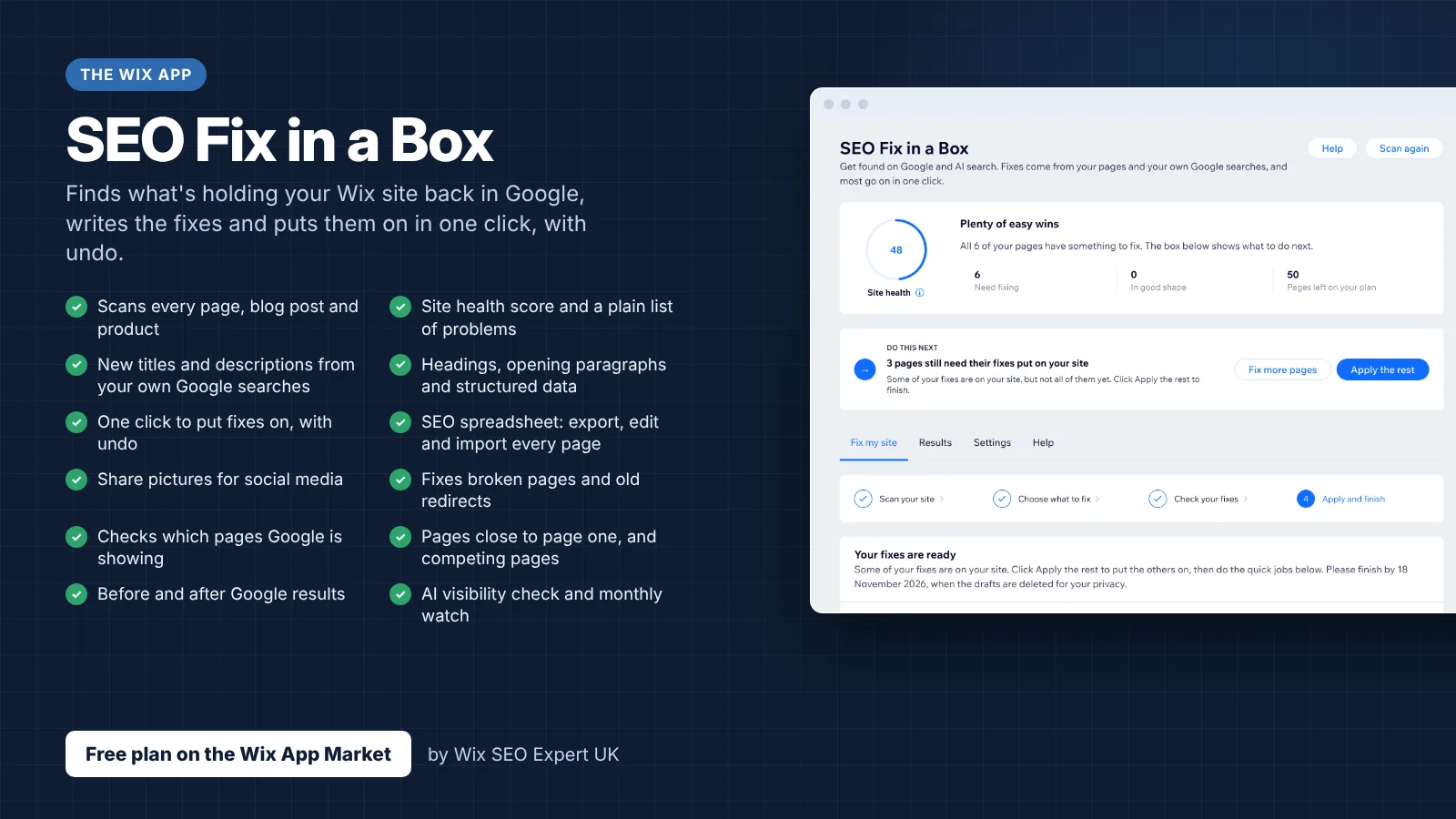
- SEO Fix in a Box: My Wix app. Free to install, it scans your site and shows what needs fixing, and paid plans write the fixes from your own Google searches
Was this lesson useful?
It takes 1 minute to tell me. The course is free and I want to keep it that way, and your feedback shows me what is working and helps other people find it.
This lesson on Topical authority mapping: the complete cluster strategy for Wix is part of Module 5: Content Strategy & Blog SEO in The Most Comprehensive Complete Wix SEO Course in the World (2026 Edition). Created by Michael Andrews, a Wix Marketplace Legend Partner with 14 years of hands-on experience, 800 completed Wix SEO projects and 456 verified five-star reviews.