Scaling your Wix SEO knowledge into a sustainable business
Module 52: SEO Audits, Client Work & Going Pro | Lesson 576 of 683 | 45 min read
By Michael Andrews, Wix SEO Expert UK
Knowing SEO is one thing. Building a sustainable business around that knowledge is an entirely different skill set. Many talented SEO professionals remain stuck as solo operators trading time for money because they never develop the systems, processes, and positioning needed to scale. This lesson covers the business infrastructure required to transform your Wix SEO expertise from a freelance skill into a scalable consulting practice. We cover specialisation strategy, building repeatable processes, when and how to bring on subcontractors, pricing for profitability, and building a client acquisition pipeline that generates consistent enquiries.
The Wix SEO Specialist Advantage
Specialisation is the single most powerful positioning decision you can make. While generalist SEO agencies compete on price in a crowded market, a Wix SEO specialist occupies a niche with less competition, higher perceived expertise, and stronger referral dynamics. Wix has over 200 million users worldwide, creating a massive addressable market of website owners who specifically need SEO help on the Wix platform.
- Reduced competition: most SEO agencies target all platforms. By specialising in Wix, you compete in a smaller pool against fewer specialists.
- Higher perceived value: when a Wix site owner searches for SEO help, who do they trust more, a generalist or someone who says "I specialise exclusively in Wix SEO"?
- Deeper expertise: by focusing on one platform, you develop nuanced knowledge of Wix-specific features, limitations, and optimisation techniques that generalists lack.
- Referral concentration: satisfied Wix clients refer you to other Wix site owners, creating a concentrated referral network within the Wix ecosystem.
- Content marketing efficiency: all your blog posts, case studies, and educational content target the same audience, compounding your organic visibility for Wix SEO queries.
- Partnership opportunities: Wix has a partner programme for web professionals. Demonstrating SEO expertise within the Wix ecosystem opens up official partnership and referral channels.
Building Repeatable Processes
Scalability requires repeatability. If every client engagement is a custom project built from scratch, you cannot scale. The goal is to create standardised processes for every phase of client work that deliver consistent quality without requiring your personal involvement in every detail.
The Standard Operating Procedure Library
Document every process your business performs into Standard Operating Procedures (SOPs). An SOP is a step-by-step guide that anyone on your team (including future hires and subcontractors) can follow to produce consistent results. Start with these core SOPs:
- Client Onboarding SOP: from signed contract to audit kick-off. Includes access requests, tool setup, baseline documentation, and kickoff meeting agenda.
- Technical Audit SOP: your complete 20-point audit process documented as a checklist with screenshots and expected outputs.
- On-Page Optimisation SOP: title tag, meta description, heading, and content optimisation process with examples and quality standards.
- Monthly Reporting SOP: how to review automated dashboards, write commentary emails, and send reports on schedule.
- Content Brief SOP: how to create a content brief for writers including keyword targets, competitor analysis, outline structure, and quality requirements.
- Backlink Outreach SOP: email templates, target site criteria, follow-up schedule, and success tracking.
- Client Offboarding SOP: how to end a client relationship professionally with documentation, access transfer, and final reporting.
Process Documentation Format
How to write effective SOPs
- Title: clear, specific name (e.g., "Monthly SEO Report Generation for Wix Clients")
- Purpose: one sentence explaining why this process exists
- Prerequisites: tools, access, and information needed before starting
- Steps: numbered, specific actions. Each step should be completable by someone who has never done it before.
- Quality checks: verification points within the process to catch errors
- Expected output: what the finished product should look like, with examples
- Time estimate: how long the process should take
- Store all SOPs in a shared location (Notion, Google Drive, or similar) accessible to your entire team
When and How to Bring On Subcontractors
You cannot scale as a solo operator because your time is finite. The first hire is not an employee; it is a subcontractor who handles specific, well-defined tasks while you retain client relationships, strategy, and quality control.
Tasks to Delegate First
- Content writing: the most time-consuming and most easily delegated task. Your content brief SOP ensures writers produce on-brand, optimised content.
- Technical audits: once your audit SOP is documented, a trained SEO subcontractor can execute the checklist and produce the raw findings. You review and add strategic recommendations.
- Link building outreach: email outreach is repetitive and time-intensive. A subcontractor can handle prospecting, emailing, and follow-up using your outreach SOP.
- Report data gathering: while your dashboards are automated, there may be manual data pulls from tools without connectors. Delegate these.
- Image optimisation and alt text: straightforward task that can be done by a less experienced person following your image SOP.
Finding and Vetting Subcontractors
Subcontractor hiring process
- Define the role clearly: specific tasks, expected hours per month, required skills, and pay rate
- Source candidates from: Upwork, PeoplePerHour, SEO community Slack groups, and LinkedIn
- Require a paid trial task: have candidates complete a real (anonymised) task from your workflow. This is the only reliable way to assess quality.
- Start with a small commitment: 10-15 hours per month for the first 3 months. Scale up after confirming quality and reliability.
- Provide your SOPs immediately: give them the documented process and assess how well they follow it without constant supervision.
- Weekly check-ins during the first month: 15-minute calls to review work quality and answer questions.
- Monthly quality audits: review a random sample of their work to ensure standards are maintained.
Managing Subcontractors Effectively
- Use project management tools (Trello, Asana, or Notion) to assign tasks, track progress, and manage deadlines.
- Set clear quality standards: what "good enough" looks like for each deliverable. Include examples of acceptable and unacceptable work.
- Pay fairly: underpaying subcontractors guarantees turnover and poor quality. Pay rates that attract and retain skilled people.
- Provide feedback: constructive, specific feedback helps subcontractors improve. Generic "good job" is useless.
- Protect client confidentiality: use NDAs and never share client names or sensitive data unnecessarily.
Pricing for Profitability in 2026
Most SEO professionals underprice their services because they price based on time rather than value. A pricing model that aligns your revenue with the value you deliver (rather than the hours you work) is essential for building a profitable, scalable practice.
Pricing Models Compared
- Hourly pricing: the simplest but worst model for scaling. Caps your income at your available hours. Clients focus on hours rather than outcomes. Creates misaligned incentives (efficiency reduces your revenue).
- Monthly retainer: fixed monthly fee for a defined scope of work. Better for predictability. Allows you to become more efficient without reducing revenue. Recommended for ongoing SEO management.
- Project-based pricing: fixed price for a defined project (e.g., an SEO audit, a site migration, a content strategy). Good for discrete deliverables. Allows you to charge based on value rather than time.
- Performance-based pricing: fees tied to results (rankings, traffic, leads). Risky because many factors affect results. Only use this as a bonus component on top of a base retainer, never as the sole pricing model.
- Value-based pricing: pricing based on the business value of the outcome rather than the cost of delivery. A Wix SEO campaign that generates an extra 200 monthly leads valued at 50 pounds each is worth significantly more than 20 hours of work at 75 pounds per hour.
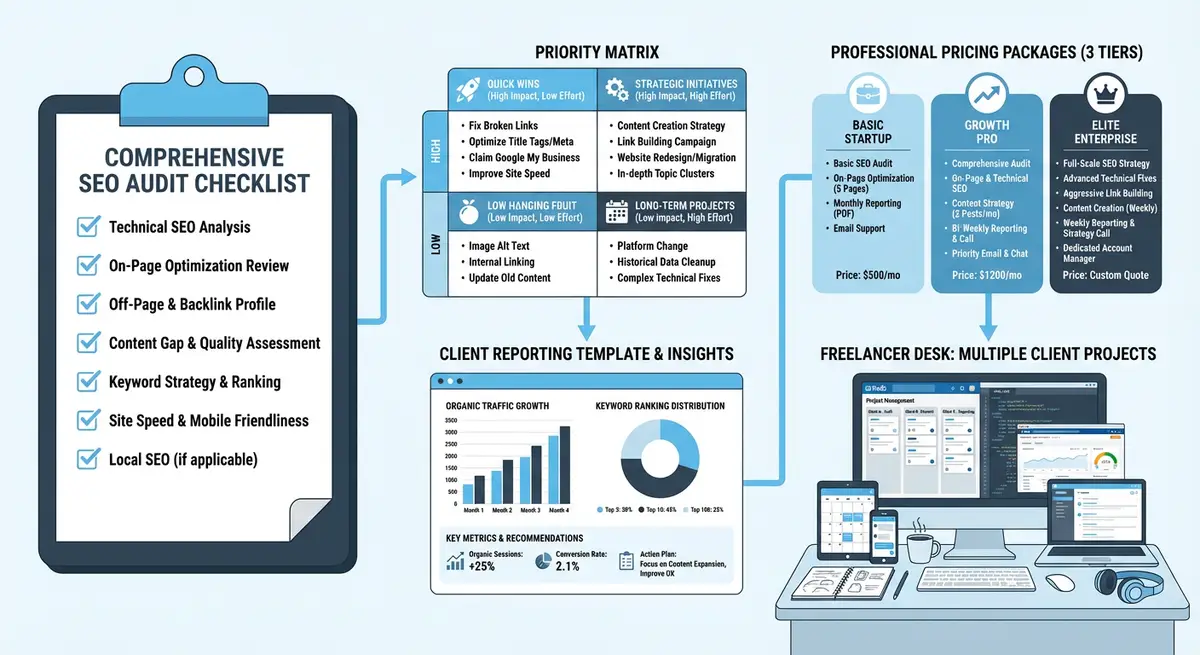
Recommended Pricing Tiers for Wix SEO Services (2026)
- Starter Package (small local businesses, 1-10 pages): 300-500 pounds per month. Includes monthly audit review, title tag and meta description optimisation, Google Business Profile management, and monthly reporting.
- Growth Package (established businesses, 10-50 pages): 700-1,200 pounds per month. Includes full monthly SEO management, content recommendations, on-page optimisation, technical monitoring, link building, and detailed reporting.
- Premium Package (ambitious businesses, eCommerce, multi-location): 1,500-3,000+ pounds per month. Includes comprehensive strategy, content creation, active link building campaigns, competitive analysis, conversion optimisation, and priority support.
- One-off projects: SEO audit (500-1,500 pounds), site migration (1,000-3,000 pounds), content strategy (800-2,000 pounds).
Legal, Insurance, and Tax Considerations
Building a sustainable SEO business requires proper legal and financial infrastructure. Many freelancers skip these foundations and regret it when a client dispute arises, tax bills surprise them, or they lack protection against professional liability claims.
Business Structure and Registration
- Register as a sole trader (simplest option for starting out) or form a limited company (provides liability protection and potential tax advantages)
- In the UK: register with HMRC for Self Assessment if sole trader, or register with Companies House if forming a limited company
- In the US: register as an LLC for liability protection, or operate as a sole proprietorship with a DBA if starting small
- Open a dedicated business bank account. Never mix personal and business finances. This simplifies accounting and is often legally required.
- Consider registering for VAT if you expect annual revenue to exceed the threshold (85,000 pounds in the UK). VAT registration also adds credibility for B2B clients.
- Consult with an accountant who specialises in freelancers or digital services businesses. The tax savings from professional advice typically exceed the consultation fee.
Insurance for SEO Professionals
- Professional Indemnity Insurance: protects you if a client claims your SEO advice caused them financial loss (e.g., a migration that resulted in significant traffic loss). This is the most important insurance for SEO consultants.
- Public Liability Insurance: protects against claims of injury or property damage. Relevant if you attend client offices or events.
- Cyber Liability Insurance: covers you if client data you handle is breached or compromised. Increasingly important given GDPR and data protection requirements.
- Typical cost: 200-500 pounds per year for combined Professional Indemnity and Public Liability. A trivial cost relative to the protection provided.
- Some larger clients require proof of insurance before signing contracts. Having insurance in place opens doors to enterprise and government clients.
Tax Planning for SEO Freelancers
Tax essentials for freelance SEO professionals
- Track all business expenses meticulously: software subscriptions, tool costs, training courses, home office costs, travel to client meetings, professional development, insurance premiums, and accountant fees
- Set aside 25-30% of all income for taxes. Transfer this to a separate savings account with every client payment to avoid tax bill surprises.
- If operating as a limited company, understand the tax-efficient combination of salary and dividends. An accountant can optimise this split.
- Claim allowable expenses: SEO tools (Ahrefs, Semrush, Screaming Frog), hosting costs, domain names, professional memberships, and relevant training courses are all deductible.
- Keep digital records of all invoices, receipts, and bank statements for at least 6 years (UK requirement) or 7 years (US requirement)
- Consider using accounting software like FreeAgent, Xero, or QuickBooks to automate bookkeeping, invoicing, and tax calculations
Building a Referral Network and Strategic Partnerships
The most sustainable client acquisition channel is referrals from a deliberate network of complementary professionals. Web designers, developers, copywriters, PPC specialists, and business coaches all encounter clients who need SEO but cannot provide it themselves. Strategic partnerships with these professionals create a mutual referral pipeline.
Building your referral network
- Identify 10-15 professionals in complementary fields: Wix web designers, copywriters, social media managers, PPC specialists, and business coaches
- Reach out with a genuine value proposition: "I refer my clients to trusted partners for services I do not provide. I am looking for a web designer I can confidently recommend. Would you be open to a reciprocal referral arrangement?"
- Formalise the arrangement: agree on whether referrals are informal (no commission) or incentivised (10-15% referral fee or equivalent reciprocal referrals)
- Provide your referral partners with a brief description of your ideal client profile so they can identify good matches
- Send a quarterly update to your referral network with your availability, any new services, and a reminder that you welcome referrals
- Acknowledge every referral promptly and keep the referring partner informed about the outcome (without breaching client confidentiality)
- Reciprocate actively: refer your own clients to your partner network whenever the need arises. Referral networks collapse when one party only takes.
Building a Client Acquisition Pipeline
A sustainable business requires a predictable flow of new client enquiries. Relying solely on referrals is dangerous because referral volume is unpredictable and drops to zero when a key referrer stops sending work. Build multiple acquisition channels so no single source can dry up your pipeline.
Acquisition Channels for Wix SEO Specialists
- Your own website SEO: rank for "Wix SEO expert", "Wix SEO services", and related terms. This is the highest-quality lead source because prospects are actively searching for what you offer.
- Content marketing: publish blog posts about Wix SEO topics. Each post is a potential entry point for prospects discovering your expertise.
- Wix Marketplace and Partner listings: be visible where Wix users look for professional help. The Wix Marketplace specifically surfaces specialists.
- Case studies and portfolio: publish detailed case studies showing before/after results. Case studies are the most persuasive sales tool in consulting.
- LinkedIn presence: share Wix SEO insights and connect with business owners who use Wix. LinkedIn is the most effective B2B networking platform.
- Referral programme: offer existing clients a discount or bonus for referring new clients. Formalise the process with a referral agreement.
- Free audit offers: offer a free basic audit as a lead magnet. The audit demonstrates your expertise and naturally leads into a paid engagement.
- Guest posting and PR: write for SEO industry publications and Wix community blogs to build authority and generate inbound links.
The Sales Conversation Framework
Converting enquiries into clients
- Discovery call (15-20 minutes): learn about their business, current SEO situation, goals, and budget. Ask more questions than you answer.
- Free mini-audit (30 minutes of your time): identify 3-5 specific issues on their Wix site with actionable recommendations. This demonstrates competence without giving away the full solution.
- Proposal presentation (20-30 minutes): present a custom proposal that addresses their specific needs, references the issues found in the mini-audit, and offers tiered pricing options.
- Follow-up: if they do not decide immediately, follow up after 3 days with additional value (a relevant blog post, a case study, or a clarification on a question they asked).
- Close: once they are ready, send the contract and onboarding documents. Make the sign-up process frictionless.
Was this lesson useful?
It takes 1 minute to tell me. The course is free and I want to keep it that way, and your feedback shows me what is working and helps other people find it.
This lesson on Scaling your Wix SEO knowledge into a sustainable business is part of Module 52: SEO Audits, Client Work & Going Pro in The Most Comprehensive Complete Wix SEO Course in the World (2026 Edition). Created by Michael Andrews, a Wix Marketplace Legend Partner with 14 years of hands-on experience, 800 completed Wix SEO projects and 456 verified five-star reviews.