Prioritising SEO work: quick wins vs long-term strategy
Module 52: SEO Audits, Client Work & Going Pro | Lesson 573 of 683 | 42 min read
By Michael Andrews, Wix SEO Expert UK
Every SEO professional and business owner faces the same challenge: limited time, limited budget, and an almost infinite list of potential optimisations. The difference between SEO professionals who deliver results and those who spin their wheels is prioritisation. Knowing what to work on first, what to defer, and what to ignore entirely is the single most valuable skill in SEO. This lesson teaches you a systematic prioritisation framework that transforms overwhelming audit findings into a clear, structured action plan that maximises results per hour invested.
Why Most SEO Campaigns Fail at Prioritisation
The typical SEO approach is to run an audit, generate a list of issues, and start working through them from top to bottom. This approach fails because it treats all issues as equally important. Fixing 50 minor title tag formatting issues might take the same time as creating one piece of comprehensive content that drives 500 monthly visits. Without a prioritisation framework, you will inevitably spend time on low-impact work while high-impact opportunities sit untouched.
- Common mistake 1: spending weeks perfecting technical SEO on a site that has no content worth ranking.
- Common mistake 2: creating new content when existing pages have basic SEO errors that prevent them from ranking.
- Common mistake 3: pursuing competitive head terms when there are dozens of uncontested long-tail opportunities.
- Common mistake 4: building backlinks before fixing on-page issues that prevent pages from converting those links into rankings.
- Common mistake 5: making the site faster when the actual problem is thin content that Google does not consider valuable enough to rank.
The Impact-Effort Matrix: Your Primary Prioritisation Tool
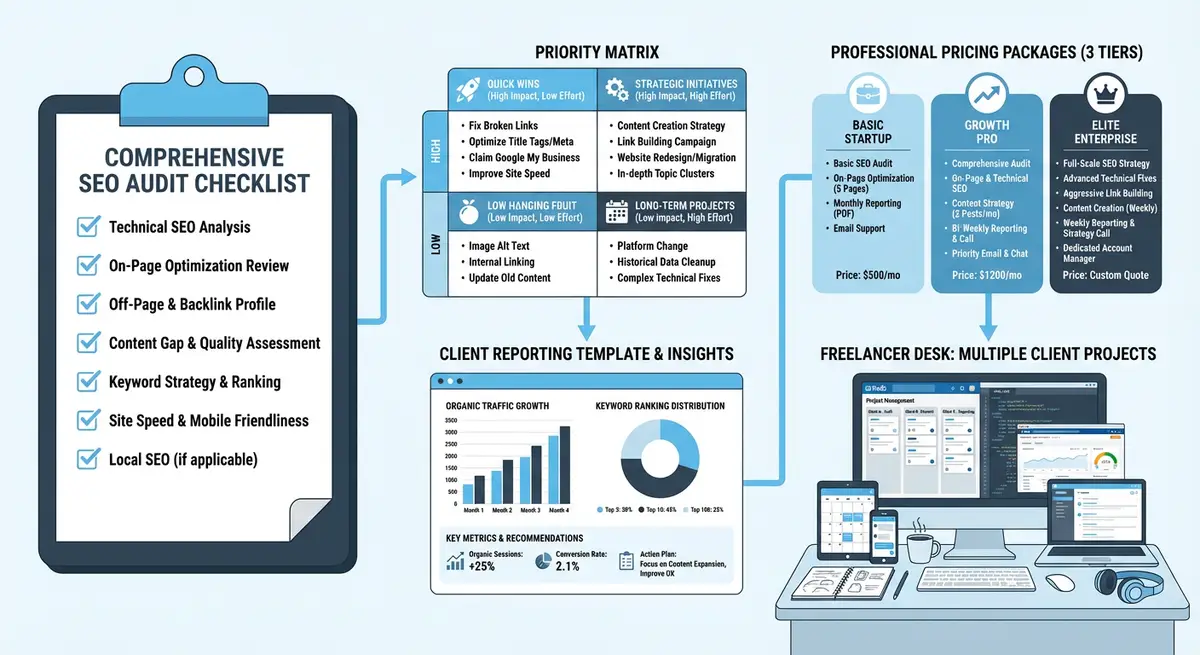
The Impact-Effort matrix is a 2x2 grid that categorises every SEO task based on two dimensions: how much impact will this have on organic performance, and how much effort does it require to implement. This simple framework prevents the most common prioritisation mistakes and ensures you always work on the highest-value activities first.
Quadrant 1: High Impact, Low Effort (Quick Wins)
These are your gold-standard tasks. They deliver meaningful results with minimal time investment. Always start here. A single afternoon of quick wins often produces more results than weeks of strategic work on lower-priority items.
- Optimising title tags for pages ranking positions 5-15 (already close to page 1)
- Adding missing meta descriptions to high-traffic pages
- Fixing broken internal links discovered in your audit
- Adding alt text to images on your top 20 landing pages
- Submitting a sitemap to Google Search Console if one does not exist
- Fixing crawl errors reported in Search Console
- Adding FAQ schema to pages that already have FAQ content
- Updating thin content pages by adding 200-300 words of relevant information
- Adding internal links from high-authority pages to pages that need ranking boosts
- Fixing 301 redirect issues (chains, loops, or broken redirects)
Quadrant 2: High Impact, High Effort (Strategic Projects)
These are your major initiatives that drive significant results but require substantial time, resources, or expertise. Plan these for weeks 2-8 of your campaign after quick wins are captured. Each strategic project should have a defined scope, timeline, and expected outcome.
- Creating comprehensive content for keyword gaps identified in competitive analysis
- Building a systematic link acquisition campaign targeting 5-10 new referring domains per month
- Redesigning and expanding thin service pages into comprehensive, authoritative resources
- Implementing a content hub strategy with pillar pages and topic clusters
- Developing a local SEO campaign with Google Business Profile optimisation and citation building
- Creating a programmatic SEO approach for location or product variant pages
- Building topical authority through a structured blog content calendar
Quadrant 3: Low Impact, Low Effort (Maintenance Tasks)
These tasks have minimal individual impact but are easy to do. Batch them into maintenance sessions rather than working on them between high-priority tasks. A monthly 2-hour maintenance session is more efficient than scattered 10-minute tasks throughout the week.
- Updating copyright dates and minor formatting issues
- Adding social sharing buttons to blog posts
- Minor text edits to improve readability
- Updating outdated statistics or dates in existing content
- Improving internal linking in older blog posts
- Adding breadcrumb navigation to pages that lack it
Quadrant 4: Low Impact, High Effort (Deprioritise or Eliminate)
These tasks consume significant time and resources with minimal return. In most cases, they should not be done at all. If a stakeholder insists on a Quadrant 4 task, quantify the opportunity cost: what high-impact work is being delayed to accommodate this request?
- Redesigning low-traffic pages that receive fewer than 10 monthly visits
- Pursuing extremely competitive head terms where the site has no authority
- Translating the entire site into languages that represent less than 1% of the target market
- Perfecting page speed scores from 85 to 100 (diminishing returns above 80)
- Building links for pages that have no commercial value
- Creating content for topics with no search demand
The 30-Day Quick Win Sprint Framework
The first 30 days of any SEO campaign should be dedicated almost exclusively to quick wins. This approach delivers early results that build stakeholder confidence, demonstrates competence, and creates a foundation for the longer-term strategic work.
Week 1: Technical Quick Fixes
Week 1 action items
- Fix all crawl errors in Google Search Console (404s, server errors, redirect issues)
- Submit or update the XML sitemap
- Fix any HTTPS/security issues
- Resolve redirect chains and loops
- Fix robots.txt issues if Googlebot is being blocked from important pages
- Add missing canonical tags
Week 2: On-Page Quick Wins
Week 2 action items
- Optimise title tags for the top 20 pages by traffic, focusing on keyword placement and CTR
- Write custom meta descriptions for the same 20 pages
- Fix any pages with missing or duplicate H1 tags
- Add alt text to all images on the top 20 pages
- Fix broken internal links identified in the audit
Week 3: Content Quick Wins
Week 3 action items
- Identify pages ranking positions 5-15 that could reach page 1 with minor improvements
- Add 200-500 words of relevant content to thin pages
- Update any content with outdated information (old dates, discontinued products, changed policies)
- Add FAQ sections to service pages (with FAQ schema markup)
- Create internal links from high-authority pages to underperforming pages that need a boost
Week 4: Structured Data and Reporting
Week 4 action items
- Add Organization or LocalBusiness schema to the homepage
- Add FAQ schema to all pages with FAQ content
- Add BreadcrumbList schema if breadcrumbs exist but lack markup
- Generate a 30-day progress report showing improvements from quick wins
- Plan the strategic roadmap for months 2-6 based on remaining audit findings
The 3-6 Month Strategic Roadmap
After the quick win sprint, transition to strategic projects that build long-term competitive advantage. These projects require sustained effort but deliver compounding returns over time.
Month 2-3: Content Development
- Create comprehensive content for the top 5 keyword gap opportunities identified in competitive analysis
- Develop a content calendar for the next 6 months based on keyword research and search demand
- Expand existing high-performing content to cover related subtopics (topical authority building)
- Create location-specific landing pages if the business serves multiple areas
- Develop case studies, testimonials, and social proof content for E-E-A-T signals
Month 3-6: Authority Building
- Implement a systematic link building campaign: guest posting, digital PR, broken link building
- Target 5-10 new referring domains per month from relevant, authoritative websites
- Build local citations and directory listings for local SEO campaigns
- Develop linkable assets (original research, tools, infographics) that attract organic backlinks
- Engage in industry community participation for brand mentions and referral traffic
Communicating Prioritisation to Clients and Stakeholders
One of the hardest aspects of SEO prioritisation is explaining to clients why you are working on certain tasks and not others. Clients often fixate on specific issues they have read about or heard from competitors. Your job is to redirect their attention to the highest-impact work while acknowledging their concerns.
- Use data, not opinions: "Fixing these 5 title tags will impact pages that drive 60% of your organic traffic" is more persuasive than "title tags are important".
- Show opportunity cost: "If we spend 20 hours on that page redesign, we will not have time to create the content that could drive 200 new monthly visitors."
- Present the roadmap visually: a simple timeline showing quick wins in month 1, strategic projects in months 2-6, with expected impact at each milestone.
- Report on quick wins early: nothing builds trust faster than showing measurable improvements in the first 30 days.
- Be honest about timeline: "SEO results for competitive keywords typically take 4-6 months. Here is what we will see at each milestone."
ROI Estimation Framework for SEO Tasks
The most sophisticated prioritisation goes beyond the impact-effort matrix to estimate actual return on investment for each SEO activity. This quantitative approach is especially valuable when presenting to stakeholders who think in financial terms rather than ranking positions.
Calculating Estimated ROI per Task
ROI estimation process for SEO activities
- Estimate the traffic gain: if optimising a page currently ranking position 8 moves it to position 3, use CTR data to estimate the click increase. Position 8 gets approximately 3.7% CTR, position 3 gets approximately 11%. For a keyword with 1,000 monthly searches, that is 73 more clicks per month.
- Estimate the conversion value: multiply the traffic gain by the site conversion rate and average conversion value. If the conversion rate is 3% and average lead is worth 50 pounds, 73 extra clicks = 2.2 extra leads = 110 pounds per month.
- Estimate the effort cost: if the optimisation takes 3 hours and your effective hourly rate is 75 pounds, the cost is 225 pounds one-time.
- Calculate ROI: 110 pounds per month in value versus 225 pounds one-time cost means the optimisation pays for itself in just over 2 months and generates ongoing returns.
- Rank all tasks by monthly ROI and work through them from highest to lowest return.
- For tasks that are difficult to quantify (like brand awareness or authority building), assign a subjective value score of 1-10 rather than a financial figure.
The Revenue Attribution Model
When reporting ROI to clients, you need a clear model for attributing revenue to SEO activities. This model must be conservative enough to maintain credibility while demonstrating genuine business impact.
- Direct attribution: organic traffic that converts directly (fills a form, makes a purchase) within the same session. This is the most defensible metric.
- Assisted attribution: organic visits that contribute to a conversion path but are not the final click. GA4 data-driven attribution models show this.
- Incremental attribution: compare organic performance periods (before your work vs after) while controlling for seasonality and market trends. The increment is attributable to SEO.
- Be conservative in your claims. It is better to say "SEO contributed to at least 50 additional leads this month" than to overstate the impact and lose credibility.
- Always present organic SEO ROI alongside paid search cost-per-click for the same keywords. This comparison dramatically illustrates the value of organic rankings.
Seasonal Planning: Aligning SEO Work with Business Cycles
Effective prioritisation accounts for seasonal patterns. SEO work done 3-6 months before a peak season yields maximum impact because rankings take time to build. Working on Christmas-related content in November is too late; the content needed to be published and ranking by September.
Seasonal SEO planning process
- Identify the client's peak and trough seasons from GA4 data (month-by-month revenue or traffic)
- Map backward 4-6 months from each peak to determine when preparatory SEO work must begin
- During trough seasons: focus on foundational work like technical fixes, content creation, and backlink building
- Pre-peak season (3-4 months out): publish seasonal content, optimise product and service pages for peak keywords, ensure structured data is complete
- During peak season: focus on monitoring and quick adjustments only. Do not make major structural changes during high-traffic periods.
- Post-peak: analyse performance, identify what worked, and begin planning for the next cycle
- Create an annual SEO calendar that maps activities to the client's business calendar for proactive planning
Measuring the Impact of Prioritisation Decisions
After implementing your prioritised action plan, you need to measure whether your prioritisation was correct. This feedback loop improves your prioritisation accuracy over time and provides accountability data for clients.
- Track each completed task with its pre-work metrics (ranking, traffic, CTR) and post-work metrics measured at 30, 60, and 90 days
- Compare actual results against estimated results. Were your ROI projections accurate? Where did you overestimate or underestimate?
- Identify which task types consistently deliver the highest returns for this specific client and industry
- Identify tasks that consumed significant time but delivered minimal results. These should be deprioritised or eliminated in future cycles.
- Present the impact data to clients in your monthly reports: "This month we completed 8 optimisations. The 3 title tag updates for position 5-10 keywords produced the largest traffic gains, confirming our focus on quick-win optimisations."
- Build a personal knowledge base of task-to-impact relationships. Over time, this becomes your competitive advantage in prioritisation accuracy.
Was this lesson useful?
It takes 1 minute to tell me. The course is free and I want to keep it that way, and your feedback shows me what is working and helps other people find it.
This lesson on Prioritising SEO work: quick wins vs long-term strategy is part of Module 52: SEO Audits, Client Work & Going Pro in The Most Comprehensive Complete Wix SEO Course in the World (2026 Edition). Created by Michael Andrews, a Wix Marketplace Legend Partner with 14 years of hands-on experience, 800 completed Wix SEO projects and 456 verified five-star reviews.