Pre-redesign SEO audit: documenting everything before you change a single page
Module 49: Redesigning Your Wix Site Without Losing Rankings | Lesson 542 of 683 | 55 min read
By Michael Andrews, Wix SEO Expert UK
The most critical phase of an SEO-safe redesign happens before you touch a single page. A comprehensive pre-redesign audit creates a complete snapshot of your current SEO state: every URL, every ranking, every backlink, every piece of structured data, every internal link. This documentation becomes your reference point for measuring post-redesign impact and your safety net if anything goes wrong. Without it, you have no way to know what you lost or how to recover it. This lesson walks you through the complete pre-redesign audit process for Wix sites.
Phase 1: URL and Page Inventory
The foundation of your pre-redesign audit is a complete inventory of every page on your Wix site. This is not just your main navigation pages. It includes blog posts, tag pages, category pages, dynamic CMS pages, hidden pages, and any page that Google has indexed.
Creating your complete URL inventory
- Run a full site crawl using Screaming Frog (free up to 500 URLs) to capture every URL on your site
- Export the crawl results to a spreadsheet with columns: URL, Status Code, Title Tag, Meta Description, H1, Word Count, Internal Links In, Internal Links Out
- In Google Search Console, go to Indexing > Pages and export the list of all indexed URLs
- Cross-reference your crawl with GSC indexed URLs to identify any pages Google has indexed that your crawl missed (this can reveal orphan pages or parameters Google discovered)
- Check your XML sitemap at yourdomain.com/sitemap.xml and verify it matches your crawl inventory
- Note any discrepancies: pages in your sitemap not found by the crawler, or pages found by the crawler not in the sitemap
Phase 2: Ranking and Traffic Baseline
You need to know exactly what each page is currently ranking for and how much traffic it drives. Without this baseline, you cannot measure the impact of your redesign.
Documenting your ranking and traffic baseline
- In GSC Performance report, set the date range to the last 6 months
- Export the Pages report showing clicks, impressions, CTR, and average position for every page
- Export the Queries report showing every keyword your site ranks for with clicks, impressions, and position
- If you use a rank tracker (Ahrefs, SEMrush, SE Ranking), export your current keyword rankings
- In Google Analytics 4, export landing page data for the same 6-month period showing sessions, users, conversions, and revenue per page
- Identify your top 20 pages by organic traffic, these are your highest-priority pages for SEO preservation
- Identify your top 50 keywords by clicks, these are the rankings you absolutely must protect
- Save all exports in a dedicated Pre-Redesign Audit folder for reference throughout the project
Phase 3: Backlink Profile Documentation
Backlinks are the most difficult SEO asset to rebuild. Every external link pointing to your site must be preserved through the redesign. Losing backlinks means losing the authority that took months or years to build.
Documenting your backlink profile
- In GSC, go to Links > Top linked pages (from external sites) and export the full list
- If you have access to Ahrefs or SEMrush, run a full backlink analysis and export all backlinks with: Target URL, Source URL, Anchor Text, Domain Rating
- Create a dedicated column in your URL inventory spreadsheet for "External Backlinks" and populate it with the count from your analysis
- Flag any page with backlinks that is planned for URL change or removal, these pages need careful redirect planning
- For high-value backlinks (from authoritative domains), note the specific source URLs so you can verify they still resolve correctly after the redesign
Phase 4: Technical SEO Snapshot
Capture your current technical SEO state so you can verify nothing breaks during the redesign.
- Core Web Vitals: record your current LCP, CLS, and INP scores for mobile and desktop from PageSpeed Insights for your top 10 pages
- Structured data: list every type of schema markup on your site and which pages have it (use Screaming Frog or manual inspection)
- Canonical tags: verify every page has the correct canonical tag (self-referencing or pointing to the preferred version)
- Robots.txt: save a copy of your current robots.txt file
- XML Sitemap: save a copy of your current sitemap.xml
- Custom code: document all code added via Wix Custom Code (head, body, page-specific)
- Third-party integrations: list all connected services (Google Analytics, Search Console, Tag Manager, Merchant Center, review platforms)
- Redirect list: export any existing redirects from Wix SEO > URL Redirect Manager
Phase 5: Content Audit
Document the content state of every important page. During a redesign, content is often rewritten, shortened, or restructured. Knowing exactly what content existed before helps you prevent unintentional keyword and topic loss.
Conducting the pre-redesign content audit
- For your top 20 pages by traffic, copy and save the full page content (text, headings, lists) in a document
- Note the H1 tag, primary keyword, and word count for every page
- Document the internal links on each page: which pages it links to and which pages link to it
- Save screenshots of each page layout (desktop and mobile) for visual reference
- Note any pages with FAQs, comparison tables, or other structured content that contributes to rich results
- Document image file names and alt text for the top images on each page

Complete How-To Guide: The Full Pre-Redesign SEO Audit for Wix
Follow these steps to complete your pre-redesign audit before making any changes
- Create a dedicated folder (Google Drive, Dropbox, or local) called "Pre-Redesign SEO Audit [Date]"
- Run a Screaming Frog crawl of your entire Wix site and export results to CSV in the audit folder
- Export GSC Performance data (Pages and Queries) for the last 6 months to CSV
- Export GA4 landing page data for the last 6 months to CSV
- Export GSC backlink data (Top linked pages) to CSV
- If available, run and export Ahrefs or SEMrush backlink analysis to CSV
- Record Core Web Vitals scores for your top 10 pages in a spreadsheet
- Document all structured data types and locations in a spreadsheet
- Save copies of robots.txt, sitemap.xml, and all Wix Custom Code
- Export existing URL redirects from Wix SEO > URL Redirect Manager
- For your top 20 pages, save full text content, H1 tags, word counts, and screenshots
- Create a master URL inventory spreadsheet combining crawl data, traffic data, backlink counts, and structured data presence
- Review and verify the audit is complete by checking you have data for every point listed in this lesson
- Lock this folder, nothing should be modified after this point, it is your pre-redesign snapshot
Essential Tools for This Lesson
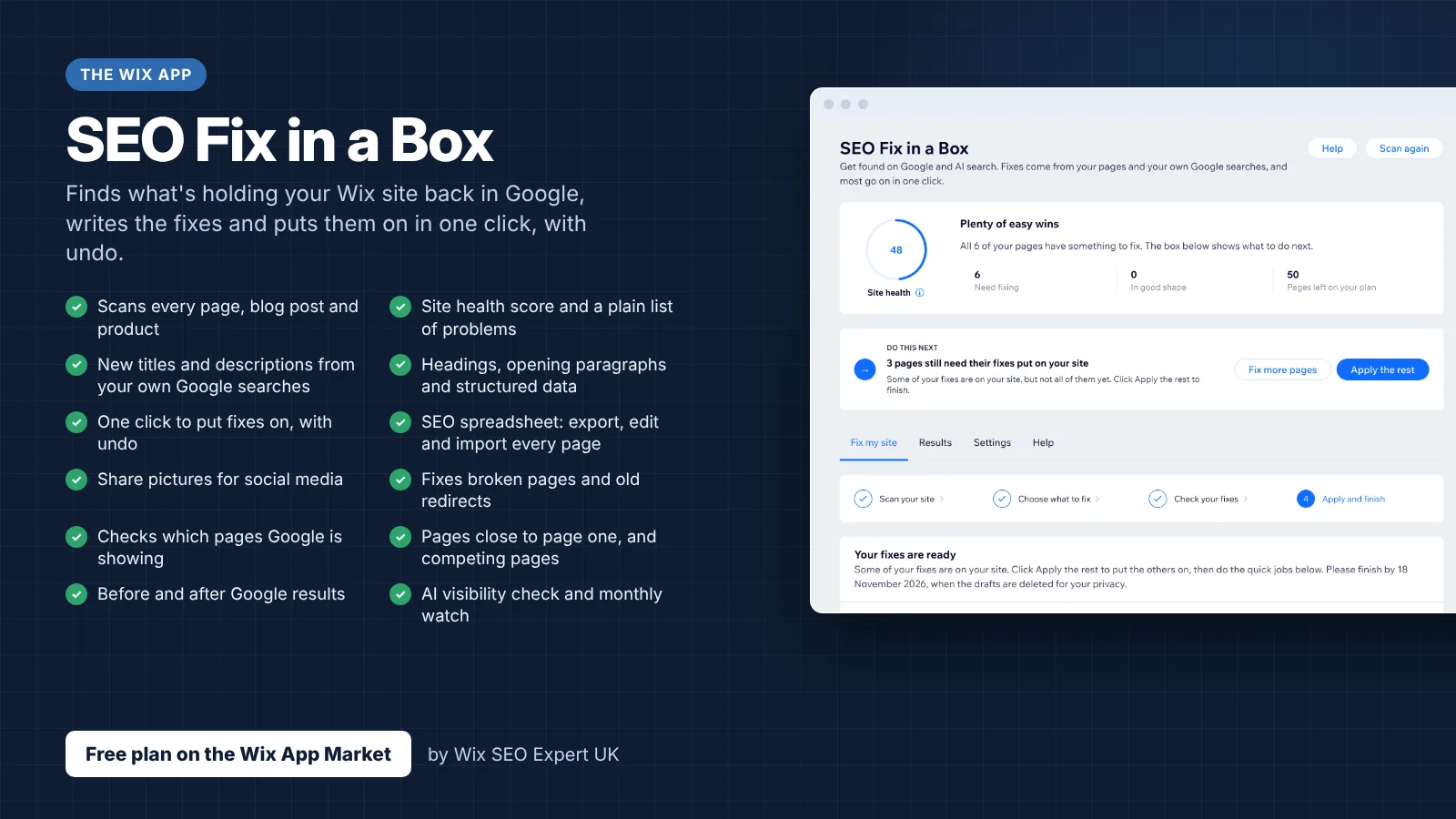
- SEO Fix in a Box: My Wix app. Free to install, it scans your site and shows what needs fixing, and paid plans write the fixes from your own Google searches
Was this lesson useful?
It takes 1 minute to tell me. The course is free and I want to keep it that way, and your feedback shows me what is working and helps other people find it.
This lesson on Pre-redesign SEO audit: documenting everything before you change a single page is part of Module 49: Redesigning Your Wix Site Without Losing Rankings in The Most Comprehensive Complete Wix SEO Course in the World (2026 Edition). Created by Michael Andrews, a Wix Marketplace Legend Partner with 14 years of hands-on experience, 800 completed Wix SEO projects and 456 verified five-star reviews.