Monitoring and measuring GEO performance: tools, metrics and tracking
Module 27: GEO: Generative Engine Optimisation for Wix | Lesson 328 of 683 | 28 min read
By Michael Andrews, Wix SEO Expert UK
GEO is still an emerging discipline, and measuring performance is harder than tracking Google rankings. There is no single dashboard that shows "you were cited 47 times this month by AI engines." But there are tools, techniques and metrics that give you meaningful visibility into whether your GEO strategy is working. This lesson covers everything available in 2026 for tracking AI search performance.
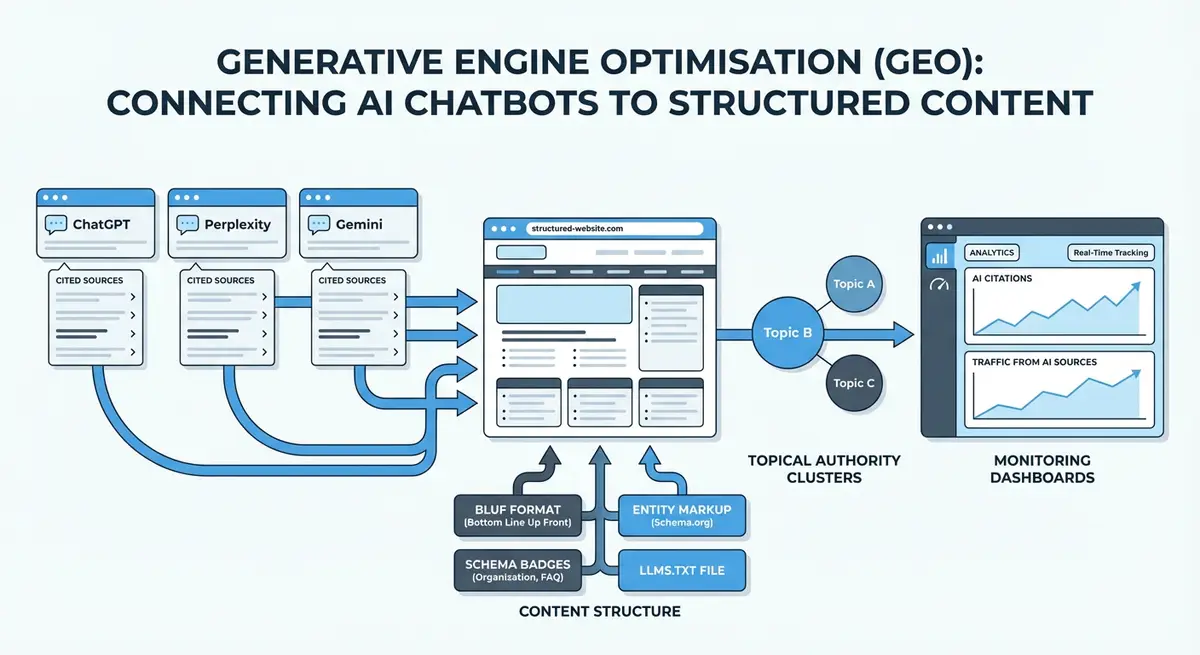
The GEO Metrics That Matter
- Citation frequency: how often your brand or content is referenced in AI-generated answers
- Source position: where in the AI answer your citation appears (first cited source carries more weight)
- Brand mention accuracy: whether AI engines describe your business correctly when citing you
- Referral traffic from AI: visits originating from ChatGPT, Perplexity and AI Overviews
- Query coverage: what percentage of your target queries result in your content being cited
Manual Monitoring: The Foundation
The most reliable GEO monitoring method in 2026 is manual querying. Maintain a list of 20-30 target queries that your ideal customers would ask AI engines. Once a week, ask these queries in ChatGPT, Perplexity and Google (checking AI Overviews). Record whether you are cited, what position your citation appears in, and what the AI says about you. This manual process takes 30-45 minutes per week but provides the most accurate picture.
Setting up a manual GEO monitoring routine
- Create a spreadsheet with columns: Query, Platform, Cited (Y/N), Position, Notes, Date
- List 20-30 queries your target customers would ask AI engines about your topic or service
- Include a mix of informational queries ("what is Wix SEO"), local queries ("best SEO expert in London") and comparison queries ("Wix vs WordPress for SEO")
- Query each platform weekly and record results
- Track trends monthly: are citations increasing, decreasing or stable?
- Note which content is being cited so you can identify what is working
Google Search Console Signals
Google Search Console does not have a dedicated AI Overviews report yet, but it provides indirect signals. Look for queries where your impressions are high but clicks are unusually low. This pattern often indicates your content is appearing in AI Overviews (users see the answer without clicking). Also monitor the Search Appearance filter for any new AI-related appearance types Google introduces.
Third-Party GEO Tracking Tools
Several tools are emerging to help track GEO performance. While the landscape is evolving rapidly, the most useful tools in 2026 include those that automatically query AI engines and track citations over time.
GEO Monitoring Tools
- Otterly.ai: Tracks your brand mentions and citations across AI search engines automatically
- Peec AI: AI search analytics platform that monitors visibility in ChatGPT, Perplexity and AI Overviews
- BrightEdge: Enterprise SEO platform with AI Overviews tracking and citation monitoring
- SEO Fix in a Box: My Wix app. Free to install, it scans your site and shows what needs fixing, and paid plans write the fixes from your own Google searches
Tracking AI Referral Traffic
When users do click through from AI-generated answers, the referral traffic appears in Google Analytics. Look for traffic sources containing "chatgpt.com", "perplexity.ai", and referrals from AI Overview clicks (which may appear as direct or Google organic). Setting up UTM parameters on your schema markup URLs can help disambiguate AI-referred traffic from organic.
Building a GEO Reporting Cadence
Report on GEO performance monthly alongside your traditional SEO metrics. Include: number of target queries where you are cited, citation trends (improving/declining), top-cited content, new queries where citations appeared, and referral traffic from AI platforms. Over time, this data reveals which content strategies and schema implementations are driving the most AI visibility.
Complete How-To Guide: Setting Up GEO Performance Tracking for Your Wix Site
This guide covers building a monitoring system, configuring analytics for AI referral traffic, and creating a reporting cadence that shows whether your GEO investment is paying off.
How to monitor and measure your GEO performance
- Step 1: Create a GEO tracking spreadsheet with tabs for: Manual Citation Tracking, AI Referral Traffic, Monthly Summary. This becomes your central GEO performance dashboard.
- Step 2: In the Manual Citation Tracking tab, create columns: Date, Query, ChatGPT Cited, Perplexity Cited, AI Overview Cited, Position (1st/2nd/3rd source), Content URL Cited, Notes.
- Step 3: List 20-30 target queries that represent your ideal AI visibility. Mix informational, local and comparison queries. These are the queries you will manually check every week.
- Step 4: Every Monday, spend 30-45 minutes querying each target query in ChatGPT, Perplexity and Google (checking AI Overviews). Record your citation status for each.
- Step 5: In GA4, create a custom channel group for AI referral traffic. Go to Admin then Data Display then Channel Groups. Add rules to capture traffic from chatgpt.com, perplexity.ai and other AI engine domains.
- Step 6: Set up a custom GA4 Exploration report showing sessions from your AI Search channel over time. This lets you track the growth of AI-referred visitors to your Wix site.
- Step 7: In Google Search Console, monitor the Performance report for queries with high impressions but unusually low CTR. Flag these as potential AI Overview appearances where users get answers without clicking.
- Step 8: If available, sign up for an AI citation tracking tool like Otterly.ai or Profound. These automate the manual checking process and provide historical trend data.
- Step 9: At the end of each month, complete your Monthly Summary tab. Calculate: total citation rate (citations divided by total queries checked), citation trend (up/down/flat vs last month), top-cited content, and AI referral traffic volume.
- Step 10: Identify your most-cited content and analyse what makes it successful. Is it the format, the data, the authority signals, or the topic depth? Use these insights to optimise other pages.
- Step 11: Identify queries where you are never cited and competitors always are. Analyse the gap: do they have better content structure, stronger entity signals, or more comprehensive coverage? Prioritise closing these specific gaps.
- Step 12: Review and update your target query list quarterly. Add new queries as your content expands. Remove queries that are no longer relevant. Adjust your strategy based on 3 months of trend data.
Was this lesson useful?
It takes 1 minute to tell me. The course is free and I want to keep it that way, and your feedback shows me what is working and helps other people find it.
This lesson on Monitoring and measuring GEO performance: tools, metrics and tracking is part of Module 27: GEO: Generative Engine Optimisation for Wix in The Most Comprehensive Complete Wix SEO Course in the World (2026 Edition). Created by Michael Andrews, a Wix Marketplace Legend Partner with 14 years of hands-on experience, 800 completed Wix SEO projects and 456 verified five-star reviews.