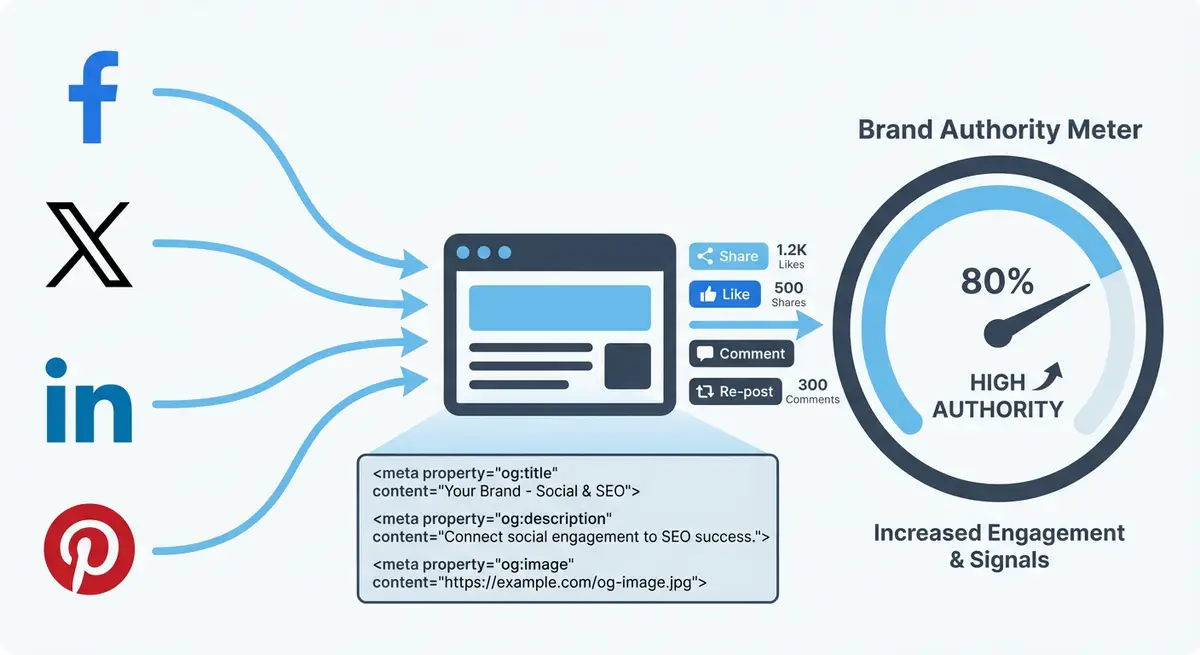
Google has stated repeatedly that social signals, likes, shares, followers, are not direct ranking factors. Yet the correlation between strong social media presence and high organic rankings is undeniable and well-documented across thousands of studies. The explanation is not contradiction; it is causation through indirect channels. Social media activity drives the behaviours and signals that Google does use: backlinks, branded searches, engagement, brand mentions and entity recognition. For Wix site owners, understanding this indirect pathway transforms social media from a "nice to have" into a strategic SEO tool that amplifies every other optimisation effort. This lesson breaks down the specific mechanisms through which social activity translates into ranking improvements, identifies which platforms deliver the most SEO value for different business types, and gives you a systematic framework for building a social presence that measurably strengthens your organic search performance.

The Indirect Path: How Social Activity Drives Rankings
The relationship between social media and SEO operates through five distinct pathways. Understanding each one lets you optimise your social strategy for maximum search impact rather than vanity metrics like follower counts that have no bearing on your rankings.
The five pathways from social media to SEO results
- 1Content amplification: you publish content on your Wix site and share it on social media, increasing its visibility to a much larger audience than organic search alone would reach in the first weeks after publication.
- 2Link earning: social shares expose your content to journalists, bloggers and content creators who may link to it from their own websites. These editorial backlinks are the most valuable ranking signal available.
- 3Branded search growth: consistent social presence builds brand recognition. People who see your content on LinkedIn or Twitter later search Google for your business name. Branded search volume is a confirmed Google ranking signal.
- 4Engagement signals: social traffic to your Wix site generates engagement data (time on page, pages per session, scroll depth) that correlates with higher rankings for the visited pages.
- 5Entity reinforcement: active profiles across multiple platforms strengthen Google's understanding of your brand as a legitimate entity, contributing to the E-E-A-T signals that influence how authoritatively Google treats your entire site.
None of these pathways involve Google directly counting your tweets or LinkedIn likes. Each one involves social activity triggering a behaviour that Google does measure. This distinction matters because it tells you what to optimise for: not maximum social engagement for its own sake, but social activity that drives the specific behaviours, backlinks, brand searches and quality traffic, that move rankings.
Which Social Platforms Deliver the Most SEO Value
Not all social platforms contribute equally to SEO. The value of each platform depends on your business type, target audience and the specific SEO pathway you are trying to activate. Here is an evidence-based assessment of each major platform's SEO contribution.
LinkedIn: Best for B2B Link Building and Authority
LinkedIn has the highest correlation with earned backlinks of any social platform for B2B content. The reason is straightforward: LinkedIn's audience includes bloggers, journalists, newsletter writers and content marketers who actively publish on their own websites. When your content performs well on LinkedIn, these professionals see it and some will reference or link to it in their own content. LinkedIn thought leadership posts that share original data, contrarian insights or detailed case studies have the highest probability of converting social engagement into backlinks.
- LinkedIn articles and long-form posts are indexed by Google and can rank in search results independently.
- Professional engagement (comments, reposts) from industry leaders strengthens your personal and brand authority signals.
- LinkedIn company pages provide strong entity signals that Google and AI search engines cross-reference.
- The platform's professional context means links shared on LinkedIn receive more qualified, higher-engagement traffic than most other social sources.
Twitter/X: Best for Fast Amplification and Journalist Reach
Twitter/X is the fastest amplification channel. Content that gains traction on X can generate thousands of views within hours, and journalists actively monitor the platform for stories and sources. A viral tweet about your Wix site content can generate links from multiple publications within days. However, the platform's fast-moving nature means most content has a very short lifespan. X is best used as an amplification tool for your highest-quality Wix content rather than your primary social strategy.
Pinterest: Best for Visual and eCommerce SEO
Pinterest is unique among social platforms because it functions primarily as a visual search engine. Pins have an exceptionally long lifespan, often driving traffic for months or years after creation. For Wix eCommerce sites, portfolio sites, food blogs and how-to content, Pinterest can be the single most valuable social platform for SEO because pins rank in both Pinterest search and Google image results. Pinterest Rich Pins pull structured data from your Wix pages, creating an additional indexable representation of your content.
YouTube: Best for Search Visibility and Backlinks
YouTube is the second largest search engine and its content appears directly in Google search results through video carousels and featured snippets. YouTube video descriptions that link to your Wix site provide both referral traffic and indirect link equity. For businesses that can create video content, YouTube offers a dual SEO benefit: the videos themselves rank in Google, and the descriptions drive traffic and links to your Wix site.
Facebook: Best for Local SEO and Community Engagement
Facebook's SEO value has diminished for link building, but it remains important for local businesses. Facebook Business Pages are indexed by Google, Facebook reviews contribute to local trust signals, and Facebook Groups provide community engagement that drives brand awareness and branded searches. For local Wix sites, maintaining an active Facebook presence with consistent NAP information is a baseline requirement.
Social Proof as an E-E-A-T Signal
Google's E-E-A-T framework (Experience, Expertise, Authoritativeness, Trustworthiness) evaluates whether content creators and websites are credible sources of information. Social media profiles contribute to every dimension of E-E-A-T in ways that are increasingly important as Google fights AI-generated content spam.
- Experience: an active social presence where you share real-world insights, case studies and behind-the-scenes content demonstrates genuine experience in your field.
- Expertise: consistent, knowledgeable social posts in your niche build a public record of expertise that Google can cross-reference with your Wix site content.
- Authoritativeness: engagement from other recognised experts (comments, reposts, endorsements) on your social posts creates a web of authority signals.
- Trustworthiness: verified social profiles, consistent branding, real engagement with followers, and positive sentiment all contribute to trust signals.
An expert with 10,000 engaged LinkedIn followers, a verified Twitter/X account, and consistent thought leadership content has dramatically stronger authority signals than an anonymous website with no social presence. Google's Quality Rater Guidelines explicitly mention checking social media profiles when evaluating content creator credibility.
The Brand Entity Effect
Google increasingly treats brands as "entities" in its Knowledge Graph, a structured database of people, businesses, concepts and their relationships. Social media profiles are a primary source of entity data. When your business has consistent, active profiles across multiple platforms, all linking to your Wix site and to each other, Google builds a stronger, more confident entity representation for your brand.
This entity recognition has practical SEO benefits. Branded search results become more comprehensive (featuring your social profiles alongside your website). Google is more confident about attributing your content to a legitimate source. AI search engines like ChatGPT and Perplexity are more likely to recommend your business when they can verify its existence across multiple platforms.
Content Distribution Strategy: Social as an Amplification Engine
The most effective social-to-SEO strategy treats social media as a distribution channel for content that lives on your Wix site. This approach ensures that all engagement, links and authority ultimately flow back to your owned domain rather than being trapped on social platforms.
Building a social amplification system
- 1Create high-quality content on your Wix site as the primary asset: blog posts, guides, tools, research and case studies.
- 2Repurpose each piece of content into platform-native formats: a LinkedIn article, a Twitter/X thread, a Pinterest pin, a YouTube summary or an Instagram carousel.
- 3Distribute the native content with a clear link back to the full resource on your Wix site.
- 4Engage with comments and discussions on each platform to boost algorithmic reach and build relationships with potential linkers.
- 5Monitor which social posts drive the most backlinks and branded searches, not just likes and shares, to identify your highest-value social activities.
The Bottom Line
Social media does not directly move your Google rankings. But it drives the activities that do: backlinks, brand mentions, branded searches, quality traffic and engagement. Treating social and SEO as separate strategies is leaving ranking potential on the table. The businesses that see the strongest SEO results are those that use social media deliberately as a distribution and amplification channel for their Wix site content.
Building Relationships That Generate Links
The highest-value outcome of social media activity for SEO is not direct traffic; it is the relationships you build with people who have their own websites and audiences. A single relationship with a journalist, blogger or newsletter writer who regularly links to your content is worth more than 10,000 social followers who never link to anything.
- Identify 20-30 content creators in your niche who regularly publish on their own websites or newsletters.
- Follow them on their most active social platform and engage genuinely with their content for 2-4 weeks before sharing your own.
- Comment thoughtfully on their posts with insights that add value to the discussion, not generic praise or self-promotion.
- Share their content with your audience, tagging them. Content creators notice and appreciate when others amplify their work.
- When you publish content on your Wix site that is genuinely relevant to their audience, share it with them directly as a resource, not a link request.
- Build the relationship before you need anything. The links will follow naturally from genuine professional respect.
Complete How-To Guide: Leveraging Social Signals to Boost Wix SEO
This step-by-step guide gives you a systematic framework for building a social media presence that measurably strengthens your Wix site's organic search performance through the five indirect pathways outlined above.
Follow these steps to leverage social signals for SEO impact
- 1Step 1: Audit your current social profiles across all platforms. Ensure your Wix site URL is linked in every bio, about section and profile description. Verify that your business name, logo and description are identical across all platforms.
- 2Step 2: Identify your top 10 performing pages in Google Search Console by impressions and clicks. These pages already have search demand and will benefit most from the additional signals that social amplification provides.
- 3Step 3: Choose 1-2 primary social platforms based on your business type. B2B businesses should prioritise LinkedIn. Visual and eCommerce businesses should prioritise Pinterest. Local businesses should focus on Facebook and Google Business Profile.
- 4Step 4: Create a weekly content calendar that schedules each top-performing Wix page for social sharing at least once per month. Write unique platform-native commentary for each share rather than posting the same link across all platforms.
- 5Step 5: Build a target list of 20-30 bloggers, journalists and content creators in your niche. Follow them on your primary platform and begin engaging with their content thoughtfully and consistently.
- 6Step 6: Repurpose your highest-value Wix blog posts into native social content: LinkedIn long-form posts, Twitter/X threads, Pinterest pins, or short video summaries. Each native post should link back to the full resource on your Wix site.
- 7Step 7: Join 3-5 relevant industry groups on LinkedIn and Facebook where your target audience is active. Share your Wix content in these groups with genuine context and original commentary, not just link drops.
- 8Step 8: Set up Google Alerts for your business name, founder name and key product or service names. Engage with every brand mention you find to amplify visibility and build relationships.
- 9Step 9: Track branded search volume in Google Search Console monthly. Navigate to Performance, filter queries containing your brand name, and record the total impressions and clicks as your baseline.
- 10Step 10: Create original research, survey data or industry analysis content on your Wix site that is inherently link-worthy. Share the key findings as social posts with a link to the full analysis to attract links from content creators.
- 11Step 11: Monitor your backlink profile in Google Search Console monthly. Navigate to Links > Top Linking Sites and identify which new linking domains correlate with content you recently promoted on social media.
- 12Step 12: Encourage your team, partners and satisfied clients to engage with your social posts. Early engagement triggers platform algorithms to show your content to a wider audience, increasing the chances of reaching potential linkers.
- 13Step 13: Track social referral traffic quality in GA4. Navigate to Acquisition > Traffic Acquisition and compare engagement metrics (time on page, pages per session, conversion rate) for social traffic versus other sources.
- 14Step 14: Review your social-to-SEO performance quarterly. Correlate months with high social activity against subsequent organic traffic trends (look for a 2-4 week lag). Identify which platforms and content types generate the strongest SEO impact and double down on those.
Final Checkpoint
After 3 months of consistent execution you should see growing branded search volume in GSC, increasing social referral traffic with strong engagement metrics, new backlinks traceable to social amplification, and a network of industry relationships that support ongoing link opportunities. Focus on one platform done well rather than spreading thin across all of them.
Essential Tools for This Lesson
Google Search Console
Track branded search volume growth and new backlinks from social amplification
Google Alerts
Monitor brand mentions across the web triggered by social activity
Google Analytics 4
Track social referral traffic quality and engagement metrics
Ahrefs Free Backlink Checker
Monitor new backlinks that correlate with social media campaigns