How organic and paid search work together: the SEO and PPC synergy
Module 29: SEO & Paid Search (SEM) Integration | Lesson 342 of 683 | 25 min read
By Michael Andrews, Wix SEO Expert UK
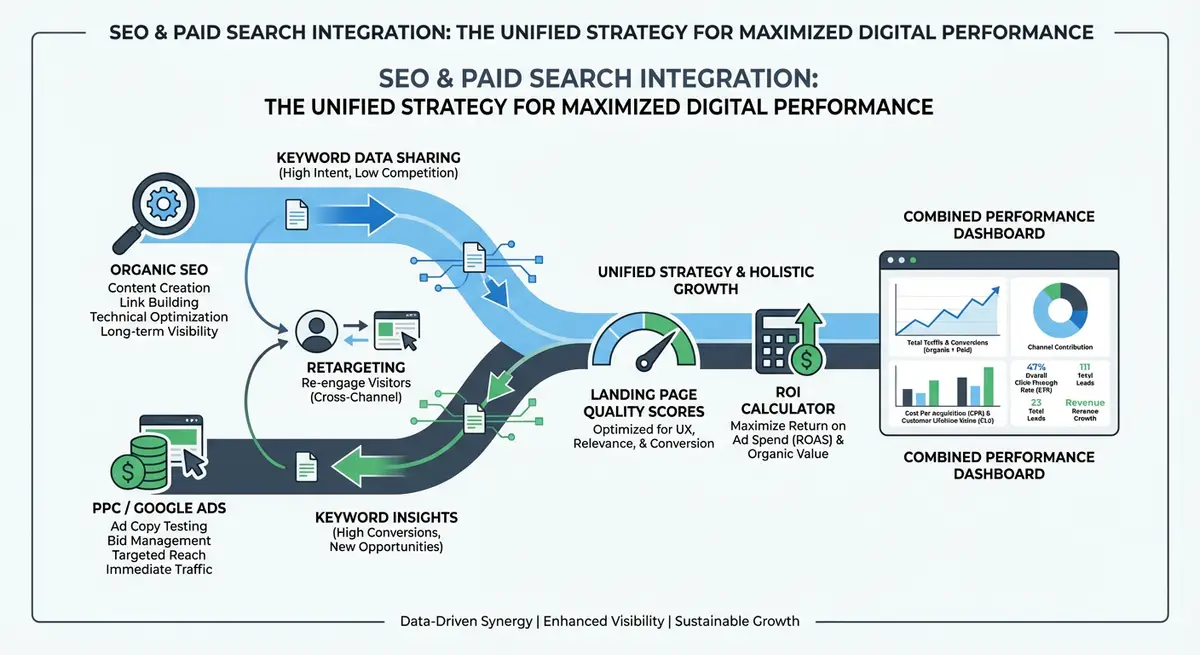
SEO and PPC are not competing strategies. They are complementary channels that, when used together, produce results neither can achieve alone. Businesses that run both organic and paid search campaigns consistently outperform those relying on a single channel. The data-sharing opportunities, SERP domination effects, and customer journey coverage make an integrated approach the most effective search marketing strategy available.
Why SEO and PPC Together Outperform Either Alone
When you rank organically for a keyword AND run a paid ad for the same keyword, something remarkable happens: your combined click-through rate exceeds what either channel achieves independently. Studies by Google show that incremental ad clicks, clicks you would not have received from organic alone, account for 89% of paid clicks when an organic listing is also present. You are not cannibalising organic traffic. You are capturing additional clicks from users who would otherwise click a competitor.
- SERP domination: owning both the paid ad and organic listing for a keyword dramatically increases your total click share
- Data sharing: PPC conversion data reveals which keywords drive revenue, informing smarter SEO keyword prioritisation
- Testing ground: PPC lets you test title tags and descriptions before committing to organic changes
- Coverage gaps: PPC fills visibility gaps while organic rankings build for new keywords
- Brand reinforcement: appearing twice on the same results page increases brand trust and perceived authority
The SERP Domination Effect
When your business appears in both the paid ads section and the organic results for the same query, you dominate the visible search results page. Users see your brand twice, which increases trust and click probability. Even if they skip the ad, they are more likely to click your organic listing because the ad has already registered your brand in their awareness. This dual-presence strategy is particularly powerful for branded terms and high-value commercial keywords.
How PPC Data Improves SEO Decisions
PPC provides something organic search cannot: real conversion data at the keyword level. Google Ads shows you exactly which search terms generate leads, sales and enquiries. This data is invaluable for SEO prioritisation. Instead of guessing which keywords are commercially valuable based on search volume alone, you can use actual conversion rates from PPC to identify the keywords worth investing organic effort in.
The Complete Customer Journey
Most customers do not convert on their first visit. They search, browse, leave and return. An integrated SEO and PPC strategy covers the entire journey: organic content captures top-of-funnel informational searches, PPC retargeting brings visitors back, and organic branded results capture the final conversion-ready search. Without both channels, you lose touch with potential customers at critical stages.
Complete How-To Guide: Building an Integrated SEO and PPC Strategy for Wix
This guide covers setting up a unified search marketing approach, sharing data between channels, and maximising the synergy between organic and paid search on your Wix site.
How to integrate SEO and PPC for your Wix business
- Step 1: List your top 30 target keywords. For each, note whether you currently have organic visibility (ranking in top 20), paid visibility (active Google Ads campaign), both, or neither. This reveals your coverage gaps.
- Step 2: For keywords where you rank organically in positions 1-3, evaluate whether running PPC ads increases total clicks. Test for 30 days with the ads on, then 30 days off. Compare total click volume from both channels combined.
- Step 3: For keywords where you have NO organic presence, set up PPC campaigns immediately. These fill the visibility gap while you build organic rankings. Plan to reduce PPC spend on each keyword as organic rankings improve.
- Step 4: Connect Google Ads and Google Search Console to GA4. Go to Admin then Product Links and connect both. This enables cross-channel analysis in a single dashboard.
- Step 5: In Google Ads, run a Search Terms Report. Export the list of actual search terms triggering your ads. Identify high-converting terms that you are not yet targeting with organic content. These become your SEO priority keywords.
- Step 6: Use PPC to A/B test title tags and meta descriptions. Run ad variations with different headlines and descriptions. The versions with the highest CTR in PPC should inform your organic title tags and meta descriptions.
- Step 7: Set up a shared keyword tracking spreadsheet. Columns: Keyword, Organic Position, Organic Clicks, PPC Active (Y/N), PPC Conversions, PPC CPC, Combined Click Share. Update monthly.
- Step 8: For branded terms where you rank organically in position 1, test pausing PPC. If organic clicks fully compensate for lost ad clicks, redirect that PPC budget to non-branded terms. If clicks drop, keep the branded ads running.
- Step 9: Implement RLSA (Remarketing Lists for Search Ads) to bid more aggressively on keywords when the searcher has previously visited your Wix site via organic search. This recaptures warm visitors.
- Step 10: Create a monthly integrated search report. Show: total search visibility (organic + paid), combined click volume, combined conversions, blended cost per acquisition (total spend divided by total conversions), and channel-specific contributions.
- Step 11: Review your budget allocation quarterly. As organic rankings improve for specific keywords, reduce PPC spend on those terms and reallocate budget to new keyword opportunities or retargeting campaigns.
- Step 12: Track the total search marketing ROI as a single metric. Calculate: (Total Revenue from Organic + Paid) minus (SEO Investment + PPC Spend), divided by (SEO Investment + PPC Spend), multiplied by 100. This gives you the true return on your combined search marketing investment.
How to Build an Integrated Organic and Paid Search Strategy
Setting up a coordinated SEO and PPC strategy on Wix requires connecting your Google Ads data to your keyword planning. These steps show you how to align both channels for maximum search visibility.
How to create an integrated organic and paid search plan on Wix
- Step 1: Log in to your Wix Dashboard and navigate to Marketing & SEO > Google Ads to access the Wix Google Ads integration. Connect your Google Ads account or create a new campaign.
- Step 2: In Google Ads, export your current campaign search terms report. Filter for keywords with at least 5 conversions in the past 90 days. These are your highest-value targets for organic SEO.
- Step 3: Open Google Search Console and compare your top converting paid keywords against your organic rankings. For each paid keyword, note your current organic position using the Performance report filtered by query.
- Step 4: Build a priority matrix. Create a spreadsheet with columns for keyword, paid CPC, monthly paid spend, organic position, monthly organic clicks, and estimated organic traffic at position 3. Sort by highest paid spend first.
- Step 5: For keywords where you rank organically between position 4 and 10, optimise the corresponding Wix page. Update the H1, title tag, and first paragraph to better target that keyword. These are the fastest organic wins.
- Step 6: Navigate to Marketing & SEO > SEO Tools in your Wix Dashboard and open the SEO Setup Checklist. Confirm all technical foundations are complete before investing in content-led ranking improvements.
- Step 7: Create or improve dedicated landing pages on your Wix site for your highest-spend paid keywords. Each page should have 1000+ words of relevant content, an H1 matching the keyword intent, and internal links from related pages.
- Step 8: Set up conversion tracking in both Google Ads and Google Analytics 4. In your Wix Dashboard, navigate to Marketing & SEO > Google Analytics and confirm conversion events are firing correctly for enquiries and purchases.
- Step 9: For keywords where you achieve organic position 1-3, pause or reduce PPC bids and redirect that budget to keywords still lacking organic coverage. Track total clicks (organic + paid) to ensure volume is maintained.
- Step 10: Monitor your blended cost per acquisition monthly. As organic rankings improve, your total CPA should decrease because each organic click costs nothing. Track this in a shared dashboard.
- Step 11: Review ad copy from your highest-CTR paid ads. Test the same language in your organic title tags and meta descriptions to improve organic click-through rates using real conversion-tested messaging.
- Step 12: Set a quarterly review to rebalance your budget. Identify which keywords have graduated to strong organic positions and reduce PPC spend on those terms by 50% each quarter until paid support is no longer needed.
Essential Resources
- Google Ads: Create and manage paid search campaigns alongside your SEO strategy
- Google Keyword Planner: Research keyword volumes and competition for SEO and PPC planning
- Microsoft Advertising: Bing Ads platform for reaching searchers beyond Google
- Google Analytics 4: Track organic and paid traffic performance and conversions
Essential Resources
- Google Ads: Create and manage PPC campaigns alongside your organic SEO strategy
- Google Search Console: Track organic rankings to identify PPC coverage gaps
- Google Analytics 4: Unified cross-channel measurement for organic and paid search
- SEO Fix in a Box: My Wix app. Free to install, it scans your site and shows what needs fixing, and paid plans write the fixes from your own Google searches
Was this lesson useful?
It takes 1 minute to tell me. The course is free and I want to keep it that way, and your feedback shows me what is working and helps other people find it.
This lesson on How organic and paid search work together: the SEO and PPC synergy is part of Module 29: SEO & Paid Search (SEM) Integration in The Most Comprehensive Complete Wix SEO Course in the World (2026 Edition). Created by Michael Andrews, a Wix Marketplace Legend Partner with 14 years of hands-on experience, 800 completed Wix SEO projects and 456 verified five-star reviews.