How AI search engines select and cite sources for Wix SEO
Module 27·Lesson 2 of 12·60 min read

How ChatGPT, Perplexity, Gemini and Google AI Overviews select sources

Each AI search engine uses different methods to find, evaluate and cite content. This lesson breaks down how ChatGPT Search, Perplexity, Google Gemini and AI Overviews each discover and select the sources they reference, and what this means for your Wix content strategy.

What you will learn in this Wix SEO lesson

  • How ChatGPT Search crawls and selects web sources
  • Perplexity citation model: how it ranks source trustworthiness
  • Google AI Overviews: the connection between organic rankings and AI citations
  • Gemini and its integration with Google Search results
  • Common patterns across all AI engines that you can optimise for

Each AI search engine has its own method for finding, evaluating and citing content. Understanding these differences is essential for GEO because the content that gets cited by Perplexity may differ from what Google AI Overviews prefers. This lesson breaks down each platform in detail so you can optimise your Wix content to be cited across all of them. By the end, you will know exactly what each platform looks for and how to tailor your content accordingly.
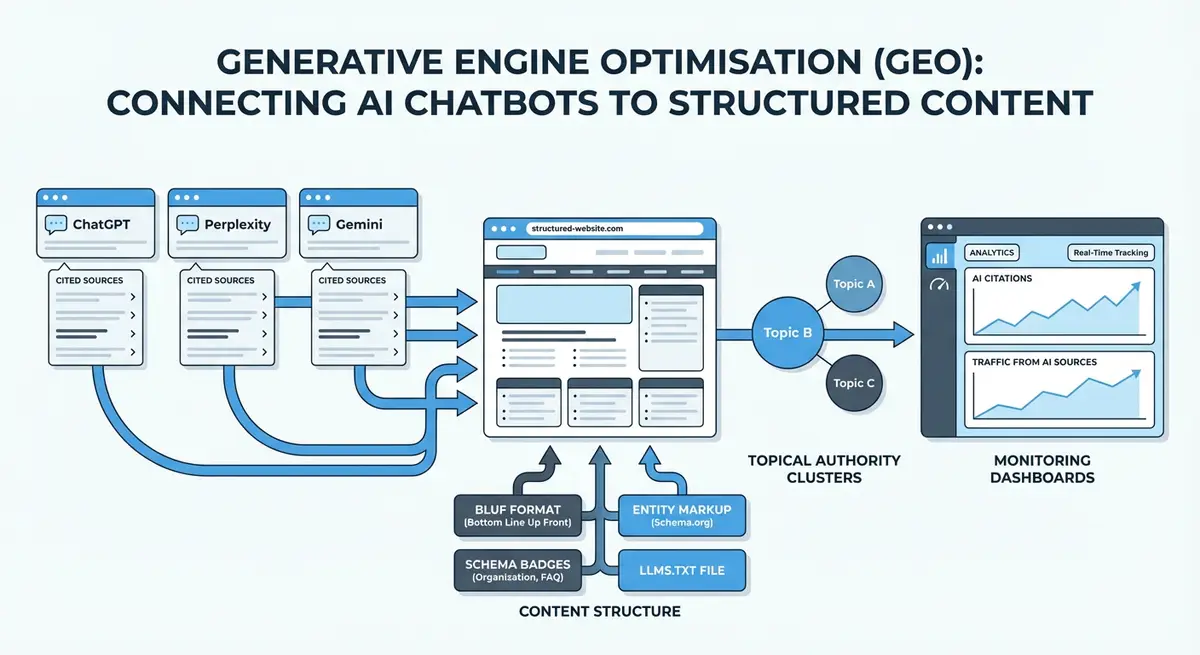
How-to infographic showing Generative Engine Optimisation including how AI search engines select sources, GEO-optimised content structure, entity SEO, schema strategies, and AI citation monitoring
GEO ensures your Wix content gets cited by AI search engines like ChatGPT, Perplexity, and Google AI Overviews.

Google AI Overviews: The Dominant AI Search Feature

Google AI Overviews are powered by Gemini and appear directly in Google search results. They draw heavily from pages that already rank well organically. If your Wix page ranks in the top 10 for a query, it has a strong chance of being cited in the AI Overview for that same query. This is the strongest link between traditional SEO and GEO: pages that rank well organically are the primary source pool for AI Overviews.

How AI Overviews Select Sources

Google AI Overviews use a multi-step source selection process. First, they identify pages that are already ranking well for the query in traditional organic results. Then, they evaluate those pages for answer quality: does the page contain a clear, factual answer that can be extracted and synthesised? Pages with structured content, specific data points, and expert attribution are strongly preferred.

  • AI Overviews primarily cite pages already ranking in the top 10 organic results for the query
  • Pages with clear, factual answers in the first paragraph are strongly preferred over pages that bury the answer
  • Structured data (FAQ schema, HowTo schema, Article schema with dateModified) increases citation probability
  • Pages with strong E-E-A-T signals are cited more often, especially for YMYL (Your Money, Your Life) queries
  • Content freshness matters: recently updated pages with dateModified schema are preferred over stale content
  • Pages from recognised entities (known brands, verified authors) receive a citation preference
  • AI Overviews tend to cite multiple sources, typically 3-5, for balanced answers. Being one of those sources is the goal.

Types of AI Overview Formats

AI Overviews appear in several formats depending on the query type. Understanding which format your target query triggers helps you structure your content for citation:

  • Paragraph format: a synthesised paragraph answering the question. Triggered by informational queries. Your content needs clear, quotable paragraphs.
  • List format: a numbered or bullet list. Triggered by "how to", "steps to", "best ways to" queries. Your content needs clearly structured lists and numbered steps.
  • Table format: a comparison or data table. Triggered by comparison queries. Your content needs HTML tables with clean headers.
  • Expandable sections: accordion-style sections with sub-answers. Triggered by complex queries with multiple aspects.
  • No AI Overview: some queries do not trigger AI Overviews, particularly navigational queries and very specific queries.

Optimising Your Wix Pages for AI Overview Citation

Specific optimisations for Google AI Overviews

  1. 1Focus on pages that already rank in the top 20 for target keywords. AI Overviews rarely cite pages below position 20.
  2. 2Add a clear, direct answer in the first paragraph after the H1. This answer should be 2-3 sentences that completely address the query.
  3. 3Use the same format as the AI Overview. If the Overview shows a list, ensure your content has a well-structured list.
  4. 4Add FAQ schema to any page with question-and-answer content. AI Overviews extract FAQ pairs frequently.
  5. 5Include dateModified in your Article schema and update it whenever you revise the content.
  6. 6Add Person schema with author credentials. AI Overviews prefer citing named, credentialed experts.
  7. 7Include specific data points and statistics with clear attribution in your content.

AI Overview Trigger Rate

Research from BrightEdge shows that AI Overviews appear on approximately 30-40% of Google search queries in 2026, with higher rates for informational and how-to queries. Check whether your target queries trigger AI Overviews before optimising, as some query types never generate them.

ChatGPT Search: The Conversational Search Revolution

ChatGPT Search uses Bing as its primary search index and supplements with its own web browsing capability. When a user asks a question, ChatGPT searches the web in real-time, reads multiple pages, and synthesises an answer with inline citations. Unlike Google AI Overviews, ChatGPT Search does not rely on existing organic rankings as heavily. Content quality, directness and factual accuracy carry more weight.

ChatGPT Search Source Selection Process

When a user asks ChatGPT a question that requires web information, the system performs a real-time search. It evaluates pages based on content relevance, author credibility, data quality, and structural clarity. ChatGPT tends to prefer pages with clear authorship attribution, specific data points, and well-organised content that can be easily parsed and cited.

  • Uses Bing index as its primary source: your Wix site must be indexed in Bing Webmaster Tools
  • Prioritises content with direct, extractable answers to specific questions
  • Cites sources with clear author attribution and verifiable credentials
  • Prefers content with verifiable data: statistics, studies, named sources, specific numbers
  • Well-structured content with clear headings and logical organisation performs significantly better
  • Tends to cite fewer sources than Perplexity (typically 3-8 per answer) but with stronger confidence
  • Brand recognition influences citation: known brands and established experts are cited preferentially
  • Fresh content is preferred: ChatGPT checks publication dates and favours recent updates

ChatGPT Search vs ChatGPT Knowledge

There is an important distinction between ChatGPT Search (real-time web search) and ChatGPT's built-in knowledge (training data). When a user asks a factual question, ChatGPT may answer from its training data without searching the web. When the question requires current information or the user explicitly requests a search, ChatGPT switches to search mode. For GEO, your goal is to be both: a source in the training data (through widespread online presence) and a cited source in real-time search results.

Quick Win for ChatGPT Visibility

Submit your Wix sitemap to Bing Webmaster Tools (bing.com/webmasters). Many Wix site owners only submit to Google Search Console and miss Bing entirely. Since ChatGPT Search uses the Bing index, this is one of the fastest GEO wins available. Also verify your site is not blocking the GPTBot user agent in robots.txt.

Perplexity: The Research-Grade Answer Engine

Perplexity operates as an answer engine with its own web crawler (PerplexityBot). It crawls the web independently and builds its own index. Perplexity is particularly citation-heavy, often referencing 5 to 15 sources per answer. It values comprehensiveness, accuracy and domain authority. Pages that cover a topic thoroughly and cite their own sources are favoured.

What Makes Perplexity Different

Perplexity is the most citation-transparent of all AI search engines. Every claim in a Perplexity answer includes a numbered citation that users can verify. This transparency means Perplexity is particularly careful about source quality. It prefers pages that themselves demonstrate research rigour: citing statistics, referencing studies, linking to primary sources, and providing detailed evidence for claims.

  • Has its own web crawler (PerplexityBot): check your robots.txt is not blocking it
  • Values comprehensive, detailed content that covers a topic in depth rather than surface-level overviews
  • Strongly prefers content that itself cites reputable sources and data
  • Domain authority and brand recognition influence citation frequency significantly
  • FAQ-structured content is frequently cited for question-based queries
  • Cites more sources per answer (5-15) than any other AI engine, creating more citation opportunities
  • Offers Perplexity Pro which uses multiple AI models, potentially retrieving different sources per model
  • Provides "Focus" modes (Academic, Writing, etc.) that change source preferences

Perplexity Citation Patterns

Analysis of Perplexity answers reveals distinct citation patterns. For factual questions, Perplexity cites authoritative reference sources (Wikipedia, industry publications, government sites). For how-to questions, it cites detailed guides with step-by-step instructions. For recommendation questions, it cites review sites, expert opinions, and business directories. For your Wix site, match your content format to the question type you want to be cited for.

Perplexity Pro Tip

Perplexity users can click any citation number to preview the source page. This means your page title, meta description, and opening paragraph are visible to users before they decide to click through. Treat your page preview as a mini sales pitch: make it compelling, specific, and relevant to the query.

Google Gemini: The Knowledge Graph Native

Google Gemini, the standalone AI assistant, integrates with Google Search results and Google Knowledge Graph. It draws from the same source pool as AI Overviews but also has access to broader web content. Gemini tends to cite authoritative, well-known sources and is particularly influenced by entity signals: recognised brands, verified authors and schema-marked content.

Gemini's Entity-First Approach

Gemini has deeper integration with the Google Knowledge Graph than any other AI search engine. When answering questions, Gemini cross-references entity data from the Knowledge Graph to verify claims and assess source authority. This means strong entity signals (schema markup, Wikipedia presence, verified Google Business Profile, consistent cross-platform identity) are disproportionately important for Gemini citations.

  • Deep integration with Google Knowledge Graph for entity verification and authority assessment
  • Strongly prefers content from recognised entities with verified web presences
  • Uses Google Business Profile data for local queries, making GBP optimisation essential
  • Accesses Google Scholar and academic sources for YMYL queries
  • Supports multi-modal queries (text + image), potentially citing image-rich content
  • Available globally with strong multilingual capabilities, important for international Wix businesses

Common Patterns Across All AI Engines

Universal GEO Principles

Across all AI search platforms, five signals consistently influence citation selection: (1) direct, factual answers in the opening paragraph, (2) clear heading structure that signals topical organisation, (3) structured data that machines can parse, (4) author and brand authority that can be verified, and (5) content freshness indicated by recent updates. Optimise for these five universals and you cover 80% of what every AI engine looks for.

Platform Comparison Matrix

Each AI platform weights these universal signals differently. Understanding the weighting helps you prioritise optimisations based on which platform matters most to your business:

  • Google AI Overviews: highest weight on existing organic rankings, structured data, and E-E-A-T signals
  • ChatGPT Search: highest weight on content directness, author credentials, and Bing index presence
  • Perplexity: highest weight on content comprehensiveness, source citations within content, and domain authority
  • Google Gemini: highest weight on entity recognition, Knowledge Graph presence, and cross-platform verification

Complete How-To Guide: Optimising Your Wix Content for Every AI Search Platform

This guide covers platform-specific optimisations for Google AI Overviews, ChatGPT Search, Perplexity and Gemini, ensuring your Wix content is citable across all AI engines.

How to optimise your Wix site for citation across all AI platforms

  1. 1Step 1: Submit your Wix sitemap to Google Search Console at search.google.com/search-console. Verify your property and confirm all important pages are indexed. This is the foundation for Google AI Overviews and Gemini.
  2. 2Step 2: Submit your Wix sitemap to Bing Webmaster Tools at bing.com/webmasters. Add your site, verify ownership, and submit your XML sitemap. This enables visibility in ChatGPT Search.
  3. 3Step 3: Check your robots.txt file. Open yourdomain.com/robots.txt and verify there are no Disallow rules for GPTBot, PerplexityBot, ClaudeBot or Googlebot. If any are blocked, update via Wix Dashboard under Settings then SEO then robots.txt.
  4. 4Step 4: For Google AI Overviews, focus on pages already ranking in the top 10. Restructure these pages with BLUF formatting: place a direct answer in the first paragraph after the H1. Match the content format (list, paragraph, table) to the AI Overview format for that query.
  5. 5Step 5: For ChatGPT Search, add clear author attribution to every content page. Include the author name, credentials, and a link to the author page. ChatGPT weights authoritative, attributed content heavily. Add Person schema with sameAs links to verified profiles.
  6. 6Step 6: For Perplexity, ensure your content is comprehensive and cites its own sources. Add references to industry reports, studies and primary data within your content. Perplexity values content that demonstrates research rigour. Include specific statistics with clear attribution.
  7. 7Step 7: For Google Gemini, strengthen your entity signals. Add Organization and Person schema with sameAs properties linking to verified profiles. Claim and fully optimise your Google Business Profile. Gemini draws heavily from the Knowledge Graph.
  8. 8Step 8: Add structured data to every key page: Article schema with datePublished and dateModified, FAQ schema for question sections, and HowTo schema for step-by-step guides. Use the @graph pattern to combine multiple types per page.
  9. 9Step 9: Include verifiable statistics and data points throughout your content. Format them as: "According to [Source], [specific number/percentage]". AI engines across all platforms extract and cite specific data points.
  10. 10Step 10: Create a comprehensive FAQ section on your most important pages. Use the question as an H3 heading and provide a direct 1-2 sentence answer before elaborating. Add FAQPage schema markup.
  11. 11Step 11: Update your top 10 pages with fresh content and set dateModified in your schema to the current date. AI engines across all platforms prefer recently updated content. Set a quarterly update schedule.
  12. 12Step 12: Test your optimisations by searching your target queries across all four platforms weekly. Record which platform cites you and which content is referenced. Adjust your strategy based on which platform-specific tactics generate the most citations.

Platform Priority

If your business targets local customers, prioritise Google AI Overviews and Gemini, as they handle the most local query volume. If your business is information-focused or B2B, Perplexity and ChatGPT Search typically drive more relevant citations. If you serve international markets, Gemini's multilingual capabilities make it particularly important.

Finished this lesson?

Mark it complete to track your course progress.

AI Lesson Tutor

AI Powered

Got a question about this lesson? Ask the AI tutor for a quick explanation or practical examples.

Your Course Resources

11 downloadable PDFs -- checklists, templates, worksheets and your certificate

Course Progress0/561 lessons

Checklists

Wix SEO Audit ChecklistPDF

20-point site-wide audit covering technical, on-page, content and local SEO

On-Page SEO ChecklistPDF

37-point per-page checklist: titles, headings, content, images, links, schema

Technical SEO Deep-DivePDF

50-point technical audit: crawlability, Core Web Vitals, speed, security, Wix-specific

Local SEO Setup ChecklistPDF

42-point local checklist: Google Business Profile, NAP, citations, reviews, local links

Site Launch SEO ChecklistPDF

48-point pre-launch and post-launch guide for new Wix sites going live

Templates & Worksheets

Keyword Research TemplatePDF

Printable tracker with columns for volume, difficulty, intent, priority and notes

Monthly SEO Report TemplatePDF

Client-ready report covering traffic, rankings, technical health and action plan

Content Brief TemplatePDF

Plan every page: target keywords, outline, competitor analysis, internal links, CTAs

Backlink Outreach TrackerPDF

Campaign log with status tracking plus 3 proven outreach email templates

Competitor Analysis WorksheetPDF

14-metric comparison table, content gap analysis and SEO SWOT framework

Achievement

Certificate of CompletionLocked

Complete all lessons to unlock (0/561 done)

Lesson Tools

No part of this Wix SEO Course content may be reproduced, copied, or distributed without the written consent of Michael Andrews.

This lesson on How ChatGPT, Perplexity, Gemini and Google AI Overviews select sources is part of Module 27: GEO: Generative Engine Optimisation for Wix in The Most Comprehensive Complete Wix SEO Course in the World (2026 Edition). It covers Wix SEO optimization (US) and optimisation (UK) strategies applicable to businesses in the United Kingdom, United States, Australia, Canada, New Zealand, Ireland and worldwide. Created by Michael Andrews, the UK's No.1 Wix SEO Expert with 14 years of hands-on experience, 750+ completed Wix SEO projects and 425+ verified five-star reviews. This is lesson 300 of 561 in the most affordable, most comprehensive Wix SEO training programme available in 2026.