How AI Overviews (SGE) are reshaping Google search results
Module 26: AI, SGE & Future-Proof SEO | Lesson 310 of 683 | 25 min read
By Michael Andrews, Wix SEO Expert UK
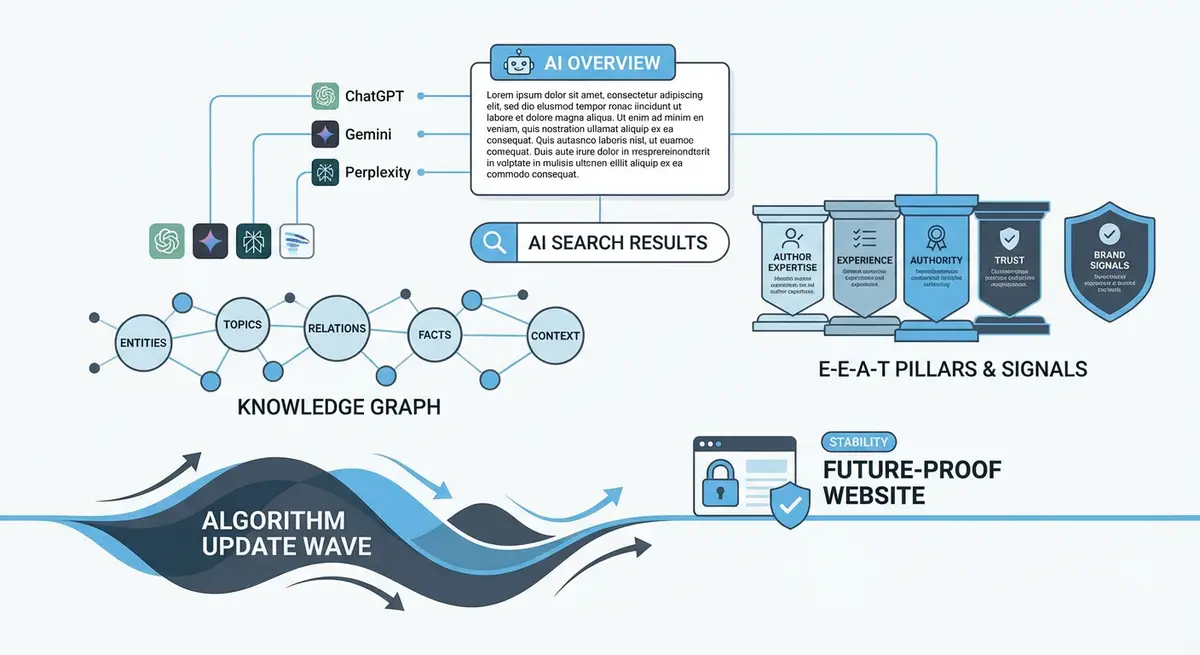
Google AI Overviews, previously called the Search Generative Experience (SGE), now appear for a significant percentage of informational searches. They represent the most fundamental change to how Google displays search results since the introduction of featured snippets. For Wix site owners, AI Overviews are both a threat and an opportunity: they reduce clicks for some queries by answering the question directly in the SERP, but they also create a new premium position for sites that are cited as sources within the AI-generated answer. Understanding how to get cited in AI Overviews is becoming as important as ranking in the traditional organic results.
What Are AI Overviews and How Do They Work
AI Overviews are AI-generated summary answers that appear at the top of Google search results for many informational queries. When triggered, Google uses its large language model to synthesise information from multiple web sources and present a comprehensive answer directly in the SERP. Below the generated answer, Google displays citation links to the sources it drew from, giving those cited sites a prominent position above the traditional organic results.
The AI Overview is not a simple copy-paste from one source. Google synthesises information from multiple pages, often combining facts from three to five different sources into a single coherent answer. This means that even partial information from your page can earn you a citation, as long as your content contributes a useful fact, statistic, or perspective that the AI includes in its answer.
What Queries Trigger AI Overviews
Not every Google search triggers an AI Overview. Google selectively deploys them based on query type and user intent. Understanding which queries are most likely to trigger AI Overviews helps you focus your optimisation efforts on the right content.
- Informational how-to queries: "how to add schema markup to Wix", "what is E-E-A-T in SEO". These are the most common triggers because the AI can synthesise a comprehensive procedural answer.
- Definitional queries: "what is a canonical tag", "what does robots.txt do". Google generates a definition that combines multiple authoritative sources.
- Comparison queries: "Wix vs WordPress for SEO", "Ahrefs vs SEMrush". The AI creates structured comparison summaries drawing from multiple review sources.
- Research and evaluation queries: "best keyword research tools 2026", "local SEO ranking factors". The AI compiles lists and evaluations from expert sources.
- Complex multi-part questions: "how does Google rank websites and what matters most". The AI breaks complex questions into sub-answers from different sources.
Queries that rarely trigger AI Overviews include navigational queries (searching for a specific website), transactional queries with strong purchase intent (buying a specific product), and YMYL queries about health, finance, and legal matters where Google is more cautious about AI-generated answers.
How Google Selects Sources for AI Overviews
Google selects sources for AI Overviews using criteria that overlap with but differ from traditional ranking factors. The AI system evaluates content based on several signals that determine citation eligibility.
- Topical authority: Sites that have demonstrated comprehensive expertise on a topic through multiple related pages and consistent publishing history.
- E-E-A-T signals: Established authorship with credentials, author pages with verifiable expertise, and transparent editorial practices.
- Extractable content structure: Direct answers formatted with clear headings, bullet points, and concise opening sentences that the AI can easily synthesise.
- Factual density: Content with specific statistics, data points, and verifiable claims rather than vague generalisations.
- Recency: Content with recent dateModified schema that demonstrates the information is current and actively maintained.
- Source diversity: Google deliberately cites multiple sources to provide balanced answers, so even lower-authority sites can be cited if they provide unique data or perspectives.
The Traffic Impact of AI Overviews
Studies from Authoritas, Sistrix, and other SEO research firms show that AI Overviews reduce organic clicks by an average of 15-25% for queries where they appear. Users who find a satisfactory answer in the AI Overview do not click through to the source pages. However, sites that are cited within AI Overviews see their click-through rate increase significantly compared to their traditional organic position, often becoming the primary source people click for more detail.
The strategic implication is that the goal has shifted from "ranking number one" to "being the source that AI Overviews cite." A site cited in an AI Overview with 100,000 impressions may receive more traffic than the traditional position one result for the same query because the citation carries the implicit endorsement of Google selecting it as a trusted source.
Content Structure That Earns AI Overview Citations
The BLUF (Bottom Line Up Front) principle is the most effective structural approach for AI Overview citations. Start every major section of your content with a direct, factual answer to the question the section addresses. The AI system extracts these direct statements and attributes them to your page. Burying your main point three paragraphs deep under introductory fluff means the AI will find a better-structured source to cite instead.
How to structure content for AI Overview citation
- Begin each page with a 2-3 sentence direct answer to the primary question immediately after the H1 heading.
- Use H2 headings that match the sub-questions the AI Overview is likely to address. If the main query is "Wix SEO guide", use H2s like "Is Wix Good for SEO?", "How to Do SEO on Wix", "Wix SEO Settings Walkthrough".
- Start each H2 section with a concise, factual answer sentence before expanding with detail.
- Include specific numbers and data points: "Wix sites load in an average of 2.3 seconds" is more citable than "Wix sites load quickly".
- Use numbered lists for processes and bullet points for feature lists. The AI system extracts these formats easily.
- Include original research or proprietary data. AI Overviews preferentially cite sources with unique information not found elsewhere.
- End sections with a clear summary sentence that reinforces the main point.
Monitoring Your AI Overview Presence
Google Search Console does not yet provide a separate report for AI Overview citations, making monitoring challenging. You need to combine manual checking with third-party tools to track your AI Overview visibility.
- Manually search your top 20 target keywords weekly in Google and note which trigger AI Overviews and whether your site is cited.
- Use third-party tools like Authoritas, Semrush Sensor, or BrightEdge that track AI Overview presence programmatically.
- In Google Search Console, look for keywords with high impressions but unusually low CTR. This pattern often indicates your content appears in AI Overviews where users get the answer without clicking.
- Track keywords where your impressions have increased but clicks have decreased. This can indicate your content is being used as an AI Overview source without earning clicks.
- Monitor your competitors AI Overview presence for your target queries to identify citation opportunities you are missing.
AI Overviews and Wix-Specific Considerations
Wix sites can and do appear in AI Overview citations. The platform handles the technical requirements (proper HTML rendering, schema markup, fast loading) automatically. Your focus should be on content quality and structure rather than technical implementation. Wix Blog posts with proper Article schema, clear author attribution, and well-structured content are just as eligible for AI Overview citations as content on any other platform.
Ensure your Wix site does not block AI crawlers. Check your robots.txt to confirm you are not blocking Googlebot or Google-Extended. While some publishers have chosen to block AI crawlers, doing so means your content cannot be cited in AI Overviews, which is increasingly a significant traffic source.
AI Overview Monitoring Tools
- Google Search Console: Monitor impression and CTR changes that may indicate AI Overview presence
- Authoritas: Track AI Overview citations and SERP feature presence
- Google Search Status Dashboard: Monitor rollout of AI Overview changes and search updates
Complete How-To Guide: Optimising Your Wix Site for AI Overviews
How to get your Wix content cited in Google AI Overviews
- Step 1: Identify which of your target keywords trigger AI Overviews. Search your top 20 keywords in Google and note which ones display an AI Overview box above the organic results. Record these in a spreadsheet with columns for: keyword, AI Overview present (yes/no), your site cited (yes/no), current organic position.
- Step 2: For each keyword that triggers an AI Overview, check if you currently rank in the top 10 organic results. Google AI Overviews overwhelmingly cite pages already ranking on page one. If you are not on page one, focus on traditional SEO first to build the authority needed for citation eligibility.
- Step 3: Examine the current AI Overview sources. Click "Show more" to see which sites are being cited. Note what they have in common: content structure, authority signals, answer format, and types of information cited.
- Step 4: Restructure your target pages using the BLUF principle. For each page, write a direct 2-3 sentence answer to the primary query immediately after the H1 heading. This answer should be factual, specific, and self-contained so the AI can extract it cleanly.
- Step 5: Add clear H2 headings that match the sub-questions AI Overviews address. Each H2 section should open with a direct answer sentence before elaborating with supporting detail.
- Step 6: Use extractable content formats throughout: numbered lists for processes, bullet points for features and benefits, definition sentences starting with "[Topic] is..." for conceptual questions. These formats are easiest for the AI to synthesise.
- Step 7: Add specific data points and statistics with clear attribution throughout your content. Replace vague claims with verifiable numbers. AI Overviews prefer citing content with specific data rather than general statements.
- Step 8: Add Article schema with datePublished and dateModified to every target page. Ensure the dateModified reflects your most recent substantive update. The AI system uses recency as a citation selection factor.
- Step 9: Add Person schema for your author with credentials, qualifications, and sameAs links to professional profiles. Author authority is a key factor in AI Overview source selection.
- Step 10: Update your target pages with fresh content quarterly. Add new data, update screenshots, and refresh examples. Each update should change dateModified in your schema to signal currency.
- Step 11: Monitor your AI Overview presence weekly. Search your target keywords in Google and note whether your content is cited. Record the date, query, and citation status in your tracking spreadsheet.
- Step 12: In Google Search Console, look for keywords with high impressions but unusually low CTR. This pattern often indicates your content appears in AI Overviews where users get the answer without clicking. Track this as a positive signal of AI visibility even when direct clicks are low.
Was this lesson useful?
It takes 1 minute to tell me. The course is free and I want to keep it that way, and your feedback shows me what is working and helps other people find it.
This lesson on How AI Overviews (SGE) are reshaping Google search results is part of Module 26: AI, SGE & Future-Proof SEO in The Most Comprehensive Complete Wix SEO Course in the World (2026 Edition). Created by Michael Andrews, a Wix Marketplace Legend Partner with 14 years of hands-on experience, 800 completed Wix SEO projects and 456 verified five-star reviews.