GEO audit checklist: the complete Wix website review
Module 27: GEO: Generative Engine Optimisation for Wix | Lesson 329 of 683 | 45 min read
By Michael Andrews, Wix SEO Expert UK
This lesson provides a complete, systematic GEO audit process designed specifically for Wix websites. Use this 30-point checklist to assess any Wix site for AI search readiness, identify gaps and prioritise improvements. This is the audit Michael performs on every client site before building a GEO strategy.
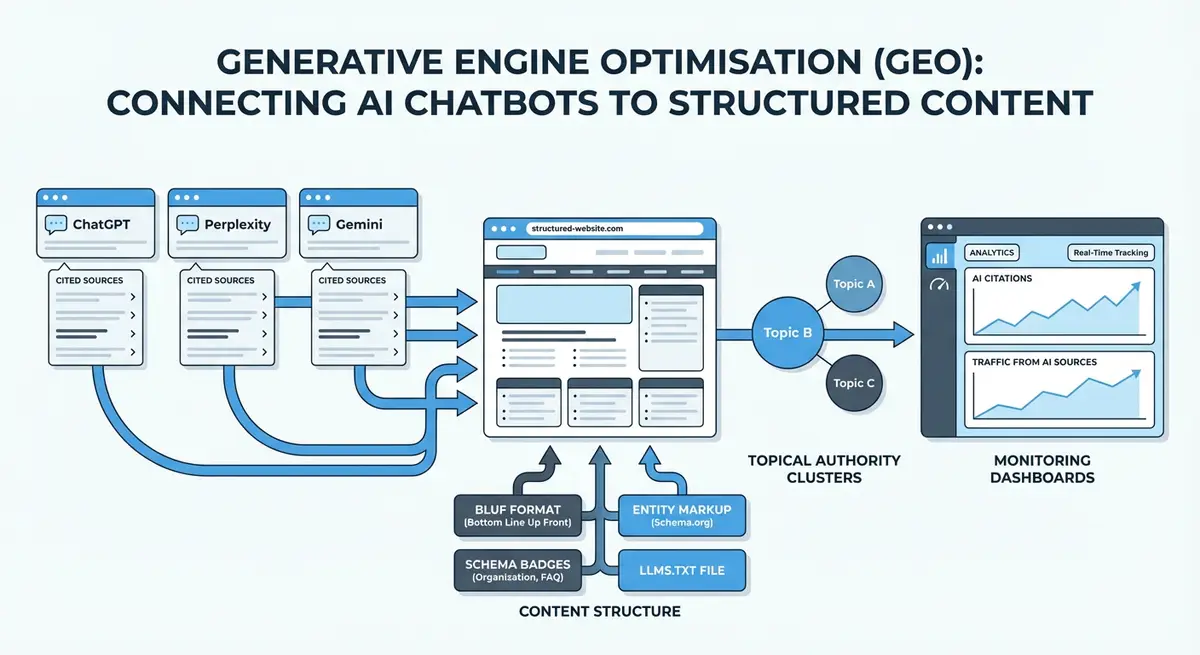
Section 1: Content Structure (8 Points)
Content structure audit
- BLUF check: does every key page open with a direct answer to its primary question in the first paragraph?
- Heading hierarchy: is the H1 > H2 > H3 structure clean and logical on every page?
- Extractable formats: does the site use definition sentences, numbered lists, tables and FAQ formatting?
- Content freshness: do pages display "Last updated" dates and is dateModified schema present?
- Content depth: are key topic areas covered by comprehensive topic clusters, not single thin pages?
- Original data: does the site contain any original statistics, survey data or proprietary research?
- Expert commentary: does content include first-person experience and professional opinions?
- Answer density: does each page section provide a factual, extractable answer within the first 2 sentences?
Section 2: Schema and Structured Data (8 Points)
Schema markup audit
- Organization schema: is comprehensive Organization schema present with name, logo, sameAs and knowsAbout?
- Person schema: does author content have Person schema with credentials, sameAs and hasCredential?
- Article schema: do blog posts and content pages have Article/BlogPosting schema with datePublished and dateModified?
- Speakable schema: are key answer sections marked with speakable schema?
- FAQ schema: are FAQ sections marked up with FAQPage schema?
- LocalBusiness schema: for local businesses, is LocalBusiness schema present with geo, areaServed and aggregateRating?
- Schema validation: do all schema implementations pass the Google Rich Results Test without errors?
- Schema completeness: are recommended properties included, not just required ones?
Section 3: Entity and Authority Signals (8 Points)
Entity and authority audit
- Brand consistency: is the business name, description and contact information identical across all platforms?
- Google Business Profile: is GBP fully optimised with photos, posts and active review management?
- Cross-platform presence: does the brand exist on LinkedIn, relevant directories, industry sites?
- Review volume and recency: are there recent, positive reviews across multiple platforms?
- Press and mentions: has the brand been mentioned in press coverage or authoritative third-party content?
- Wikidata presence: does the business or key person have a Wikidata entry (if eligible)?
- Author pages: do content authors have dedicated, detailed author pages on the site?
- External credentials: are professional qualifications, certifications and awards documented and linked?
Section 4: Machine-Readable and Crawler Access (6 Points)
AI crawler access audit
- robots.txt: are AI crawlers (GPTBot, PerplexityBot, ClaudeBot, Google-Extended) allowed access?
- llms.txt: is there an llms.txt file (or equivalent structured summary) available?
- ai.txt: is there an ai.txt file with business and attribution preferences?
- Sitemap: is the XML sitemap submitted to both Google Search Console and Bing Webmaster Tools?
- Page load speed: can AI crawlers access and render pages quickly? Run a Core Web Vitals check.
- JavaScript rendering: does key content render without requiring complex JavaScript execution?
Prioritising Your GEO Fixes
Not all 30 points carry equal weight. After completing the audit, prioritise fixes in this order for maximum impact.
- Quick wins (do this week): BLUF formatting on top 5 pages, submit sitemap to Bing, check robots.txt for AI crawler blocks
- High impact (do this month): add Organization and Person schema, optimise Google Business Profile, ensure Article schema with dateModified on all content
- Medium-term (1-3 months): build topic clusters, create original data/research content, add speakable schema
- Long-term (ongoing): earn press mentions, build cross-platform authority, maintain review generation, monitor AI citations monthly
Complete How-To Guide: Running a Full GEO Audit on Any Wix Website
This guide walks through the complete 30-point GEO audit process, from content structure assessment to schema validation to entity verification, with specific steps for each checkpoint.
How to perform a comprehensive GEO audit on a Wix website
- Step 1: Create a GEO audit scorecard spreadsheet with four sections: Content Structure (8 points), Schema and Structured Data (8 points), Entity and Authority (8 points), Machine-Readable Access (6 points). Score each item as Pass, Partial or Fail.
- Step 2: Content audit, point 1: Open the site's top 5 pages. Does each page begin with a direct answer to its primary question in the first paragraph? Score as Pass if 4+ pages use BLUF formatting.
- Step 3: Content audit, points 2-4: Check heading hierarchy (H1 > H2 > H3 with no skips), extractable formats (lists, tables, definition sentences), and content freshness (visible "Last updated" dates).
- Step 4: Content audit, points 5-8: Assess topic cluster depth (comprehensive coverage vs thin single pages), original data (any unique statistics or research), expert commentary (first-person experience), and answer density (factual answers within 2 sentences of each heading).
- Step 5: Schema audit, point 1: Use the Google Rich Results Test on the homepage. Check for Organization schema with name, logo, sameAs and knowsAbout. Score as Pass if all properties are present and valid.
- Step 6: Schema audit, points 2-4: Test the about page for Person schema with credentials and sameAs. Test 3 blog posts for Article schema with datePublished, dateModified and author. Check for Speakable schema on key pages.
- Step 7: Schema audit, points 5-8: Check for FAQ schema on pages with FAQ sections, LocalBusiness schema for local businesses, validation status (no errors in the Schema Markup Validator), and completeness (recommended properties, not just required ones).
- Step 8: Entity audit, points 1-3: Search the brand name in Google. Check NAP consistency across the top 10 results. Verify Google Business Profile is fully optimised with photos, posts and reviews.
- Step 9: Entity audit, points 4-6: Check for cross-platform presence (LinkedIn, directories, industry sites). Assess review volume and recency. Search for press mentions and authoritative third-party references.
- Step 10: Entity audit, points 7-8: Verify author pages exist with detailed credentials. Check for Wikidata entry if the business qualifies. Confirm external credentials are documented and linked.
- Step 11: Access audit, points 1-4: Check robots.txt for AI crawler access. Look for llms.txt and ai.txt files. Verify sitemap submission to both Google and Bing.
- Step 12: Access audit, points 5-6: Run PageSpeed Insights to verify fast crawl access. Test whether key content renders without complex JavaScript. Calculate final score out of 30 and prioritise fixes: quick wins first, then high-impact items, then medium-term improvements.
Essential Resources
- Google Rich Results Test: Validate all schema markup as part of your GEO audit
- Google PageSpeed Insights: Test page speed for AI crawler access during your GEO audit
- Google Search Console: Comprehensive indexing and performance data for your GEO audit baseline
Was this lesson useful?
It takes 1 minute to tell me. The course is free and I want to keep it that way, and your feedback shows me what is working and helps other people find it.
This lesson on GEO audit checklist: the complete Wix website review is part of Module 27: GEO: Generative Engine Optimisation for Wix in The Most Comprehensive Complete Wix SEO Course in the World (2026 Edition). Created by Michael Andrews, a Wix Marketplace Legend Partner with 14 years of hands-on experience, 800 completed Wix SEO projects and 456 verified five-star reviews.