Enterprise SEO crisis management and recovery on Wix
Module 42: Enterprise SEO Strategy on Wix | Lesson 484 of 683 | 30 min read
By Michael Andrews, Wix SEO Expert UK
Enterprise SEO crises can wipe out months or years of organic growth overnight. Algorithm updates, technical failures, manual penalties, negative SEO attacks, site migrations gone wrong and competitor disruptions all pose existential threats to organic traffic at scale. This lesson covers how to prepare for, detect, diagnose and recover from SEO crises at enterprise level, including the incident response frameworks that separate organisations that recover in weeks from those that lose ground for years.
Common Enterprise SEO Crises
- Google core algorithm updates causing significant ranking drops across broad keyword sets
- Technical deployment errors: accidental noindex tags, robots.txt blocking, canonical tag errors or broken redirects affecting hundreds of pages
- Site migration failures: lost redirects, changed URL structures or broken internal linking during a redesign or platform change
- Manual actions from Google for thin content, unnatural links or structured data violations
- Negative SEO: toxic backlink attacks, content scraping or brand impersonation targeting your domain
- Server and hosting issues: extended downtime, slow response times or CDN failures affecting Googlebot access
- Security compromises: hacked pages, injected spam content or phishing pages hosted on your domain
Building an SEO Incident Response Framework
Enterprise SEO incident response process
- Detection: automated monitoring alerts the team to abnormal metric changes within one hour of occurrence.
- Triage: the on-call SEO team member assesses severity. Is this affecting revenue pages? How many pages are impacted? Is the cause internal or external?
- Diagnosis: systematic investigation following a checklist. Check Google Search Console for manual actions, crawl errors and indexing changes. Review recent deployments for technical issues. Check algorithm update tracking tools.
- Communication: notify stakeholders with a clear, calm assessment. State what is known, what is unknown and what is being investigated. Set expectations for next update.
- Remediation: implement fixes based on diagnosis. For technical issues, deploy corrections immediately. For algorithm updates, develop a content and technical improvement plan.
- Verification: confirm fixes are working through monitoring tools. Verify affected pages are recrawled and reindexed.
- Post-mortem: document what happened, why it happened, how it was detected, how it was fixed and what preventive measures will be implemented.
Recovering from Google Algorithm Updates
Google core updates are the most common enterprise SEO crisis. Unlike technical issues that have clear fixes, algorithm updates require strategic content and quality improvements. The recovery process is methodical: identify which pages and query types were most affected, analyse what changed in the SERP (who gained what you lost), assess your content against Google quality guidelines and implement systematic improvements. Recovery from core updates typically takes two to four update cycles: three to twelve months.
Complete How-To Guide: Enterprise SEO Crisis Preparedness
Prepare your enterprise for SEO crises
- Step 1: Build your SEO crisis monitoring system. Set up automated alerts for traffic drops exceeding 10 percent day-over-day, new Google Search Console manual actions, pages returning 5xx errors and sudden indexing count decreases.
- Step 2: Create your incident response playbook. Document the exact steps for each crisis type: who to contact, what to check first, escalation procedures and communication templates.
- Step 3: Establish an on-call rotation for SEO monitoring. Ensure someone is always responsible for responding to critical alerts within one hour during business hours.
- Step 4: Subscribe to algorithm update tracking services. Follow Google SearchLiaison on Twitter/X, subscribe to Semrush Sensor, Moz Algorithm History and Search Engine Roundtable for early update signals.
- Step 5: Maintain regular site backups and configuration snapshots. Document the state of critical SEO elements (title tags, canonical tags, robots directives) so you can identify what changed when issues arise.
- Step 6: Run annual SEO crisis simulations. Practice your response to simulated scenarios: a 30 percent traffic drop, a manual action, a site migration failure. Identify weaknesses in your process before a real crisis exposes them.
- Step 7: Build relationships with Google contacts. For enterprise sites, having a direct line to Google through a Google Partner agency or Google support can accelerate diagnosis and resolution during crises.
- Step 8: Create a crisis communication template for stakeholders. Pre-draft emails for different severity levels so you can communicate quickly and clearly during high-pressure situations.
Essential Resources
- Google Search Console: Monitor for manual actions, security issues and sudden ranking drops
- Screaming Frog: Rapid site auditing during crisis diagnosis and recovery
- Wayback Machine: Access cached versions of pages to understand pre-crisis state
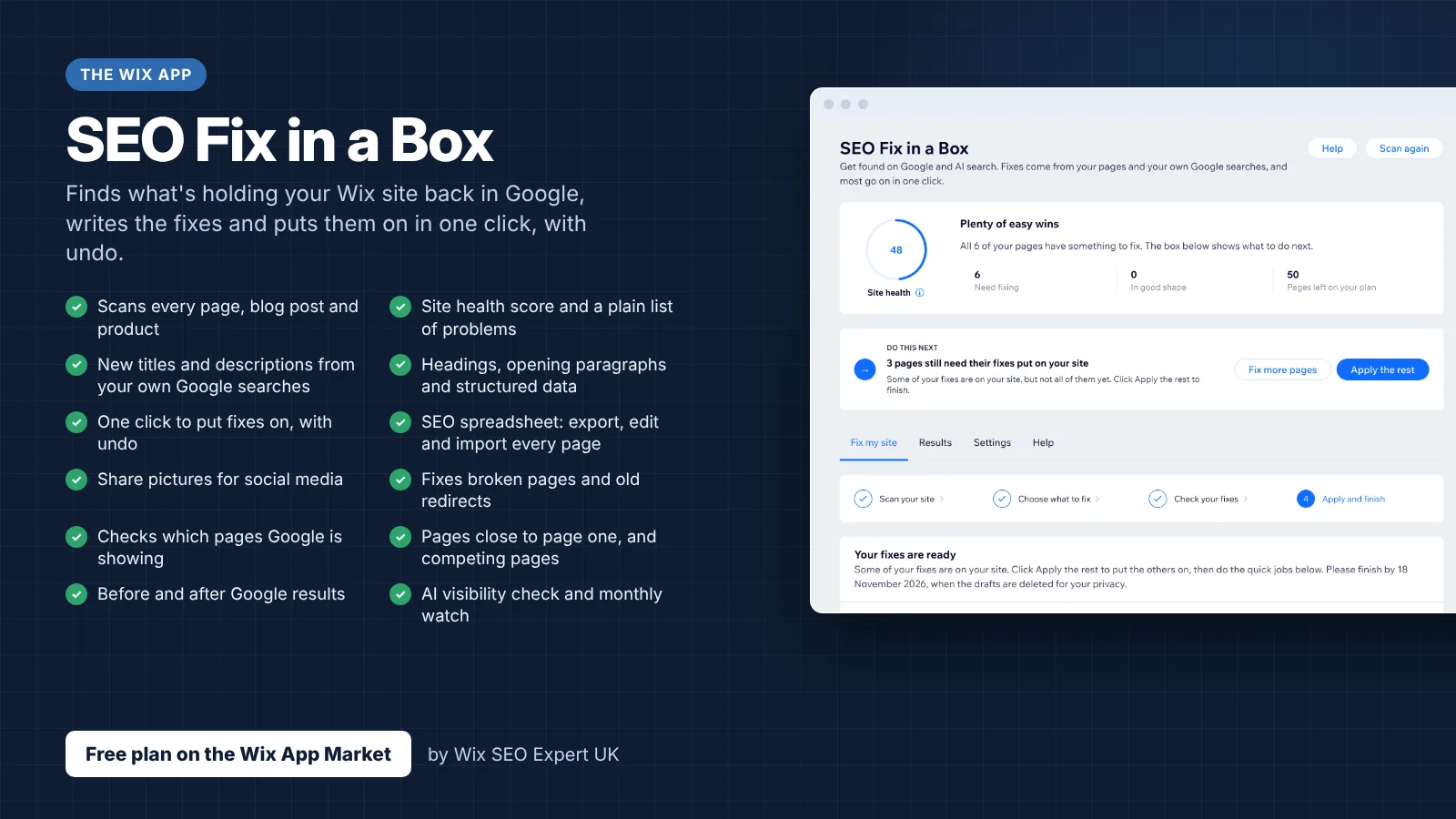
- SEO Fix in a Box: My Wix app. Free to install, it scans your site and shows what needs fixing, and paid plans write the fixes from your own Google searches
Was this lesson useful?
It takes 1 minute to tell me. The course is free and I want to keep it that way, and your feedback shows me what is working and helps other people find it.
This lesson on Enterprise SEO crisis management and recovery on Wix is part of Module 42: Enterprise SEO Strategy on Wix in The Most Comprehensive Complete Wix SEO Course in the World (2026 Edition). Created by Michael Andrews, a Wix Marketplace Legend Partner with 14 years of hands-on experience, 800 completed Wix SEO projects and 456 verified five-star reviews.