Citation building: the 50 directories every local business needs
Module 9: Local SEO Domination | Lesson 113 of 683 | 55 min read
By Michael Andrews, Wix SEO Expert UK
Citations are mentions of your business name, address and phone number on third-party websites. They are one of the foundational ranking factors in local SEO because Google uses them to verify that your business is real, established and located where you claim. The more consistent, authoritative citations you have, the stronger Google's confidence in your business entity. Citation building is not glamorous work, but it is among the most reliable ways to improve local rankings. Businesses that systematically build citations on the right directories, in the right order, with consistent NAP data see measurable local ranking improvements within 4-8 weeks. This lesson gives you the complete prioritised directory list, the submission process and the ongoing management system.
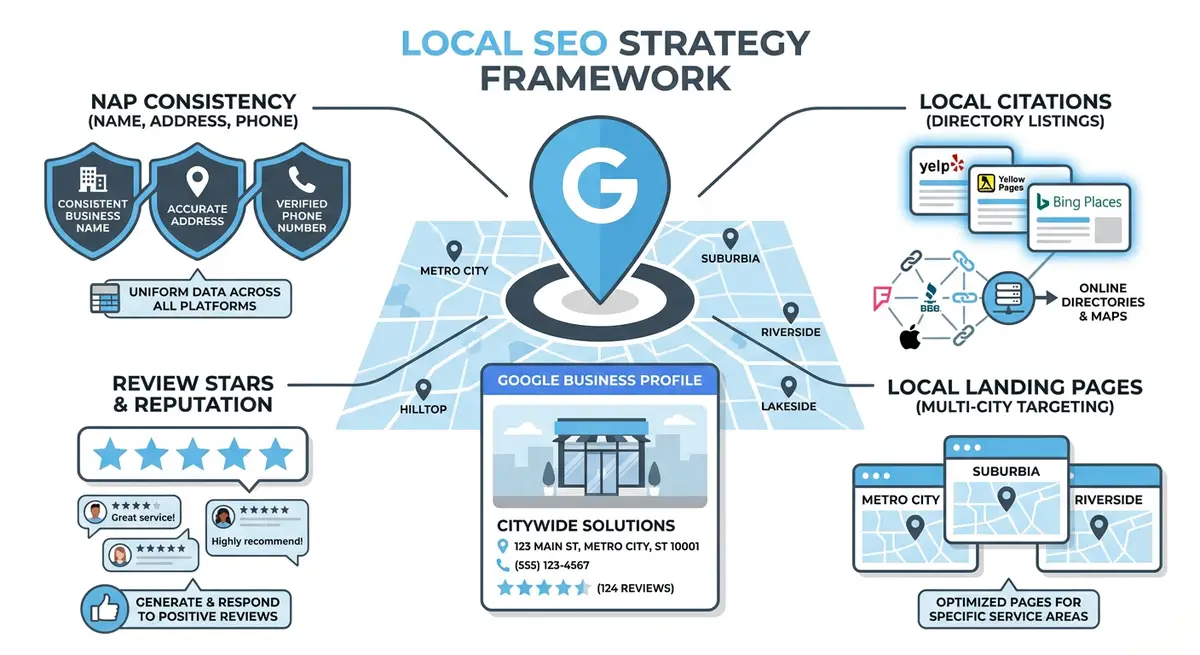
How Citations Affect Local Rankings
- Entity verification: Google cross-references your GBP data against third-party citations. Citations on authoritative directories confirm your business exists at the claimed location.
- Citation volume: more citations from more directories signals a more established business. However, quality and consistency matter more than raw numbers.
- Citation quality: a citation on Yell.com or the BBC carries more weight than a listing on an unknown directory with no domain authority.
- Category relevance: citations on industry-specific directories (e.g., Checkatrade for tradespeople, TripAdvisor for hospitality) carry additional relevance signals.
- Geographic relevance: citations on local directories specific to your city or region carry additional proximity signals.
- Data aggregator impact: the four major data aggregators (Data Axle, Neustar Localeze, Foursquare, Factual) feed your business data to hundreds of smaller directories. Correct data at the aggregator level cascades across the ecosystem.
Tier 1: Core Platforms (Build First)
These are the highest-authority platforms that Google references most heavily. Every local business should have accurate, complete listings on all of these before moving to any other directories.
- Google Business Profile (business.google.com): the most important citation. Your primary local listing.
- Bing Places (bingplaces.com): powers Bing search, Microsoft Copilot and Cortana local results.
- Apple Business Connect (businessconnect.apple.com): controls your appearance on Apple Maps, Siri and Safari.
- Facebook Business Page (facebook.com/business): one of the highest-authority citation sources with review integration.
- Yelp (yelp.co.uk): powers Apple Maps reviews in many markets and has strong domain authority.
- Yell.com: the most authoritative UK-specific business directory with high domain authority.
Tier 2: Major General Directories
- Thomson Local (thomsonlocal.com): historic UK directory with strong domain authority.
- Scoot (scoot.co.uk): well-established UK business directory.
- 192.com: particularly trusted for UK business verification.
- FreeIndex (freeindex.co.uk): free UK directory with review functionality.
- Hotfrog (hotfrog.co.uk): international business directory with UK presence.
- Cylex (cylex-uk.co.uk): growing UK business directory.
- Foursquare (foursquare.com): location-based platform that feeds data to many apps and services.
- Trustpilot (trustpilot.com): review platform that doubles as a high-authority citation.
- LinkedIn Company Page: professional network citation with strong domain authority.
- Twitter/X Business Profile: social citation with brand verification.
- Instagram Business Account: visual social citation with location tagging.
Tier 3: Industry-Specific Directories
Industry-specific directories carry extra relevance signals because they confirm your business operates in a specific sector. Google gives these citations additional weight for industry-relevant searches.
- Tradespeople: Checkatrade, MyBuilder, Rated People, Bark, TrustATrader, Which? Trusted Traders.
- Hospitality: TripAdvisor, OpenTable, DesignMyNight, Zomato.
- Healthcare: NHS Choices (if applicable), Healthgrades, CQC (if regulated).
- Legal: Law Society Find a Solicitor, Chambers and Partners, Legal 500.
- Accountancy: ICAEW, ACCA Find an Accountant, AccountingWEB.
- Estate agents: Rightmove, Zoopla, OnTheMarket.
- Hospitality and events: Hitched (weddings), Bark, Eventbrite.
- Fitness: ClassPass, MindBody, GymPass.
- Automotive: AutoTrader, RAC Approved Garage, MotorCodes.
Tier 4: Local and Regional Directories
- Your local Chamber of Commerce member directory.
- Your local council business directory (many councils maintain "support local" directories).
- Regional business federation directories (FSB, BNI chapter pages).
- Local newspaper classified and business listings.
- Local "What's On" and events websites for your town or city.
- University or college supplier directories (if you work with educational institutions).
- Local tourism board directories (if relevant to your business).
- Community Facebook groups with business listing threads.
The Citation Building Process
How to build citations systematically
- Open your Master NAP document from the previous lesson. Have it visible throughout the citation building process.
- Create a citation tracking spreadsheet with columns: Directory Name, URL, Account Username, Submission Date, Status (Pending/Live/Needs Update), NAP Verified (Yes/No), Last Checked Date.
- Start with Tier 1 directories. For each platform, either claim an existing listing or create a new one.
- Enter your NAP details exactly as specified in your Master NAP document. Do not abbreviate or modify any detail.
- Fill in every available field beyond basic NAP: categories, business description, opening hours, photos, website URL, social media links.
- Upload your logo and at least 3 business photos to every directory that supports images.
- Write a unique business description for each major directory (at least 100 words). Avoid copy-pasting the exact same description everywhere, as Google may interpret identical descriptions across many directories as manipulative.
- Save login credentials for every directory account in your password manager.
- After completing Tier 1, move to Tier 2, then Tier 3, then Tier 4. Space your submissions across 2-4 weeks rather than creating all citations in a single day.
- After all submissions, wait 2-3 weeks for listings to go live, then run a BrightLocal or Whitespark audit to verify accuracy and completeness.
Automated vs Manual Citation Building
- Manual building: you create each citation yourself. Most control over accuracy and completeness. Time-consuming (30-60 minutes per directory for full optimisation). Best for businesses building their first 20-30 citations.
- BrightLocal Citation Builder: submits your data to directories on your behalf for approximately £2-3 per directory. Saves significant time but you have less control over the exact formatting and description used.
- Whitespark Citation Building Service: managed service that builds citations and monitors them ongoing. More expensive but handles everything.
- Yext: real-time citation management across many directories through a single dashboard. Requires ongoing subscription; if you cancel, listings may revert. Approximately £199-499/year.
- Recommendation: manually build your Tier 1 citations for maximum control. Use an automated service for Tier 2-4 citations to save time. Always verify automated submissions for NAP accuracy.
Data Aggregators: The Citation Force Multiplier
The four major data aggregators distribute your business information to hundreds of smaller directories, apps and platforms. Submitting correct data to these aggregators is the most efficient way to build citation volume because one submission cascades across the entire ecosystem.
How to submit to data aggregators
- Data Axle (formerly Infogroup): visit dataaxle.com and submit your business information through their listing management tool.
- Neustar Localeze: visit neustar.biz/resources/product-literature/localeze and submit your business details.
- Foursquare: claim or create your Foursquare business listing at business.foursquare.com.
- Factual (now part of Foursquare): your Foursquare submission covers Factual's data feed as well.
- Ensure every data aggregator submission uses your exact Master NAP formatting.
- After submission, allow 4-8 weeks for data to propagate across the aggregator network.
- Monitor for propagation accuracy: run a citation audit after 8 weeks to verify the data reached downstream directories correctly.
Ongoing Citation Management
Monthly and quarterly citation maintenance
- Monthly: check your top 10 citations (Tier 1 platforms) for accuracy. Log in and verify NAP is unchanged.
- Quarterly: run a full BrightLocal or Whitespark citation audit to catch any changes or new incorrect listings.
- Whenever your business details change: immediately update all Tier 1 and Tier 2 directories, then update data aggregators, then update remaining directories within 2 weeks.
- Whenever you discover a new directory relevant to your industry: add it to your citation tracking spreadsheet and submit a listing.
- Annually: review your full citation portfolio. Remove listings on directories that have become spammy or low-quality. Add listings on new authoritative directories that have emerged.
FAQ: Citation Building
How many citations do I need?
For most local businesses, 40-60 high-quality, consistent citations provide the foundation needed for strong local rankings. The top-ranking business in a given local market typically has 80-120 citations. Focus on quality and consistency over raw numbers.
Do citations from international directories help UK businesses?
Minimally. Citations from UK-specific directories carry more geographic relevance than international ones. However, global platforms like Facebook, LinkedIn and Yelp are valuable regardless of geography due to their high domain authority.
Essential Tools for This Lesson
- BrightLocal Citation Builder: Automated citation submission service covering hundreds of directories
- Whitespark Local Citation Finder: Discover citation opportunities and audit existing citations
- Moz Local: Check your citation health score and manage listings across platforms
- Apple Business Connect: Claim and manage your Apple Maps business listing
Was this lesson useful?
It takes 1 minute to tell me. The course is free and I want to keep it that way, and your feedback shows me what is working and helps other people find it.
This lesson on Citation building: the 50 directories every local business needs is part of Module 9: Local SEO Domination in The Most Comprehensive Complete Wix SEO Course in the World (2026 Edition). Created by Michael Andrews, a Wix Marketplace Legend Partner with 14 years of hands-on experience, 800 completed Wix SEO projects and 456 verified five-star reviews.